
Cut some equal triangles from an old cereal box, every side 5 cm long. Tape three of them together round one corner, and that corner rises into a point, like the top of a tent. Keep taping on triangles, three at every corner, and soon the shape closes up into a solid with no gap.
How many triangles did it take? What if you put four triangles round every corner? Five? Six?
In this unit you will build two of these solids, the tetrahedron and the octahedron, and count their faces, edges and corners. You will also make a cone and a cylinder from paper. In Back to the triangles you will see that there are only three answers, and why six triangles never close.
16.0 Review
In Grade 6 you met the parts of a solid. A face is a flat surface of it, an edge is a line where two faces meet, and a vertex is a corner, where edges meet (more than one: vertices). For a cube or a cuboid, the numbers of vertices (V), edges (E) and faces (F) are linked by
A cube has 8 vertices, 12 edges and 6 faces: 8 − 12 + 6 = 2.
16.1 Tetrahedron
A tetrahedron is a solid with 4 faces, each an equilateral triangle. It has 4 vertices and 6 edges. Its name is Greek: tetra means four, and hedra means seat or face, so “tetrahedron” means “four faces”.
A solid is called regular when two things are true:
- all its faces are the same regular polygon (equal sides and equal angles), and
- the same number of faces meet at every vertex.
A tetrahedron is regular: its faces are equal equilateral triangles, and 3 of them meet at each vertex. So is a cube: its faces are equal squares, and 3 meet at each vertex. A cuboid that isn’t a cube is not regular: some of its faces are rectangles that aren’t squares, and a rectangle’s sides aren’t all equal.
Turn the tetrahedron below and count its parts yourself.
How many faces of a tetrahedron meet at each of its vertices?
Pick an answer to see why.
16.1.1 Skeleton of a tetrahedron
A skeleton model shows only the edges and the vertices of a solid: sticks for the edges, joints for the corners, and nothing between them. You can see straight through it, so you can count every edge and vertex without turning it round.
16.2 Octahedron
An octahedron is a solid with 8 faces, each an equilateral triangle. It has 6 vertices and 12 edges. Okto is Greek for eight, as in an octopus’s eight arms. It looks like two square pyramids joined at their square bases, but there is no square face inside it: the square in the middle is only a ring of 4 edges.
How is an octahedron different from a tetrahedron?
Pick an answer to see why.
16.2.1 Skeleton of an octahedron
Five regular solids
You have now met three regular solids: the cube, the tetrahedron and the octahedron. There are exactly two more. The dodecahedron has 12 faces, each a regular pentagon (5 equal sides), and the icosahedron has 20 faces, each an equilateral triangle.
For every one of these solids, the number of vertices minus the number of edges plus the number of faces is 2:
This is Euler’s formula, the rule you used for cubes and cuboids in Grade 6. It works for every solid with flat faces and no holes through it. Look at the table again: the cube and the octahedron swap their numbers of vertices and faces (8 and 6), and so do the dodecahedron and the icosahedron (20 and 12). Only the tetrahedron is its own partner.
Exercise 16.1
Question 1
True or false?
a. All the faces of a tetrahedron are equilateral triangles.
Pick an answer to see why.
b. All the edges of a tetrahedron are equal.
Pick an answer to see why.
c. A tetrahedron has only three faces.
Pick an answer to see why.
d. The faces of an octahedron are not all equilateral triangles.
Pick an answer to see why.
e. An octahedron has only 4 edges.
Pick an answer to see why.
Question 2
Answer these questions.
What is a tetrahedron?
Answer
Write any two differences between a tetrahedron and an octahedron.
Answer
Write the formula that relates the faces, edges and vertices of a dodecahedron and of an icosahedron.
Answer
What is the shape of the faces of an octahedron?
Answer
How many vertices and edges does an octahedron have?
Answer
Question 3
A tetrahedron has 6 edges and 4 faces. Find its number of vertices.
Answer
Question 4
An octahedron has 6 vertices. How many faces does it have?
Hint
Answer
16.3 Cone and cylinder
Not every solid has only flat faces. A cone and a cylinder each have a curved surface, one that bends, so a ruler laid along it the wrong way touches it at only one point.
16.3.1 Cone
From the activity:
A cone is a solid with one vertex, one circular base and one curved surface.
The properties of a cone:
- a.It has one vertex.
- b.It has one circular base.
- c.It has one curved surface.
The vertex of a cone is also called its apex: the point at the top, opposite the base.
A funnel’s top part is shaped like a cone, open at the wide end and cut off near the point. Which part of a cone is missing in the funnel’s top?
Pick an answer to see why.
Skeleton model of a cone
A hollow model of a cone is a thin shell, its curved surface, with nothing inside. Many cones in daily life are like this: an ice-cream cone, a birthday cap, a ढडिया (dhadiya), the cone of bamboo strips used to catch fish. You can make one from a circle of paper.
Try different cuts below. Slide Roll and watch the paper bend until OA meets OB.
Cylinder
The properties of a cylinder:
- a.Its bases are circles.
- b.It has one curved surface.
- c.Its two bases are parallel to each other.
A cylinder is a solid with two circular faces that are equal and parallel, and one curved surface between them. It has no vertex.
Which is true of every cylinder?
Pick an answer to see why.
16.3.2 Skeleton model of a cylinder
Exercise 16.2
Question 1
Answer these questions.
What is a cone? Write any two of its properties.
Answer
What is a cylinder? Write any two of its properties.
Answer
Write one similarity and one difference between a cone and a cylinder.
Answer
Draw a sample figure of a cone and of a cylinder.
Answer
Question 2
What are the shapes of the base and the surface of a cone? And of a cylinder?
Answer
Question 3
Collect any five cylindrical objects. Write about their curved surfaces and their bases.
Answer
Printable PDFs
- Study notes 2 pages
- Harder practice questions 2 pages Answer key
Practice every question in the book, and keep track of the ones you miss →
Back to the triangles
Equal triangles, taped edge to edge, with the same number at every corner. How many close up a solid?
- 3 at every corner: 4 triangles, the tetrahedron.
- 4 at every corner: 8 triangles, the octahedron.
- 5 at every corner: 20 triangles, the icosahedron.
- 6 at every corner: it never closes.
Why? Each angle of an equilateral triangle is 60°. Round a corner of a solid, the angles must add up to less than 360°, or the paper can’t rise into a point.
| Triangles at a corner | Their angles add up to | What happens |
|---|---|---|
| 3 | 3 × 60° = 180° | rises into a sharp point |
| 4 | 4 × 60° = 240° | rises into a point |
| 5 | 5 × 60° = 300° | rises into a low point |
| 6 | 6 × 60° = 360° | lies flat, like floor tiles |
With 6 the triangles lie flat on the table and go on forever, like the tiles on a floor. So there are only three ways to close a solid with equal triangles meeting the same way at every corner.
Euler’s formula agrees. With 5 triangles at each corner and F faces: every triangle has 3 edges, each shared by 2 triangles, so E = 3F ÷ 2; every triangle has 3 corners, 5 meeting at each vertex, so V = 3F ÷ 5. Only F = 20 makes the formula work: E = 30, V = 12, and 12 − 30 + 20 = 2. ✓
The same idea gives the other regular solids. At least 3 faces must meet at a corner, or there is no point at all. Squares have 90° corners: 3 make 270°, so they close into a cube, but 4 make 360° and lie flat. Regular pentagons have 108° corners: 3 make 324°, so they close into a dodecahedron, but 4 make 432°, too many. Regular hexagons have 120° corners: 3 already make 360°, and shapes with more sides have even bigger corners. So there can be no more than five regular solids, which is what Euclid proved.
Where this is used
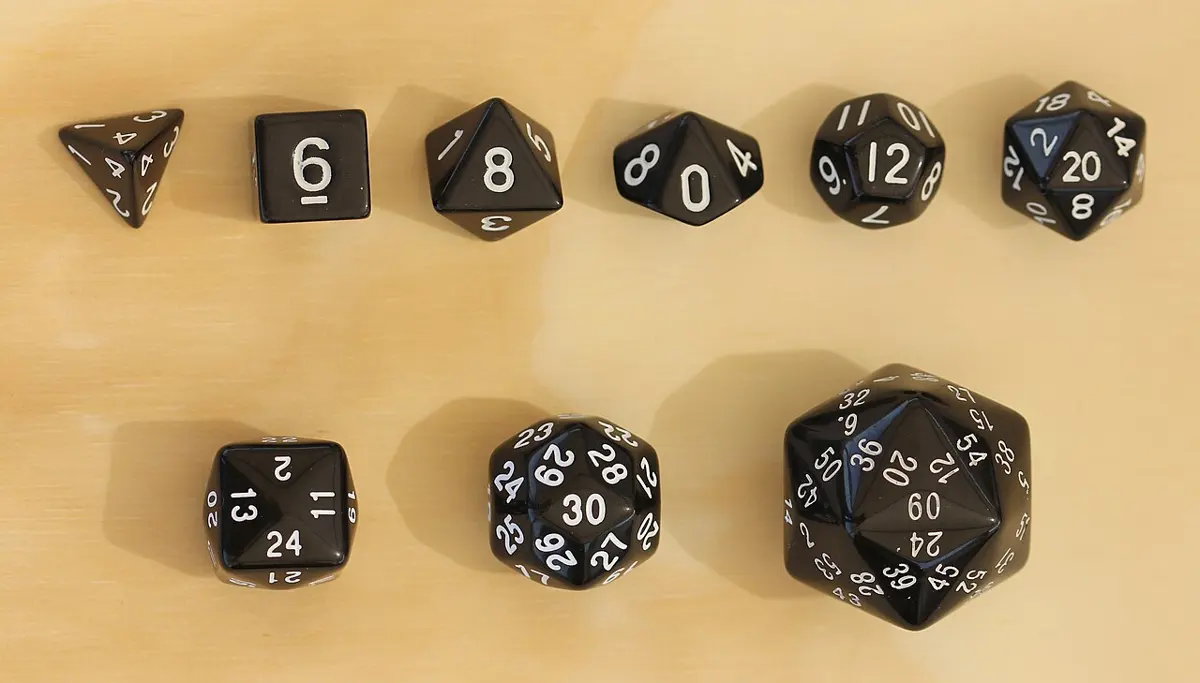
- Dice. Games use dice shaped like all five regular solids: a 4-sided die is a tetrahedron, an 8-sided one an octahedron, a 12-sided one a dodecahedron and a 20-sided one an icosahedron. Every face of a regular solid is the same and sits the same way, so each number is equally likely to come up.
- Molecules. A molecule of methane, the gas that burns in a biogas stove, is a tetrahedron: a carbon atom in the middle and a hydrogen atom at each of the four corners. Biogas is about half to four fifths methane. In Nepal, the government helps families build biogas plants at home.
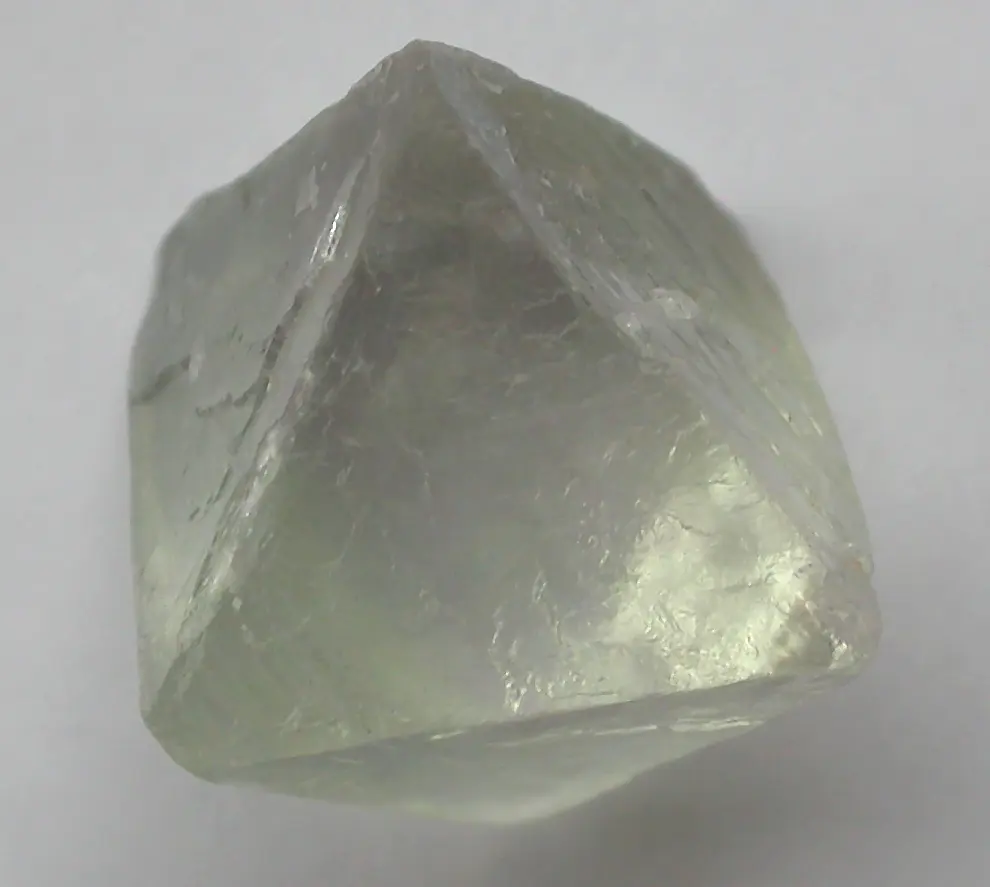
- Crystals and viruses. Tetrahedra, cubes and octahedra all occur in crystals. Fluorite, for example, grows as cubes and sometimes as octahedra, and it splits most easily along the faces of an octahedron. Many viruses, such as the herpes virus, keep their genes in a shell shaped like an icosahedron.
- Cones and cylinders. A cylinder rolls in a straight line and stacks well, so gas, water and oil are kept in cylinders and carried in cylindrical pipes. A cone pours, as a funnel, or holds, as an ice-cream cone.
Where these facts come from
- The five regular solids: Wikipedia, “Platonic solid” (Plato’s Timaeus linking fire with the tetrahedron, air with the octahedron, water with the icosahedron, earth with the cube, and the dodecahedron with the heavens; Euclid’s Elements, Book XIII, which describes them and argues there are no others; the angles at a vertex must add up to less than 360°; dice in role-playing games; the tetrahedron, cube and octahedron in crystals; icosahedral viruses such as herpes), read November 2026.
- Fluorite: Wikipedia, “Fluorite” (it “crystallizes in isometric cubic habit, although octahedral and more complex isometric forms are not uncommon”; its “four perfect cleavage planes … help produce octahedral fragments”), read November 2026.
- Methane: Wikipedia, “Methane” (“a tetrahedral molecule with four equivalent C–H bonds”), read November 2026.
- Biogas: Wikipedia, “Biogas” (50–80% methane by volume; in Nepal, government subsidies for home biogas plants), read November 2026.
- Euler’s formula: Wikipedia, “Euler characteristic” (V − E + F = 2 for convex polyhedra, stated by Leonhard Euler in 1758), read November 2026.
A companion to your textbook, not a replacement for it: study from the book your school uses, and where the two differ, follow your teacher. Found a mistake? Please tell us.