
A floor tile cracks in a kitchen in Bhaktapur. Nobody measures anything: the mason takes a spare tile from the box left over from the building work, and it drops into the gap exactly. At the key shop, the same thing happens with a key. The shopkeeper clamps your key beside a blank, and a machine copies its outline cut by cut. The new key opens the same lock.
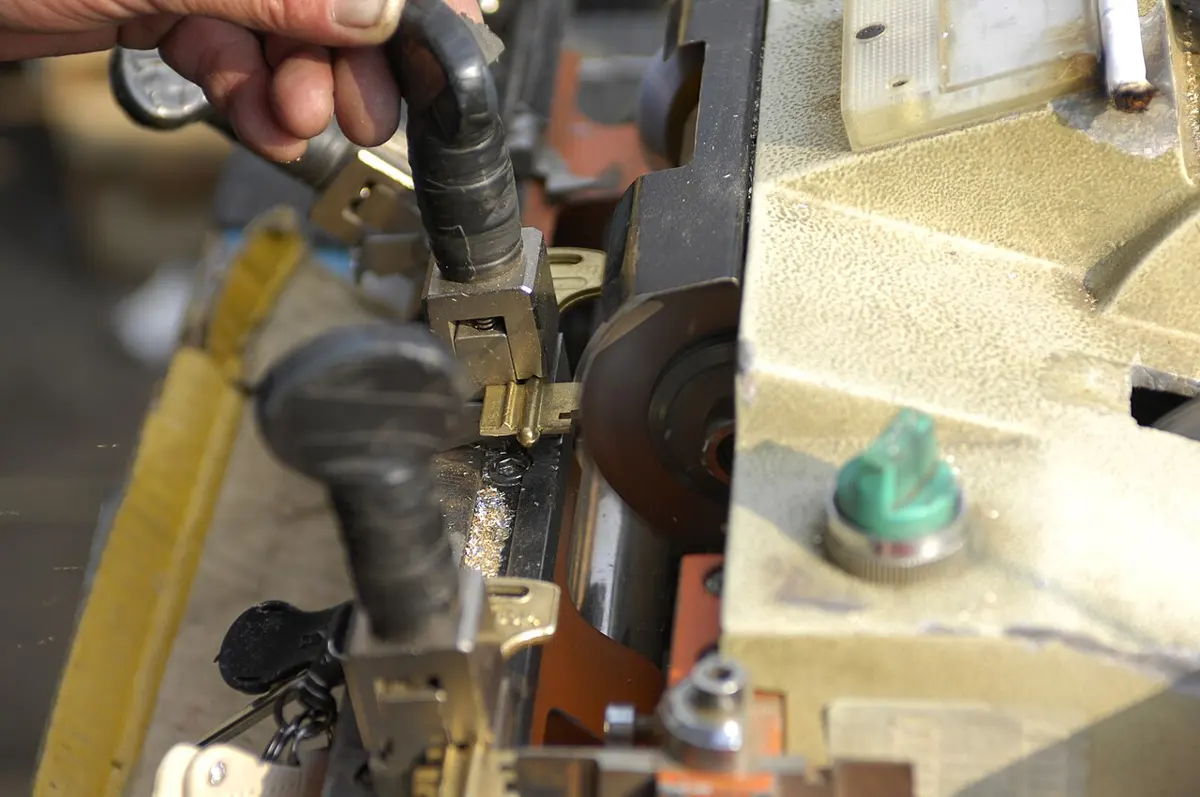
Two tiles from one box, a key and its copy: each pair is exactly alike, the same shape and the same size. How can you be sure two figures are exact copies, without measuring every part? And does it matter if one of them is turned round, or turned over? In Back to the tiles you will answer both questions.
15.0 Review
In Grade 6 you named shapes by their sides and corners: triangles, squares, rectangles. Now look at pairs of things, and ask two questions about each pair. Do they have the same shape? Are they the same size?
15.1 Congruent figures
Lay one on the other
How do you check that two flat things are exactly alike? The surest way is to put one on top of the other. If every edge and every corner of one lies on the other, with nothing sticking out anywhere, they are the same shape and the same size.
All four activities end the same way, and that gives us a word.
Figures that have the same shape and the same size are called congruent figures. One fits exactly on the other.
Each corner of one figure lies on a corner of the other: these are corresponding corners (or vertices). The sides that lie on each other are corresponding sides, and the angles that lie on each other are corresponding angles. In congruent figures, corresponding sides are equal and corresponding angles are equal. We write , and read it “triangle ABC is congruent to triangle XYZ”. The letters are written in matching order: A goes with X, B with Y and C with Z.
Slide, turn, flip
To lay one figure on another, you may need to slide it, turn it round, or even flip it over, as you would a cut-out paper shape. None of these changes its shape or size, so a figure is still congruent to its copy however it has been moved. Try it below.
A photo of your school is printed in two sizes, one small and one large. Are the two prints congruent?
Pick an answer to see why.
A paper triangle fits exactly on another paper triangle only after it is turned over. Are the two triangles congruent?
Pick an answer to see why.
Checking given figures
When the sides are written on the figures, you can check congruence without cutting anything out: compare the shapes, then compare the matching sides.
Exercise 15
Question 1
Which of these pairs of figures are congruent? Why?
Answer
Answer
Answer
Question 2
Which of these pairs of figures are congruent? Find out by measuring the sides. (Here they are drawn on half-centimeter squared paper, so you can also count squares along the straight sides.)
Answer
Answer
Answer
Answer
Answer
Answer
Answer
Question 3
Take five solid objects (a book, a coin, a matchbox, a die, an eraser…). Use each to draw congruent figures.
Answer
Question 4
Join your hands for namaskar. Are your two hands congruent? Discuss in class.
Answer
Question 5
Take a Rs 1 coin and a Rs 2 coin. Are they congruent? Discuss with your family.
Answer
Printable PDFs
- Study notes 1 page
- Harder practice questions 2 pages Answer key
Practice every question in the book, and keep track of the ones you miss →
Back to the tiles
The two tiles from one box are congruent: same shape, same size. That is why the spare drops into the gap exactly. Nobody measured, because a factory makes every tile in a batch from one mold, and laying one on the other proves the match.
The key and its copy are congruent too: the machine moves the old key along a guide while a cutter cuts the blank beside it, so each notch of the copy is as deep as the matching notch of the original.
And turning? A tile can go into the gap turned round, or upside down, and it still fits, because turning and flipping don’t change a shape or its size. A key is pickier: it must go into the lock the right way up. But turned round or not, it is the same key.
Where this is used
- Spare parts. Interchangeable parts, made congruent so that any one can replace any other, go back to Honoré Blanc’s musket locks of about 1778. Nuts and bolts, bulbs and sockets, and phone chargers all depend on them.
- Keys. A key-cutting machine copies a key by moving it along a guide while a blade cuts a blank clamped beside it.
- Tiles and bricks. A floor or a wall goes together without gaps because its tiles or bricks are congruent copies, all from one mold.
- Printing and photocopying. A copy made at 100% is congruent to the page it copies; at 50% or 200% it is similar, the same shape but a different size.
Where these facts come from
- Interchangeable parts: Wikipedia, “Interchangeable parts” (“components that are identical for practical purposes”; Honoré Blanc’s flintlock mechanisms from about 1778), read November 2026.
- Key duplication: Wikipedia, “Key duplication” (the original key moved along a guide while the blank is moved against a blade), read November 2026.
A companion to your textbook, not a replacement for it: study from the book your school uses, and where the two differ, follow your teacher. Found a mistake? Please tell us.