
A school in Bhaktapur is getting ready for its Science Day. The teachers have three jobs, and each one is a question of measuring.
- The winner’s prize is a box 30 cm long, 20 cm broad and 10 cm high. How much wrapping paper covers it?
- The school is putting up a new water tank shaped like a cube, to hold 1,000 liters. How long must each edge be?
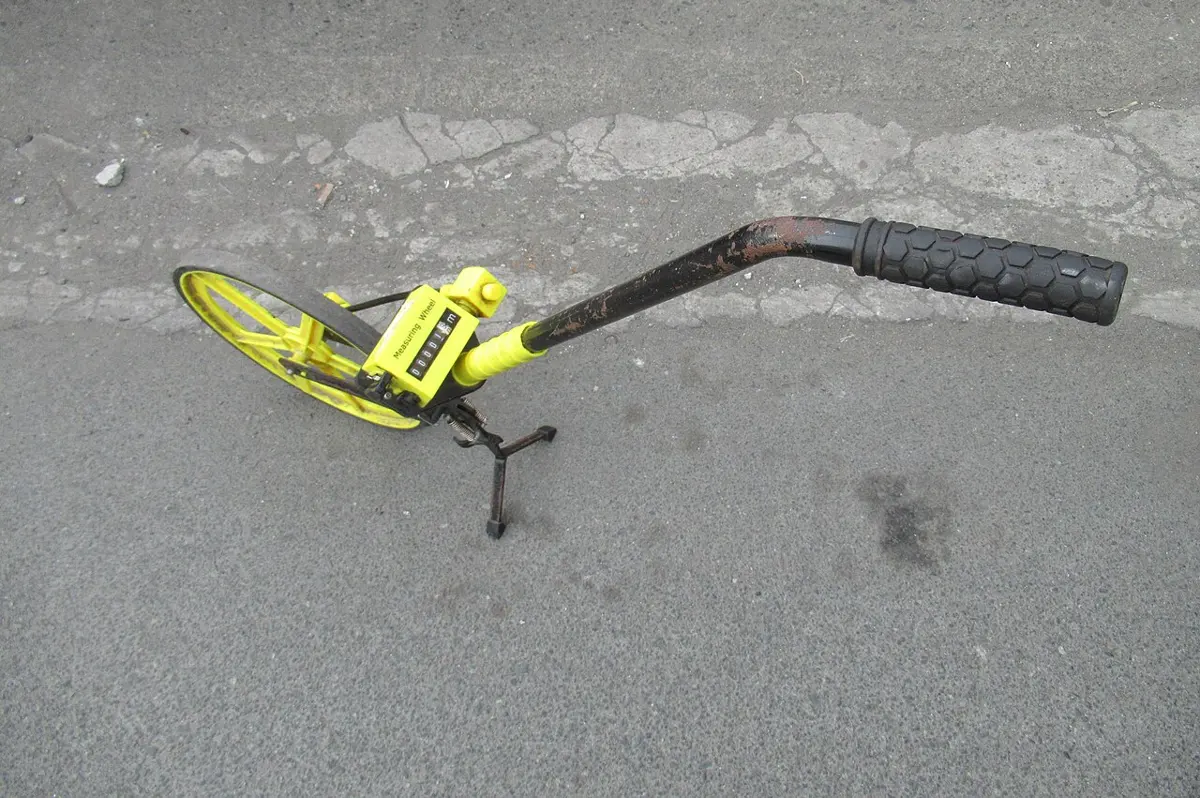
- The sports teacher marks out a 100 m running track with a measuring wheel: she pushes it along the ground and counts its clicks, one click for every meter. Its wheel is about 31.8 cm across. Why that odd number?
The paper covers the surface of a box: its surface area. The water fills the space inside the tank: its volume. And the wheel works because of one number that every circle shares, a little more than 3. In this unit you will find the perimeter of a triangle, the surface area and volume of a cuboid and a cube, and the length round a circle. In Back to Science Day you will do all three jobs.
9.0 Review
9.1 Perimeter of a triangle
You have found the perimeter of rectangles and squares since Grade 5. A triangle works the same way. The perimeter of a triangle is the total length of its three sides: the distance all the way round it.
Two special triangles have a shortcut.
- An equilateral triangle has three equal sides, each a: P = a + a + a = 3a.
- An isosceles triangle has two equal sides, each a, and a third side b: P = 2a + b.
An equilateral triangle has sides of 9 cm. What is its perimeter?
Pick an answer to see why.
An isosceles triangle has a perimeter of 20 cm, and its two equal sides are 7 cm each. How long is the third side?
Pick an answer to see why.
Exercise 9.1
Question 1
Find the perimeter of each triangle by measuring its sides. The small marks along each side are 1 cm apart, with a half-centimeter mark between, like a ruler’s. (If you can, copy the triangles onto paper with a ruler and measure them there too.)
Triangle PQR.
Answer
Triangle ABC.
Answer
Triangle XYZ.
Answer
Question 2
Find the perimeter of each triangle.
Triangle ABC.
Answer
Triangle XYZ.
Answer
Triangle PQR.
Answer
Question 3
Find the perimeters of the triangles ABC and ADE. Sides with the same marks are equal.
Hint
Answer
Question 4
Kushal makes a paper triangle with a perimeter of 40 cm. Two of its sides are 14 cm and 16 cm. How long is the third side?
Answer
Question 5
A plot of land is an equilateral triangle with sides of 18 m. How many rounds of fence can be made with 540 m of wire?
Answer
Question 6
One side of a triangular garden is 12 ft, and the other two sides are 7 ft each. A plastic rope costs 60 paisa a foot. How much does it cost to put 20 rounds of rope round the garden?
Answer
Question 7
Find the unknown side of each triangle.
Triangle ABC, perimeter 19 cm.
Answer
Triangle PQR, perimeter 23 cm.
Answer
Triangle MNO, perimeter 28 cm.
Answer
9.2 Cuboid and cube
9.2.1 Total surface area of a cuboid
A box has six flat faces. The total surface area of a solid is the area of all its faces added together: the amount of paper that would cover it exactly, with no overlap. It is measured in square units, cm² or m², like any area.
Fold a net back into a box below.
Call the box’s length l, its breadth b and its height h. Each pair of faces uses two of the three:
| Faces | Each face is | Area of the pair |
|---|---|---|
| top and bottom | l by b | 2lb |
| front and back | l by h | 2lh |
| the two ends | b by h | 2bh |
Adding the three pairs,
So the total surface area of a cuboid is A = 2(lb + bh + lh). Change the box below and watch each pair.
A cuboid is 5 cm long, 2 cm broad and 1 cm high. What is its total surface area?
Pick an answer to see why.
9.2.2 Total surface area of a cube
Let every edge of the cube be a, so l = b = h = a. Put this into the cuboid’s formula:
Another way. Each face of the cube is a square of side a, with area . There are 6 faces, so .
So the total surface area of a cube is square units.
A cube has edges of 2 cm. What is its total surface area?
Pick an answer to see why.
Exercise 9.2
Question 1
Find the unknown edge or the total surface area of each solid.
Total surface area = ?
Answer
Total surface area = 45 cm². Find the height h.
Answer
Total surface area = 216 cm². Find the edge a.
Answer
Total surface area = ?
Answer
Question 2
A cuboid is 10 cm long and 8 cm broad, and its total surface area is 376 cm². Find its height.
Answer
A carton of biscuits is 50 cm long and 30 cm broad, and its total surface area is 9,400 cm². Find its height.
Answer
Question 3
The total surface area of a cube is 726 cm². Find the length of one edge. How much of the ground does the cube cover when it stands on it?
Answer
The total surface area of a cube-shaped box is 864 cm². Find the length of one edge. If its lid is taken off, how much of its outside can be painted?
Answer
Question 4
A board duster, 8 cm broad and 7 cm high, lies on a table and covers 80 cm² of it.
Find the length of the duster.
Answer
Find the total surface area of the duster.
Answer
Question 5
Measure the edges of these solids at home or in class, and find the total surface area of each.
A board duster (a cuboid).
Answer
A die (a cube).
Answer
9.3 Volume of cuboid and cube
The volume of a solid is the space it takes up, counted in unit cubes: cm³, m³. In Grade 6 you built cuboids from 1 cm cubes: a layer of l × b cubes, and h layers.
For any cuboid and any cube:
Liters and cubic meters
Water and milk are sold in liters, written l (or L). One liter is the space in a cube 10 cm on each side:
A cube 1 m on each side is 100 cm each way, so it holds 100 × 100 × 100 = 1000000 cm³: that is 1,000 liters.
A cuboid tank is 2 m long, 1 m broad and 1 m high. How many liters does it hold?
Pick an answer to see why.
Exercise 9.3
Question 1
Find the volume of each solid.
A carton 16 cm long, 6 cm broad and 5 cm high.
Answer
A matchbox 5 cm long, 1.5 cm broad and 3.5 cm high.
Answer
Question 2
Find the unknown edge of each solid.
Volume = 450 cm³.
Answer
A cube of volume 343 cm³.
Answer
Question 3
A room is 5 m long, 4 m broad and 3 m high. Find its volume.
Answer
Question 4
The length of a meeting hall is twice its height. Its breadth is 8 m and its volume is 576 m³. Find the total surface area of the hall.
Answer
Question 5
Each edge of a die is 9 cm. Find its volume.
Answer
Question 6
A cube-shaped box has a volume of 512 cm³. Find its total surface area.
Answer
A cube has a volume of 125 cm³. Find the length of an edge and its total surface area.
Answer
Question 7
A cuboid piece of gold, 4 cm long, 2 cm broad and 1 cm high, is melted and made into a cube.
Find the volume of the gold cube.
Answer
Find the total surface area of the gold cube.
Answer
Question 8
A full pot of milk is a cuboid 32 cm long, 16 cm broad and 8 cm high. A cube-shaped jug with edges of 8 cm is used to take the milk out. How many jugfuls empty the pot?
Answer
Question 9
A village is building a cuboid tank to hold 64,000 l of water. It is 8 m long and 4 m broad. How deep must it be?
Answer
A school is building a cube-shaped water tank to hold 216,000 l. How much ground does its base cover?
Answer
9.4 Circumference and diameter of a circle
The circumference of a circle is the length all the way round it: a circle’s perimeter. A wheel rolled once round the ground marks out its circumference. Is there a link between the circumference and the diameter, the width across the middle?
Roll a wheel below and compare its track with its diameter.
That number is the same for every circle in the world, from a coin to a wheel to the Earth itself. It is called pi, written with the Greek letter .
Multiply both sides by d. Since a diameter is two radii, d = 2r:
is a little more than 3.14. Its decimals never end and never repeat (3.14159…), so in sums we use 3.14 or (which is about 3.143). Neither is exact, but both are close enough for any measuring in this book. Each question says which one to use.
A wheel has a diameter of 70 cm. How far does it roll in one full turn? ()
Pick an answer to see why.
Which is true for every circle?
Pick an answer to see why.
Exercise 9.4
Question 1
Find the circumference of each circle. ()
r = 3.5 cm
Answer
r = 49 cm
Answer
r = 10.5 cm
Answer
d = 70 m
Answer
d = 17.5 cm
Answer
d = 56 m
Answer
Question 2
Find the radius of each circle from its circumference. ()
Since , the radius is .
c = 176 cm
Answer
c = 308 cm
Answer
c = 616 cm
Answer
c = 660 m
Answer
c = 242 cm
Answer
c = 330 m
Answer
Question 3
A goat is tied to a peg with a rope 14 m long. It keeps the rope tight and walks round the peg 5 times. How far does it walk? ()
Answer
A car’s wheel has a diameter of 77 cm. How far does the car go while the wheel turns 50 times? ()
Answer
Question 4
A bicycle wheel has a radius of 35 cm. How many times must it turn to cover 44 m? ()
Answer
A runner goes round a circular pond with a diameter of 140 m. How many rounds make 17.6 km? ()
Answer
Question 5
A bus wheel rolls 44 m in 20 turns. Find the radius of the wheel. ()
Answer
Aisha walks 15 times round a circular pond and covers 1 km 980 m. About how wide is the pond across? ()
Answer
Mixed exercise
Question 1
Abinash bought a triangular plot of land with sides of 30 ft, 24 ft and 27 ft. What is the length round the plot?
Answer
Question 2
The perimeter of an equilateral triangle is 23.25 cm. Find the length of one side.
Answer
Question 3
Sangam bought 440 m of wire net for Rs 35,200. He used it to fence his triangular plot, whose sides are 9 m, 8 m and 5 m. How many rounds did the net make? How much does one round cost?
Answer
Question 4
A cube-shaped tank holds 343,000 l of water. Find its total surface area.
Answer
The total surface area of a cube-shaped tank is 1,176 m². How many liters of water can it hold?
Some books print 1,776 m² here, but the answer they give, 2,744,000 liters, comes from 1,176 m².
Answer
Question 5
A cuboid’s length is twice its breadth. Its height is 10 cm and its volume is 8,000 cm³. Find its total surface area.
Answer
Question 6
A room is 8 m long and 4 m high, and its total surface area is 304 m². Find its volume.
Answer
Question 7
A cuboid’s length is twice its breadth. Its height is 10 cm and its total surface area is 736 cm². Find its volume.
Hint
Answer
Question 8
The length of a room is three times its breadth. Its height is 2 m and its volume is 96 m³.
Find the length and breadth of the room.
Answer
Find the total surface area of the room.
Answer
Question 9
A wire 44 m long is bent into a triangle. Two of its sides are 16 m and 17 m. Find the third side.
Answer
Question 10
The total surface area of a cube is 600 cm². Find its volume.
Answer
Question 11
A cube has a volume of 1,728 cm³. Its total surface area is equal to that of a cuboid 8 cm high and 12 cm broad. Find the length of the cuboid.
Answer
Question 12
The total surface area of a cube of silver is 150 cm². It is melted and made into a cuboid 5 cm broad and 4 cm high. Find the length of the cuboid.
Answer
Question 13
A truck’s wheel turns 400 times as the truck goes 2.2 km. Find the radius of the wheel. ()
Answer
Question 14
A cuboid tank full of water is 1 m long, 90 cm broad and 60 cm high. The water is taken out with a cube-shaped bucket with edges of 30 cm. How many bucketfuls empty the tank?
Answer
Question 15
A room is 8 m long, 6 m broad and 2 m high.
How much does it cost to paint the whole surface of the room (walls, floor and ceiling) at Rs 50 a square meter?
Answer
If each student needs 0.5 m² of floor, how many students can the room hold?
Answer
Printable PDFs
- Study notes 2 pages
- Harder practice questions 2 pages Answer key
Practice every question in the book, and keep track of the ones you miss →
Back to Science Day
The prize box, 30 cm × 20 cm × 10 cm:
The paper must cover 2,200 cm², a little more for the folds and overlaps: a sheet 60 cm by 40 cm (2,400 cm²) is about right.
The tank, 1,000 liters: that is 1000 ÷ 1000 = 1 m³, so and a = 1 m. Each edge is one meter.
The measuring wheel clicks once a turn, and in one turn it rolls its circumference. For a click every meter, its circumference must be 100 cm:
That is why the wheel is about 31.8 cm across: not a round number, because isn’t one. The 100 m track is 100 clicks.
Where this is used
- Packaging. Boxes are cut from flat sheets of card, so the card needed is the box’s surface area, with flaps added. For the same volume a box nearer a cube uses less card, as the think box showed.
- Water tanks. A tank’s volume in m³, times 1,000, gives the liters it holds; 1 m³ is 1,000 liters.
- Painting and plastering. A painter finds the area of the walls and ceiling to know how much paint to buy, as in Mixed exercise, Question 15.
- Wheels that measure. A measuring wheel (also called a trundle wheel or surveyor’s wheel) counts its turns; one with a circumference of exactly 1 m counts meters. A vehicle’s odometer counts distance from the turns of its wheels in the same way.
- Fences and walls. The length of fence or wall round a plot is its perimeter.
Where these facts come from
- The measuring wheel: Wikipedia, “Surveyor’s wheel” (one turn rolls the wheel’s circumference; a trundle wheel “has a circumference of exactly 1 metre”, with a click once a turn; other names), read November 2026.
- The Earth’s size: Wikipedia, “Earth”, infobox (equatorial circumference 40,075.017 km, equatorial radius 6,378.137 km), read November 2026.
- The liter: Wikipedia, “Litre” (one liter is a cube 10 cm on each side, 1,000 cm³; 1 m³ = 1,000 liters), read November 2026.
- Measuring-wheel photo: credited under the photo.
- The measurements in the examples and questions are made up for practice.
A companion to your textbook, not a replacement for it: study from the book your school uses, and where the two differ, follow your teacher. Found a mistake? Please tell us.