
You need water. You may want a cold drink. Telling the two apart is one of the first lessons in looking after yourself, and in spending money wisely.
This unit is about wants and needs. You will read a girl’s plan for a useful holiday, a poem that asks what circus elephants really want, and an old story about a farmer’s hidden treasure. You will practice the present simple (She wants to be a doctor. Do they need water?) and the real if: If the elephant is freed, it will walk to the jungle.
Getting started
A. What might they want?
The unit opens with four people, each with a thought bubble.
- A young man rests his chin on his hand and dreams of snowy mountains with paragliders floating in the sky.
- A young woman sits at a table, dreaming of herself standing with books in her arms, like a teacher.
- A boy looks up and smiles, thinking of a new smartphone.
- A young man in a jacket imagines himself at a desk in an office, working on a laptop.
Look at the pictures and guess what these people might want.
Model answers
B. Listen and sing
The song is short and repeats one idea: we can’t have everything we want. We want a lot of things, but sometimes there just isn’t enough for everyone, or enough money, or enough time.
Can we get all the things we want? Why?
A model answer
What’s the difference between needs and wants?
Answer
Reading I: My Holiday Plan
Before you read
The two pictures show a girl sitting cross-legged on a mat with her hands joined above her head, doing yoga, and a little girl kneeling in a flower bed with marigolds, gardening.
What are the girls doing in the pictures?
Answer
Do you do these types of things?
A model answer
What are the benefits of doing these things?
A model answer
The text, part by part
The writer is a girl in school. She tells us, in her own words, her plan for the summer holidays.
- A different kind of holiday. Every summer until now, she has gone on trips. This year she wants a productive holiday: one in which she gets something useful done.
- Yoga. She will focus on two things. The first is yoga. Her father often says that yoga is a great art, and that it improves concentration (the power to keep your mind on one thing). She wants to focus better on her studies, so she has signed up (enrolled) for free yoga classes for school students, run every summer by a local group called “Yoga for Youth”. Two of her friends are joining too.
- Gardening. The second is her favorite hobby, gardening. She has wanted to garden for a long time, but she has dance classes every evening after school, so she never had time. Now she will design a garden herself and spend the holidays on it. In a month or two it should be ready, and after school opens she will only need a little time to look after (preserve) the plants. She wants rare plants that are good for the environment, and when the garden is done she will put a fence around it.
- A promise to herself. She made the same two plans last summer, but didn’t finish either, so she isn’t happy with her achievements. This year, whatever happens, she will put these two things first and become a better person before she moves up to the next class.
Words from the text
| Word | Meaning |
|---|---|
| productive | getting a lot of useful work done |
| focus | to give all your attention to one thing |
| hobby | something you enjoy doing in your free time |
| concentration | the ability to keep your attention on one thing |
| enroll | to put your name on the list for a course or class |
| design | to plan how something will look and be made |
| preserve | to keep something safe, so it stays in good condition |
| rare | not common; found only in a few places |
| fence | a wall of wood, wire or bamboo around a garden or field |
| achievement | something good you have done through hard work |
| prioritize | to put something first, because it matters most |
A. Complete the sentences
Choose the correct words from the box to complete the sentences: preserve, productive, concentration, enroll, gardening, fence, achievements, rare
- a.Both of their children got good grades in their examinations. They were proud of their children’s ……… .
- b.We must ……… our natural resources.
- c.It was a ……… meeting. I learned a lot from it.
- d.Do you want to learn how to dance? If yes, ……… on the course before 25th July.
- e.The school has a bamboo ……… . You must use the front gate to enter.
- f.A panda is a ……… animal. It’s only found in some places.
- g.The ability to direct all your efforts and attention to one thing means ……… .
- h.My father is very interested in ……… . We have a beautiful garden.
Answer
B. True or false?
Read the text and write True or False for these statements.
- a.The writer of “My Holiday Plan” is going out on a trip during her summer holiday.
- b.“Yoga for Youth” is going to charge school students.
- c.She is going to get help from her father in the garden.
- d.She achieved a lot from her last summer holiday.
Answer
C. Answer the questions
What two things is the writer going to do during her holiday?
Answer
What is the advantage of doing yoga?
Answer
Is the writer going to yoga classes alone?
Answer
Why couldn’t she do gardening in the past?
Answer
What type of plants is she going to grow in the garden?
Answer
What does she plan to do when she goes to the next grade?
Answer
Why did the writer decide to go to yoga classes?
Pick an answer to see why.
D. Your holiday
What are the two most interesting things you really want to do in your coming holiday? Talk to your friends.
A model answer
Pronunciation: syllables
A syllable is a beat in a word, built round one vowel sound. Rare has one: we say it as a single unit, even though it has two vowel letters. Pro-duc-tive has three. To count, clap as you say the word slowly, or put your hand under your chin: your jaw drops once for each syllable.
How many syllables do these words have? (Example: pro-duc-tive, three syllables.) productive, summer, preserve, concentration, plant, herbal, fence, achievement, holiday, gardening
Answer
Grammar I: the present simple
A. Find the verbs
These sentences are from the text. Complete them with the correct words from the text.
- a.One ……… yoga and another is gardening.
- b.My father always ……… me that yoga is a great art.
- c.One who ……… yoga will be able to increase his/her concentration power.
- d.Once my garden work ……… done, I am planning to build a fence around it.
- e.I want to be a better person when I ……… to the next class.
Answer
Now, talk to your friends. a. What words did you write for the blanks? b. What class of words do they belong to? c. What tense are the verbs in?
Answer
B. How the present simple works
We use the present simple for habits (My father tells me…), for facts (Yoga is a great art), and for what people want, need, like and know (She wants to be a doctor).
| Statement | Question | Negative |
|---|---|---|
| They work hard. | Do they work hard? | They don’t work hard. |
| She makes her bed. | Does she make her bed? | She doesn’t make her bed. |
| She wants to be a doctor. | Does she want to be a doctor? | She doesn’t want to be a doctor. |
| They need some water. | Do they need any water? | They don’t need any water. |
- With he, she, it or one person or thing, the verb takes -s: she makes, he wants, it needs. (Spelling: watch → watches, go → goes, study → studies, have → has.)
- In a question and a negative, do or does does the work, and the main verb goes back to its plain form: Does she make…? Not Does she makes…?
- Notice some in the statement and any in the question and the negative.
- Be is different: it needs no do. She is in Grade 7. Is she in Grade 7? She isn’t in Grade 7.
Which question is correct?
Pick an answer to see why.
C. About yourself
Complete these sentences about yourself with correct verb forms.
- a.My friend ……… also in grade 7. We both ……… in grade 7.
- b.My father ……… in an office and my mother ……… in a bank.
- c.Our school ……… not very big. It only has 10 rooms.
- d.She likes tea but I ……… coffee.
- e.We are regular students. We don’t ……… classes.
- f.Do you ……… your homework every day?
- g.Does she ……… ? We need a dancer for tomorrow’s program.
- h.My mother earns a lot of money but I ……… .
Answer
Writing I: my holidays
An essay of about 100 words has three short parts: an opening sentence that says what it is about, the middle with the details, and a closing sentence. Here the four clue questions give you the middle. Use the present simple for what you usually do, and going to or will for your plan.
You have summer or winter holidays every year. How do you spend your holidays? Write a short essay in approximately 100 words. Use these questions as clues: a. When does your school close for the holidays? b. How long is the next holiday? c. What things do you usually do during the holidays? d. What’s your plan for the coming holiday?
Hint
A model essay
Listening: needs and wants
A. Before you listen
The three pictures show a heap of fresh food (fruit, vegetables, grains and nuts), a drop of water, and houses.
Can we live without these things? Why or why not?
A model answer
You will hear a short talk that explains needs and wants, with some examples. Read B and C first.
B. True or false?
Listen to the audio and write True or False.
- a.We must have food to live.
- b.Shelter keeps us safe.
- c.People have the same needs to stay safe and healthy.
- d.Games and computers are necessary for us to live.
- e.We don’t need any of the things if we want to survive.
Answer
C. Complete the sentences
Listen to the audio again and complete the sentences. Use ONLY ONE word.
- a.We need food to ……… .
- b.It’s ……… to decide if something is a need or a want.
- c.A hamburger is a type of ……… .
- d.Trees and ……… create other things we need and want.
Answer
D. Needs or wants?
Look at the list of things. Discuss and categorize them into NEEDS and WANTS: food, computer, water, cold drinks, air, mobile phones, shelter
Answer
Reading II: The Circus Elephant
Before you read
The picture shows a big elephant standing alone, one leg tied to a post with a chain. In a thought bubble above it, a herd of elephants walks through green grass.
Does the elephant in the picture look happy or sad? Why?
A model answer
Where do you think he wants to go?
A model answer
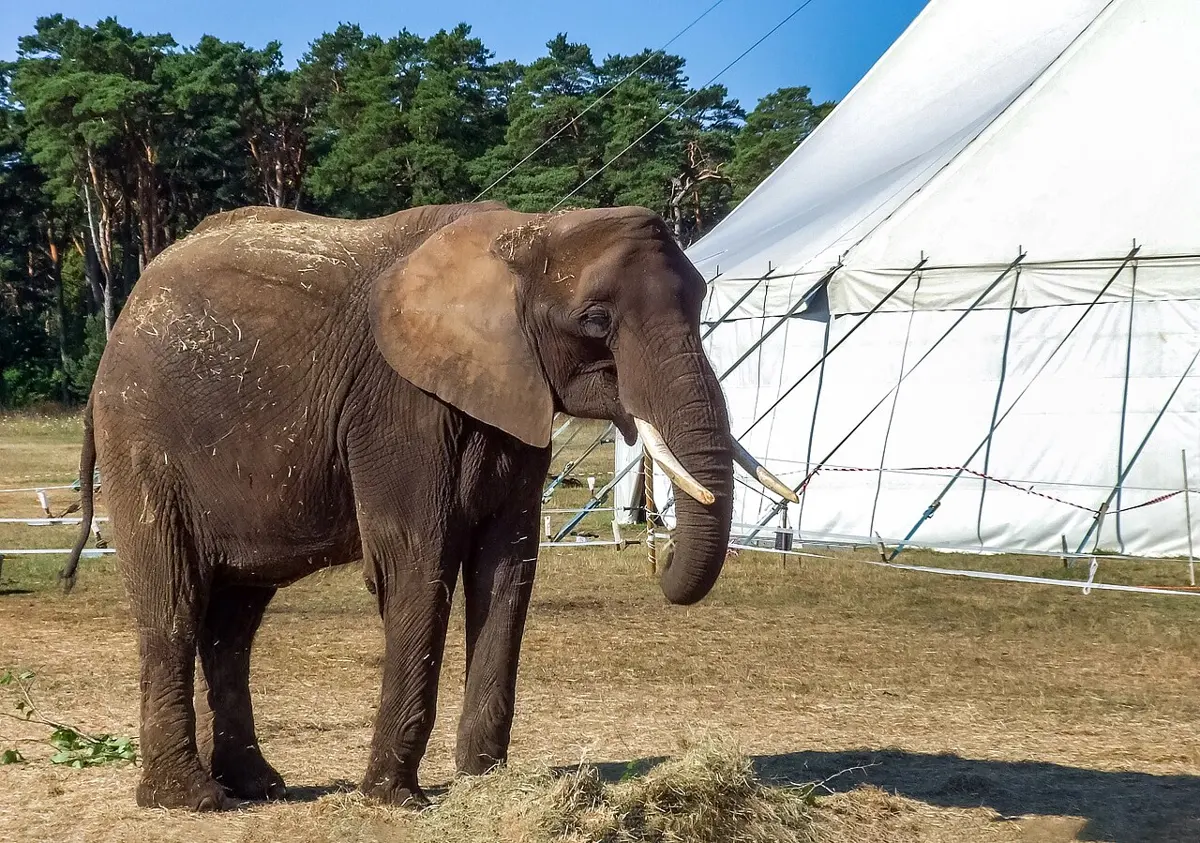
The poem, part by part
The poem is by John Forster. It is written as a string of questions, because the poet doesn’t know the answers: nobody can ask an elephant what it thinks.
- What are they thinking? Every night the circus elephants tramp (walk heavily) round and round the ring. The poet wonders whether they wish they were far away, in the green light of the forest.
- A different life. There they could roam (wander) wherever they liked, eat as much as they wanted, and live far away from people.
- The show. Meanwhile, these gentle giants do their tricks, and the children stare (look for a long time) with delight (great joy).
- Is it right? The poem ends with three questions. Is it fair? Should the elephants be there? Is it right to keep them captive (not free)?
The poem doesn’t give an answer. It leaves the question to you.
Words from the poem
| Word | Meaning |
|---|---|
| tramp | to walk with slow, heavy steps |
| ring | the round space in the middle of a circus where the shows happen |
| roam | to wander freely, with no fixed place to go |
| at will | whenever and however you like |
| eat your fill | to eat as much as you want |
| gentle | kind and calm, not rough |
| giant | something very big |
| trick | a clever act an animal is trained to do |
| stare | to look at something for a long time |
| delight | great pleasure or joy |
| captive | kept as a prisoner; not free |
A. Rhyming words
Find the rhyming words for these from the poem: a. fight b. pill c. play
Answer
B. True or false?
Are the following statements true or false? Write True or False.
- a.The circus elephant walks round the ring each night.
- b.They want to stay in the forest.
- c.They are free at the circus.
- d.The children are happy to see the elephant’s tricks.
- e.The circus elephant should be set free.
Answer
C. Talk about the circus
Have you ever been to a circus? If yes, what types of things did you see there? If no, what types of things do you think you will find at the circus? Talk to your friends.
A model answer
Grammar II: if… will…
A. A chain of ifs
These four sentences make a chain: each result becomes the next if.
| If… (the condition) | …will (the result) |
|---|---|
| If the circus elephant is freed, | it will walk to the jungle. |
| If the elephant walks to the jungle, | it will find its friends. |
| If the elephant finds its friends, | it will become happy. |
| If the elephant becomes happy, | I will be happy too. |
This is the real if: the condition may really happen, now or in the future. The if-part is in the present simple (is, walks, finds), even though it is about the future, and the result takes will + plain verb.
| If-part | Main part |
|---|---|
| If + present simple | will / won’t + plain verb |
| If it rains tomorrow, | we will stay at home. |
| If you don’t hurry, | you will miss the bus. |
The two parts can swap places: We will stay at home if it rains. A comma only when the if-part comes first.
B. Choose the correct response
Choose the correct response for each of the sentences.
- a.If you ……… greasy food, you will become large. (i. eat ii. will eat)
- b.If your sister goes to Paris, she ……… a good time. (i. has ii. will have)
- c.If he ……… that, he will be sorry. (i. will do ii. does)
- d.If I leave now, I ……… in Kathmandu by 8:00 p.m. (i. will arrive ii. arrive)
- e.You ……… on your test if you don’t study. (i. won’t do well ii. don’t do well)
- f.They won’t know the truth if you ……… them. (i. won’t tell ii. don’t tell)
- g.If I bake a cake, ……… have some? (i. will you ii. do you)
- h.If he ……… you, will you answer the phone? (i. will call ii. calls)
Answer
Which sentence is correct?
Pick an answer to see why.
Speaking: what do you want to be?
A. What do they want to be?
The six pictures show: Pemba in a pilot’s cap beside a plane; Nitu pointing at a blackboard with a book in her hand; Dinesh with a stethoscope beside a patient in bed; Nabina in a black gown in front of a courtroom railing; Himesh in a running vest, sprinting on a track; and Jay in sunglasses and a cap, sitting in a director’s folding chair.
Look at the pictures and say what they want to be.
Answer
B. Complete the sentences
Work in pairs. Take turns to complete the sentences. (Example: A: If you want to be a doctor, … B: You need to study hard.)
- a.If you want to be an engineer, …
- b.If you want to be a pilot, …
- c.If you want to be a driver, …
- d.If you want to be a teacher, …
- e.If you work hard, …
- f.If you don’t sleep well, …
Model answers
Writing II: the farmer’s treasure
The story is an old fable about a farmer with three lazy sons. Before he dies, he tells them that a treasure is hidden in his fields. The sons dig every part of the fields but find nothing. A friend of their father suggests they sow seeds in the dug soil, the rain comes that season, and the fields give a rich crop. Then the sons understand: the treasure was the hard work.
Read how the farmer made his lazy sons hardworking. Put the verbs from the brackets in the past forms to complete the story.
Answer
Project work: a needs and wants survey
Extra bit: Controlling Anger
- The problem. A young boy has trouble controlling his anger. When he gets angry, he says the first thing that comes into his head, even when it hurts people.
- The father’s gift. His father gives him a hammer and a bag of nails. Every time he loses his temper, he must hammer a nail into the fence in the backyard.
- Fewer nails. In the first days the boy uses half the nails. Week by week he needs fewer, until he learns to control his temper. Then his father tells him to pull out one nail for each day he stays calm.
- The holes. When the last nail is out, the father praises him, but points to the holes left in the fence. The fence will never be the same again. Angry words are like that: you can say sorry, but they leave a scar.
What was the problem with the boy?
Answer
What did his father give him?
Answer
What do the holes in the wall mean in the boy’s life?
Answer
Exercise
Practice the whole unit. Try each one, then open the answer.
Sort these into needs and wants: clean water, a video game, warm clothes, chocolate, medicine, a gold watch.
Answer
Make questions and negatives.
- a.Dawa plays the flute.
- b.They need a bigger room.
Answer
Complete with the right forms.
- a.If you ……… (water) the plants every day, they ……… (grow) well.
- b.If Shreya ……… (not / come) today, I ……… (call) her.
- c.We ……… (go) to the park if it ……… (not / rain).
Answer
How many syllables? rare, garden, concentration, achievement, fence
Answer
Correct the mistakes.
- a.Does she wants a new bag?
- b.If it will rain, we will stay home.
- c.My father work in a bank.
Answer
Printable PDFs
- Study notes 2 pages
- Harder practice questions 2 pages Answer key
Practice every question in the book, and keep track of the ones you miss →
A companion to your textbook, not a replacement for it: study from the book your school uses, and where the two differ, follow your teacher. Found a mistake? Please tell us.