
“Water boils at 100 °C,” says your science teacher. When you tell your friend about it later, do you say the water boiled at 100 °C? No: it still does. Some things stay true however long ago someone said them.
This unit is about facts and truths: things that are true always, or for a long time. You will read about elephants, the biggest animals that walk on land, and how to use a computer; hear a voice message inviting a friend to a party; and write short messages and a set of instructions. In the grammar, you will learn to report a fact (She said that the Earth is round) and the zero conditional, the if sentence for things that happen every time (If you heat ice, it melts).
Getting started
A. What Raju says
Raju says four true things: two plus two is four; the Sun is a star; there are countless stars in the sky; the Earth moves round the Sun.
To tell someone what he said, start with Raju said that… Because these are facts, still true now, we usually keep the present: Raju said that the Sun is a star. (Raju said that the Sun was a star is good English too; the present just makes it clear that it is still true.)
Read what Raju is saying. Tell your friends what he is saying. (Begin like: Raju said that …)
Answer
B. Three animal riddles
The song is three riddles in one, a verse for each animal; each verse gives four clues, and you guess the animal.
- First animal: it has a hard shell and no legs, eats plants and leaves, and lays tiny eggs.
- Second animal: it is big and brown, has teeth and claws, runs and hunts, and eats deer for lunch.
- Third animal: it is long and gray, has no wings but strong fins, and eats small fish.
What three animals are described in the song?
Answer
Reading I: Elephants
Before you read
What are the largest animals on Earth? Make a list of five animals.
A model answer
What animal do you think is the largest of them all?
Answer
The text, part by part
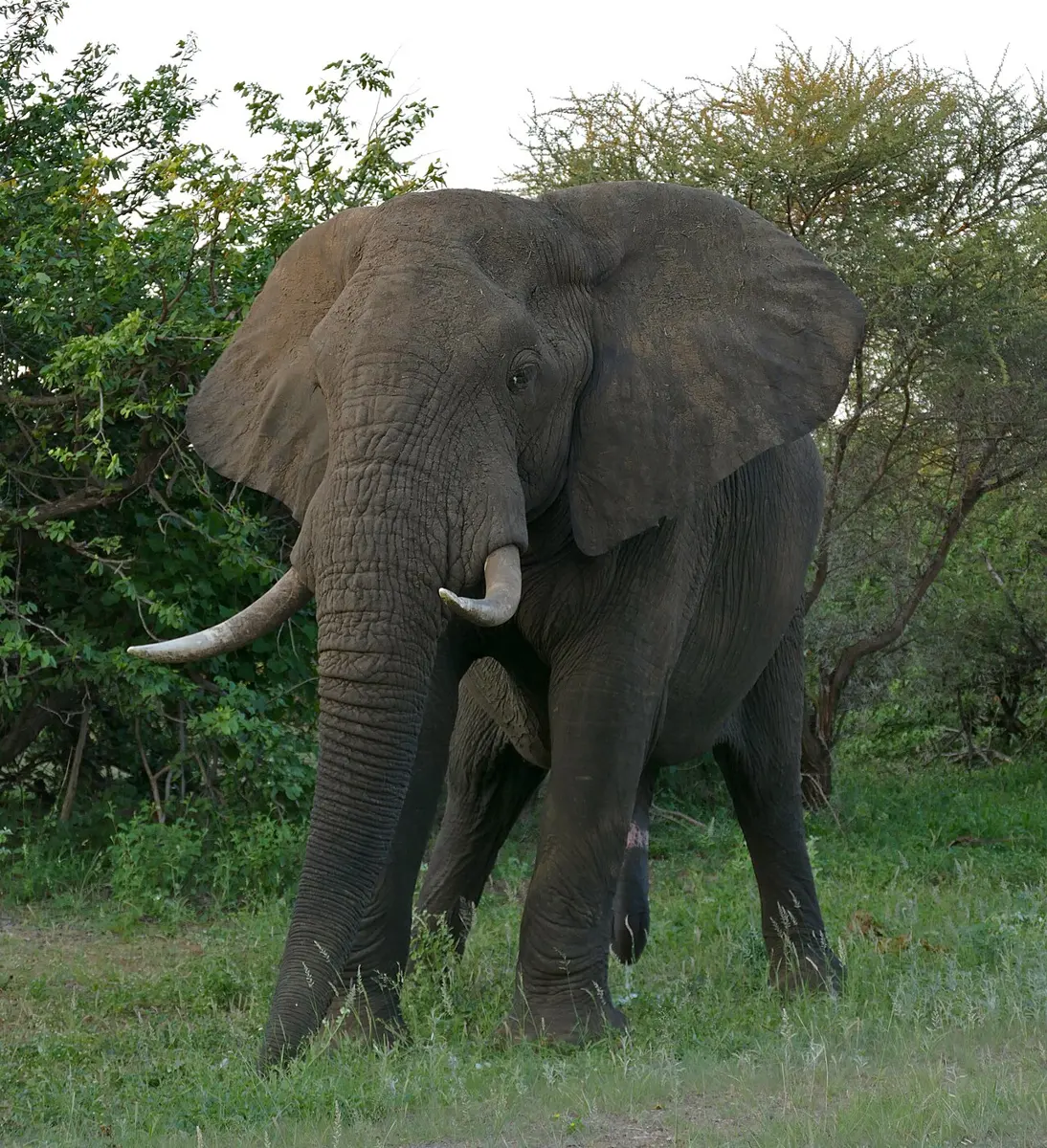
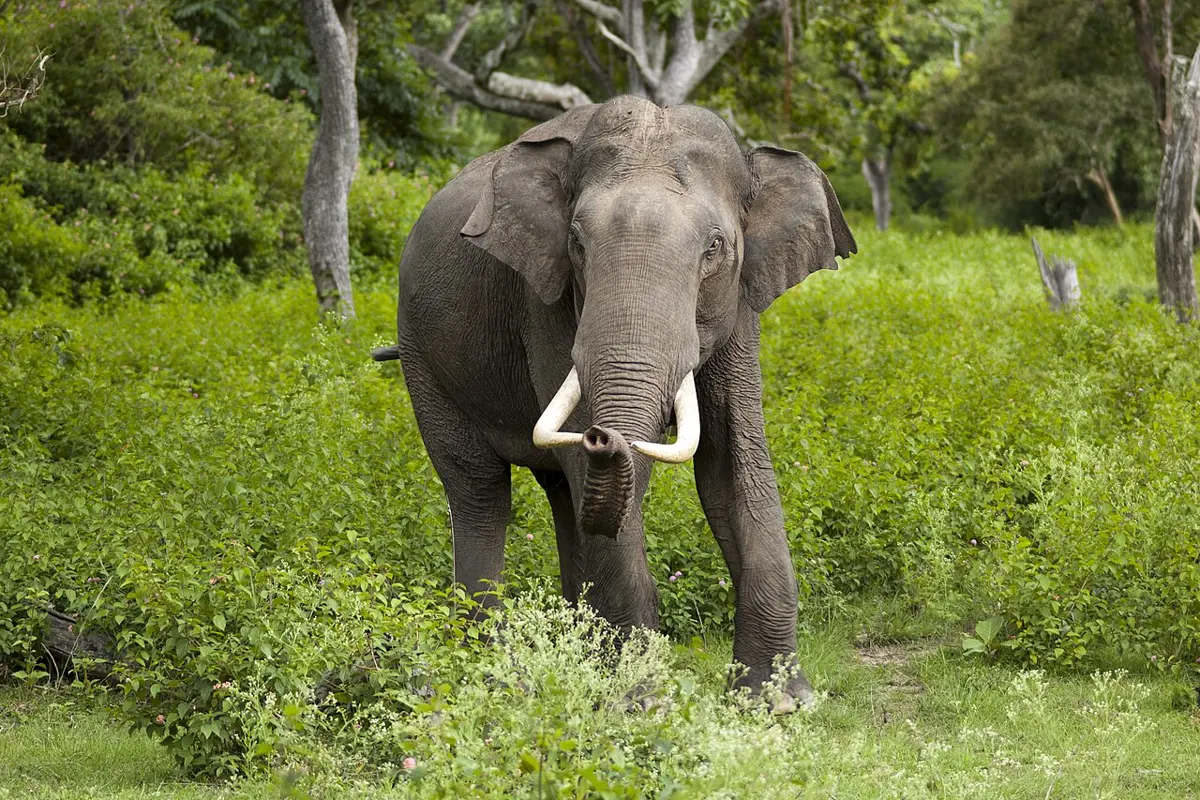
- Unlike any other animal. Elephants are the biggest mammals that live on land, and nothing else looks like them: a long nose (the trunk), large floppy ears and thick, wide legs.
- Two kinds. The text describes the African and the Asian elephant. African elephants live south of the Sahara and in the rainforests of Central and West Africa; Asian elephants live in Nepal, India and Southeast Asia, in scrub (land with low trees and bushes) and rainforest.
- Size and age. African elephants are bigger: about 13 feet (4 meters) tall and about 6,350 kg. Asian elephants are a little smaller: up to 8.9 feet (2.7 meters) and about 4,990 kg. African elephants live up to 70 years, Asian ones up to 60.
- Trunks and tusks. The tip of an African elephant’s trunk has two “fingers” to pick things up; an Asian elephant’s has one. Both male and female African elephants grow large tusks. Among Asian elephants, usually only the males do; females and some males have tiny tushes that may not even show outside the mouth.
- What tusks are for. Tusks are huge teeth with deep roots. Elephants use them to dig, lift, gather food and defend themselves, and they protect the trunk. Like people who are right-handed or left-handed, an elephant is right-tusked or left-tusked: its dominant (main) tusk is the one more worn down.
- Food. Elephants eat all kinds of plants: grasses, fruit, leaves, bark and roots, 75 to 150 kg a day, and spend about 18 hours a day eating.
- Family. A herd is matriarchal: the oldest female (the matriarch) leads it, teaches the young how to behave with other elephants, and the herd looks after its weak and injured members. A herd is mostly female relatives and their calves; when it grows too big, it splits.
- Growing up. A mother usually has one calf after a pregnancy of about 22 months, the longest of any land animal. Elephants are adults by 8 to 13 years. Then the young males leave the herd and live alone, or in small groups of males, bachelor herds.
Words from the text
| Word | Meaning |
|---|---|
| mammal | an animal that gives birth to live young and feeds them with its milk |
| species | one kind of animal or plant |
| continent | one of the Earth’s large land masses: Asia, Africa… |
| scrub | land covered with low trees and bushes |
| tusk | a very long pointed tooth that grows out of the mouth |
| evolve | to change slowly over a very long time |
| dominant | more important or stronger than the others |
| worn down | made smaller or thinner by use |
| gathering | collecting |
| consume | to eat or drink |
| matriarchal | led or controlled by a woman or a female |
| herd | a large group of animals that live and feed together |
| pregnancy | the time when a baby grows inside its mother |
| bachelor | an unmarried man; here, a young male elephant on his own |
A. The crossword
Solve the crossword puzzle.
Across: 1. a large group of animals that lives and feeds together · 4. the animals that give birth to a baby and feed them with their milk · 6. long pointed teeth of an elephant · 8. collecting · 9. areas with short trees
Down: 2. more important · 3. ruled or controlled by females · 5. types, sorts of an animal or bird · 7. a period when a baby grows in the womb
Answer
B. True or false?
Write whether the following statements are True or False.
- a.There are other land animals larger than elephants.
- b.The Asian and the African are the two major species of elephants found in the world.
- c.African elephants weigh more than Asian ones.
- d.Tusks are of no use for elephants.
- e.Elephants spend two thirds of their time eating.
- f.The herd of the elephants is ruled by a male.
Answer
C. Answer the questions
Why do elephants look unique?
Answer
Where do African elephants live?
Answer
What is the average age of Asian elephants?
Answer
What unique things do elephants and human beings share?
Answer
How do elephants care for weak and injured members?
Answer
When do the male elephants quit their herd?
Answer
How can you tell an elephant’s dominant tusk?
Pick an answer to see why.
D. An elephant you have seen
Have you or any of your friends ever seen an elephant? Where did you or they see it? Describe the features of an elephant to your friends.
A model answer
Pronunciation
Look the words up in a dictionary: the pronunciation is given in symbols between slashes, /ˈmæməlz/, with a mark ˈ before the loud beat. Here are the words with their British dictionary symbols.
Use an English dictionary and find the pronunciation for the following words. (mammals, scrub, tusks, gathering, dominant, species, matriarchal, herd, pregnancy)
Answer
Speaking: reporting facts
A. What people say about elephants
Seven people say seven facts about elephants:
- Elephants are the world’s largest land animals.
- You can tell the two species apart by their ears.
- Their trunks are flexible.
- Their tusks are actually teeth.
- They communicate through vibrations.
- Calves can stand on their own within 20 minutes of birth.
- They’ve got thick skin.
B. Tell your partner
Work in pairs. Tell your partner what was said about elephants, as in the example. (Example: The teacher said that elephants are the world’s largest land animals.)
Model answers
Grammar I: reporting facts and truths
When we tell someone what another person said, we can report it in our own sentence, without quotation marks:
| What she said | Reported |
|---|---|
| “The Earth is round.” | She said that the Earth is round. |
| “Knowledge is power.” | He said that knowledge is power. |
Usually the verb moves one step back into the past when we report (“I am tired.” → She said that she was tired), because it was true then and may not be now; you will learn this in Grade 8. But with a fact, a truth or a saying that is still true, we usually keep the present tense: the Earth is still round. Moving it back (She said that the Earth was round) isn’t wrong, but keeping the present is more natural, and it shows you know it is still true.
Said or told? Said needs no person after it: She said that… Told needs one: She told me that…, The teacher told us that… (never She told that…). The word that can be left out in speech: She said the Earth is round.
A. What the boy says
What is the boy in the picture saying? Tell your friends what the boy is saying. (China has the largest population in the world. · Water boils at 100° centigrade. · Nepal lies between India and China. · Rainbows have seven different colors. · There are twelve months in a year. · Snow is white. · English is an international language. · The Earth moves round the Sun.)
Answer
B. Match
Match the statements in column A with their reported speech in column B.
- a.Knowledge is power. · b. The Sun sets in the west. · c. The Earth is round. · d. All humans are born equal. · e. Man is mortal. · f. Honesty is the best policy. · g. Truth always wins.
- i.Mr. Sen said that truth always wins. · ii. Chitra said that man is mortal. · iii. She said that honesty is the best policy. · iv. He said that knowledge is power. · v. The teacher told us that the Sun sets in the west. · vi. My father said that the Earth is round. · vii. She said that all humans are born equal.
Answer
C. Report the statements
Now, report the following statements as in the example below. The beginning of each sentence has been given. (Example: Human blood is red. → Mr. Sen said that human blood is red.)
- a.The sky is blue. (Nita said that …)
- b.The Earth rotates on its axis. (Sabin told me that …)
- c.There are seven days in a week. (Nabina said that …)
- d.Diamond is the hardest natural substance. (The science teacher said that …)
- e.Sentences in English are separated by a full stop. (Our English teacher said that …)
- f.Dark clouds are the signs of rain. (My mother said that …)
- g.It’s very cold at the North and South Poles. (Our geography teacher told us that …)
Answer
“Bats are mammals,” Ramila told us. Which report is right?
Pick an answer to see why.
Listening: a voice message
A. Before you listen
What is a voice message?
Answer
When do you leave a voice message?
Answer
The recording
Ellen leaves a voice message for her friend Nadia. Listen for dates, a time and a name: she spells the name of the house letter by letter.
B. Answer in two words or fewer
Listen to the audio and answer using no more than two words. (Example: Who is the speaker? Ellen)
- a.When are they moving into the new house?
- b.What function are they going to have when they celebrate?
- c.What day is the party?
- d.What time is the party?
- e.What is the name of the house?
- f.What does the speaker want Nadia to bring?
Answer
C. Write what you hear
Listen to the recording and write everything you hear. Your teacher will pause the audio for you to write.
How to do it
Writing I: short messages
A. The message you wrote
Look at the text you wrote in “C” above in the listening section. Read it and answer these questions.
- a.What is the text?
- b.Who has left it?
- c.What is it about?
Answer
B. Other short messages
Five short messages, each with the same three parts: a greeting with the friend’s name, one or two sentences, and the writer’s name at the end. Kanchan wishes Urgen a happy birthday; Pooja wishes Manoj a happy New Year; Mona congratulates Karina on passing Grade 7; Sara asks Nitu whether she left her coat at her house; Manoj tells Nimesh that football practice is on Friday, not Monday.
A short message says one thing and stops. It doesn’t need I hope you are well, or Yours sincerely.
C. Write your messages
Now, write similar messages to your friend in the following situations.
- a.Giving best wishes to a friend on a special occasion such as Dashain/Eid/Christmas.
- b.Your school starts at 9:00 a.m. tomorrow.
- c.The cricket match for tomorrow has been postponed for the day after tomorrow.
Model messages
Reading II: Use of a Personal Computer
Before you read
The picture shows a desktop computer: a monitor (screen), a system unit (the tall box), a keyboard and a mouse.
Monitor, keyboard and mouse traced from a photo by Kwangmo, CC0
System unit traced from a photo by Paowee, CC BY 4.0
Speakers traced from a photo by Evan-Amos, public domain
UPS traced from a photo by MSDN.WhiteKnight, CC0
What do you see in the picture?
Answer
Can you name any of the items?
Answer
Do you have any of these devices? If yes, what do you use it/them for?
A model answer
The text, part by part
Isabella gives a short talk on how to use a personal computer.
- Switching on. Press the power button. It is in different places on different models, and is marked with a symbol. The screen lights up: the monitor or display, like a television screen.
- The keyboard. It has keys with special jobs: the function keys F1 to F12 along the top (F1 usually opens Help), and, on many keyboards, a block of number keys on the right.
- Moving and deleting. Home takes you to the start, End to the end. Delete and Backspace remove text. Ctrl with a letter is a shortcut in Word and other programs: Ctrl + V pastes what you have copied.
- The mouse. A small device you hold in your hand to move the cursor, the arrow that shows where you are on the screen. It has a left and a right button for different jobs. A laptop has a flat touchpad instead, though you can plug in a mouse or a keyboard too.
- Switching off. Shut the computer down properly: click Start, then Shut down, and remove the power cables if there are any.
Words from the text
| Word | Meaning |
|---|---|
| device | a machine or tool made for a job |
| era | a period of time in history |
| monitor | a computer’s screen |
| numerical | to do with numbers |
| erase | to rub out, remove |
| hand-held | small enough to hold in the hand |
| cursor | the arrow or line that shows where you are on a screen |
| externally | from the outside, plugged in |
A. Match
What do the words/phrases on the left refer to? Match.
- a.Power button · b. Monitor · c. Keyboard · d. Home button · e. Backspace · f. Mouse pad
- i.leads to the beginning of the document. · ii. helps to switch on the computer. · iii. erases text on a document. · iv. is available on a laptop computer. · v. helps us type documents. · vi. is the computer screen.
Answer
B. True or false?
Write True or False for the following statements.
- a.The “Power” button varies based on the type of computer.
- b.A keyboard is not an input device.
- c.The F1 key helps to shut down the computer.
- d.The “Delete” button erases text on a document.
- e.A mouse has more than two clicking points.
- f.One should remove the electric cables after shutting down the computer.
Answer
C. Answer the questions
What type of device is a computer?
Answer
What should a user do first to start a computer?
Answer
What is the computer screen similar to?
Answer
How many function keys are there on a keyboard?
Answer
Write any one feature of the mouse.
Answer
What should a user do after s/he uses a computer?
Answer
You have copied a sentence. Which keys paste it?
Pick an answer to see why.
D. Computers in student life
Do you, your family or your friends have a computer at school or at home? What do you or they use it for? Discuss its advantages in student life.
A model answer
Grammar II: the zero conditional
A. Study the sentences
Six sentences in this part are about things that happen every time: water heated turns into vapor; people who eat too much put on weight; you get burned if you touch fire; you get water from hydrogen and oxygen; heated ice melts; to pass the exam, study hard.
They are zero conditionals: an if sentence for facts and general truths, where one thing always follows another.
| If + present simple | present simple |
|---|---|
| If you heat ice, | it melts. |
| If people eat too much, | they put on weight. |
- Both parts are in the present simple. If means almost the same as when or whenever here: When you heat ice, it melts.
- The if-part can come first (with a comma after it) or second (no comma): You get burned if you touch a fire.
- The second part can also be an order: If you want to pass the exam, study hard.
Compare it with two other if sentences. The first conditional is about one particular future event: If it rains tomorrow, we will stay home. The imagined if of Unit 5 is about something unreal: If I were a bird, I would fly. The zero conditional is about what happens every time. Switch between the zero and the first conditional here:
B. Put the words in order
Try these first, then do the book’s:
Rearrange the given words to make meaningful sentences. (Example: a baby/if/pull their ear/cries/you → A baby cries if you pull their ear.)
- a.don’t waste/you want to be/your time/successful/if
- b.everywhere/pollution increases/if/throw wastes/people
- c.do regular exercises/our muscles/if/become strong/we
- d.if/balanced diet/we don’t eat/become weak/we
- e.we plant trees/give off/they/if/oxygen
Answer
C. Complete the sentences
Use the correct forms of verbs from the brackets to complete the sentences.
- a.If you freeze water, it ………… (become) solid.
- b.If you ………… (mix) red and blue, you get purple.
- c.Does ice melt if you ………… (heat) it?
- d.The metal ………… (expand) if you heat it.
- e.Go to bed early if you ………… (be) tired.
- f.If you press this button, the TV ………… (switch) on.
- g.If they work too much, they ………… (get) tired.
- h.The baby ………… (wake up) if you make too much noise.
- i.Does oil float if you ………… (pour) it into water?
Answer
If you ___ a magnet near iron filings, they jump to it.
Pick an answer to see why.
Writing II: instructions
A. Washing hands
There are seven steps for washing hands, and seven small pictures in a different order. The pictures, from top to bottom, show: (1) one hand rubbing over the back of the other, with bubbles; (2) one hand scrubbing the other’s nails with a small brush; (3) hands drying in a towel; (4) hands under a running tap; (5) hands cupped together, with no soap yet; (6) fingers rubbing in between each other, with bubbles; (7) palms rubbing together, with bubbles.
Instructions start with a verb in its plain form (Wet, Lather, Rub, Rinse, Dry), one step to a line, in the order you do them.
Read the instructions for washing hands properly. Match the instructions with the correct pictures.
Answer
B. Brushing your teeth
Write a set of instructions for brushing your teeth. Use the given clues. (soak the brush · put toothpaste · brush teeth gently · spit the paste · rinse mouth with water)
Hint
A model answer
Project work
Extra bit: facts about your body
The Extra bit lists eleven surprising facts about the human body, from National Geographic Kids: your mouth makes half a liter to more than a liter of saliva a day; parts of your brain are busier while you dream than when you are awake; your body gives off light too faint to see; a belly button holds dozens of kinds of bacteria (67 on average, in a study of belly buttons in 2012); newborn babies cry without tears for their first few weeks; a heart beats about three billion times in a life; the left lung is smaller than the right; human teeth are about as hard as a shark’s (measured in 2012); the nose may tell a trillion smells apart; humans seem to be the only animals that blush; blood is about 7 to 8% of your weight.
Read some interesting facts about our bodies. Choose your favorite five facts and put them in order of your priority.
A model answer
Exercise
Practice the whole unit. Try each one, then open the answer.
Report these facts. Begin with the words given.
- a.“Light travels faster than sound.” (Our teacher told us that …)
- b.“Everest is the highest mountain in the world.” (Pasang said that …)
- c.“A spider has eight legs.” (My grandmother said that …)
Answer
Complete the zero conditionals.
- a.If you ……… (drop) a glass on the floor, it usually ……… (break).
- b.Plants ……… (die) if they ……… (not get) water.
- c.If you mix yellow and blue, you ……… (get) green.
Answer
Find the mistake and correct it.
- a.She told that the Earth is round.
- b.If you heat ice, it will melted.
- c.Our teacher said us that the Sun rises in the east.
Answer
Write a short message to your friend Sneha: the science exhibition is on Friday, not Thursday, and she should bring her model.
A model message
Write three instructions for switching off a computer properly.
A model answer
Printable PDFs
- Study notes 2 pages
- Harder practice questions 2 pages Answer key
Practice every question in the book, and keep track of the ones you miss →
A companion to your textbook, not a replacement for it: study from the book your school uses, and where the two differ, follow your teacher. Found a mistake? Please tell us.