
Watch a mason building a wall in Bhaktapur. Brick after brick goes down in rows, each one pressed tight against the next, and the wall grows with no gaps between them.
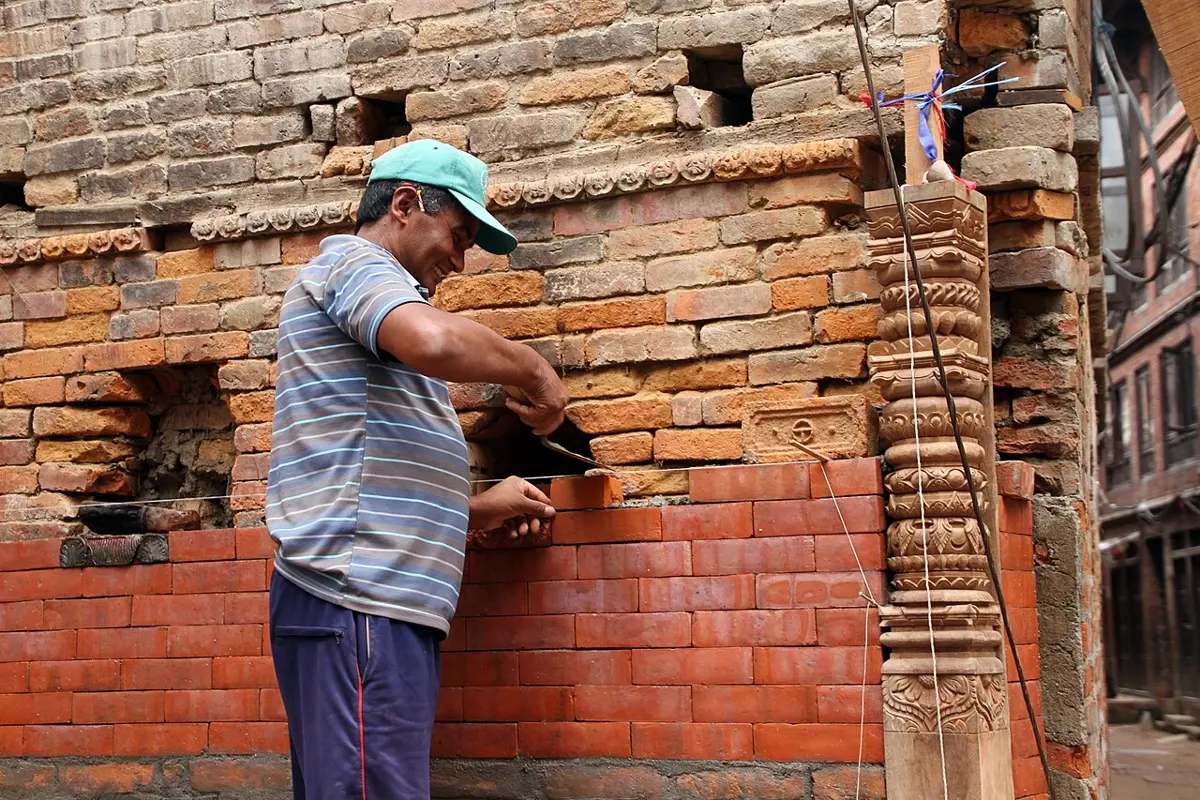
Bricks are rectangles. Floor tiles are squares or rectangles too. Nobody makes round bricks, or tiles with five equal sides. Why not? What is special about rectangles and squares that lets them cover a wall or a floor with nothing left over?
In this unit you will learn about shapes that can be folded into two matching halves, and about shapes that fit together to cover a surface. In Back to the bricks you will see the answer.
19.0 Review
19.1 Symmetric figures
Figures that can be folded into two equal parts, with one part lying exactly on the other, are called symmetric figures. The fold line, drawn as a dotted line, is called the axis of symmetry or the line of symmetry. Each half is the mirror image of the other: stand a mirror on the line, and the half you can see together with its reflection makes the whole figure again.
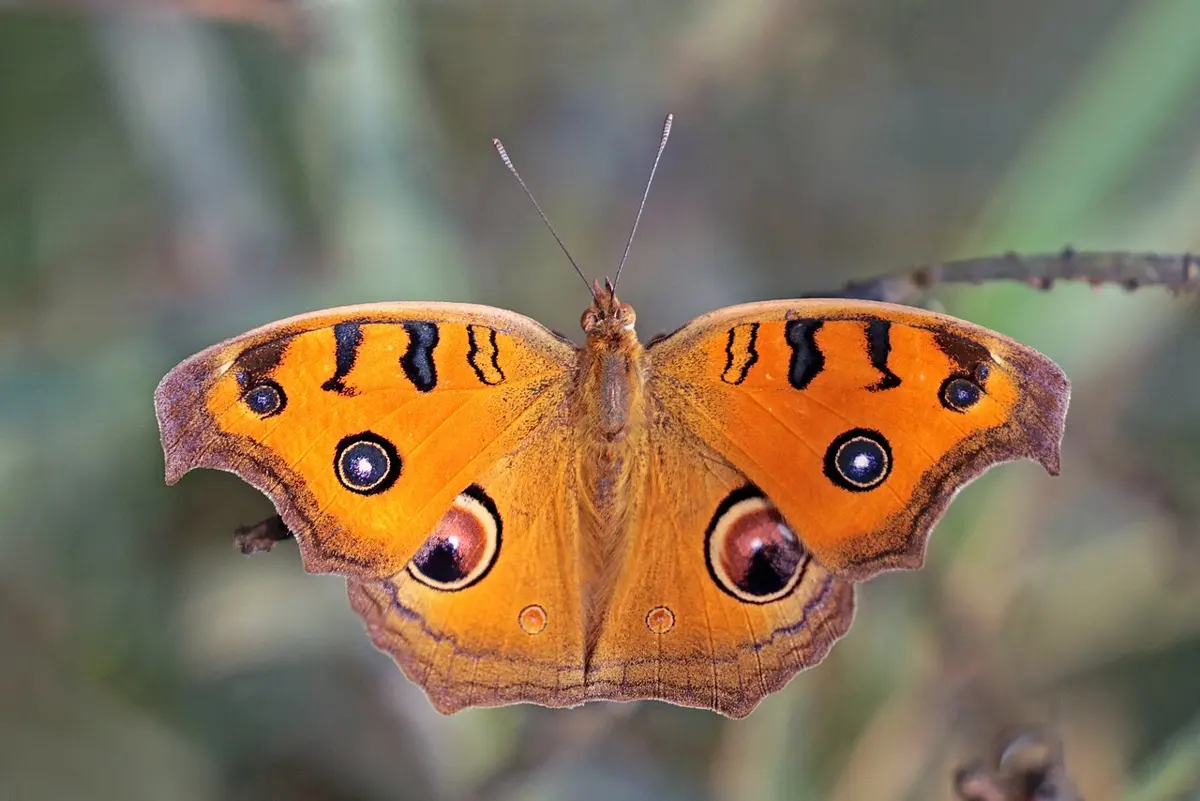
A figure can have one line of symmetry, several, or none.
Exercise 19.1
Question 1
Draw these triangles on squared (graph) paper, and draw their lines of symmetry.
Answer
Question 2
Draw the lines of symmetry of each figure.
Answer
Question 3
Complete each figure, taking the dotted line as the line of symmetry.
Answer
Question 4
Make two lists of the capital letters of the English alphabet: those that have a line of symmetry, and those that don’t.
Answer
Question 5
Copy and complete the table: draw each figure with all its lines of symmetry.
| Name of the plane figure | Figure with its lines of symmetry |
|---|---|
| isosceles triangle | |
| square | |
| rectangle | |
| equilateral triangle |
Answer
Question 6
Are these traffic signs symmetric?
Answer
Question 7
Is this figure symmetric? Why?
Answer
19.2 Tessellation from rectangle and square
Look at these patterns. What shapes are in each, and how are they arranged?
In each pattern, one shape (triangles, rectangles or squares) is repeated, the pieces touching each other closely, with no gaps and no overlaps. Covering a surface with shapes like this is called tessellation, and the pattern made is a tessellation. The shapes are its tiles.
Exercise 19.2
Question 1
What designs are in these figures, and how many colors does each use?
Answer
Question 2
Join the dots to make tessellations of rectangles, and color them.
Answer
Question 3
Join the dots to make tessellations of squares, and color them.
Answer
Miscellaneous Exercise
Question 1
Name the perpendicular sides and the parallel sides in each figure.
Answer
Question 2
Measure the angles of the figures in Question 1 with a protractor, and say what kind each angle is.
Answer
Question 3
Measure the angles and sides of these triangles, and classify each by its angles and by its sides.
Answer
Question 4
Draw a line segment AB 5 cm long and draw its perpendicular bisector. Mark C on the perpendicular bisector, 4 cm from AB. Join CA and CB. What kind of figure is formed?
Answer
Question 5
Draw a line segment AB 6 cm long. At A, draw a 90° angle towards the right, and at B a 30° angle towards the left. What figure is formed?
Answer
Question 6
Draw a line segment PQ. At P and at Q, draw 120° angles on the same side (the right side). Using a set square, draw a line segment RS parallel to PQ, with R and S on the two arms. What figure is formed?
Answer
Question 7
Find the midpoint (the middle point) of the base BC of triangle ABC and join it to A. What kind of triangles are the two triangles formed? Find out by measuring their angles.
Answer
Question 8
Draw a line segment AB. At A draw a 60° angle towards the right and at B a 60° angle towards the left. What figure is formed? Measure all its sides and angles.
Answer
Question 9
Draw a line segment XY = 6 cm. At X draw a 90° angle towards the right and at Y a 60° angle towards the left. What figure is formed? Measure all its angles and sides.
Answer
Question 10
Draw a line segment PQ = 7 cm. Using a set square, draw a line segment XY parallel to PQ. With a protractor, draw 80° angles at P and at Q, on the same side, and mark where their arms meet XY as S and R. What figure is formed? Measure all its angles and sides.
Answer
Question 11
A cuboid-shaped tank has 6 flat faces and 12 edges. How many vertices does it have?
Answer
Question 12
What is the difference between a plane figure and a solid figure? Answer with figures.
Answer
Question 13
Plot the points (0, 9), (5, 9), (5, −2) and (0, −2) on squared paper. Join them in order and name the figure formed.
Answer
Question 14
Draw a line segment AB = 5 cm.
- a.Draw and .
- b.With arcs of radius 7 cm, mark C on AX and D on BY.
- c.Join C to D and D to A.
- d.What kind of triangle is ACD? Measure its angles and sides.
Answer
Printable PDFs
- Study notes 2 pages
- Harder practice questions 2 pages Answer key
Practice every question in the book, and keep track of the ones you miss →
Back to the bricks
Why can bricks and square tiles cover a wall or a floor with no gaps, when round or five-sided tiles can’t?
Look at any point where the corners of tiles meet. The angles around a point always add up to 360°, a full turn. For the tiles to close up with no gap, their corners there must add up to exactly 360°.
- Four square corners: 90° + 90° + 90° + 90° = 360°. They close up exactly. So do the four right-angled corners of rectangles.
- Six corners of equilateral triangles: 6 × 60° = 360°. Triangles tessellate too.
- A regular pentagon (five equal sides) has corners of 108°. Three of them make 324°, leaving a gap of 36°; four would make 432°, too much. Regular pentagons can’t tessellate.
- Circles have no corners at all. However you pack them, gaps are left between them.
Rectangles have one more advantage for a mason: their flat sides sit tightly against the bricks above and below, so a wall of them is strong, especially when each row is moved along by half a brick, as in the photo at the start.
Where this is used
- Floors, walls and roads. Tiles, bricks and paving stones are rectangles, squares or hexagons, the shapes that cover a surface with no gaps, so nothing is wasted and water can’t collect in holes.
- Honeycombs. Bees build their cells as hexagons, which tessellate and hold the most honey for the wax they use.
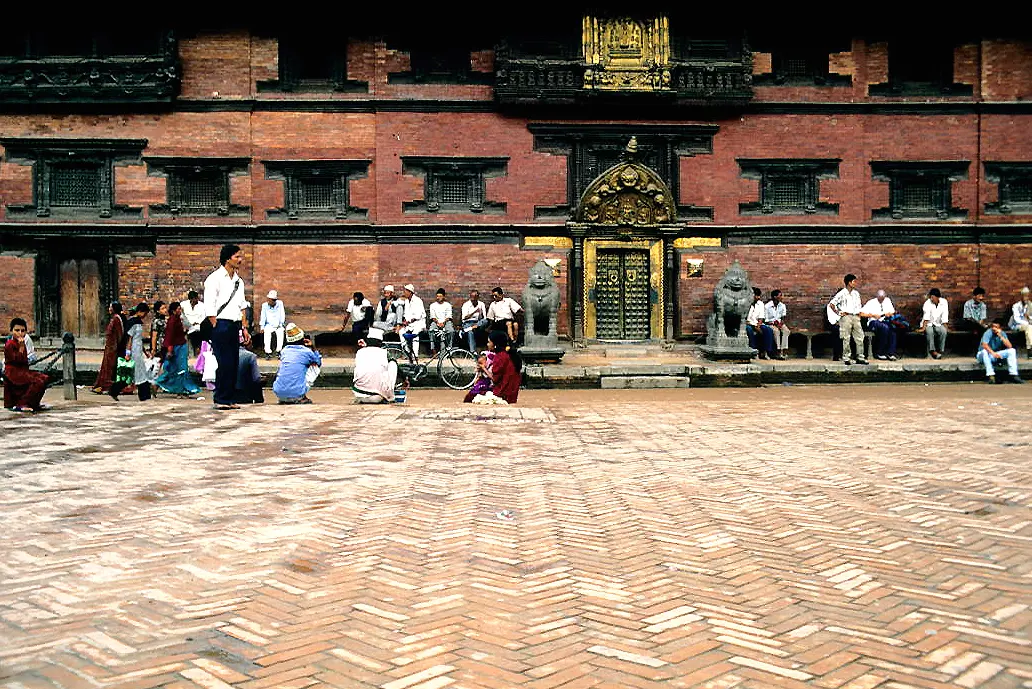
- Design and signs. Many logos, flags, traffic signs and the fronts of temples are made symmetric, because a symmetric shape looks balanced and is easy to recognize.
- Living things. Most animals, from butterflies to people, are nearly symmetric about a line down the middle of the body.
Where these facts come from
- Lines of symmetry and mirror images: Wikipedia, “Reflection symmetry” (a figure with a line along which it can be folded so the two halves match; bilateral symmetry of animals), read November 2026.
- Tessellation: Wikipedia, “Tessellation” (tiles with no overlaps and no gaps; the angles at a vertex adding to 360°; only equilateral triangles, squares and regular hexagons tessellate on their own), read November 2026.
- Honeycombs: Wikipedia, “Honeycomb conjecture” and “Honeycomb” (hexagonal cells divide a surface into equal parts with the least total wall), read November 2026.
A companion to your textbook, not a replacement for it: study from the book your school uses, and where the two differ, follow your teacher. Found a mistake? Please tell us.