
Pemba’s family and Anisha’s family live side by side in Kavre. Each family farms a field of exactly 1 ropani.
This year Pemba’s family plants potatoes on of their field. Anisha’s family plants potatoes on of theirs.
Which family has more land under potatoes? How much do the two families have under potatoes together? And if one bag of seed potatoes plants of a ropani, how many bags does Pemba’s family need?
The fractions are cut into different sizes: quarters and eighths. In this unit you will learn to make them the same size, so you can compare them, add them, multiply them and divide them. At the end, in Back to the fields, you will answer all three questions, and see how Nepal’s own land units, the ropani and the aana, already do the hardest step for you.
4.0 Review
In Grade 5 you met fractions: a whole cut into equal parts, and some of those parts taken. In , the denominator 4 says how many equal parts the whole is cut into, and the numerator 3 says how many of them we take.
Three more words from Grade 5 come back in this unit.
- Like fractions have the same denominator: and . Their parts are the same size.
- Unlike fractions have different denominators: and . Their parts are different sizes.
- A mixed number is a whole number and a fraction together: is 2 wholes and a quarter. As an improper fraction it is (2 wholes are 8 quarters, and 1 more makes 9).
In Grade 5 you added and compared only like fractions. This unit is about unlike ones.
4.1 Equivalent fractions
Fractions that name the same amount with different numbers are called equivalent fractions. So and are equivalent fractions.
The color never moved. Only the fold lines changed. So : three names for one amount.
Making equivalent fractions
Look at what each fold did. When every part was cut in two, there were twice as many parts in the whole, and twice as many colored parts. Both numbers were multiplied by 2.
So, to make an equivalent fraction, multiply the numerator and the denominator by the same number (not 0).
Try it yourself below: cut every part of the bar into smaller pieces, and watch the name of the fraction change while the colored length stays the same.
Lowest terms
You can also go the other way: divide the numerator and the denominator by the same number. Folding made parts smaller; dividing puts small parts back together into bigger ones.
A fraction is in its lowest terms when no number except 1 divides both its numerator and its denominator. is in lowest terms. is not, because 2 divides both 6 and 8.
From now on, give every answer in its lowest terms. That is how teachers expect a final answer, and it is the easiest form to picture.
Which fraction is equivalent to ?
Pick an answer to see why.
What is in lowest terms?
Pick an answer to see why.
Exercise 4.1
Question 1
Color the parts that show the fraction given.
Answer
Answer
Answer
Answer
Question 2
Cut each part of the picture into two equal parts. Write the colored part as a fraction before and after.
Answer
Answer
Answer
Answer
Question 3
Which number goes in the box?
Answer
Answer
Answer
Answer
Question 4
Write two fractions equivalent to each fraction.
Answer
Answer
Answer
Answer
Question 5
Write a fraction equivalent to each fraction, with 16 as its denominator.
Answer
Answer
Answer
Answer
Question 6
Find the equivalent fractions in each list.
, , ,
Answer
, , ,
Answer
Question 7
Fill in the boxes. Each branch multiplies the top and the bottom by one number.
: , , ,
Answer
: , , ,
Answer
: , , ,
Answer
4.2 Comparison of unlike fractions
When two fractions have the same denominator, their parts are the same size. So the fraction with the greater numerator is the greater fraction.
4.2.1 Converting unlike fractions into like fractions
That is the whole trick. To compare unlike fractions, first make the denominators the same, using equivalent fractions. Then compare the numerators.
Which denominator? It must be a number that both denominators go into, a common multiple. The smallest one is the easiest to work with: the lowest common multiple, or LCM (Unit 2 explains it fully). To find it, list the multiples of each denominator and take the first number that is in both lists.
Putting several fractions in order
The same idea puts any number of fractions in order: make them all like fractions, then order the numerators.
Which is bigger, or ?
Pick an answer to see why.
What is the LCM of 4 and 6, the best common denominator for quarters and sixths?
Pick an answer to see why.
Exercise 4.2
Question 1
Write each pair as like fractions.
and
Answer
and
Answer
and
Answer
and
Answer
Question 2
Put >, < or = in the box.
Answer
Answer
Answer
Answer
Question 3
Which fraction is bigger?
and
Answer
and
Answer
and
Answer
and
Answer
Question 4
Write , and in ascending order.
Answer
Question 5
Kriti ate of a roti, and Bibek ate of a roti of the same size. Who ate more?
Answer
Question 6
Two poles of the same length are painted. of the first pole is painted black, and of the second pole is painted white. Which color covers more?
The textbook gives black and white on one pole, but , more than the whole pole. So the book’s numbers don’t work on one pole; here they are on two poles of the same length.
Answer
Question 7
Sabina spends of her income on food and on education. On which does she spend less?
Answer
Question 8
Ujwal ate of a cake in the morning and of the same cake in the evening. When did he eat less?
Answer
4.3 Addition and subtraction of unlike fractions
In Grade 5 you added like fractions: add the numerators, keep the denominator. That works because the parts are the same size. For unlike fractions, first make the parts the same size. Then add as before.
So to add or subtract unlike fractions:
- Find the LCM of the denominators.
- Change each fraction into an equivalent fraction with the LCM as its denominator.
- Add or subtract the numerators, and keep the denominator.
- Write the answer in lowest terms (and an improper fraction as a mixed number too).
There is a second way to find the LCM, with prime factors: write each denominator as a product of primes. For Example 1, 10 = 2 × 5 and 6 = 2 × 3. Both have a 2. Then 10 is missing the 3 of 6, and 6 is missing the 5 of 10. So multiply 10 by 3 and 6 by 5: both become 30.
Mixed numbers
With mixed numbers, there are two ways, as in Grade 5: add the wholes and the fractions apart, or change everything into improper fractions first. Two things can happen with the fractions.
What is ?
Pick an answer to see why.
What is ?
Pick an answer to see why.
Exercise 4.3
Question 1
Work out. Give each answer in lowest terms, and an improper fraction as a mixed number.
Answer
Answer
Answer
Answer
Answer
Answer
Answer
Answer
Answer
Answer
Question 2
Rojina had of a basket of apples. She gave her friend apples that would fill of the basket. What part of a basket of apples does Rojina have now?
Answer
Question 3
From place A to place B is m, and from B to C is m. How far is it from A to C through B?
Answer
Question 4
Two fractions add up to . One of them is . What is the other?
Answer
Question 5
Pratik cut an apple into 8 equal pieces. He ate of the apple, and his sister Riya ate . How much of the apple did they eat together?
Answer
Question 6
Aaryan bought kg of sweets for his birthday. He gave kg to his family and kg to his friends. How much is left?
Answer
4.4 Multiplication of fractions
4.4.1 Multiplying a fraction and a whole number
Multiplying by a whole number is repeated adding. means four lots of : . That is 4 × 3 = 12 fifths.
So to multiply a fraction by a whole number, multiply the numerator by the whole number and keep the denominator. The parts stay the same size; you just have more of them.
“Of” means times
“ of 56” means: cut 56 into 8 equal shares and take 7 of them. In maths, a fraction of a number is the fraction times the number.
What is of 20?
Pick an answer to see why.
Exercise 4.4.1
Question 1
One box of tiles covers of a house’s roof. How much of the roof do 3 boxes cover?
Answer
Question 2
Stones are being laid in a park. One truck of stones covers of the park. How much of the park do 6 trucks cover?
Answer
Question 3
Find the product.
Answer
Answer
Answer
Answer
Question 4
Find the value.
of 2 kg
Answer
of 100 cm
Answer
of 1 year
Answer
of 200 students
Answer
Question 5
What is of 25?
Answer
What is of 120?
Answer
Question 6
Kushal had Rs 1,000. He lent of it to Sagar.
How much did Kushal lend to Sagar?
Answer
How much does Kushal have left?
Answer
Question 7
A sack holds 25 kg of rice. of the rice is taken out. How many kilograms are taken out, and how many are left in the sack?
Answer
Question 8
The road from Dumre to Chandrawati is 18 km long. of the road has been blacktopped. How many kilometers have been blacktopped, and how many are still to do?
Answer
4.4.2 Multiplying a fraction by a fraction
What does mean? You can’t add “half a time”. But “of” helps: is half of .
So to multiply two fractions, multiply the numerators for the new numerator, and multiply the denominators for the new denominator.
Why? The denominators multiply because cutting one way into b and the other way into d makes b × d small parts. The numerators multiply because the overlap is a strips one way and c the other, so a × c small parts.
What is ?
Pick an answer to see why.
Exercise 4.4.2
Question 1
Find the product.
Answer
Answer
Answer
Question 2
Mijash is pasting colored paper on the wall of his room. One packet of paper covers m². How much does half a packet cover?
Answer
Question 3
One watermelon weighs kg. How much do watermelons weigh (five whole ones and a half)?
Answer
Question 4
A car uses liters of petrol in one hour. How much petrol does it use in hours?
Answer
Question 5
A glass is full of milk. Rohan drinks of that milk.
What part of a full glass does he drink?
Answer
What part of a full glass is left?
Answer
4.5 Division of fractions
4.5.1 Dividing a fraction by a whole number
Dividing by 2 is the same as taking half, which is multiplying by . The number is called the reciprocal of 2: turn a number upside down and you get its reciprocal. The reciprocal of 3 is , and the reciprocal of is . A number times its reciprocal is always 1: .
So to divide by a whole number: change ÷ into ×, and turn the divisor into its reciprocal.
4.5.2 Dividing by a fraction
Dividing asks “how many fit?” 6 ÷ 2 asks how many 2s fit into 6. In the same way, asks how many three-quarters fit into 3.
The rule is the same as before: change ÷ into ×, and turn the divisor into its reciprocal. Only the second fraction is turned over.
How many quarter-liter glasses can you fill from liters of juice?
Pick an answer to see why.
What is the reciprocal of ?
Pick an answer to see why.
Exercise 4.5
Question 1
Divide.
Answer
Answer
Answer
Answer
Answer
Answer
Answer
Answer
Question 2
Work out.
Answer
Answer
Answer
Answer
Question 3
Sudarshan hired 15 people to dig his land for vegetables. Together they dug of the land in one day. How much did one person dig, if they all dug the same amount?
Answer
Question 4
A tole improvement committee wants to lay bricks on its road. of a truckload of bricks covers of the road. How much of the road does a whole truckload cover?
Answer
Question 5
A rope 25 m long is cut into pieces each m long. How many pieces are there?
Answer
Question 6
A small window needs m of curtain cloth. How many windows can you curtain from a roll of cloth 30 m long?
Answer
Question 7
How many bottles of liters can be filled from 20 liters of milk?
Answer
Question 8
How many containers of liter each can be filled from liters of oil?
Answer
Question 9
Subtract from . Divide the result by . Then multiply by . What do you get?
Hint
Answer
Printable PDFs
- Study notes 2 pages
- Harder practice questions 2 pages Answer key
Practice every question in the book, and keep track of the ones you miss →
Back to the fields
Pemba’s family has potatoes on of a ropani, and Anisha’s family on .
Who has more? Pemba’s family, by of a ropani: , and .
Together: ropani of potatoes.
Seed for Pemba’s family: how many eighths fit into ? bags.
Now the surprise. A farmer in the hills would say it in aana: 1 ropani = 16 aana. So of a ropani is 12 aana, and is 10 aana. Twelve aana against ten: Pemba’s field has 2 aana more, and together they have 22 aana, that is 1 ropani and 6 aana. No LCM needed! Sixteenths are a common denominator for halves, quarters and eighths, so the aana does the hardest step for you.
Where this is used
- Land. In the hills, 1 ropani = 16 aana, 1 aana = 4 paisa, 1 paisa = 4 daam. In the Tarai, 1 bigha = 20 kattha and 1 kattha = 20 dhur. Land deeds in Nepal give areas in these units, so buying, selling or sharing out land means adding and dividing them.
- Cooking. Scaling a recipe for more or fewer people multiplies every amount by the same fraction.
- Time. of an hour is 45 minutes, and of a year is 8 months: a fraction of a quantity.
- Money. Until 2001, share prices in the United States were written in eighths and sixteenths of a dollar.
- Sharing. Dividing a quantity by a fraction answers “how many pieces?”: bottles from a can of milk, curtains from a roll of cloth.
Where these facts come from
- Nepal’s land units: Wikipedia, “Nepalese units of measurement” (1 ropani = 16 aana = 64 paisa = 256 daam = 5,476 sq ft = 508.72 m²; 1 bigha = 20 kattha, 1 kattha = 20 dhur), read November 2026.
- Share prices in fractions: Wikipedia, “Decimalisation”, section on securities (US exchanges used eighths or sixteenths of a dollar, converting to decimals between September 2000 and April 2001), read November 2026.
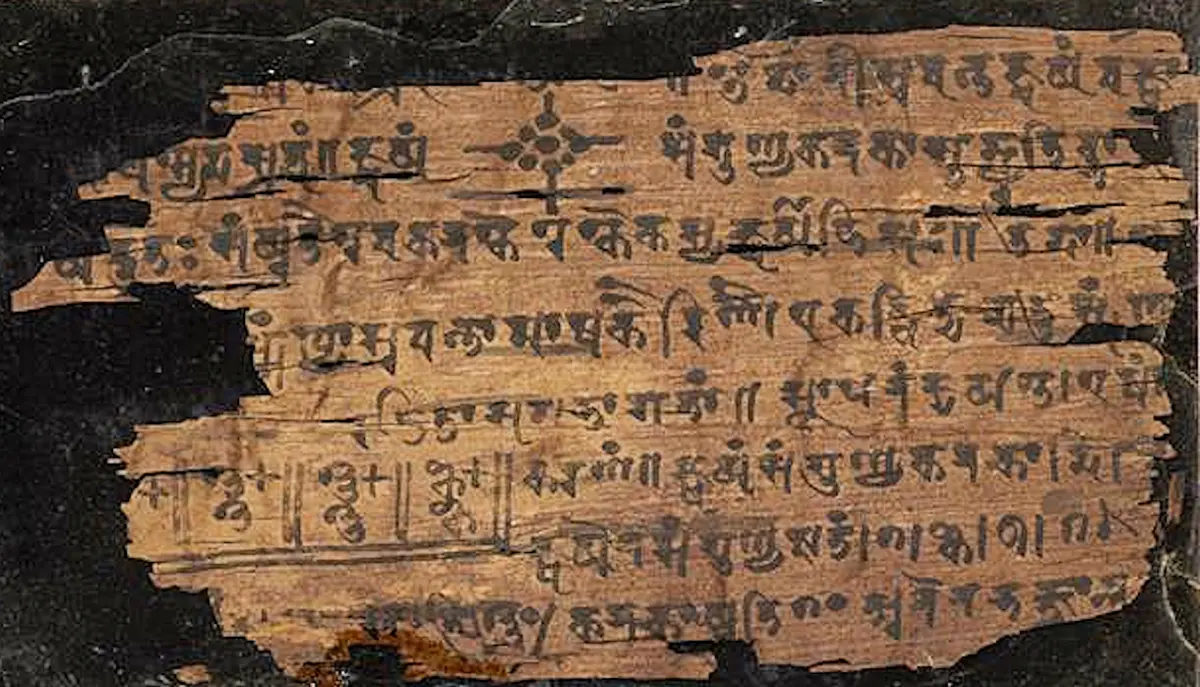
- The fraction line: Wikipedia, “Fraction”, History (Indian works placed the numerator, aṃśa, over the denominator, cheda, without a bar: the Bakhshali manuscript, Brahmagupta about 628, Bhaskara about 1150; the bar first attested in al-Hassar, of Fez, about 1200; then Fibonacci in the 13th century), read November 2026.
- The Bakhshali manuscript: Wikipedia, “Bakhshali manuscript” (birch bark, found in 1881 near Bakhshali, now in Pakistan), read November 2026.
A companion to your textbook, not a replacement for it: study from the book your school uses, and where the two differ, follow your teacher. Found a mistake? Please tell us.