
Isha and three friends buy apples at a fruit shop in Bhaktapur. Apples cost Rs 175 a kilogram, and the digital scale shows 2.5 kg.
How much do the apples cost? The four friends share the bill equally: how much does each one pay? And when the answer has more digits than our money has, what do they actually hand over?
Each question is one kind of sum with decimals: multiplying, dividing and rounding off. In this unit you will learn all three, and see why the decimal point lands where it does. At the end, in Back to the apples, you will answer the three questions, and find out why a paisa or two can go missing when a bill is shared.
5.0 Review
In Grade 5 you added and subtracted decimals by putting the decimal points one under another. A decimal fraction is a fraction whose denominator is 10, 100, 1000 and so on, like . It is the same amount as a decimal: .
So before adding or subtracting, write both numbers in the same form: both as decimals or both as decimal fractions. Decimals are usually quicker.
5.1 Multiplication of decimal numbers
5.1.1 Multiplying a decimal number by a whole number
Three lots of 0.25 is repeated addition, and repeated addition is multiplication:
Here is the idea that makes every decimal multiplication easy. 0.25 is 25 hundredths. Three times 25 hundredths is 75 hundredths, just as three times 25 apples is 75 apples. And 75 hundredths is 0.75. So you can multiply the digits as a whole number, and the place they stand in (hundredths) stays the same.
To multiply a decimal by a whole number:
- Multiply as if there were no decimal point: 25 × 3 = 75.
- Count the digits after the point in the decimal: 0.25 has 2.
- Put the point in the answer so that it has the same number of digits after it: 0.75.
What is 3.6 × 4?
Pick an answer to see why.
5.1.2 Multiplying a decimal by a decimal
Look at the bottoms: hundredths times tenths gives thousandths, because 100 × 10 = 1000. Two digits after the point and one digit after the point give three digits after the point. That is the whole rule.
To multiply two decimals:
- Multiply as if there were no decimal points: 25 × 2 = 50.
- Count the digits after the point in both numbers together: 0.25 has 2 and 0.2 has 1, so 3 in all.
- Put the point so that the answer has that many digits after it: 0.050. A zero at the end, after the point, can be dropped: 0.05.
You can also see why. Take a square of side 1 and cut it into 10 strips across and 10 strips down. Shade 3 strips one way and 4 the other way. The part shaded both ways is of of the square: 0.3 × 0.4.
Multiplying by 10, 100 and 1000
Multiplying by 10 makes every digit worth ten times as much. A digit in the tenths place moves to the ones place, a hundredth moves to the tenths place, and so on: every digit moves one place to the left. It looks as if the point jumped one place to the right.
Count the zeros: multiplying by 10, 100, 1000 moves the point as many places to the right as there are zeros. When the digits run out, fill the empty places with 0, as in 62,840.
Exercise 5.1
Question 1
Write each fraction as a decimal.
Answer
Answer
Answer
Answer
Answer
Question 2
Multiply.
2 × 2.51
Answer
5 × 1.25
Answer
4 × 12.67
Answer
7 × 0.923
Answer
9 × 9.9
Answer
10 × 8.297
Answer
100 × 0.657
Answer
21 × 0.21
Answer
101.03 × 2.35
Answer
232.01 × 4.2
Answer
183.31 × 3.1
Answer
530.12 × 1.52
Answer
986.41 × 1.02
Answer
555.76 × 5.05
Answer
Question 3
Solve these problems.
Aayusha has 3 red pencils. Each pencil is 3.75 inches long. What is the total length of the three pencils?
Answer
A square field has sides 8.45 m long. Find its perimeter.
Answer
A rectangular garden is 7.25 m long and 5.13 m wide. What is its perimeter?
Answer
A ruler costs Rs 25.50. What do 10 such rulers cost?
Answer
5.2 Division of decimal numbers
The dividend is the number being divided, the divisor is the number you divide by, and the quotient is the answer. Dividing a decimal by a whole number is ordinary long division with one extra rule: when you bring down the first digit after the point, put the point in the quotient. Everything after it is tenths, hundredths and so on, so the quotient’s digits there are tenths and hundredths too.
There is another way, which turns the sum into whole numbers. Multiplying the dividend and the divisor by the same number doesn’t change the answer: 10 ÷ 2 and 100 ÷ 20 are both 5. So multiply both by 100:
Dividing by 10, 100 and 1000
Dividing by 10 makes every digit worth a tenth as much, so every digit moves one place to the right: the point seems to move one place left. Dividing by 100 moves them two places, by 1000 three places.
When the point runs out of digits, write zeros in the empty places, as in 0.023259.
Dividing by a decimal
Sometimes the divisor is a decimal: a cauliflower of 2.85 kg costs Rs 171; what does 1 kg cost? Use the trick of the second way above: multiply both numbers by 10, 100 or 1000, until the divisor is a whole number.
What is 6.3 ÷ 0.7?
Pick an answer to see why.
What is 3.6 ÷ 100?
Pick an answer to see why.
Exercise 5.2
Question 1
Divide.
183.31 ÷ 10
Answer
288.012 ÷ 12
Answer
121.77 ÷ 11
Answer
530.1 ÷ 100
Answer
966.45 ÷ 15
Answer
557.825 ÷ 25
Answer
Question 2
Solve these problems.
Sandesh rides his motorbike 7.5 km in 10 minutes, at a steady speed. How far does he go in one minute?
Answer
The perimeter of a square field is 48.64 m. How long is each side?
Answer
A rectangular field has an area of 248.64 m² and a length of 16 m. Find its breadth.
Answer
A cauliflower weighing 2.85 kg costs Rs 171. What does 1 kg cost?
Answer
5.3 Rounding off decimal numbers
Writing a number as the nearest simpler number is called rounding off. You rounded whole numbers to the nearest ten or hundred in Grade 5. Decimals are rounded the same way, to the nearest whole number, the nearest tenth (one digit after the point) or the nearest hundredth (two digits after the point).
The rule, as in Grade 5: look at one digit only, the digit just after the last one you keep.
- If it is less than 5, the last digit you keep stays as it is. Drop the digits after it.
- If it is 5 or more, add 1 to the last digit you keep. Drop the digits after it.
For example, round 3.573 to the nearest hundredth. Keep 3.57; the next digit is 3, less than 5, so 3.573 ≈ 3.57. Round 92.637 to the nearest hundredth. Keep 92.63; the next digit is 7, so add 1: 92.637 ≈ 92.64.
What is 45.736 rounded to the nearest tenth?
Pick an answer to see why.
Exercise 5.3
Question 1
Round off each number at the third, second and first decimal place. (So: to the nearest hundredth, tenth and whole number.)
5.6342
Answer
23.472
Answer
45.736
Answer
78.862
Answer
0.917
Answer
36.727
Answer
104.983
Answer
0.8624
Answer
Question 2
Solve these problems.
A digital scale shows the price of some goods as Rs 346.72. How much money do you pay?
Answer
A cube-shaped tank holds 345.543 ft³.
- i.What is its volume as a whole number?
- ii.Round off its volume at the second decimal place.
Answer
Four marigold garlands cost Rs 275 in all. How much does one garland cost? Round off to one decimal place.
Answer
Question 3
- a.Measure the length of your sign pen, your pencil and your bench in cm.
- b.Divide the bench’s length by the pencil’s length.
- c.Round off both lengths to whole numbers.
- d.Divide the rounded bench length by the rounded pencil length.
- e.Compare the answers of b and d.
- f.Show your work with a drawing.
Answer
Printable PDFs
- Study notes 2 pages
- Harder practice questions 2 pages Answer key
Practice every question in the book, and keep track of the ones you miss →
Back to the apples
Isha and her friends bought 2.5 kg of apples at Rs 175 a kilogram.
The cost: 175 × 2.5. Without the point, 175 × 25 = 4375, and there is 1 digit after the point: Rs 437.50.
Each friend’s share: 437.50 ÷ 4 = Rs 109.375. That has three digits after the point, but money has only two: 1 paisa is a hundredth of a rupee, and there is no thousandth.
What they hand over: rounded to the nearest paisa, Rs 109.375 ≈ Rs 109.38 (the next digit is 5, so round up). Paid on a phone, that is what each could send. In cash, where paisa coins are hardly ever used, they round to the nearest rupee: about Rs 109 each.
Where this is used
- Shops and fuel. A digital scale or a petrol pump multiplies the amount by the price per kilogram or liter, a decimal times a decimal, and shows the bill.
- Money. A rupee is 100 paisa, so prices have two decimal places. Banks and phone payments keep the paisa; cash rounds to the nearest rupee.
- Measuring. Builders and tailors multiply lengths in meters (37.7 × 2.8) to find areas of floors and cloth.
- Sharing. Dividing a bill, a load or a length into equal parts gives decimals, which are then rounded off to something you can pay or measure.
- Computers. Every calculator and spreadsheet rounds answers to a fixed number of decimal places, and has to round to the nearest, not cut off, to avoid errors like Vancouver’s.
Where these facts come from
- The decimal point: Wikipedia, “Decimal separator” (al-Uqlidisi’s decimal fractions in the 10th century; Napier’s tables of 1614 and 1619 used the point; India and Nepal use the point), read November 2026.
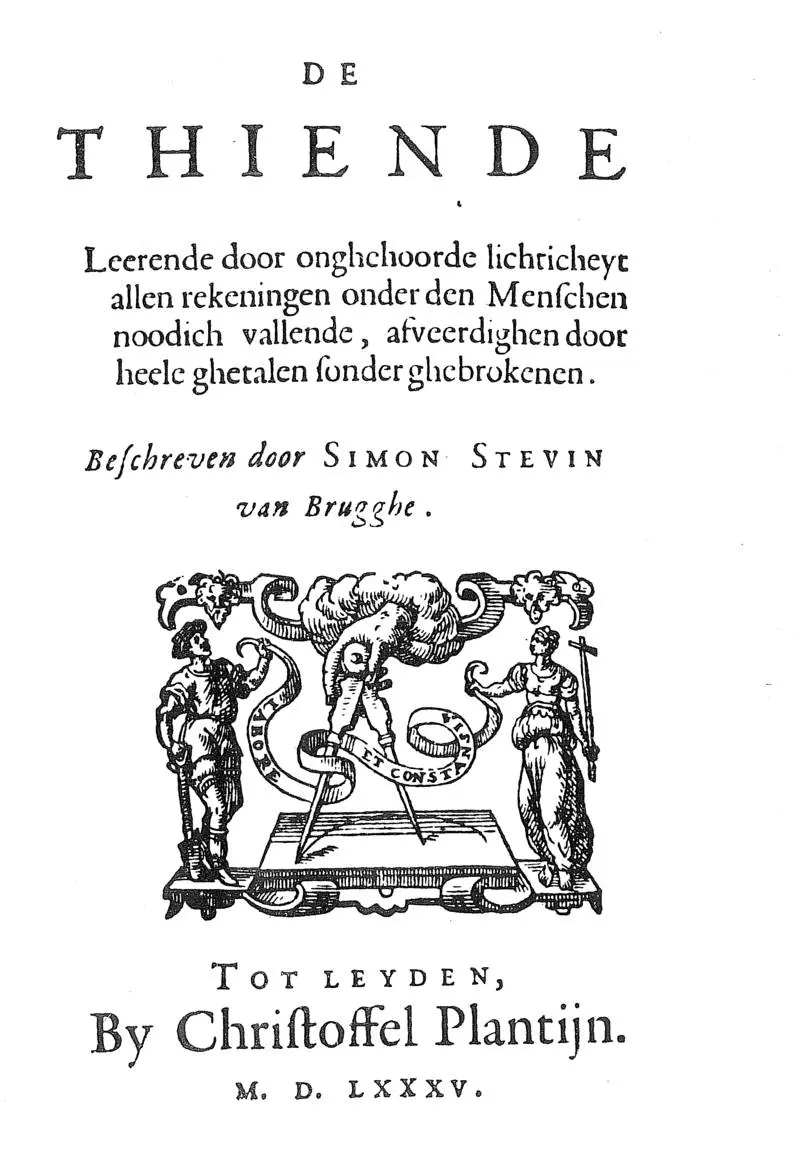
- Simon Stevin: Wikipedia, “De Thiende” (published 1585 in Dutch, with a French version, La Disme; it popularized decimal fractions and argued for decimal coinage, weights and measures), read November 2026.
- The Vancouver index: Wikipedia, “Vancouver Stock Exchange” (started at 1000 in January 1982, recalculated about 3000 times a day and truncated to three decimal places each time; corrected over the weekend of 25–28 November 1983 from 524.811 to 1098.892), read November 2026.
- The price of apples is made up for the sums, not today’s market price.
- Every answer: worked out here and checked by a computer program with exact decimals.
A companion to your textbook, not a replacement for it: study from the book your school uses, and where the two differ, follow your teacher. Found a mistake? Please tell us.