
It is your birthday. The cake is cut into 8 equal slices. You eat 2 slices. Your sister eats 3.
How much of the cake is gone? How much is left for your parents?
You could count slices. But a slice is not a number. To write “2 slices out of 8” as a number, we use a fraction: .
In this unit you will learn to turn pictures into fractions, and fractions into pictures. You will meet fractions bigger than one whole. And you will add and take away fractions, the way you add slices of cake. At the end, you will come back to this cake and answer both questions in two lines.
5.0 Review
Parts of a fraction
Cut a roti into 4 equal parts and take 1. You have one quarter of the roti, .
A fraction has two numbers.
- The bottom number is the denominator: how many equal parts the whole is cut into.
- The top number is the numerator: how many of those parts we take.
So in , the whole is cut into 4 equal parts, and we take 3 of them.
The parts must be equal. A roti torn into one big piece and three small ones is not cut into quarters.
Three kinds of fractions
The pictures show three kinds.
A proper fraction is less than one whole. Its numerator is smaller than its denominator: , , .
An improper fraction is one whole or more. Its numerator is as big as or bigger than its denominator: , , .
A mixed number is a whole number and a proper fraction written together: means 1 whole and more. We read as “two and three quarters”.
An improper fraction and a mixed number can show the same amount. In picture c, and are two names for the same colored part.
Like and unlike fractions
Fractions with the same denominator are like fractions: , and are all eighths. Their parts are the same size.
Fractions with different denominators are unlike fractions: and . Their parts are different sizes.
Like fractions are easy to compare. The parts are the same size, so more parts means more. is more than .
Which of these is an improper fraction?
Pick an answer to see why.
Are and like fractions?
Pick an answer to see why.
5.1 Changing improper fractions and mixed numbers
Look at three circles. Each is cut into quarters, and 11 quarters are colored.
We can count the colored part in two ways.
- Count every quarter: 4 + 4 + 3 = 11 quarters. That is , an improper fraction.
- Count whole circles first: 2 whole circles, and 3 quarters more. That is , a mixed number.
So . How do we change one into the other without drawing?
A mixed number into an improper fraction
Every whole circle has 4 quarters. So 2 wholes have 4 × 2 = 8 quarters. Add the 3 quarters left over, and we have 11 quarters.
The rule: multiply the denominator by the whole number, add the numerator, and keep the denominator.
An improper fraction into a mixed number
Now go the other way. Every 4 quarters make one whole. How many 4s are there in 11? Divide: 11 ÷ 4 = 2, remainder 3.
So 11 quarters make 2 wholes, with 3 quarters left over: .
The rule: divide the numerator by the denominator. The quotient is the whole number. The remainder is the new numerator, over the same denominator.
What is as a mixed number?
Pick an answer to see why.
A fraction of a group
A fraction can also be a part of a group of things, not only of one shape.
Exercise 5.1
Question 1
Write a proper fraction with the same denominator as the fraction given.
Answer
Answer
Answer
Question 2
Write an improper fraction with the same denominator as the fraction given.
Answer
Answer
Answer
Question 3
Write the fractions in ascending order (smallest first).
, , ,
Answer
, , ,
Answer
, , ,
Answer
Question 4
Write the fractions in descending order (biggest first).
, , ,
Answer
, , ,
Answer
, , ,
Answer
Question 5
A bag has 6 red balls, 10 green balls and 13 blue balls, all of the same shape and size.
How many balls are there in the bag?
Answer
What fraction of the balls are red?
Answer
What fraction of the balls are green?
Answer
What fraction of the balls are blue?
Answer
Question 6
Which fraction does the colored part of each picture show? Choose from the list.
, , , ,
Answer
, , , ,
Answer
, , , ,
Answer
, , , ,
Answer
, , , ,
Answer
, , , ,
Answer
, , , ,
Answer
, , , ,
Answer
, , , ,
Answer
Question 7
Write the colored part as a fraction. Is it a proper fraction, an improper fraction or a mixed number?
Answer
Answer
Answer
Answer
Question 8
Sort these into proper fractions, improper fractions and mixed numbers:
, , , , , , , , ,
Answer
Question 9
Change into an improper fraction.
Answer
Answer
Answer
Answer
Answer
Answer
Answer
Answer
Answer
Answer
Question 10
Change into a mixed number.
Answer
Answer
Answer
Answer
Answer
Answer
Answer
Answer
Answer
Answer
Question 11
Say what each one is, with an example.
Like fractions
Answer
Unlike fractions
Answer
Proper fraction
Answer
Improper fraction
Answer
Mixed number
Answer
Question 12
Write the colored part as an improper fraction and as a mixed number. Part a is done for you: .
Answer
Answer
Answer
Answer
Answer
Answer
Answer
Question 13
Draw a picture of each number and color it.
Answer
Answer
Answer
Question 14
There are 27 students in Class 5 at a school in Salyantar. 14 of them are girls.
How many boys are there?
Answer
What fraction of the students are boys?
Answer
What fraction of the students are girls?
Answer
Color a picture to show the boys and the girls.
Answer
Are these fractions proper, improper or mixed numbers?
Answer
5.2 Adding and subtracting fractions with the same denominator
Did you see what happened? We added pieces. Every piece was an eighth, so the answer was in eighths too.
To add like fractions, add the numerators and keep the denominator:
To take away, subtract the numerators and keep the denominator:
Why does the denominator stay the same? It tells the size of each piece. Putting eighths together doesn’t make the pieces any smaller or bigger.
When the fractions make more than a whole
Sometimes the fraction parts add up to more than one whole. Then the answer needs one more step.
What is ?
Pick an answer to see why.
What is ?
Pick an answer to see why.
Back to the cake
You ate and your sister ate .
Gone: of the cake.
Left: the whole cake is , so of the cake is left for your parents.
Check: , the whole cake. ✓
Exercise 5.2
Question 1
Write each colored part as a fraction, then add the fractions.
Answer
Answer
Answer
Answer
Answer
Question 2
Some parts have one-way lines, and some are cross-hatched. Write the fraction of all the shaded parts, and of the cross-hatched parts. Then subtract the cross-hatched fraction from the shaded one.
Answer
Answer
Answer
Question 3
Work out.
Answer
Answer
Answer
Answer
Answer
Answer
Question 4
Work out.
Answer
Answer
Answer
Answer
Answer
Answer
Question 5
From the money in a bag, Aman took , Sujan took and Rehan took . What fraction of the money did they take in all?
Answer
Question 6
In a cinema hall, of the seats are first class and are second class. What fraction of the seats are first or second class?
Answer
Question 7
In a garden, of the plants are orange trees and are mango trees. Which are more, and by how much?
Answer
Question 8
Kritika ate of her oranges and gave to her friend. How much more did her friend get than Kritika ate?
Answer
Question 9
A shopkeeper has kg of potatoes. He sells kg in the morning and kg in the evening.
How many kilograms did he sell in the day?
Answer
How many kilograms are left?
Answer
Question 10
For Dashain, Binita went to her mama’s home. She traveled km by bus and km by jeep. How far did she travel?
Answer
Question 11
If we cut off a stick, what part of the stick is left?
Answer
Question 12
Shreesh had three days off, Saturday, Sunday and Monday, for an election. He did of his work on Saturday, on Sunday and on Monday.
How much of his work did he do in the three days?
Answer
How much work is left?
Answer
On which day did he work most, and on which day least?
Answer
Question 13
Swastika went home for Dashain tika. She brought back kg of beans, kg of siltung and kg of black lentils (mas), and mixed them.
How many kilograms of these pulses (गेडागुडी) does she have now?
Answer
Her landlord likes local produce, so she gives him kg. How much is left for her?
Answer
Question 14
Gagan spent of his money on lunch and on an exercise book.
What fraction of his money did he spend?
Answer
What fraction did he save?
Answer
If Gagan had Rs 1,000, how much did he spend, and how much did he save?
Answer
Printable PDFs
- Study notes 2 pages
- Harder practice questions 2 pages Answer key
Practice every question in the book, and keep track of the ones you miss →
Where this is used
- In the market. Shopkeepers in Nepal sell by the half kilo (आधा किलो) and the quarter kilo (पाउ, 250 grams).
- Land. In the hills, land is measured in ropani. One ropani is 16 aana, so one aana is of a ropani, and “8 aana” is half a ropani.
- Time. Nepali says साढे सात (half past seven) and पौने आठ (a quarter to eight): times as mixed numbers of hours.
- Cooking. A recipe for 4 people needs half of everything to cook for 2.
- Music. In written music, a whole note lasts 4 beats, a half note 2 beats and a quarter note 1 beat. The fractions are in the names.
Where these facts come from
- Nepal’s land units: Wikipedia, “Nepalese units of measurement” (1 ropani = 16 aana), read November 2026.
- सवा, साढे, पौने, डेढ, अढाई: नेपाली बृहत् शब्दकोश (Nepal Academy), the headwords and their meanings.
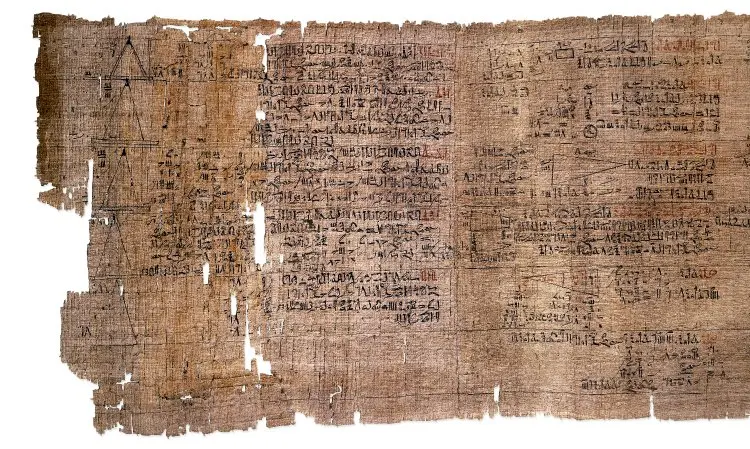
- The Rhind papyrus: Wikipedia, “Rhind Mathematical Papyrus” (copied by the scribe Ahmes about 1550 BC, now in the British Museum) and “Egyptian fraction” (fractions written as sums of fractions with 1 on top), read November 2026.
- Note values: Wikipedia, “Note value” (in 4/4 time, a whole note is 4 beats, a half note 2, a quarter note 1), read November 2026.
A companion to your textbook, not a replacement for it: study from the book your school uses, and where the two differ, follow your teacher. Found a mistake? Please tell us.