
You are at a school event. Your best friend is on your left, and your cousin is on your right. They have never met. Everyone is waiting for you to say something. What do you say, and who do you name first?
This unit is about introducing other people. You will read the life story of a famous poet, T. S. Eliot, and learn how a biography is built. You will introduce two friends to each other, listen to two children meeting, and practice am, is and are. Then you will read and write a message of congratulations, fill in a school form, and check your capital letters.
Getting started
A. Who are they, and what do they do?
The unit opens with four pictures of people at work or on the move.
- A man sits on a low stool, sawing a plank of wood. Nails, a hammer and a set square lie on the floor around him.
- A man in a white coat holds a stethoscope to a boy lying in bed.
- Three children in school uniform, with bags on their backs, walk along a path towards a school building.
- A young man in a running vest with the number 5 runs on a red track.
Look at the pictures and say who they are and what they do.
Model answers
When we say what someone does, we use the present simple, with an -s for one person: A carpenter makes furniture. A doctor treats patients. You learned this in Grade 5.
Which sentence says what a teacher does?
Pick an answer to see why.
B. Listen and sing
The song is a list of jobs, two or three in each line, each with the thing that person does. Here are the jobs it names, with what each one does in the song.
| Job | What they do |
|---|---|
| writer | writes |
| poet | writes poems (the song says sings: a poem is close to a song) |
| painter | paints beautiful things |
| doctor | heals: makes sick people well |
| lawyer | appeals: asks a court to change its decision |
| pilot | flies planes |
| teacher | teaches |
| driver | drives |
| actor | brings characters (the people in a play or film) to life |
| player | plays |
| dancer | dances |
| merchant | sells goods (a merchant is a trader) |
The last verse turns the song around. All these people keep busy, or stroll about at their ease. But whatever they do, and whatever happens to them, every one of them eats food that a farmer grew. Without the farmer’s work, no one else could work at all.
The song uses one old word: befall, which means happen to someone (usually something bad).
What does a merchant do?
Pick an answer to see why.
C. Introduce someone you like
Who do you like most? Introduce him or her to your class.
Hint
A model answer
Reading I: T. S. Eliot
Before you read
What does a poet do?
A model answer
Can you name some Nepali poets?
A model answer
Who is the man in the picture?
Answer
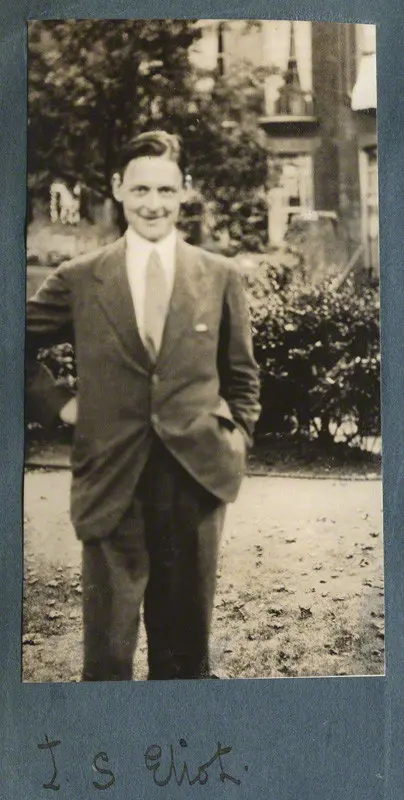
What kind of text is it?
The text is a biography: the story of a real person’s life, written by someone else. (When you write the story of your own life, it is an autobiography.)
A biography usually tells a life in time order: when and where the person was born, their family and school, their work, the honors they won, and when they died. That is why it is full of dates. Because the person lived in the past, most of it is in the past simple: was born, studied, wrote, died.
The text, part by part
1. Who he was. The first paragraph says what Eliot was best known for: he was a poet, a playwright (a writer of plays) and a literary critic (someone who writes about books and judges how good they are). He was born in America but lived in England, so he is called “American-born”. His full name was Thomas Stearns Eliot. He was born on 26 September 1888 in St. Louis, a city in the state of Missouri, USA. His parents were Henry Ware Eliot and Charlotte Champe Stearns.
2. School and college. From 1898 to 1905, he went to Smith Academy in St. Louis, the school of Washington University that prepared boys for college. He learned four languages there: Latin, ancient Greek, French and German. He started writing poems at fourteen. His first poem to be printed, A Fable for Feasters, began as a school exercise and appeared in the school magazine, the Smith Academy Record, in February 1905. Then he studied philosophy (the study of big questions about life, truth and right and wrong) at Harvard, a university near Boston. He finished his first degree, a B.A., in 1909 and his M.A. the next year, and he worked as a philosophy assistant there in 1909–10. By 1916 he had finished his PhD thesis (a long piece of research) for Harvard.
3. Childhood and faith. As a child, Eliot had a hernia, a weak place in the muscles of the belly, so he couldn’t run and play like other boys, and he spent his time with books. His parents hired an Irish nurse, Annie Dunne, to look after him. She was a Catholic, and she sometimes took him to her church. Some of his biographers think this is where his interest in religion began. Stories from the Bible, myths and religious teachings fill his later writing.
4. His works. Eliot changed the way poems were written in English. His poems didn’t rhyme neatly or tell a simple story; they jumped between voices and pictures, like modern life. This new style is called modernism. His first famous poem, The Love Song of J. Alfred Prufrock, is called a masterpiece: a very fine piece of work. His other best-known poems are Gerontion (1920), The Waste Land (1922), The Hollow Men (1925), Ash Wednesday (1930), Old Possum’s Book of Practical Cats (1939) and Four Quartets (1943). He also wrote seven plays; the text names three: The Rock (1934), Murder in the Cathedral (1935) and The Cocktail Party (1949).
5. Honors and death. In 1948 he received two great honors: the Order of Merit from the British king, and the Nobel Prize in Literature. He died in London on 4 January 1965. He left a landmark in English poetry: a turning point that changed what came after it.
Where was T. S. Eliot born?
Pick an answer to see why.
Why is Eliot called an “American-born English poet”?
Pick an answer to see why.
Words from the text
Words linked here open in English Vocabulary, where you can practice them in a game.
| Word | Meaning |
|---|---|
| playwright | a person who writes plays (dramas). The wright is an old word for a maker, as in shipwright, so it isn’t spelled write. |
| literary | about literature: books, poems and plays |
| critic | a person who judges books, films or art and writes about them |
| preparatory | getting someone ready for something (a preparatory school gets pupils ready for college) |
| philosophy | the study of big questions: what is true, what is right, what we can know |
| hernia | a weak place in a muscle wall, where a part inside pushes out |
| inclination | a feeling that makes you want to do something, or lean towards it |
| masterpiece | an outstanding piece of work, the best of its kind |
| adopt | to take up and follow a belief or a way of life (it also means taking a child into your family) |
| landmark | an event or work that marks an important change in history (also a building you can see from far away) |
| stirring | causing strong feelings; moving people to act |
| pass away | to die (a gentle, polite way to say it) |
A. Find the words
Find the words in the text which mean the following.
- a.a person who writes drama or plays
- b.an outstanding piece of work
- c.followed
- d.an event marking a unique or important historical change
- e.died
Answer
B. Eliot’s life in a table
Read the text again and complete the table about Eliot’s life with correct information.
| Year | Incident |
|---|---|
| 1888 AD | ……… |
| 1905 AD | ……… |
| 1909 AD | ……… |
| 1916 AD | ……… |
| 1948 AD | ……… |
| 1965 AD | ……… |
Hint
Answer
C. Answer the questions
Where was T. S. Eliot born?
Answer
Where did he take his higher education?
Answer
What problem did he face in his childhood?
Answer
What made him inclined towards Catholicism?
Answer
What was Eliot’s first publication?
Answer
List the awards he got.
Answer
D. Eliot’s literary works
Read the text again and make a list of Eliot’s literary works.
Hint
Answer
Speaking: introducing others
In Grade 5, you learned to introduce yourself: Hi, I’m Kriti. Now you will introduce two people to each other. You are in the middle: you know both of them, but they don’t know each other.
Three steps make a good introduction:
- Name one person to the other, and say one or two things about them: where they live, what they do.
- Do the same the other way round, so each one hears the other’s name.
- Let them greet each other: Nice to meet you. Nice to meet you too.
A. Act out the conversation
The picture shows three young people. A girl in a pink headscarf holds her friend Sonam’s arm and introduces her to a boy, Tilak.
- First she tells the girl who the boy is: his name is Tilak, he lives in Achham and he plays volleyball.
- Then she tells Tilak who the girl is: her name is Sonam, she lives in Helambu and she is an actor.
- Sonam greets Tilak with hi and says she is glad to meet him. Tilak says hi back, with the same words and too at the end.
Achham is a district in Sudurpashchim Province, in the far west. Helambu is a valley of Sherpa and Hyolmo villages in Sindhupalchok, north of Kathmandu. So Tilak and Sonam live at two ends of the country.
B. Expressions for introducing
Here are the book’s expressions in two groups: what the person in the middle says, and how the two new friends answer.
| To introduce two people | To answer |
|---|---|
| Ritesh, please meet Sarita. | Nice to meet you. |
| Ritesh, have you met Sarita before? | Pleased to meet you. |
| I’d like you to meet Nitesh. | How do you do? |
| I’d like to introduce you to Lakpa. | Happy to meet you. |
| Sabir, this is Karina. Karina, this is Sabir. |
Some of these are formal: polite and careful, for teachers, guests, older people and offices. Others are informal: easy and friendly, for friends and classmates.
- Formal: I’d like to introduce you to … · I’d like you to meet … · How do you do? · Pleased to meet you.
- Informal: Ritesh, this is Karina. · Have you met Sarita? · Nice to meet you. · Happy to meet you.
You want to introduce your friend Pratik to your head teacher. What do you say?
Pick an answer to see why.
Someone says to you, “How do you do?” What do you answer?
Pick an answer to see why.
Make a group of three and introduce each other. Use the expressions in the table.
A model (three classmates, Shristi, Abinash and Diya)
Listening
A. Before you listen
The picture shows a girl and a boy in school uniform, facing each other with their palms pressed together.
Look at the picture and answer these questions.
- a.What are the children doing in the picture?
- b.Do you do the same? When?
- c.How do you introduce yourself to others?
Model answers
Now listen. Read the questions in B and C first, so you know what to listen for.
B. Choose the best answer
a. Ranjan lives near the ………
Pick an answer to see why.
b. Both Ranjan and Manju read in grade ………
Pick an answer to see why.
c. Manju’s father teaches in a ……… near their home.
Pick an answer to see why.
C. True or false?
a. Manju and Ranjan were already good friends.
Pick an answer to see why.
b. They introduced each other.
Pick an answer to see why.
c. Ranjan’s father is a businessman.
Pick an answer to see why.
d. Both Manju and Ranjan were happy at the end.
Pick an answer to see why.
D. Write about Manju or Ranjan
Now, write about either Manju or Ranjan. Write as much information as you remember.
Model answers
Grammar: am, is and are
A. Sentences from the text
Complete these sentences from the text T. S. Eliot.
- a.T. S. Eliot ……… a great American-born English poet.
- b.His other best-known poems in English ……… Gerontion, The Waste Land and others.
Answer
B. Which one: am, is or are?
The section opens with four pictures: a girl singing into a microphone, two boys playing football, a girl with a school bag, and a bus driver at the wheel. Under them: She is a singer. They are children. She is a student. Mr. Sharma is a driver.
Am, is and are are the three present forms of the verb be. Which one you use depends only on the subject: the person or thing the sentence is about.
| Subject | Verb | Example |
|---|---|---|
| I | am | I am in Grade 6. (I’m) |
| he, she, it, one person or thing | is | Mr. Sharma is a driver. (he’s, she’s, it’s) |
| you, we, they, two or more | are | They are children. You are late! (we’re, you’re, they’re) |
You met these in Grade 5. In Grade 6, the subjects get longer, so find the subject first, then choose:
- Two names joined by and are two people: Pemba and Rojina are cousins.
- A plural noun takes are, even when it doesn’t end in -s: The goats are in the shed. The children are in the hall. These people are from Ilam.
- You always takes are, even for one person: You are my best friend.
- A name or a title is one person: Dr. Yadav is a dentist.
- Be also helps another verb in the present continuous: I am reading a comic. The goats are eating grass.
To make it negative, add not: I am not (I’m not) tired. She is not (isn’t) here. They are not (aren’t) ready. To make a question, put the verb first: Is she a singer? Are they children? You will practice questions in Unit 2.
Kushal and his sister ……… in the same class.
Pick an answer to see why.
Those shoes by the door ……… my brother’s.
Pick an answer to see why.
Which sentence is correct?
Pick an answer to see why.
C. Complete with is, am or are
Complete the sentences with is, am or are.
- a.Shikha and Tanuja ……… good friends.
- b.Sandeep ……… a player. He plays cricket.
- c.I ……… the only child of my parents.
- d.Ms. Singh ……… a teacher. She teaches English.
- e.Ms. Chaudhary works in an office. She ……… an officer.
- f.The cows ……… grazing in the field.
- g.I ……… doing my homework.
- h.These notebooks ……… mine.
- i.This girl acts in movies. She ……… a good actress.
- j.Kaji ……… a farmer. He grows crops.
Answer
Reading II: a message of congratulations
Before you read
Is the following text a letter?
Answer
When do you congratulate people?
A model answer
The message, part by part
The message is short, but each part has a job.
- The heading is one word, Congratulations, with three exclamation marks, so you know at once that it brings good news.
- Who and what for. The school congratulates a girl in Grade 6, Shijan Tharu, for winning an essay-writing competition for the whole of Gandaki Province. The essay’s title was My Parents: My Role Model.
- The prize. She received a cash prize of Rs. 20,000 and a gold medal.
- A kind word. The school calls her a role model for everyone: a person others look up to and want to be like.
- Congratulations again, this time spoken to Shijan herself, for her great achievement.
- Who it is from: the Head Teacher and the whole school family of Saraswoti Secondary School.
Who wrote the message?
Pick an answer to see why.
Words from the message
| Word | Meaning |
|---|---|
| congratulations | words that say you are happy about someone’s success or good luck. Always with -s. |
| competition | an event in which people try to win, and a winner is chosen |
| receive | to get or be given something |
| achievement | something good you have done by working hard |
| role model | a person others admire and want to be like |
| essay | a short piece of writing on one subject |
A. Find the words
Write the words from the text that have the following meanings. The first letter has been given.
- a.an expression of pleasure at the success or good fortune of a person (C …)
- b.an occasion on which a winner is selected from among two or more contestants (C …)
- c.taken something that has been offered (R …)
- d.something that is obtained successfully (A …)
Answer
B. Ask and answer
Ask these questions to your friend. He or she must answer in short.
- a.Who is the winner of the Essay Writing Competition?
- b.In which class does Shijan study?
- c.What is the cash prize for the winner?
Answer
C. Collect messages
Collect any two messages of congratulations from a newspaper or magazine and present them to your class.
Hint
How to present one (an example)
Writing
A. A short biography of Bal Krishna Sama
Here are notes about the playwright Bal Krishna Sama. Your job is to turn them into a short biography, as the Eliot text did. Here is how notes become sentences.
| In the notes | In the biography |
|---|---|
| Date of Birth: Magh 24, 1959 BS | He was born on Magh 24, 1959 BS. |
| Parents: Samar Shamsher… / Kirti Rajya Lakshmi Rana | His parents were … and … |
| Early life: studied in Durbar High School | He studied at Durbar High School. |
| Contribution: wrote many stories, poems… | He wrote many stories, poems … |
| Death: 2038 BS | He died on … |
Three tips:
- Keep the time order: birth, family, school, work, death.
- Use the past simple, because his life is over: was born, studied, wrote, died. Use the present only for what is still true: He is known as one of Nepal’s greatest dramatists.
- Join short facts with and, where or which so the sentences don’t all sound the same.
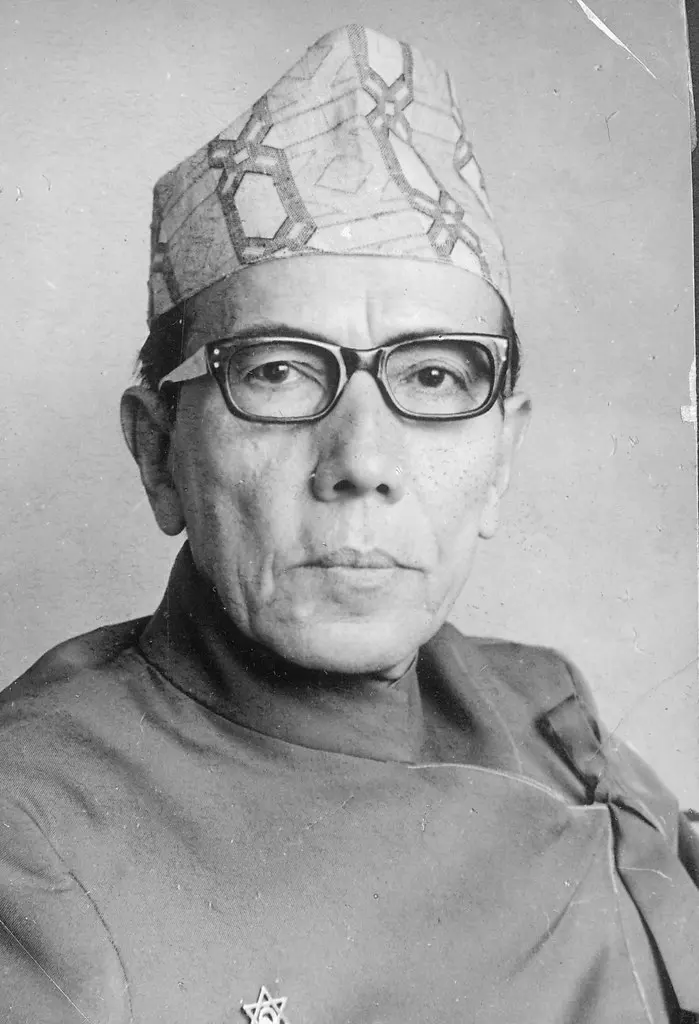
Write a short biography of Bal Krishna Sama using the given clues.
Name: Bal Krishna Sama
Real name: Bal Krishna Shamsher Janga Bahadur Rana
Date of birth: Magh 24, 1959 BS (February 1903)
Birthplace: Gyaneshwor, Kathmandu
Parents: Samar Shamsher Janga Bahadur Rana and Kirti Rajya Lakshmi Rana
Early life: studied at Durbar High School, Rani Pokhari, and I.Sc. at Tri-Chandra College, Ghantaghar
Contribution: wrote many stories, poems, essays, compositions and biographies; known as one of Nepal’s greatest dramatists
Literary works: Mutuko Byatha, Mukunda Indira, Prahlad, Andhabeg, Bhakta Bhanubhakta, Prempinda, Amar Singh, Swasni Manchhe and others
Death: Saun 6, 2038 BS (July 21, 1981)
A model biography
B. A message of congratulations
A message of congratulations has the same parts as Shijan’s: a heading, who and what for, the prize, a kind word, congratulations again, and who it is from. Here is one about a boy who won a quiz. Put each phrase in its place.
Read the message in Reading II again and write a similar message of congratulations. Use these clues: the name of your friend, his or her achievement, the prize won, congratulations, the name of your school.
A model answer
Project work: a registration form
A form is a page with spaces to fill in. Schools, banks, hospitals and offices use forms to collect the same facts from everyone. Before you fill one in, learn what its words mean.
| On the form | What it asks for |
|---|---|
| BLOCK letters | write in CAPITAL LETTERS, each one separate, so anyone can read it |
| Date of birth | the day you were born; in Nepal, often in BS: 2070-11-19 |
| Sex: M F O | circle M (male), F (female) or O (other) |
| Occupation | the person’s job |
| Guardian | the adult who looks after you, if it isn’t your father or mother |
| Current address | where you live now |
| Permanent address | your family’s home place, if it is different |
| Tel | telephone number |
| PHOTO | the box where you stick a passport-size photo |
Read about Yangchen, then fill in the school form for her.
Yangchen Sherpa is joining Grade 6. She was born on 2070-11-19 BS. Her family’s home is in Khumjung, Solukhumbu, where her father, Pasang Sherpa, is a trekking guide and her mother, Dolma Sherpa, runs a tea shop. Yangchen now lives with her uncle, Tenzing Sherpa, in Boudha, Kathmandu. He is a teacher, and he is her guardian.
Extra bit: capital letters
In Grade 5, you learned that a sentence starts with a capital letter, and that names, places and I always take one. Here are the rules in full.
| Use a capital letter for | Examples |
|---|---|
| the first word of a sentence | She has given me a book. |
| names of people | Ramhari, T. S. Eliot |
| names of places: streets, towns, countries, continents, planets | Durbar Marg, Pokhara, Nepal, Asia, Mars, the Earth, the Sun |
| days, months and festivals | Sunday, March, Baisakh, Dashain, Eid |
| titles of books, films and songs (the important words) | War and Peace, Murder in the Cathedral |
| names of institutions: schools, banks, offices | Saraswoti Secondary School, Nepal Rastra Bank |
But not the seasons: *I love winter. The rains come in summer.*
Which sentence is written correctly?
Pick an answer to see why.
Which title is written correctly?
Pick an answer to see why.
Exercise
Practice the whole unit. Try each one, then open the answer.
Introduce these people to each other in two or three sentences.
- a.your friend Kushal and your cousin Ayushma
- b.your mother and your class teacher, Mr. Joshi
Answer
Complete with am, is or are.
- a.My uncle and aunt ……… doctors.
- b.I ……… from Gorkha.
- c.The news on the radio ……… good today.
- d.You ……… always on time.
- e.The students of Grade 6 ……… on a trip.
- f.Everybody ……… happy.
Answer
Rewrite with capital letters where they are needed.
my sister binita was born in jhapa on a monday in july. she reads the kathmandu post every morning, even in winter.
Answer
Turn these notes into two sentences of a biography.
Laxmi Prasad Devkota · born: 1909, Kathmandu · known as: Mahakavi (great poet) · famous work: Muna Madan
Answer
Write a short message of congratulations to your friend Nischal, who came first in the school’s art competition.
A model answer
Printable PDFs
- Study notes 2 pages
- Harder practice questions 2 pages Answer key
Practice every question in the book, and keep track of the ones you miss →
A companion to your textbook, not a replacement for it: study from the book your school uses, and where the two differ, follow your teacher. Found a mistake? Please tell us.