
Put on a pair of polarized sunglasses and look at a lake, a wet road or a phone screen, then tilt your head. The glare on the water fades and comes back; the phone’s screen goes dark at one tilt and bright at another. Nothing about the light’s color or brightness tells you why. The answer is a property of light you can’t see with the naked eye: the direction in which it vibrates.
Interference and diffraction showed that light is a wave. They can’t say what kind of wave: sound, a longitudinal wave, interferes and diffracts too. This unit shows that light’s vibrations are across its direction of travel, so light is a transverse wave, and that they can be sorted, by a filter or by reflection, into a single direction. That sorting is polarization.
13.1 Introduction
Interference and diffraction show that light behaves as a wave: two beams can overlap and cancel or add, and light bends round edges into patterns of bright and dark bands. But every wave does that, longitudinal or transverse.
Polarization is different. It is something only transverse waves can do, so it is strong evidence that light is a transverse wave. In ordinary light the vibrations are across the ray in all directions; in polarized light they are in one direction only. A longitudinal wave, such as sound, vibrates along its direction of travel, so there is nothing across the ray to sort, and sound can’t be polarized.
You have probably met polarization already, without the name:
- Polarized sunglasses cut the glare from water and roads, but not the light from the rest of the scene.
- 3D glasses at the cinema send a different picture to each eye, though both pictures are on the same screen at once.
- Two polarizing filters, one turned against the other, let through less and less light as one of them is turned, until almost none gets through.
All three use the same idea: light vibrates across its path, and we can choose which direction of vibration gets through.
Figure 13.2 shows the activity.
13.2 Polarized and unpolarized light
Light is an electromagnetic wave: an electric field and a magnetic field, at right angles to each other, both vibrating across the direction of travel. The electric field is the part that acts on the electrons in matter, in our eyes, in film, in filters, so the direction of light’s vibration means the direction of its electric field, .
Unpolarized light has vibrations in all directions across the ray, changing at random many millions of times a second. Light from the sun, flames, bulbs and most LEDs is unpolarized: each atom sends out its light with its own direction, and the mixture has no favorite. Sunlight, a candle flame and a tube light all give unpolarized light.
Polarized light (in full, plane-polarized or linearly polarized light) vibrates in one direction only across the ray. It is made by passing unpolarized light through a polarizing filter, or by reflection from a surface such as glass or water at a particular angle. Light from an LCD screen, and the glare reflected from a lake, are polarized (the glare partly, the screen almost wholly).
Between the two is partially polarized light, with more vibration in one direction than in the one at right angles to it. Light from the blue sky and light reflected from shiny non-metal surfaces is usually partially polarized.
Since we can’t draw a wave vibrating in all directions at once, there is a shorthand (Figure 13.3). Looking along the ray, unpolarized light is a star of arrows, all equal. From the side, it is drawn as arrows across the ray (vibration in the page) and dots (vibration in and out of the page), in equal numbers. Polarized light is drawn as arrows only, or dots only.
Polarized light is useful in many ways: polarizing sunglasses and camera filters cut glare; 3D films use it to show each eye its own picture; and scientists use it to study crystals, molecules and strains in materials.
Which of these can’t be polarized?
Pick an answer to see why.
13.3 Polarization of light waves
Polarization is the restricting of the vibrations of light to a single direction across the ray (a single plane through the ray). It can be done with a polarizing filter, by reflection, by scattering, and by some crystals.
The classic way, used since the early 1800s, is a pair of tourmaline crystals (Figure 13.4). Tourmaline is a semi-precious stone, a crystal that lets through light vibrating parallel to one direction in it (its optic axis) and absorbs nearly all the light vibrating at right angles to it.
- Unpolarized light falls on the first crystal, called the polarizer. Only the vibrations parallel to its axis get through, so the light leaving it is plane-polarized. To the eye it looks the same, only dimmer (about half as bright, plus the crystal’s own tint).
- A second crystal, the analyzer, is placed after the first, with its axis parallel to the first one’s. The polarized light vibrates along its axis, so it passes.
- Now turn the analyzer slowly about the ray. Less and less light gets through, until, with its axis at 90° to the polarizer’s (crossed), no light comes through at all.
- Keep turning: the light returns, and is brightest again at 180°.
The light leaving the polarizer looks just like ordinary light. Only the analyzer, turned, shows that it is different. This is why the second filter is called the analyzer: it tells whether light is polarized, and in which direction. Unpolarized light through one turning crystal gets through equally at every angle.
Malus’s law
How much light gets through the analyzer at an angle in between? Malus found the rule in 1809. If polarized light of intensity falls on an analyzer whose axis is at an angle to the light’s direction of vibration, only the part of the electric field along the axis, , gets through. Intensity goes as the square of the amplitude, so the light let through is
This is Malus’s law. At all the light passes; at , none; at , half ().
For unpolarized light falling on a single polarizer, the direction of vibration takes every angle equally, and the average of over all angles is . So an ideal polarizer lets through exactly half of unpolarized light, whichever way it is turned, and stops the other half.
13.4 Plane of vibration and plane of polarization
Polarized light vibrates in one direction across the ray. Two planes through the ray are named from it (Figure 13.5):
- The plane of vibration is the plane that contains the direction of vibration (the electric field ) and the direction of travel of the light. The light vibrates in this plane.
- The plane of polarization is the plane that contains the direction of travel and is perpendicular to the plane of vibration. There is no vibration in it.
So the two planes both contain the ray, and they are at right angles to each other.
13.5 Polarization by reflection: Brewster’s law
In 1808, Malus discovered that light reflected from a transparent surface such as glass or water is partially polarized, and that how strongly depends on the angle of incidence. In 1815 the Scottish physicist David Brewster (1781–1868) found, by measuring many materials, that at one particular angle the reflected light is completely plane-polarized, and that at this angle the reflected and refracted rays are at right angles to each other. The angle is the polarizing angle, or Brewster’s angle, .
Why does reflection polarize light? Unpolarized light falling on the surface can be thought of as two equal parts (Figure 13.6): one vibrating perpendicular to the plane of incidence, along the surface (drawn as dots), and one vibrating in the plane of incidence (drawn as arrows). The reflected ray is sent out by the electrons in the glass, set vibrating by the refracted light. An electron can’t send light out along its own direction of vibration. At Brewster’s angle the reflected ray is at 90° to the refracted ray, so it lies exactly along the direction in which the “arrow” vibrations in the glass move the electrons: that part can’t be reflected at all. Only the “dot” part, vibrating along the surface, is reflected. The reflected light is completely polarized, vibrating parallel to the surface. The refracted light keeps all of the arrow part and most of the dot part: it is partially polarized.
Brewster’s law
Let unpolarized light AO fall at O on the surface of a transparent medium of refractive index , at the polarizing angle (Figure 13.6). It is refracted along OC at the angle , and reflected along OB, completely polarized.
- By Snell’s law,
- At the polarizing angle, the reflected and refracted rays are at right angles. The angle of reflection is , so along the surface , that is,
- Put this in (13.1): , so
The refractive index of a medium equals the tangent of its polarizing angle. This is Brewster’s law. For glass (), ; for water (), 53.1°.
If the light goes from a medium of refractive index into one of , the same steps give (the refractive index of the second medium relative to the first, ).
Uses of Brewster’s law
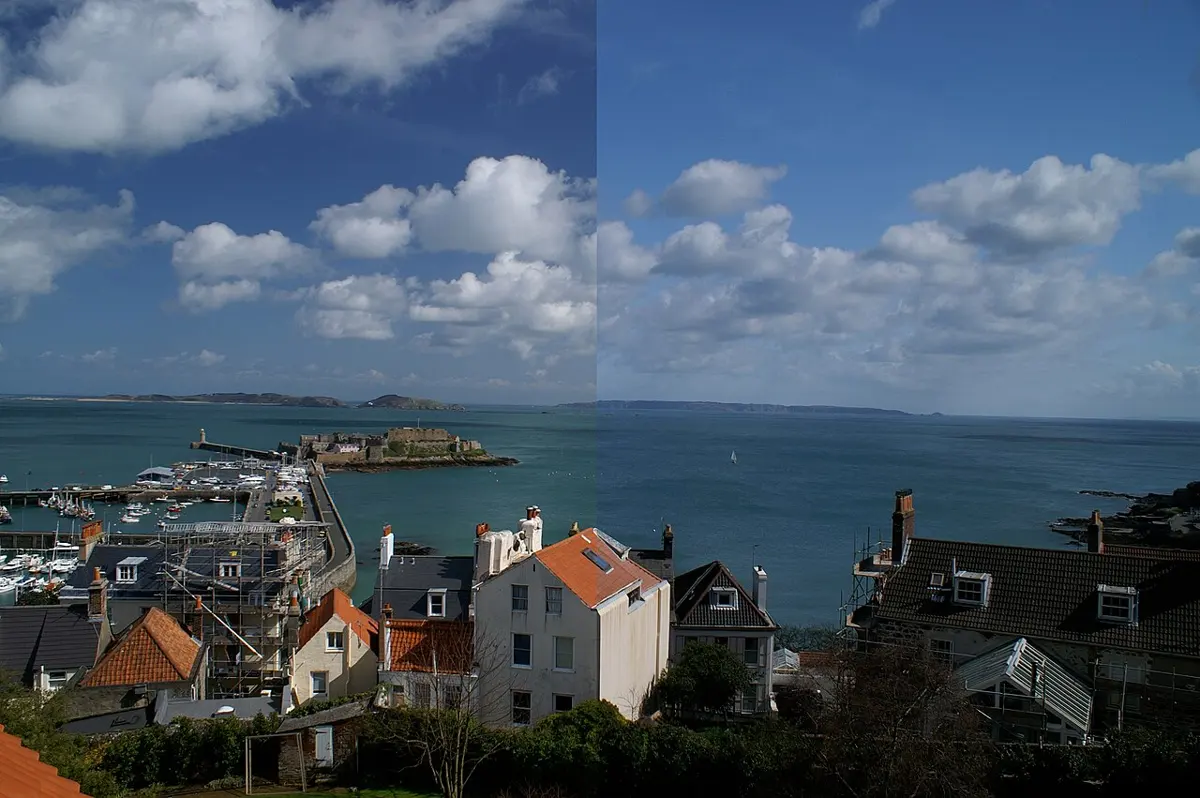
- Polarizing sunglasses and filters. Glare from water, roads and windows is reflected light, strongly polarized along the surface (horizontally, for a lake or a road). Polarized sunglasses have their transmission axis vertical, so they block the glare but let through the rest of the scene.
- Photography. A polarizing filter on a camera, turned to the right angle, removes reflections from water and shop windows, and darkens a blue sky.
- Lasers. The windows at the ends of a gas laser’s tube are set at Brewster’s angle: light vibrating in the plane of incidence passes them with no loss by reflection at all, so the laser builds up that light, and its beam comes out polarized.
- Measuring refractive index. Finding the angle at which reflected light is completely polarized gives , even for an opaque material that light can’t be sent through.
- Studying surfaces. How light reflected from a surface is polarized shows the thickness of thin films on it, such as an oxide layer on a silicon chip.
Light reflected from a lake at Brewster’s angle is completely polarized. In which direction does it vibrate?
Pick an answer to see why.
13.6 Polaroids
A Polaroid is a thin plastic sheet that polarizes light, invented by the American Edwin Land in 1929 (as a student, aged 19) and improved by him in 1938 into the H-sheet still used today. Unlike a tourmaline crystal, it can be made cheaply in large sheets of any size.
An H-sheet is made from a film of polyvinyl alcohol (PVA), a plastic whose molecules are long chains. The film is warmed and stretched, which lines up its long chains in one direction, and then dipped in iodine. The iodine sticks along the chains, making them conduct electricity along their length, like millions of tiny parallel wires (Figure 13.8).
When light falls on the sheet:
- The part of the electric field parallel to the chains drives electrons along them. It loses its energy to them and is absorbed.
- The part perpendicular to the chains can’t move the electrons far across a chain, so it passes through.
So the light that comes out is plane-polarized, vibrating at right angles to the chains. That direction is the sheet’s transmission axis (its pass axis). A polaroid lets through about 40 % of unpolarized light: less than the ideal 50 %, because it absorbs a little of the light it is meant to pass. Its slight gray tint comes from that.
Uses of polaroids
- Sunglasses with vertical transmission axes, to cut horizontally polarized glare from water, snow and roads.
- Camera filters, to remove reflections and darken the sky.
- 3D films. The two pictures, for the left and right eye, are projected through polarizing filters of different kinds onto a screen that keeps polarization; each lens of the glasses lets through one picture only.
- LCD screens (phones, calculators, watches): the liquid crystal sits between two polaroids and turns the light’s plane of vibration, or doesn’t, pixel by pixel; the second polaroid turns that into light and dark.
- Optical instruments: polarizing microscopes show the structure of rocks, crystals and fibers in bright colors.
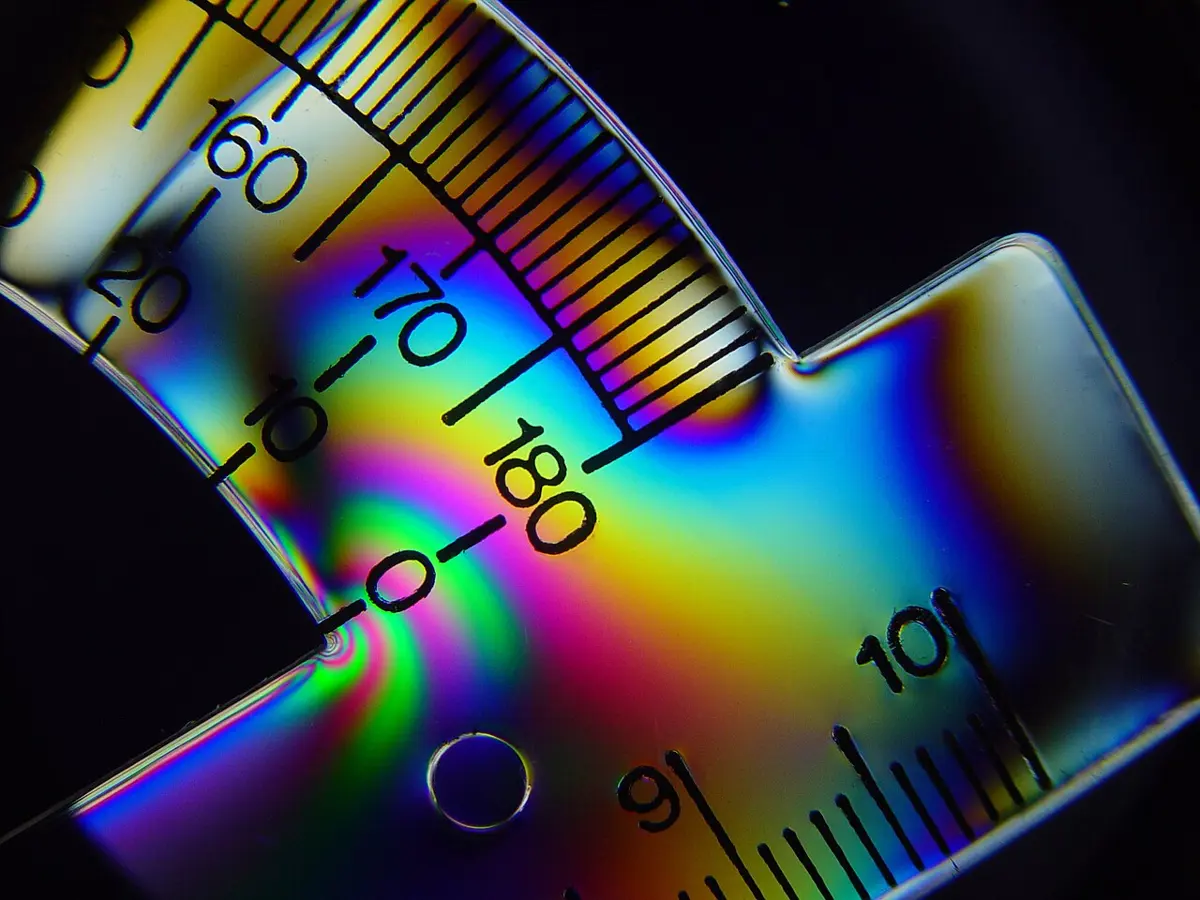
- Stress analysis (photoelasticity): a clear plastic model of a part, between crossed polaroids, shows colored fringes where it is strained, so engineers can see where it would break.
- Window glass that controls how much light comes in (two polaroids, one turned).
Double refraction and optical activity
Two more effects of polarized light are worth knowing: calcite’s double refraction (question 19) and optical activity (question 10) come up in the exercise, and both in any further study of light.
Double refraction
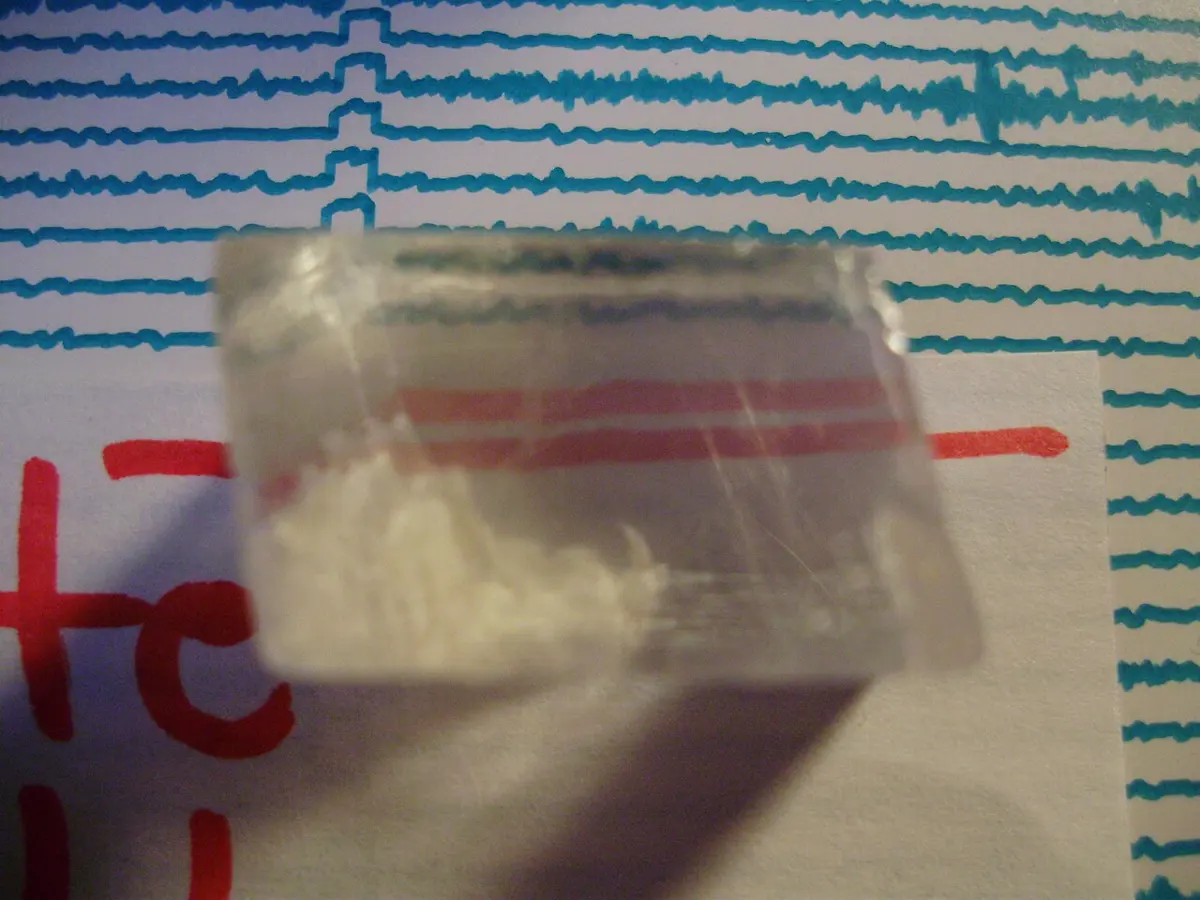
Some crystals, such as calcite (Iceland spar, Malus’s crystal) and quartz, split a ray of light into two rays, refracted by different amounts. Look through a clear calcite crystal at a line of print and you see it twice. This is double refraction, or birefringence.
- One ray obeys Snell’s law with a fixed refractive index (1.66 in calcite): the ordinary ray, or o-ray.
- The other has a refractive index that depends on its direction in the crystal (1.49 to 1.66 in calcite), and doesn’t obey Snell’s law in general: the extraordinary ray, or e-ray.
Both rays are plane-polarized, with their vibrations at right angles to each other. Turn an analyzer in front of the crystal and one image fades as the other brightens, just as Malus saw. A Nicol prism, two pieces of calcite cemented so that one ray is reflected out of the way, was the standard way to polarize light for a century before polaroids.
Optical activity
Some substances turn the plane of vibration of polarized light passing through them. They are called optically active, and the property optical activity. Quartz does it, and so do solutions of many substances whose molecules come in left- and right-handed forms, such as sugar: cane sugar turns the plane to the right (clockwise, looking towards the source), fructose to the left.
The angle turned is proportional to the length of the solution the light passes through and to its concentration, so measuring it (with a polarimeter: polarized light, the tube of solution, and an analyzer turned until the light is darkest) gives the concentration of sugar in a solution. Sugar factories and laboratories testing medicines use it. The angle for a 1 dm tube and a concentration of 1 g/mL is the substance’s specific rotation.
Exercise
Choose the correct option
- What is polarization of light?
Pick an answer to see why.
- Which material is used as a polarizing filter?
Pick an answer to see why.
- In how many directions does plane-polarized light vibrate?
Pick an answer to see why.
- What happens to the transmitted light when the angle between the axes of two polarizers is 90°?
Pick an answer to see why.
- What happens at Brewster’s angle?
Pick an answer to see why.
- What is the angle of incidence for which reflected light is completely polarized at an air–glass surface, if the glass has a refractive index of 1.49?
Pick an answer to see why.
- When reflected light is completely polarized at an air–glass surface, what is the angle between the reflected light and the refracted light?
Pick an answer to see why.
- What is one application of polarization?
Pick an answer to see why.
- Which wave can’t be polarized?
Pick an answer to see why.
- What is the property of turning the plane of polarization called?
Pick an answer to see why.
- What is the polarizing angle of a crystal whose critical angle is 45°?
Pick an answer to see why.
- What percentage of the intensity of unpolarized light is not transmitted by an ideal polarizing sheet?
Pick an answer to see why.
Answer these questions
Polarization is an important property of light waves: it shows that they are transverse, and has practical uses in optics.
- a.Define polarization of light.
- b.Differentiate between polarized and unpolarized light, with one example of each.
- c.A light ray falls on a glass surface at Brewster’s angle, so the reflected ray is completely polarized and the reflected and refracted rays are at 90°. If the angle of refraction is 33.7°, calculate the refractive index of the glass and the angle of incidence.
Answer
Polarization of light shows that the direction of light’s vibrations can be controlled, especially by reflection at particular angles.
- a.What is plane-polarized light?
- b.Explain polarization by reflection, with a suitable diagram.
- c.Light falls on a surface so that the angle between the reflected and refracted rays is 90°. If the angle of incidence is 56°, calculate:
- i.the refractive index of the medium,
- ii.the speed of light in that medium (take m/s).
Answer
Polaroids are optical devices that analyze and control the polarization of light, with important uses in reducing glare and improving contrast.
- a.What are Polaroids?
- b.Mention two practical applications of Polaroids in optics.
- c.Unpolarized light passes through two Polaroid sheets, one after the other.
- i.What happens to the intensity after the first Polaroid? Explain.
- ii.What happens if the second Polaroid’s axis is perpendicular to the first? Why?
- iii.Describe what happens as the second Polaroid is slowly turned from perpendicular to parallel to the first. How does this show polarization?
Answer
When light is reflected at a particular angle, known as Brewster’s angle, the reflected beam is completely polarized. This has important uses in optics.
- a.State Brewster’s law and derive it.
- b.Using a diagram, explain why light reflected at Brewster’s angle is completely polarized.
- c.State two practical uses of polarization in everyday life or technology.
Answer
Figure 13.11 shows light reflected and refracted at the boundary between a denser and a rarer medium.
- a.Define Brewster’s angle and state its significance.
- b.Using the figure, explain why reflected light is completely polarized at Brewster’s angle.
- c.If the refractive index of the denser medium is 1.5, calculate Brewster’s angle.
- d.Unpolarized light falls on a glass slab so that the reflected light is completely polarized. If the refractive index of the glass is 1.66, calculate:
- i.Brewster’s angle,
- ii.the angle between the reflected and refracted rays,
- iii.the speed of light in the glass.
Answer
A ray of light passes from a denser medium into a rarer medium, falling at an angle of incidence . The reflected and refracted rays are at 90° to each other (Figure 13.12). The angles of reflection and refraction are and .
- a.Find the critical angle of the denser medium.
- b.Define plane-polarized light and differentiate it from unpolarized light.
- c.Explain, using the vibrations of the electromagnetic wave, why the reflected light is completely polarized.
Hint
Answer
Certain anisotropic materials, such as calcite, show double refraction, splitting a beam of light into two rays; this shows that light waves are transverse.
- a.Explain polarization of light and its importance in wave optics.
- b.State and explain Brewster’s law.
- c.Describe a simple experiment that shows the transverse nature of light.
- d.What are Polaroids, and how are they used to make polarized light?
- e.Unpolarized light falls on a transparent surface at the polarizing angle. If the refractive index of the material is 1.5, calculate the polarizing angle.
Answer
Printable PDFs
- The unit as a book (A5) 16 pages Answers as an A4 booklet, 4 sheets
- Study notes 3 pages
- Worksheet 4 pages Answer key
- Harder practice questions 2 pages Answer key
Quiz yourself: Energy, Heat, Light and Sound, Grades 5–12 →
Practice every question in the book, and keep track of the ones you miss →
A companion to your textbook, not a replacement for it: study from the book your school uses, and where the two differ, follow your teacher. Found a mistake? Please tell us.