
Look at any building going up in Nepal, from a two-room house in a hill village to a tower in Kathmandu, and you will find the same gray powder in bags of 50 kg: cement. Mixed with sand, gravel and water it becomes concrete, the most used material on Earth after water. Every year the world makes about four billion tonnes of cement, half a tonne for every person alive.
Cement is also chemistry on a giant scale. Limestone and clay are heated until they partly melt, at almost 1500 °C, and new compounds form that did not exist in the rocks; ground to powder, these compounds react with water and set into artificial stone. This unit is about what cement is made from, how a cement plant turns rock into powder, the two cements you see on the bags in every hardware shop, OPC and PPC, and Nepal’s own cement industry, the country’s biggest.
19.1 Introduction
How do highways and tall buildings stay standing for decades? The bricks of a wall are held firmly together by a substance used in almost every kind of building. It is a gray powder when dry, and when mixed with water it sets into something like rock. You may have seen it near your school, by the roadside or on a building site. This substance is cement.
Cement is a fine, gray powder made by heating limestone, clay and other minerals together and grinding the product; mixed with water, it sets and hardens and binds other materials together, so it is the binder in mortar and concrete.
19.2 Raw materials for cement production
Good cement needs a precise mix of four things: calcium (from limestone), silica, alumina and iron oxide (from clay or shale), plus gypsum as a setting regulator. Small amounts of corrective materials fine-tune the chemical composition. The raw materials are grouped as:
- Calcareous materials: rich in lime, as calcium carbonate: limestone, chalk, marl.
- Argillaceous materials: rich in clay, supplying silica and alumina: clay, shale, slate.
- Corrective materials: minor parts that adjust the raw mix so the right clinker forms: iron ore, bauxite.
- Alternative raw materials: materials added to improve some qualities of cement, recycle industrial waste and lessen cement’s harm to the environment: fly ash (from coal power stations), blast-furnace slag (from steel works) and gypsum. Gypsum goes in at the very end, ground with the clinker, as the setting regulator; it never goes through the kiln.
What each brings, with the share it makes of the finished cement:
- i.Limestone (calcium carbonate, CaCO₃): supplies calcium, as lime (CaO), which makes 60–67% of cement and forms the calcium silicates. Limestone is the most important raw material: in the raw mix fed to the kiln it is by far the largest part, about three-quarters, since it loses almost half its mass as CO₂ in the kiln.
- ii.Clay or shale: supplies silica (SiO₂), alumina (Al₂O₃) and iron oxide (Fe₂O₃), all needed to form clinker; together these oxides make roughly 20–30% of cement, silica most of it.
- iii.Gypsum (CaSO₄·2H₂O), 3–5%, ground in with the clinker: regulates the setting time by controlling how fast the cement reacts with water.
- iv.Bauxite (alumina, Al₂O₃), 0–2%: tops up the alumina for a particular kind of cement, since alumina affects its properties.
- v.Magnesium oxide (MgO), 0.1–4%: comes in with the limestone. A little adds hardness, but it is kept low because too much slowly reacts with water after the concrete has set, swells, and cracks it.
- vi.Alkali oxides (Na₂O, K₂O), 0.3–1.5%: lower the temperature at which the mix melts during clinker formation, but are kept low because too much causes efflorescence (white salty patches on walls) and harms durability.
- vii.Alternative materials (fly ash, slag): typically 5–10% in ordinary cement, and much more, 15–35%, in a blended cement such as PPC. They recycle industrial waste, lessen the harm to the environment, and improve strength and durability. Blast-furnace slag is used because it is latent hydraulic: ground fine, it sets slowly with water by itself once something alkaline sets it off, and cement provides that.
Which raw material supplies most of the calcium oxide in cement?
Pick an answer to see why.
19.3 Steps involved in cement production
Cement production in general has four steps.
1. Crushing and grinding. Limestone, clay and sometimes iron ore are dug from quarries and broken into small pieces in crushers, then ground in mills to a fine powder. This powdered mixture is the raw meal, kept in silos until it goes to the kiln.
2. Blending. The raw meal must have exactly the right chemical make-up to give good cement. It is mixed thoroughly in blending silos by compressed air or mechanical mixers; samples are analyzed continuously, and the proportions of the key oxides, CaO, SiO₂, Al₂O₃ and Fe₂O₃, are corrected.
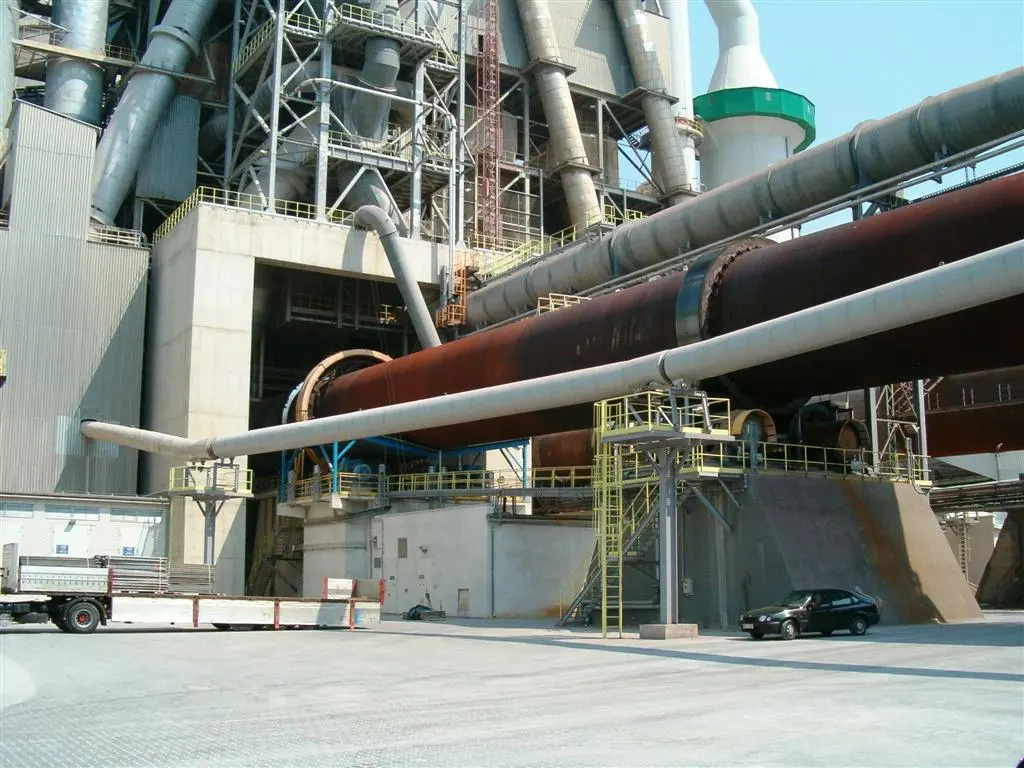
3. Burning (calcination and clinker formation). The blended raw meal is fed into a rotary kiln: a long steel tube lined with fire bricks, a few meters across and 50 to over 100 meters long, sloping gently and turning slowly, with a flame of coal or other fuel at its lower end. The meal is heated to 1400–1500 °C, and as it moves towards the flame it changes:
- Water evaporates from the raw meal.
- Calcium carbonate breaks down into calcium oxide and carbon dioxide, calcination:
\ce{CaCO3(s) ->[\pu{\text{800–900 °C}}] CaO(s) + CO2(g)}
- Calcium oxide reacts with silica, alumina and iron oxide to form new compounds. Cement chemists write CaO as C, SiO₂ as S, Al₂O₃ as A and Fe₂O₃ as F, so the compounds have short names:
The four products are dicalcium silicate, C₂S (belite); tricalcium aluminate, C₃A; tricalcium silicate, C₃S (alite); and tetracalcium aluminoferrite, C₄AF.
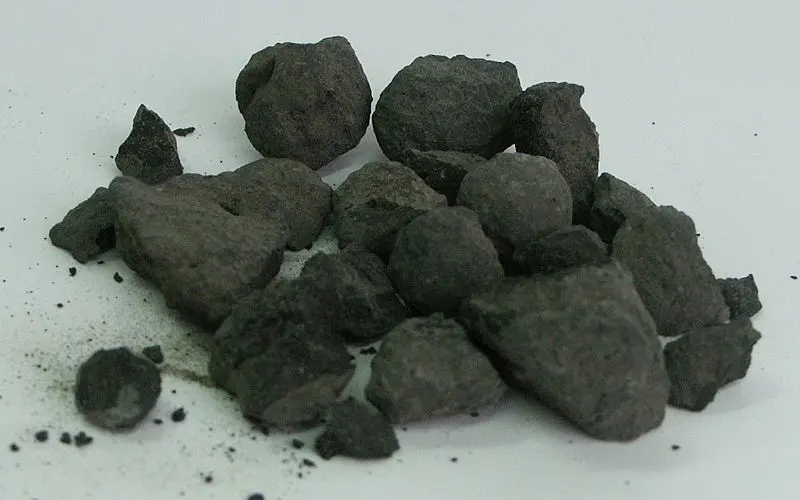
These compounds come out of the kiln as small, hard, dark gray lumps called clinker, the intermediate product of cement.
The kiln is built as a long, sloping tube for a reason: the raw meal and the hot gas move in opposite directions (countercurrent). The meal slides down towards the flame and meets hotter and hotter gas; the gas leaving the kiln, still hot, warms the fresh meal in the preheater on its way out. Little heat is wasted, and each reaction happens in its turn.
4. Final grinding (finish grinding). The clinker is cooled and ground in a cement mill (a ball mill or roller press) with 3–5% gypsum. The gypsum controls the setting time: without it, the tricalcium aluminate would react with water almost at once and the cement would stiffen within minutes (flash setting), too fast for builders to use. The finished cement is stored in silos, then packed into bags or carried in bulk.
Why is gypsum ground in with the clinker?
Pick an answer to see why.
How cement sets and hardens
Mixed with water, the clinker compounds hydrate: they react with water to form new compounds, which grow as tiny interlocking needles and sheets and glue the sand and gravel together. The most important product is a jelly-like calcium silicate hydrate, written C–S–H, which gives concrete its strength:
Cement chemists write these more briefly, with C for CaO, S for SiO₂ and H for H₂O: 2C₃S + 6H → C₃S₂H₃ + 3CH, and 2C₂S + 4H → C₃S₂H₃ + CH, where CH is calcium hydroxide.
These reactions give out heat (the heat of hydration). Tricalcium silicate reacts in hours and days, giving early strength; dicalcium silicate reacts over weeks and months, giving later strength. So concrete keeps getting stronger for a long time, and is usually tested at 28 days. It hardens because of a chemical reaction, not by drying: concrete must be kept wet (cured) for the first week or two, or the reaction stops for want of water. That is why builders splash water on a new roof slab every day.
OPC and PPC cement
Not all cement is the same: by composition and properties it is sorted into types. The two used most in building are Ordinary Portland Cement (OPC) and Portland Pozzolana Cement (PPC), each chosen for what the work needs.
1. OPC (Ordinary Portland Cement). The most widely used cement in building. It is clinker (made from limestone and clay) ground with gypsum; mixed with water, it sets and hardens fairly fast. With its high strength and quick setting, OPC suits general construction such as pavements, buildings and bridges, where early strength matters. It comes in grades 33, 43 and 53: the number is its compressive strength in N/mm² (MPa) at 28 days, measured on standard cubes of cement mortar. Grade 43 is the usual one for general construction; grade 53 for work needing high strength, such as prestressed concrete.
2. PPC (Portland Pozzolana Cement). A variety of OPC: OPC clinker and gypsum ground with a pozzolana, usually fly ash (in the standards, 15–35% of the cement), or volcanic ash. A pozzolana is a material rich in reactive silica that does not set with water by itself, but reacts slowly with the calcium hydroxide that cement releases as it sets, forming more calcium silicate hydrate:
So the weak, soluble calcium hydroxide, which water and chemicals can attack, is turned into the strong binder, and the concrete becomes denser, stronger in the long run and more resistant to chemicals, moisture and cracking. PPC releases less heat while setting, so it suits massive work such as foundations, bridges and dams, and long-lasting structures.
Features of OPC and PPC
| Feature | OPC | PPC |
|---|---|---|
| Raw materials | limestone, clay (as clinker) and gypsum | OPC clinker, gypsum and pozzolanic materials (fly ash, volcanic ash) |
| Composition | mainly Portland clinker (rich in calcium silicates) with gypsum | less clinker, with gypsum and the pozzolana |
| Properties | high early strength, more heat of hydration, faster setting; can be less durable in harsh conditions | lower early strength, less heat of hydration, slower setting; better long-term durability and resistance to chemical attack; often better workability |
| Common use | structures needing early strength: high-rise buildings, bridges, roads, precast and prestressed work | general building, mass concrete (dams, foundations), hydraulic and marine works, plastering, masonry, aggressive surroundings |
| Cost | generally dearer: more clinker | often cheaper: fly ash, a by-product, replaces clinker |
| Manufacture | more energy, as more clinker is made | less energy: less clinker is made |
| Eco-friendliness | less: more CO₂ from making clinker, more natural resources used | more: uses industrial by-products, emits less CO₂, saves natural resources |
| Strength | high early strength (especially grades 43 and 53) | lower early strength, but equal or higher strength in the long run |
| Setting time | generally faster | generally slower |
| Durability | good in general conditions, but less resistant to some chemical attacks | generally more durable, especially against sulphate and chloride attack; less permeable |
| Workability | may need more water for the same smoothness | usually better, thanks to the fine, round fly-ash particles |
| Heat of hydration | more heat while setting, which can crack mass concrete | less heat, so better for mass concrete |
| Grades | sold in grades: OPC 33, OPC 43, OPC 53 | not sold in grades; must meet one minimum strength |
A dam is being built with a huge volume of concrete. Which cement suits it best, and why?
Pick an answer to see why.
19.4 Manufacture of Portland cement with flow sheet diagram
Portland cement (here, OPC) is the most widely used cement in the world, the basic ingredient of concrete, mortar, plaster and many other building materials. It was patented in 1824 by Joseph Aspdin, a bricklayer of Leeds in England, who named it after Portland stone, a building stone from England that set concrete looked like.
The typical composition of ordinary Portland cement is:
| Compound | Formula | Share (%) | What it does |
|---|---|---|---|
| Tricalcium silicate | 3CaO·SiO₂ (C₃S) | 45–60 | sets in hours and days: gives early strength |
| Dicalcium silicate | 2CaO·SiO₂ (C₂S) | 15–30 | reacts slowly: strength gained in later weeks and months, long-term durability |
| Tricalcium aluminate | 3CaO·Al₂O₃ (C₃A) | 6–12 | reacts fastest: the first stiffening and much of the early heat of hydration |
| Tetracalcium aluminoferrite | 4CaO·Al₂O₃·Fe₂O₃ (C₄AF) | 6–10 | gives cement its gray color, a little strength; lowers the melting point in the kiln |
| Gypsum | CaSO₄·2H₂O | 3–5 | regulates the setting time; prevents flash setting |
| Minor compounds | MgO, Na₂O, K₂O, etc. | < 2 | affect soundness (no swelling later) and other properties |
Portland cement is made by two main methods, the dry process and the wet process. Both make clinker, then grind it with gypsum. In the dry process the raw materials are crushed, dried and ground to a fine powder, the raw meal, which is preheated and fed into the kiln. In the wet process the raw materials are ground with water into a slurry, which is blended and fed into the kiln. After that both are alike, but the dry process uses far less fuel and is better for the environment, so almost every plant today uses it.
Flow sheet: the dry process
The dry process is the most common method today, because it saves energy.
- Raw material crushing. Limestone, clay and other materials are broken into small pieces in crushers.
- Drying and grinding. The crushed materials are dried (by hot gas from the kiln) and ground in a ball mill or roller mill to a fine powder, the raw meal.
- Blending (raw meal homogenization). The raw meal is tested and blended in silos to get the right chemical composition.
- Preheating. The raw meal falls through a preheater tower of cyclones, taking up heat from the kiln’s exhaust gas, which saves energy. In a modern plant a precalciner at the foot of the tower, with its own burner, completes most of the calcination before the meal enters the kiln.
- Clinker formation (rotary kiln). The preheated meal enters the rotary kiln and is heated to about 1450 °C; it changes chemically into small, hard lumps, clinker.
- Clinker cooling. The hot clinker is cooled quickly in a cooler by blasts of air, which fixes its compounds (and the air, heated, goes back to the kiln to burn the fuel).
- Grinding with gypsum. The cooled clinker is ground with 3–5% gypsum to a fine powder: Portland cement.
- Storage and packaging. The cement is stored in silos, then packed in bags for distribution.
Flow sheet: the wet process
The wet process is the older way. It mixes the raw materials with water into a slurry, which blends well but needs much more fuel to evaporate the water.
- Raw material crushing. Limestone, clay and other materials are broken into small pieces in crushers.
- Slurry formation. The crushed materials are mixed with water in a wash mill into a thick, semi-liquid slurry with 30–40% water.
- Grinding. The slurry is ground further in a ball or tube mill, to a fine, even particle size that helps the reactions in the kiln.
- Homogenization (blending). The slurry is stored in large tanks and stirred all the time, so its composition is the same throughout.
- Clinker formation (rotary kiln). The slurry is fed into a long rotary kiln and heated to about 1450 °C; the water is first boiled off, then the clinker forms.
- Clinker cooling. The hot clinker is cooled quickly in a cooler.
- Grinding with gypsum. The cooled clinker is ground with 3–5% gypsum to Portland cement.
- Storage and packaging. The cement is stored in silos and packed in bags.
19.5 Cement industry in Nepal
Nepal’s cement industry has grown fast, in what it makes and what it sells abroad. In 2024 its plants could make about 22 million tonnes a year; more than 50 cement companies were at work, with about Rs 300 billion invested and about 15,000 people employed. The Nepal Manufacturers’ Association counted 65 plants in 2023: 23 that make their own clinker and 42 that only grind clinker into cement. The country used about 8 million tonnes of cement in 2024, far less than its plants can make: Nepal, which once had to import cement and clinker to meet its needs, now makes nearly all it uses. Exports of cement and clinker reached Rs 3.85 billion in the fiscal year 2023/24, almost three times the year before, helped by an 8% cash incentive for exporting mineral-based products and discounts on electricity for factories that use a lot of it. Big road, hydropower and building projects are expected to keep demand growing, and Nepal hopes to become an exporter in the region.
The public sector began the industry:
- Himal Cement, at Chobhar near Kirtipur, Nepal’s first cement factory, was set up in the late 1960s and made cement until 2002, when it was closed after years of complaints about its dust in the Kathmandu Valley. Its site is now the Chobhar Dry Port.
- Hetauda Cement, at Lamsure, Hetauda (Makwanpur), set up in 1976 with the Asian Development Bank’s help, opened in 1986, with a capacity of 750 tonnes a day.
- Udayapur Cement, at Jaljale, Udayapur, was built with Japanese help from 1987 to 1993 and began production in 1992–93, rated at 800 tonnes a day.
Both Hetauda and Udayapur, with their old machinery, have run far below capacity and fallen deep into debt; Udayapur stopped production in February 2026 for want of working capital, and in 2026 the government was weighing how to save both.
The private sector now makes nearly all of Nepal’s cement: Arghakhanchi, Sagarmatha, Maruti, Agni, Jagdamba, Triveni, Balaji, Butwal, Koshi, Pashupati, Ambe, Hongshi-Shivam, Mittal, Surya, Kanak, Dang, Suprim, Bishwokarma, Buddha, Siddhartha, Reliance and many more.
Challenges for cement production in Nepal
- i.Energy shortages: power cuts and too little electricity at times disrupt the plants; a cement plant uses a great deal of power.
- ii.Outdated equipment: old machinery, as at the government plants, wastes energy and needs more maintenance.
- iii.High costs of raw materials: rising prices of imported coal and clinker squeeze profits, and some plants have had to stop.
- iv.Regulatory barriers: strict environmental and licensing requirements slow new plants and quarries.
- v.Export restrictions: trade barriers limit Nepali cement abroad, especially in India, which requires its own (BIS) certification.
- vi.Poor infrastructure: bad roads and logistics raise prices and delay delivery, especially from plants in the hills.
- vii.Oversupply: the plants can make far more than the market buys, so price wars put companies in financial distress.
- viii.Labor shortages: too few skilled workers affects quality and productivity.
- ix.Environmental impact: dust, quarrying of hillsides, and CO₂, both from burning fuel and from the limestone itself.
- x.Financial instability: economic difficulties and limited access to loans hold the industry back.
Exercise
A. Multiple choice questions
- Which of the following is the primary ingredient in the production of Portland cement?
Pick an answer to see why.
- What is the function of gypsum in the production of cement?
Pick an answer to see why.
- Which of the following is not a primary raw material for cement?
Pick an answer to see why.
- Which of the following cements contains fly ash or volcanic ash?
Pick an answer to see why.
- Which grade of cement is generally used for construction work?
Pick an answer to see why.
- Which type of cement is most suitable for mass concrete work such as dams?
Pick an answer to see why.
- Which of the following is responsible for the early strength of cement?
Pick an answer to see why.
- Which manufacturing process of cement is more energy-efficient and commonly used today?
Pick an answer to see why.
- What should be the minimum percentage of lime in OPC?
Pick an answer to see why.
- Which of the following is not a raw material used in cement production?
Pick an answer to see why.
B. Short answer questions
Give reasons:
- a.The wet process of cement manufacture is not used nowadays.
- b.Gypsum is added to clinker during grinding.
- c.OPC is not suitable for mass concrete work.
- d.PPC is preferred for construction in a marine environment.
Answer
Define cement. Write any two uses of cement.
Answer
What are the raw materials of cement?
Answer
What is the function of gypsum in the production of cement?
Answer
Differentiate between:
- a.OPC and PPC
- b.the dry process and the wet process of cement production
Answer
What is clinker? Write its use.
Answer
What are the stages in the production of cement?
Answer
Give a flow sheet diagram for the production of cement.
Answer
What are the challenges faced by the cement industry in Nepal?
Answer
Write one advantage and one disadvantage of OPC.
Answer
What are the merits and demerits of PPC?
Answer
What is the function of pozzolanic material in PPC?
Answer
C. Long answer questions
Describe the stages in the production of cement. Draw a flow sheet diagram showing the different stages of cement production.
Hint
Answer
Explain the flow sheet diagram for the manufacture of Portland cement by the dry process.
Answer
Describe the whole process of manufacturing Portland cement by the wet process.
Answer
Differentiate between OPC and PPC.
Answer
Write a note on the cement industry in Nepal.
Answer
Printable PDFs
- Study notes 2 pages
- Worksheet 4 pages Answer key
- Harder practice questions 2 pages Answer key
Quiz yourself: Materials and Chemicals We Use, Grades 5–12 →
Practice every question in the book, and keep track of the ones you miss →
A companion to your textbook, not a replacement for it: study from the book your school uses, and where the two differ, follow your teacher. Found a mistake? Please tell us.