
A tall sal tree in the Chitwan forest has no heart and no pump, yet every sunny day it lifts hundreds of liters of water from the soil to leaves 30 meters above the ground. A potted tulsi on a windowsill does the same on a smaller scale, and if you forget to water it, its leaves droop by afternoon. How does water get into a plant, how does it climb, and where does it go?
This unit is the first of plant physiology, the study of how a plant works. It follows water from the soil into the root, up the stem and out of the leaves, through four processes: diffusion, osmosis, imbibition and the pull of transpiration.
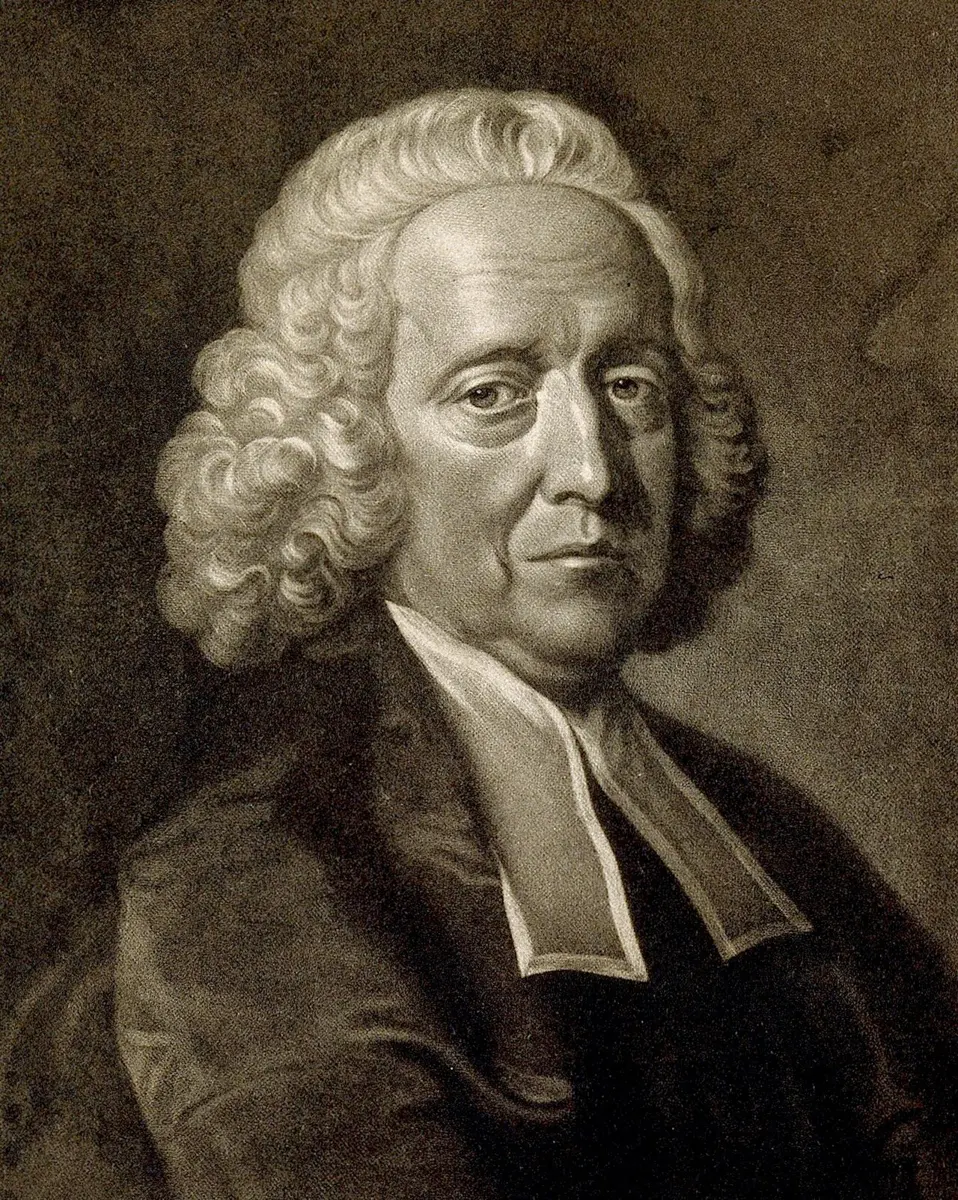
2.1.1 General introduction
Plant physiology is the study of how plants work: all the living processes of growth, reproduction, metabolism, defense and communication that keep a plant alive. Most of these happen in cells, tissues and organs, so physiology is closely tied to plant anatomy: in a plant, structure and function go together. And since much of what happens in a cell happens to molecules, physiology leans on chemistry and physics.
Three kinds of movement keep a plant alive:
- Water and minerals come from the soil. They are absorbed by the roots and carried up in the xylem, pulled by the loss of water vapor from the leaves and held together by water’s cohesion and adhesion. The soil’s minerals are renewed by the cycles of nature (biogeochemical cycles).
- Sugars made in the leaves are carried to every other part in the phloem.
- Messages travel through the plant as plant hormones.
Through all of these a plant keeps its own inside steady: how much carbon dioxide its leaves hold, which way its stems, roots and leaves point, and how much water it carries and keeps. This unit is about water.
2.1.2 Diffusion
Spray a little perfume in one corner of a room. Within a minute someone in the far corner smells it, though no one has moved the air. Drop a crystal of potassium permanganate, or a drop of ink, into a still glass of water: a purple cloud spreads slowly until the whole glass is evenly colored.
Diffusion is the random movement of molecules, ions or other particles that spreads them from a region where they are more concentrated to a region where they are less concentrated, until they are evenly spread (equilibrium).
Why should random movement go one way? Every molecule moves because of its own kinetic energy, bumping and changing direction all the time, with no preferred direction. But where there are many molecules, more of them happen to move out than move in from the emptier side. So there is a net movement down the concentration gradient. Once the molecules are evenly spread, as many move each way, and nothing seems to change, though the molecules are still moving.
Some points about diffusion:
- It is a passive process: the cell spends no energy (no ATP) on it. The energy is the particles’ own kinetic energy.
- It is faster when warmer, because the particles move faster.
- It happens in gases, liquids and solids, but at very different speeds: fastest in gases, where the particles are far apart, and slowest in solids, where they are packed tight.
Diffusion has two parts:
- The diffusion medium, or diffusant: the substance in which the particles spread, a solid, liquid or gas. In the glass of ink, the water is the medium.
- The diffusing particles, or diffusate: the molecules or ions that spread. In the glass, the dye. Light particles (of small molecular mass) diffuse faster than heavy ones: at the same temperature, hydrogen spreads through air three to four times as fast as oxygen.
Diffusion pressure
Particles that are spreading behave as though they exert a pressure in the direction they spread. This imagined pressure is called diffusion pressure (DP): the tendency of particles to diffuse. It is higher where the particles are more concentrated, so particles diffuse from a region of higher diffusion pressure to one of lower diffusion pressure, and the steeper the difference (the concentration gradient), the faster they go.
Significance of diffusion in plants
- Ions and other substances spread through the protoplasm of a cell by diffusion.
- Some minerals are taken in from the soil water by the roots passively, by diffusion.
- The scent of flowers diffuses through the air and guides insects to them, which helps cross-pollination.
- Water vapor diffuses out of the leaf through the stomata in transpiration; carbon dioxide diffuses in through the same pores for photosynthesis, and oxygen out.
- Diffusion moves substances over short distances inside the cells of every tissue, at both ends of the long-distance transport.
- Osmosis, the cell-to-cell movement of water through membranes, is a special kind of diffusion.
Why does a drop of ink spread faster in hot water than in cold water?
Pick an answer to see why.
In a room, the smell of an incense stick (dhup) spreads from one corner. Here the air is the
Pick an answer to see why.
2.1.3 Osmosis
Soak a dry raisin in water overnight and it is plump by morning. Sprinkle salt on cucumber slices for achar and in minutes they sit in their own juice. In both, water has crossed the membranes of living cells, in opposite directions.
Osmosis is the movement of water (the solvent) through a semipermeable membrane, from where water is more concentrated to where it is less concentrated: from a dilute solution (or pure water) into a more concentrated solution. It is passive, and it is a special kind of diffusion: the diffusion of water through a membrane.
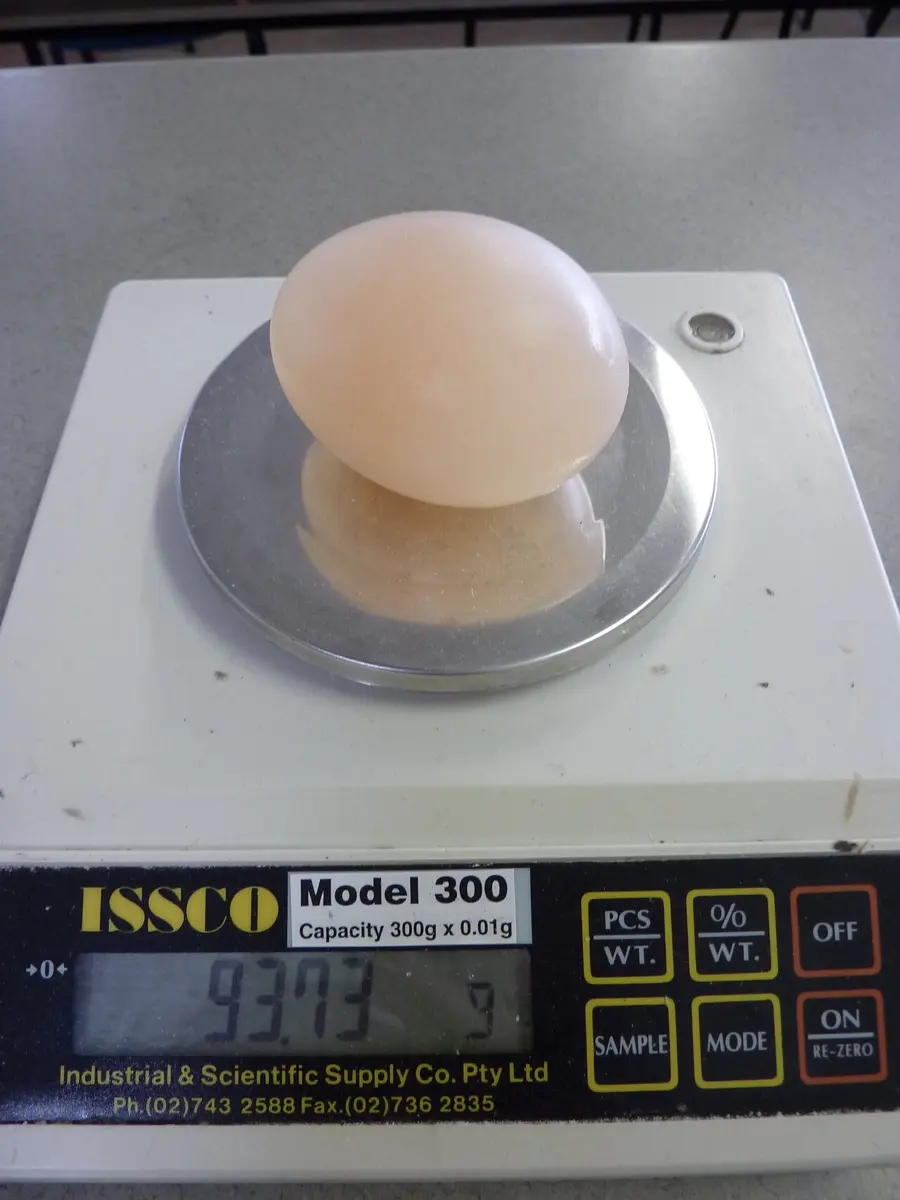
A semipermeable membrane lets water molecules through but not the larger dissolved molecules such as sugar. Cellophane and the membrane under an eggshell behave like this. The membranes of a living cell, the plasma membrane and the vacuole’s membrane (the tonoplast), are better called selectively permeable: they let water through freely, and choose which solutes may pass.
Two solutions are compared by their water:
- A hypotonic solution has more water (less solute) than the solution it is compared with. Pure water is the extreme.
- A hypertonic solution has less water (more solute).
- An isotonic solution has the same.
In osmosis, water moves from the hypotonic solution into the hypertonic one. A solution that can draw water in by osmosis is called osmotically active; in simple terms, it is the hypertonic one.
Conditions for osmosis:
- The two solutions must have different concentrations of water: one hypotonic, the other hypertonic.
- They must be separated by a semipermeable membrane.
So osmosis can’t happen without a membrane, and in a plant the membrane is that of a living cell: when a cell dies, its membranes stop being selective, and osmosis through it stops.
Osmosis in a plant cell
A plant cell has three layers round its middle (Figure 2.3): the cell wall outside, which lets water and solutes through freely; the thin layer of cytoplasm bounded by the plasma membrane; and the large central vacuole, full of cell sap (water with sugars, salts and acids) and bounded by the tonoplast. The two membranes act together as one semipermeable layer. So a plant cell is a little osmotic system: water enters the vacuole from the solution outside, or leaves it, depending on which side has more water.
Osmotic pressure
Put a solution and pure water on the two sides of a semipermeable membrane. Water flows into the solution. Now press on the solution’s side, harder and harder: at one pressure, the flow stops. That pressure is the solution’s osmotic pressure (OP): the pressure that must be put on a solution to stop water entering it through a semipermeable membrane. It measures how strongly the solution draws water in.
OP depends on how much solute is dissolved: the more concentrated the solution, the higher its OP. A 20% sugar solution has a higher OP than a 10% one, and pure water has an OP of zero, less than that of the sap of any plant cell. OP is measured in atmospheres (atm), bars or megapascals (1 MPa = 10 bar ≈ 9.9 atm), with an osmometer. The cell sap of most plant cells has an OP of about 5 to 20 atm; that of desert and salt-marsh plants, much more.
Turgor pressure, wall pressure and DPD
When water enters a plant cell, it collects in the vacuole. The vacuole swells and the protoplast expands, pressing outwards on the cell wall. This outward pressure is the turgor pressure (TP). The wall is strong and only a little elastic, so it presses back inwards with an equal and opposite pressure, the wall pressure (WP). So in a cell, TP = WP.
Turgor pressure works against the entry of water: the harder the protoplast presses on the wall, the harder it is for more water to get in. So the real “pull” that draws water into a cell is not its OP alone, but its OP less its TP. This is the diffusion pressure deficit (DPD), also called suction pressure (SP):
The name suction pressure was given by Renner (1915); diffusion pressure deficit by Meyer (1938). The name says what it is: water in the cell has a lower diffusion pressure than pure water, and DPD is by how much.
The rule that follows is the most useful in this unit: water moves from a cell (or solution) with a lower DPD to one with a higher DPD. A cell with the higher DPD “sucks harder”.
Types of osmosis
1. Endosmosis. Put a living plant cell in water (a hypotonic solution). Its cell sap is hypertonic to the water, so water enters the cell by osmosis: endosmosis. The vacuole grows and the protoplast keeps expanding until it presses hard against the wall. The cell is then fully turgid, and the state is called turgidity.
As water comes in, the cell sap gets more dilute, so its OP falls; and as the protoplast swells, its TP rises. When the TP has risen to equal the OP:
A DPD of zero means the cell can draw in no more water: it is saturated. Because the wall is stiff, the cell takes in only a little water before its TP catches up, so its sap is diluted, and its OP falls, only a little.
2. Exosmosis. Put a living cell in a strong solution (hypertonic to its sap). Water leaves the cell: exosmosis. The cell loses its turgor and becomes flaccid, and if it loses more, plasmolyzed (2.1.4).
Significance of osmosis
- Roots absorb water from the soil by osmosis: the sap of the root hairs is more concentrated than the soil water.
- Water passes from cell to cell across the root and through the leaf by osmosis, always towards the cell with the higher DPD.
- Osmosis makes plant cells turgid or flaccid. Turgid cells hold soft stems, leaves and flowers firm; a plant that loses turgor wilts.
- Stomata open and close as their guard cells take in or lose water by osmosis.
- Osmosis helps in the bursting (dehiscence) of anthers, sporangia and fruits, and in movements such as the drooping of the touch-me-not’s (lajjawati’s) leaves when touched.
- The radicle and plumule of a germinating seed push out with the force of their turgid, growing cells.
- Osmosis keeps food safe: salt in achar and salted fish, and sugar in jam and murabba, draw water out of bacteria and molds (2.1.4).
A cell has OP 10 atm and TP 10 atm. What happens if it is placed in pure water?
Pick an answer to see why.
Which pair of cells would show water moving from X to Y?
Pick an answer to see why.
Practical: the potato osmometer
The living cells of a potato tuber make a simple osmometer, and the curriculum’s first plant physiology practical.
Potato: ZooFari, Wikimedia Commons, public domain
Imbibition
Leave a wooden door in the rain through the monsoon and it swells so much that it sticks in its frame. Soak dry chana overnight for chana masala and in the morning the seeds are twice their size. Neither has a semipermeable membrane, and the wood isn’t even alive. This is imbibition.
Imbibition is the taking in of water by solid substances that attract water (hydrophilic colloids such as cellulose, starch, proteins and pectin), which then swell, without the water forming a solution. The solid that takes in water is the imbibant; the liquid, the imbibate.
- It needs an attraction between the imbibant and the liquid: wood and seeds imbibe water, but not petrol; rubber imbibes petrol, but not water. Tin, plastic and rock don’t imbibe water at all.
- The imbibant swells: its volume increases, though a little less than the sum of the volumes of solid and water taken in.
- Heat is given out (the heat of wetting): imbibition is exothermic. Damp hay, and wet seeds packed in a heap, warm up partly for this reason.
- The swelling can push with great force, the imbibition pressure: soaked seeds packed in a closed tin can burst it, and in the old days, dry wooden wedges driven into cracks in a rock and then soaked were used to split it.
- Dead materials imbibe as well as living ones. Imbibition is the first step in a seed’s germination: water is drawn into the dry seed coat and stored food, the seed swells and its coat bursts, and only then can its cells take in water by osmosis.
Which of these shows imbibition?
Pick an answer to see why.
2.1.4 Plasmolysis
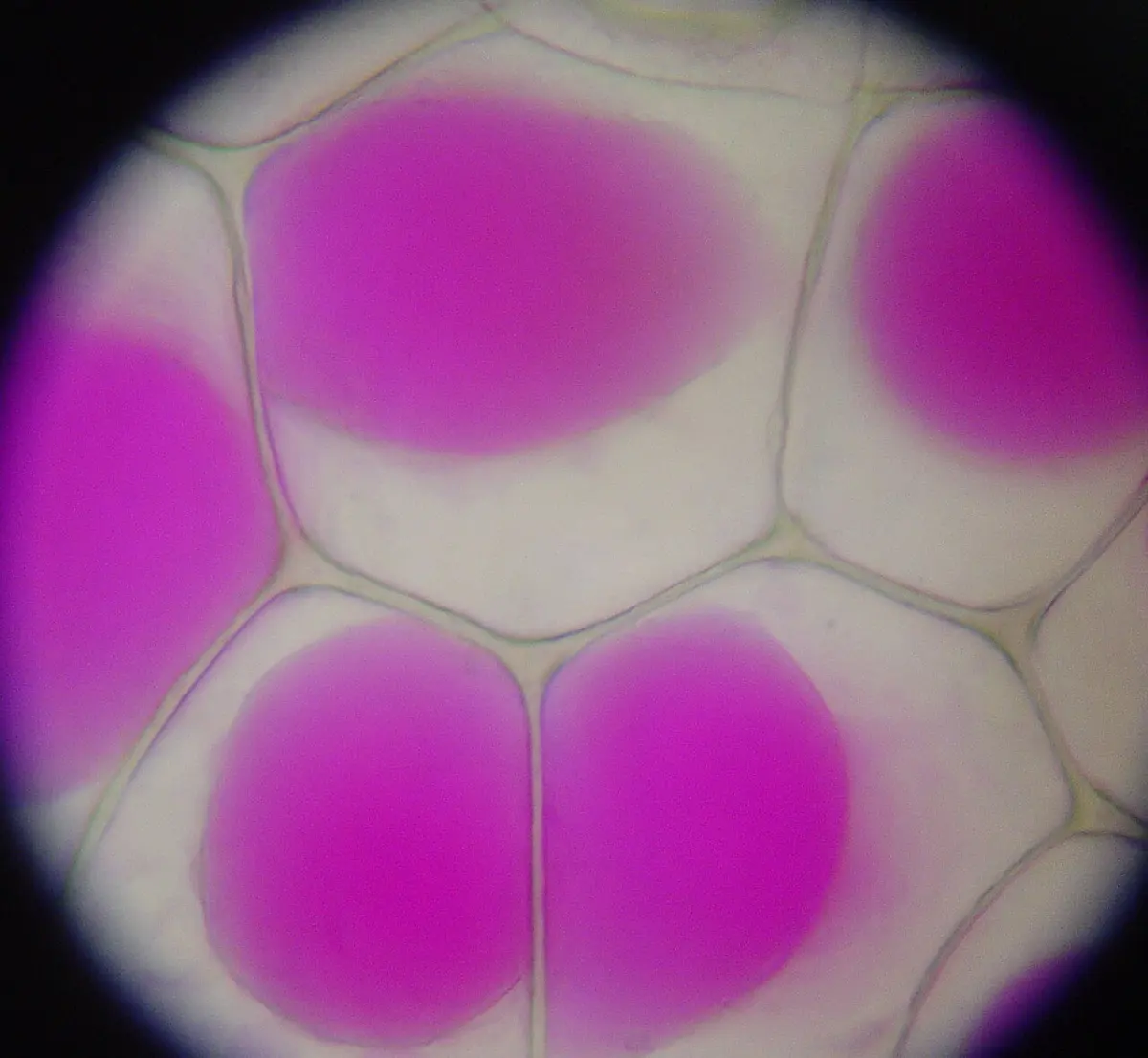
When a living plant cell loses water by exosmosis, its vacuole shrinks and its protoplast shrinks with it. At first the cell is just flaccid: limp, its protoplast no longer pressing on the wall. Then the protoplast begins to pull away from the wall, first at the corners (incipient plasmolysis), and at last it shrinks into a ball in the middle of the cell. The shrinking of the protoplast away from the cell wall, because of exosmosis, is plasmolysis.
The wall is fully permeable, so the outside solution fills the space between the wall and the shrunken protoplast. If the cell stays plasmolyzed for long, its protoplasm is damaged and the cell dies.
A plasmolyzed cell put back into water soon enough takes in water by endosmosis and swells back against its wall. This recovery is deplasmolysis.
As exosmosis goes on, the sap gets more concentrated, so its OP rises, and the TP falls. At incipient plasmolysis the protoplast stops pressing on the wall, so TP = 0, and from then on:
The cell keeps losing water until its OP (now its DPD) equals the OP of the outside solution. Then exosmosis stops, and the cell is in its most shrunken state for that solution.
Significance of plasmolysis
- It shows whether a cell is living or dead: only a living cell, with working membranes, can be plasmolyzed.
- It demonstrates exosmosis in plant cells, and lets the OP of a cell sap be measured: the solution that just causes incipient plasmolysis has the same OP as the sap.
- Food preservation: salting pickles, meat and fish, and sweetening jams and jellies with sugar, plasmolyzes any bacteria and fungi that land on them, so they can’t grow.
- Killing weeds: salt spread on the ground plasmolyzes the root cells of grasses and weeds. The same harm comes from too much fertilizer close to a crop’s roots: the soil water becomes hypertonic, and the plant wilts and burns.
- It shows that the cell wall is fully permeable: the outside solution passes through it to fill the space round the shrunken protoplast.
In a fully plasmolyzed cell,
Pick an answer to see why.
2.1.5 Ascent of sap
A plant needs water in every living cell: it makes up most of the protoplasm, and the green cells of the leaf use it in photosynthesis. Water is absorbed only by the roots, so it must move up continuously. The upward movement of water and the minerals dissolved in it, from the roots to the leaves and the other aerial parts, against gravity, is the ascent of sap.
The path. Water enters the root hairs of the root’s outer layer (the epiblema), crosses the cortex, the endodermis and the pericycle, and enters the xylem: first the protoxylem, then the metaxylem. Then it rises in the xylem of the stem, the branch, the leaf’s petiole and its midrib, veins and veinlets, and passes into the mesophyll cells of the leaf, from where it evaporates.
root hair (epiblema) → cortex → endodermis → pericycle → protoxylem → metaxylem → xylem of stem → xylem of branch → xylem of petiole → xylem of midrib, veins and veinlets → mesophyll cells of the leaf
It rises in the tracheary elements of the xylem: in flowering plants, the vessels and tracheids; in gymnosperms, which have no vessels, the tracheids alone.
How the sap rises: cohesion and tension
The most widely accepted explanation is the cohesion–tension theory (transpiration pull theory) of the Irish scientists H. H. Dixon and J. Joly (1894). It rests on three things:
- An unbroken column of water. The vessels and tracheids form continuous, very thin tubes from the root to the leaf, filled with water from end to end.
- Cohesion and adhesion. Water molecules cling strongly to one another (cohesion, through hydrogen bonds) and to the walls of the vessels (adhesion). So a thin column of water can be pulled like a rope without breaking: it can bear a tension of many atmospheres.
- Transpiration pull. Water evaporates from the wet walls of the mesophyll cells into the air spaces of the leaf and out through the stomata. The cells that lose water draw water from the cells next to them, and those from the xylem of the veins. This pull, the transpiration pull, puts the water in the leaf’s xylem under tension, and the tension passes down the unbroken columns all the way to the root. The whole column moves up, and the roots draw in more water from the soil.
So the energy that lifts the water comes from the Sun, which evaporates it from the leaves. The plant spends none of its own.
Two other forces help a little, but can’t explain a tall tree. Root pressure, the push from water entering the root by osmosis, is what pushed Hales’s vine sap up his tube, and what causes guttation (2.1.7); but it is small, often absent, and lowest on hot days when water is needed most. Capillarity, the rise of water in a narrow tube, lifts water in a xylem vessel 40 µm wide by less than a meter.
Significance of ascent of sap
- It supplies water to the mesophyll cells of the leaves for photosynthesis.
- It carries water and minerals from the roots up to every part of the plant, to the top of the tallest tree, through the vessels and tracheids.
- It keeps water, the main part of protoplasm, available to every living cell.
- It keeps the leaves supplied with the water that is lost by transpiration, and so keeps the stream moving.
- Because the stream keeps flowing, the roots go on absorbing water and minerals: ascent of sap and absorption are linked, each depending on the other.
Which statement about the ascent of sap is correct?
Pick an answer to see why.
2.1.6 Transpiration
Water is the main part of a cell’s protoplasm and a raw material of photosynthesis. Yet only a small part of the water a plant absorbs is used in growth and metabolism: 97 to 99.5% of it is lost from the aerial parts, mainly by transpiration and a little by guttation.
Transpiration is the loss of water as vapor from the aerial parts of a living plant. The water leaves, as the purest water, through the stomata, the cuticle or the lenticels, by diffusion.
A maize plant transpires about 200 liters of water in a growing season, and a large tree hundreds of liters on a hot day.
Types of transpiration
By where the water leaves, transpiration is of three types:
a. Stomatal transpiration
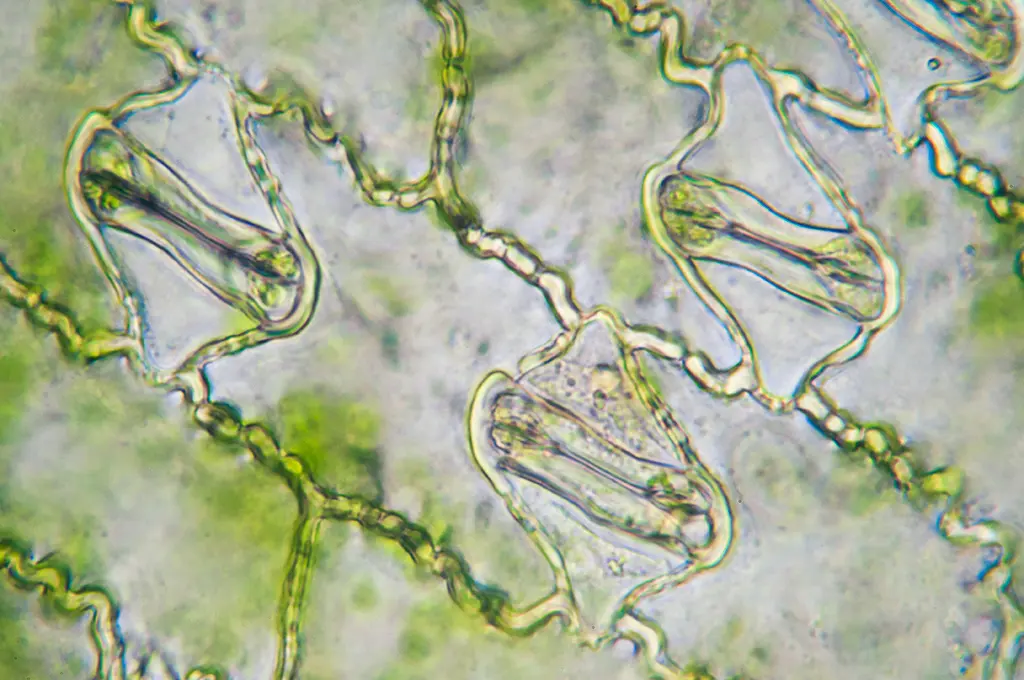
Through the stomata (one stoma): tiny pores in the epidermis of leaves and young stems, each guarded by two guard cells. It is by far the largest part, about 80 to 90% of all transpiration.
It happens in two steps:
- Evaporation. Water evaporates from the wet walls of the turgid mesophyll cells into the air spaces between them and into the sub-stomatal cavity (the air chamber just inside each stoma). The air inside the leaf becomes nearly saturated with water vapor: its vapor pressure is high.
- Diffusion. When the stoma is open, water vapor diffuses out through it into the outside air, because the vapor pressure inside the leaf is higher than outside.
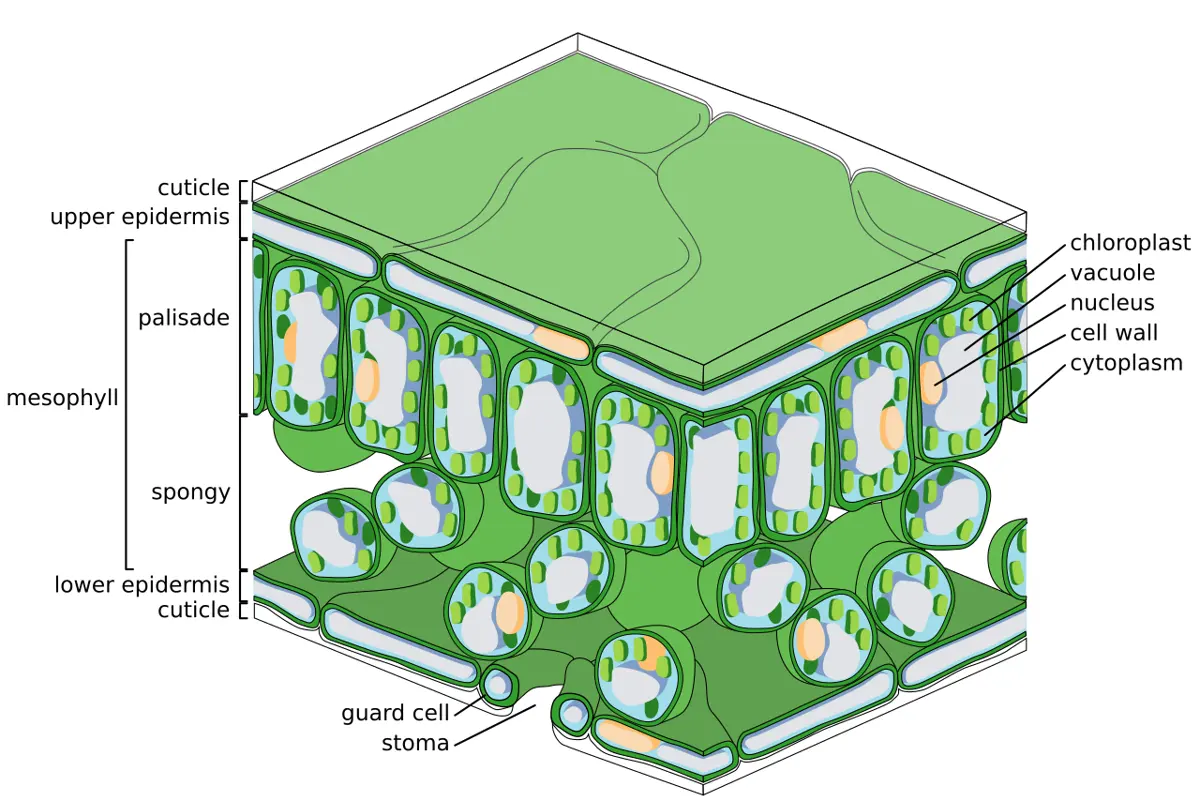
How a stoma opens and closes. The two guard cells of a dicot’s stoma are kidney-shaped, with a thick inner wall (on the side of the pore) and a thin outer wall. When water enters the guard cells by osmosis, their turgor rises; the thin outer walls stretch and bulge outwards and pull the thick inner walls with them, so the guard cells bow apart and the pore opens. When the guard cells lose water and become flaccid, their inner walls come back together and the pore closes.
Stoma: photo on Wikimedia Commons, CC0 (traced)
- Stomata usually open in the day and close at night. (The cacti and other CAM plants of Unit 3 do the opposite.)
- In dicots, the guard cells are kidney-shaped; in grasses and other monocots they are dumbbell-shaped, swollen at the two ends and narrow in the middle, where their walls are thick. When the bulbs at the ends swell, the narrow middles are pushed apart.
- The number and distribution of stomata differ from plant to plant. Most dicot leaves, held flat, have more stomata on the lower surface; monocot leaves such as maize, standing upright, have them on both surfaces about equally. A floating water-lily leaf has them only on the upper surface.
b. Lenticular transpiration
Through the lenticels: small, raised pores in the bark of woody stems and twigs, and on some fruits (look for the tiny pale dots on an apple or a guava). Lenticels are found only on woody plants with bark, and the water lost through them is a tiny share, well under 1% of the total.
c. Cuticular transpiration
Directly through the cuticle, the waxy layer covering the leaves and young stems. About 3 to 10% of the water a leaf loses goes this way. It is higher where the cuticle is thin, as in herbs that grow in the shade, and it matters most in dry weather when the stomata are shut: then the cuticle is the only way out. The thicker the cuticle, the lower the cuticular transpiration.
Basil: F. M. Blanco, Flora de Filipinas (1880s), public domain
Mango leaf: traced from W. H. Fitch's plate in Curtis's Botanical Magazine (public domain)
Significance of transpiration
Transpiration does a plant good and harm. It can’t be avoided: the stomata must be open to let carbon dioxide in for photosynthesis, and water vapor escapes through the same pores. It has been called a necessary evil.
Advantages:
- It draws water and minerals up to every part of the plant: the transpiration pull.
- It keeps a flow of water through the plant, balancing absorption with loss, so fresh water and minerals keep arriving.
- The minerals carried in the stream are left behind, and concentrated, in the leaves and growing parts that use them.
- By drawing water through every cell, it helps keep the cells turgid, which growing and dividing cells need.
- It cools the leaves. Every gram of water evaporated carries away about 2,400 joules of heat. Without it, a leaf in the full sun would heat well above the air’s temperature. The shade under a tree is cooler than under a tin roof partly for this reason.
- Moderate transpiration goes with healthy growth: a plant growing in air so damp that it can hardly transpire grows weakly.
Disadvantages:
- When the soil is dry or cold and the roots can’t take in water as fast as the leaves lose it, the plant loses turgor and wilts, its stomata close and photosynthesis slows; if it goes on, the plant dies.
- A plant must take in and move far more water than it uses: several hundred grams of water for every gram of dry matter it builds (in classic measurements about 370 g for maize, 510 g for wheat). Where water is scarce, that is the plant’s (and the farmer’s) biggest problem.
- Closing the stomata to save water also shuts out carbon dioxide, so a thirsty plant makes less food.
Factors affecting transpiration
External factors
- Relative humidity. The more humid the air, the smaller the difference in vapor pressure between the inside of the leaf and the air, and the slower the transpiration. In dry air it is fast.
- Temperature. Warmth makes water evaporate faster and lets the air hold more vapor, so transpiration rises with temperature. But in very hot, dry hours many plants close their stomata to save water (midday closure), and transpiration then falls.
- Light. Most stomata open in light, so a plant transpires far more by day than by night. Light also warms the leaf. Of the colors, blue and red light open stomata; green light does very little.
- Wind. A breeze sweeps away the damp air round a leaf, so transpiration is faster in wind. A strong wind may cool the leaf and close its stomata, and then transpiration falls again. Textbooks often give a wind of about 20–30 km per hour as the most favorable and 40–50 km per hour as the point where it falls; the real figures differ from plant to plant.
- Carbon dioxide. A low concentration of carbon dioxide inside the leaf (as when photosynthesis uses it up in the morning) makes the stomata open; a high concentration makes them close, cutting transpiration.
- Atmospheric pressure. Vapor diffuses faster at lower pressure, so transpiration is higher where the air is thinner, as in the mountains, and lower when the pressure is higher.
- Water in the soil. When the soil is moist, the roots keep the leaves supplied and the stomata stay open; in dry soil the plant loses turgor and closes its stomata, and transpiration falls.
Internal factors
- Leaf area. A plant with more leaf area has more stomata and more surface, and loses more water. Plants of dry places (xerophytes) reduce their leaf area: small leaves, leaves that fall early in the dry season, or leaves turned into spines as in cacti.
- Leaf structure. A thick cuticle cuts transpiration. So do fewer stomata, and stomata only on the lower surface. In xerophytes such as Pinus and Nerium (kaner) the stomata are sunken below the surface; in Nerium they lie in pits (stomatal crypts) lined with hairs, which hold still, damp air over the pores.
- Leaf modifications. Some plants have done away with ordinary leaves: the flat green stems of Opuntia (a phylloclade), the green needle-like branches of Asparagus (cladodes), and the flat, leaf-like leaf stalks of Acacia melanoxylon and A. auriculiformis (phyllodes) do the leaves’ work and lose much less water.
On which day will a field of maize lose water fastest?
Pick an answer to see why.
Why does a plant with sunken stomata lose less water?
Pick an answer to see why.
2.1.7 Guttation
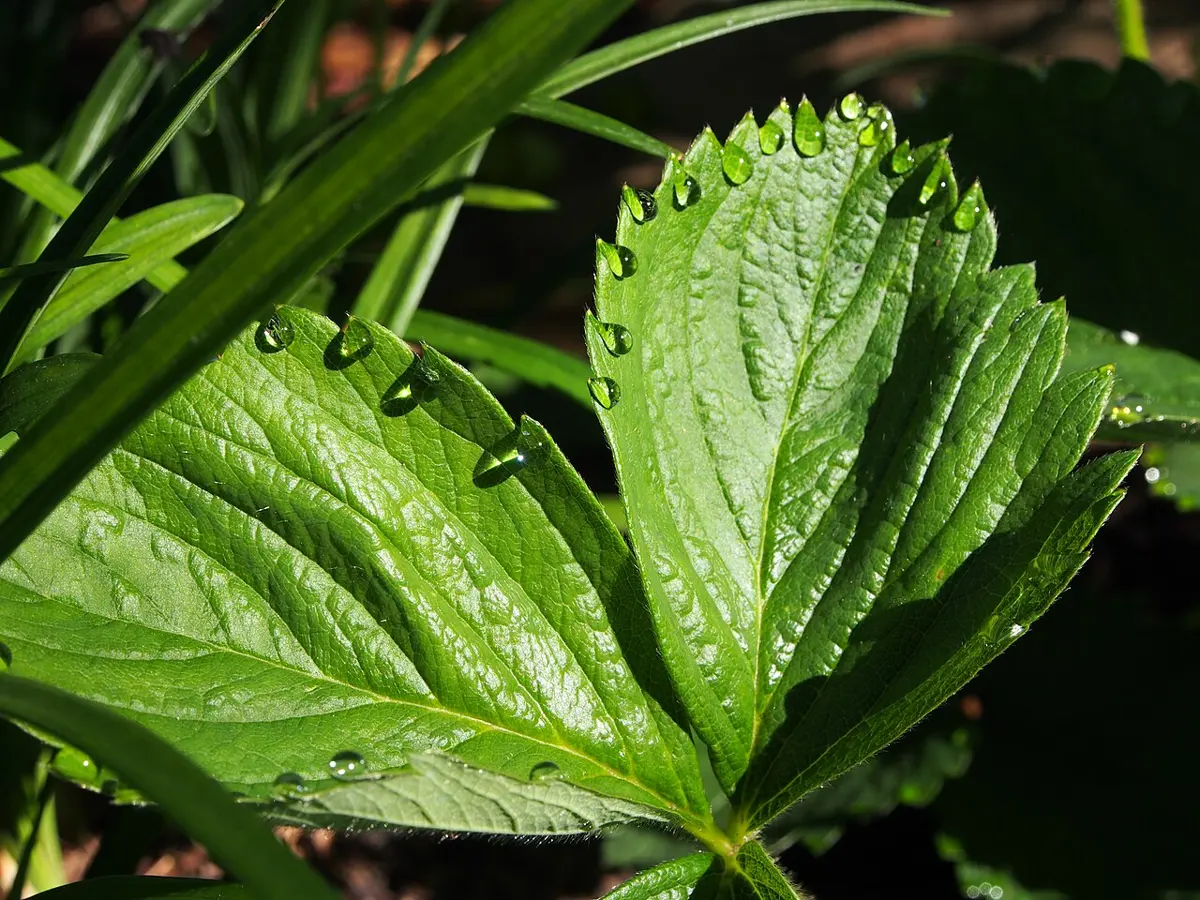
Go out early on a cool morning after a humid night and look at the edges of grass blades, taro (karkalo) leaves, strawberry or tomato leaves: many carry a neat row of drops along their tips and edges. They are not dew.
- i.When are such drops usually seen?
- ii.Which plants show them?
- iii.Do tall, woody trees show them?
At night and in the early morning, when the air is humid, a plant can hardly transpire, yet its roots go on absorbing water. Water builds up in the xylem as root pressure, which pushes sap up and out through special pores at the tips and edges of the leaves, the hydathodes. This loss of water as liquid droplets is guttation. It is common in grasses (including young rice and wheat) and herbaceous dicots: tomato, balsam, Colocasia (taro), strawberry, nasturtium. It is rare in tall woody trees, whose root pressure is too small to push water so high.
A hydathode is a pore at the end of a vein. Under it lies a small mass of loosely packed, thin-walled cells, the epithem, between the vein’s last xylem and the pore. The pore is like a stoma whose guard cells can no longer open and close, so it is always open.
Conditions for guttation:
- Little or no transpiration, but water still being absorbed (humid nights and mornings, warm moist soil).
- A good root pressure.
The guttation fluid is not pure water: it carries sugars, salts and amino acids, which may dry into a white crust on the leaf’s edge.
Differences between transpiration and guttation
| Transpiration | Guttation | |
|---|---|---|
| 1.Through | stomata, cuticle and lenticels | hydathodes |
| 2.Water lost as | vapor | liquid drops |
| 3.When | mostly in the day | at night and early morning |
| 4.Temperature | more in warm weather | more in cool weather |
| 5.Air | favored by dry air; slowed by humid air | favored by humid air; stopped by dry air |
| 6.Process | evaporation and diffusion | pushed out by root pressure; no diffusion |
| 7.Control | controlled, by the opening and closing of stomata | not controlled: hydathodes are always open |
| 8.Root pressure | not needed | needed |
| 9.What is lost | pure water | water with sugars, salts and amino acids |
| 10.Cooling | cools the plant | doesn’t cool the plant |
Drops of water are seen along the edges of taro leaves at dawn. What pushed them out?
Pick an answer to see why.
Exercise
A. Tick the correct alternatives
- What is the cause of diffusion?
Pick an answer to see why.
- What is the medium in which diffusion occurs called?
Pick an answer to see why.
- What is the direction of diffusion of molecules?
Pick an answer to see why.
- What is true about transpiration through stomata?
Pick an answer to see why.
- Which of the following acts as a semipermeable membrane?
Pick an answer to see why.
- When does endosmosis occur?
Pick an answer to see why.
- A plant cell has undergone exosmosis. Which statement is correct?
Pick an answer to see why.
- What is true about osmosis?
Pick an answer to see why.
- Which of these is an effect of plasmolysis?
Pick an answer to see why.
- Which of the following materials shows imbibition?
Pick an answer to see why.
- What is true about imbibition?
Pick an answer to see why.
- The ascent of sap takes place in the tracheary elements of the xylem. Which are the tracheary elements?
Pick an answer to see why.
- What is the main cause of the ascent of sap?
Pick an answer to see why.
- A plant gives out water drops from its leaf margins, mainly on humid nights and mornings. Which of the following plants shows this?
Pick an answer to see why.
- Which part of the leaf is responsible for guttation?
Pick an answer to see why.
B. Answer the following questions
Look at the figure below and answer the questions.
- a.What process does the figure show?
- b.What causes the dye molecules to spread in the water?
- c.In this process, what do the water molecules act as?
- d.What would you see if the temperature of the water were raised?
Answer
Define osmosis. Write its significance in plants.
Answer
Mention the two conditions necessary for osmosis. Does osmosis take place in a non-living cell or object? Why?
Answer
What is endosmosis? What is its effect on a plant cell?
Answer
In the figure, a cell has undergone successive changes after being placed in a solution.
- a.Is the solution hypotonic or hypertonic?
- b.What type of osmosis is it?
- c.The protoplast of the cell has shrunk to its smallest volume. What is this called?
- d.What happens if the cell d is placed in water? What is it called?
Answer
Write the significance of plasmolysis.
Answer
Define ascent of sap. Mention three important points which make the ascent of sap possible in plants.
Answer
A white-flowered balsam twig is stood in a beaker of water colored with eosin, a red dye. After some hours, red streaks are seen in its stem and its white flowers turn red.
- a.Why do the white flowers of the twig turn red?
- b.Can the color change be seen in other parts too? If yes, in which part?
- c.A transverse section of the twig, seen under the microscope, shows the red color only in the xylem. What can be concluded from it?
Answer
Define transpiration and mention its types.
Answer
Write about the role of stomata in transpiration.
Answer
How do diffusion and osmosis play a vital role in stomatal transpiration? Give your views.
Answer
Describe the role of light and temperature in transpiration.
Answer
List the advantages and disadvantages of transpiration.
Answer
Write the differences between transpiration and guttation.
Answer
Define transpiration. Discuss the various factors affecting transpiration in plants. (1 + 7)
Answer
Project work
Printable PDFs
- Study notes 4 pages
- Worksheet 4 pages Answer key
Quiz yourself: Life Processes and the Human Body, Grades 5–12 →
Practice every question in the book, and keep track of the ones you miss →
A companion to your textbook, not a replacement for it: study from the book your school uses, and where the two differ, follow your teacher. Found a mistake? Please tell us.