
Around 1950 there were perhaps 800 one-horned rhinoceroses in Chitwan; by the late 1960s, after a decade of poaching and the clearing of the valley for farms, there were fewer than about a hundred. Protected since 1973, Nepal’s rhinos have come back: the count of 2021 found 752. But every rhino alive in Chitwan today descends from the few that survived those years, and carries only the genes they happened to carry.
The rhinos’ story is evolution at work, though not the kind most people imagine. Which rhinos survived the 1960s had more to do with luck than with being stronger or better adapted. This unit is about the causes of evolution: the old idea that animals change because they need to (Lamarck), the idea that nature picks the better-fitted from among those born different (Darwin), and the modern theory, which adds genes, mutation and plain chance.
7.3.1 Introduction
Groups of living things have changed slowly over very long times; Unit 19 gave the evidence. How they change is a different question, and scientists have answered it in different ways. This unit takes the three main theories in turn:
- i.Lamarckism (the theory of inheritance of acquired characters)
- ii.Darwinism (the theory of natural selection)
- iii.The modern synthetic theory (neo-Darwinism)
7.3.2 Lamarckism (theory of inheritance of acquired characters)
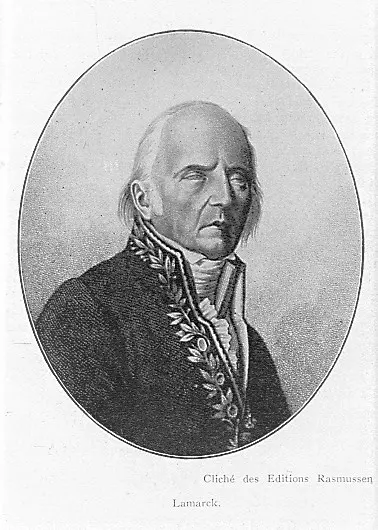
Jean-Baptiste de Lamarck (1744–1829), a French biologist, was the first to put forward a full theory of how living things evolve. In his book Philosophie zoologique (1809) he proposed that organisms change gradually in form and structure, over generations, in response to their environment, and that the changes an organism acquires in its lifetime are passed to its young: the inheritance of acquired characters.
Lamarckism rests on four postulates:
- i.Tendency to increase in size. Living things and their parts tend to grow larger and more complex over time, driven, Lamarck believed, by an internal vital force; growth is limited only by life itself.
- ii.Direct influence of the environment. A change in the environment gives the organism new needs, and new needs bring new habits; for example, to escape a new predator, an animal might need to run faster, and so begin to.
- iii.Use and disuse of organs. An organ that is used more and more grows stronger and larger; one that is not used weakens, shrinks and in the end disappears.
- iv.Inheritance of acquired characters. The changes an individual acquires in its lifetime by use and disuse are passed to its offspring. Added up over many generations, they make a new species, different from its ancestors.
Examples Lamarck gave
Lamarckism was the first full theory of evolution, and it set biologists thinking about how species change. Lamarck explained these cases by his postulates:
1. The giraffe’s neck. The ancestors of giraffes, he said, were short-necked animals that ate the leaves of low trees. When the low leaves ran short, they stretched their necks and legs to reach higher; each giraffe’s neck grew a little longer by the stretching, and its young were born with that longer neck. Over many generations of stretching, the long neck of the modern giraffe was made.
2. The duck’s webbed feet. The ancestors of ducks lived on land. When they took to the water, they spread their toes to paddle, and the skin between the toes, stretched again and again, grew into webs, inherited by their young.
3. The snake’s lost legs. The ancestors of snakes had legs, but as they took to creeping through narrow places, the legs were used less and less, became weaker, and in the end disappeared; the loss was inherited.
4. The human appendix. Our ancestors ate much tough plant food and had a large, working cecum and appendix that helped digest it. As they changed their diet, the appendix was used less and became small.
Criticisms of Lamarckism
Lamarck’s theory was not accepted by most scientists, for these reasons:
- i.Organisms don’t always grow larger: some lines have become smaller over time. The first land plants that formed forests were giant clubmosses and tree ferns; many plants that came later are shrubs, herbs and grasses.
- ii.It is not reasonable that an organism can grow a new organ simply because it needs or wants one.
- iii.Injuries and mutilations are not inherited. For generations, the ears and tails of some breeds of dogs were cut and the feet of girls in China were bound; their young were born normal. Boys in many communities have been circumcised for thousands of years, yet boys are still born with a foreskin.
- iv.Use does not always improve an organ, and what use builds is not handed on: a wrestler’s or a blacksmith’s muscles are built up by work, but their children are born with ordinary muscles.
Ryan Cupo, CC0, via PhyloPic
From such results, Weismann put forward the theory of continuity of germplasm (1892). An organism has two kinds of cells:
- i.somatic cells (the somatoplasm): the cells of the body, which die with it;
- ii.germ cells (the germplasm): the cells that make eggs and sperm in the ovaries and testes, which are passed on.
Only changes in the germ cells can be inherited. A change in the somatic cells, such as stronger muscles or a lost tail, dies with the body. Heredity flows from germ cells to germ cells, generation after generation; the body is only a carrier for them.
Neo-Lamarckism
Some biologists tried to save Lamarck’s idea by changing it; their views are called neo-Lamarckism. They held that the environment can act directly on the germ cells, or on the body in ways that reach the germ cells, and so cause heritable changes. Modern genetics gives this idea a little support, in a very different form:
- The environment can change genes: X-rays, ultraviolet light and some chemicals cause mutations in the germ cells, and these are inherited. But the changes are random, not fitted to the organism’s needs.
- Bacteria pick up genes from their surroundings and from each other, and pass them on.
- Epigenetics: some chemical marks that switch genes on or off are set by the environment (diet, stress) and, in some plants and worms, are passed on for a few generations. In mammals this is rare and short-lived.
None of these makes an organ grow because it is used, and none makes an acquired body change hereditary in the way Lamarck described. What remains true from neo-Lamarckism is that body characters come from the interaction of heredity and environment.
According to Weismann, which change could be passed to the next generation?
Pick an answer to see why.
7.3.3 Darwinism (theory of natural selection)
Charles Darwin (1809–1882) gathered the evidence for his theory on a voyage round the world aboard HMS Beagle, from 1831 to 1836, as its naturalist. He collected plants, animals, rocks and fossils in South America, the Galápagos Islands, Australia and many islands, and noticed how species changed from place to place. Back in England he spent twenty years gathering more evidence, from breeders of pigeons and dogs and from his own experiments. In 1858 he learned that a younger naturalist, Alfred Russel Wallace, working in the islands of Southeast Asia, had reached the same idea; their papers were read together that year, and Darwin published On the Origin of Species in 1859.
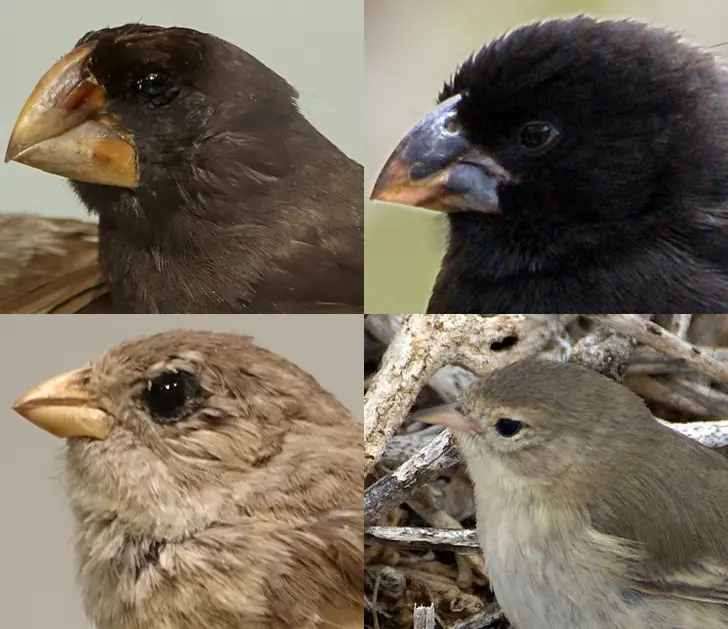
Darwinism rests on five facts and inferences:
- a.Enormous fertility (prodigality of production)
- b.Struggle for existence
- c.Variation and heredity
- d.Natural selection (survival of the fittest)
- e.Origin of new species
a. Enormous fertility. Every kind of living thing produces far more young than can possibly survive; if all survived, its numbers would grow in a geometric ratio (doubling and doubling again).
- i.An oyster can lay up to about 100 million eggs in a year.
- ii.A starfish can produce millions of eggs in a season. If they all survived and bred, starfish would fill the sea in a few generations.
- iii.A Paramecium divides two or three times a day: in a month, a single one could in theory have more descendants than there are stars in the Milky Way.
- iv.An Atlantic salmon lays 8,000 to 25,000 eggs.
- v.Even the elephant, the slowest breeder of all animals, would multiply beyond belief: Darwin worked out that one pair, breeding from 30 to 90 years old and having six young, would leave nearly 19 million descendants after about 750 years.
b. Struggle for existence. Since more are born than can survive, and food and space are limited, the living things must compete, with each other and with their surroundings. Darwin used “struggle” in a wide sense: not only fighting, but getting food, escaping enemies, finding a mate and surviving the weather. There are three kinds:
- i.Intraspecific struggle: between members of the same species, for the same food, shelter, nesting places and mates. It is the sharpest, since they need exactly the same things. Example: young sal seedlings in a forest gap compete for light, and only a few grow into trees; street dogs fight over scraps.
- ii.Interspecific struggle: between members of different species: as predator and prey, or competitors for the same food. Example: tigers and leopards in Chitwan both hunt deer and wild boar. People and wild animals compete too: elephants, rhinos and deer raid crops in villages next to the national parks, while forests are cleared for farms.
- iii.Environmental struggle: against the conditions of life, such as floods, droughts, cold, landslides and fires.
c. Variation and heredity. No two individuals of a species are exactly alike (Why aren’t you exactly like your brother or sister? in Going Further 9–12 looks at why). Some differences are useful in the struggle, some harmful, and many useless (neutral), of no effect either way. Many of them are inherited: young resemble their parents. An individual with a useful variation is more likely to survive and to pass it on. (Darwin didn’t know where variations come from or how they are inherited; genetics answered that later.)
d. Natural selection (survival of the fittest). In the struggle for existence, individuals with useful variations are more likely to survive and reproduce, and those with harmful ones to die young or leave fewer young. Nature, in effect, selects the fittest, as a breeder selects the best cattle or the hen that lays the most eggs, but with no aim. The phrase survival of the fittest was coined by the English philosopher Herbert Spencer in 1864, and Darwin used it in later editions of the Origin. “Fittest” means best fitted to the surroundings, leaving the most young, not strongest.
e. Origin of new species. The useful variations are inherited and build up, generation after generation. Over a long time, a population, especially one cut off in a different place, changes so much that it becomes a new species.
In Darwin’s theory, “the fittest” are the individuals that:
Pick an answer to see why.
Examples of natural selection
a. The giraffe. Among the ancestors of giraffes, some were born with longer necks, some with shorter, as necks vary in every herd today. When the low leaves ran short in dry seasons, those with longer necks could reach the leaves higher up, survived better and left more young; the young inherited their parents’ long necks. Over many generations the average neck grew longer. No giraffe’s neck grew by stretching. (Giraffes’ long necks may also have been selected in fights between males, which swing their necks like clubs; biologists still debate it.)
b. Mosquitoes and DDT. From the 1950s, the insecticide DDT was sprayed in houses across the world, Nepal’s Terai included, to kill the mosquitoes that carry malaria. At first it worked very well. But a few mosquitoes carried genes that let them survive it; when DDT killed the rest, these survived and multiplied, and their young inherited the resistance. Within some years, in many places most mosquitoes were resistant. The spraying did not cause the resistance; it selected the mosquitoes that already had it. DDT is now restricted worldwide by the Stockholm Convention (2001) because it builds up in food chains and harms birds; it is still allowed only for killing mosquitoes indoors where malaria is a danger. The same thing happens with bacteria and antibiotics, and with the germs of malaria and their drugs.
c. Industrial melanism. The peppered moth (Biston betularia) of Britain rests by day on tree trunks. Most were pale, speckled black and white like the lichens on the bark; a rare black (melanic) form was first recorded near Manchester in 1848. As factories filled the air with soot in the Industrial Revolution, the lichens died and the bark was blackened. Pale moths now stood out on the dark bark and were eaten by birds, while black ones were hidden; by 1895, about 98% of the moths around Manchester were black. In the 1950s, Bernard Kettlewell released marked moths of both forms and showed that birds took more of the form that showed up on the bark. After clean-air laws in the 1950s and 1960s cleaned the air, the bark grew pale again, and the pale moths came back: by about 2000 the black form had become rare again. The change in the moths followed the change in the trees, both ways.
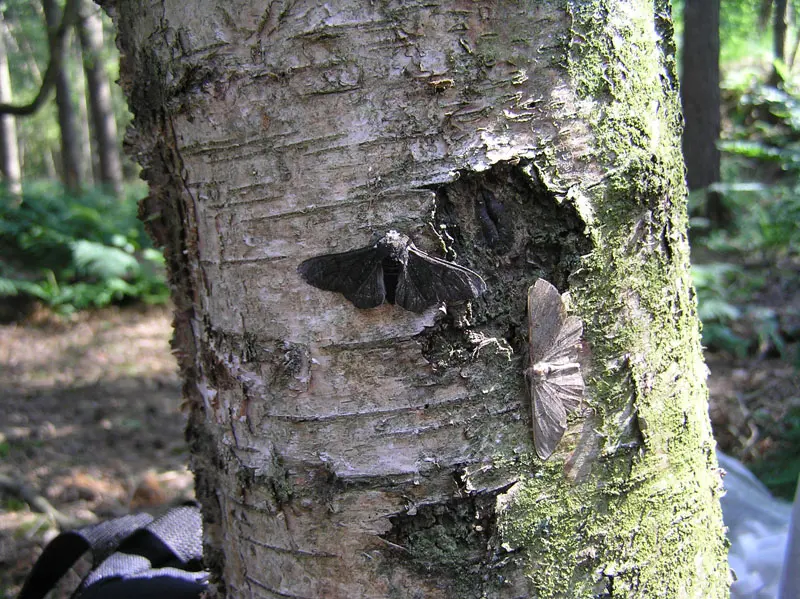
In a polluted wood, black peppered moths became common because:
Pick an answer to see why.
Criticisms of Darwinism
Darwin’s theory was widely accepted, because it rested on facts anyone could check and explained a great deal. But some questions were raised that it could not answer in his time:
- i.It had no explanation of heredity: Darwin did not know how variations are inherited, nor how new variations arise (Mendel’s work was unknown to him).
- ii.It could not explain how small variations that are not yet useful would be kept and built up, or how a complex organ could arise if its early stages were of no use.
- iii.It could not easily explain over-specialized organs that seem to go beyond what is useful, such as the elephant’s huge tusks or the antlers of some deer. (Darwin later explained some of them by sexual selection: features that win mates even at a cost.)
- iv.It explained the survival of the fittest, but not the arrival of the fittest: where the useful variations come from in the first place.
- v.It made no distinction between somatic variations (in the body, not inherited) and germinal variations (inherited).
Most of these gaps were filled when genetics was joined to Darwin’s theory, as the modern synthetic theory.
7.3.4 Modern synthetic theory (neo-Darwinism)
Between about 1918 and 1950, biologists brought together Darwin’s natural selection, Mendel’s genetics and the study of populations into one theory, the modern synthetic theory of evolution, also called neo-Darwinism. The mathematicians of population genetics, R. A. Fisher, J. B. S. Haldane and Sewall Wright, worked out how genes spread in populations. The foundation book of the synthesis was Genetics and the Origin of Species (1937) by Theodosius Dobzhansky; others followed from Ernst Mayr (species and their formation), Julian Huxley (who gave the theory its name in 1942), G. G. Simpson (fossils) and G. Ledyard Stebbins (plants). In his book Processes of Organic Evolution (1966), Stebbins named five basic processes: gene mutation, changes in chromosome structure and number, genetic recombination, natural selection and reproductive isolation.
The theory’s central idea is that evolution is a change in the frequencies of alleles (forms of genes) in the gene pool of a population over generations. The gene pool is the total of all the alleles of all the individuals in a population. The modern theory is described under six points:
- i.Mutation
- ii.Genetic recombination
- iii.Gene migration (gene flow)
- iv.Genetic drift
- v.Isolation
- vi.Natural selection
The first two make variation; the next two change allele frequencies by movement and chance; isolation splits populations; natural selection sorts the variation.
i. Mutation
A mutation is a sudden, heritable change in the genetic material of an organism. Mutations are the only source of new alleles, and so the raw material of all evolution. They are random: a mutation is not more likely to happen because it would be useful. Most are harmful or neutral; a few, in some surroundings, are useful.
The Dutch botanist Hugo de Vries gave the word its meaning. Studying the evening primrose (Oenothera lamarckiana) around 1900, he saw new forms appear suddenly, which bred true, and in his Mutationstheorie (1901–1903) he proposed that new species arise by such sudden jumps. (Most of his primrose “mutations” turned out later to be rearrangements and doublings of chromosomes.)
Mutations are of two main kinds:
a. Chromosomal mutations: changes in the structure or the number of chromosomes, large enough to be seen under the microscope.
- Changes in structure, when a chromosome breaks and its pieces are rejoined wrongly: a piece lost (deletion), a piece doubled (duplication), a piece turned the other way round (inversion), or a piece joined to another chromosome (translocation).
- Changes in number: one chromosome more or fewer (aneuploidy: in humans, an extra chromosome 21 causes Down syndrome), or whole extra sets of chromosomes (polyploidy). Polyploidy is common in plants and can make a new species in one step: bread wheat has six sets of chromosomes, from three ancestral grasses.
b. Gene mutations (point mutations): changes in the DNA sequence within a gene, too small to see. One base may be replaced by another (substitution), or bases may be added (insertion) or removed (deletion). Sickle-cell anemia comes from a single substitution in the gene for hemoglobin: one A changed to T, so one amino acid of the protein changes, from glutamic acid to valine.
ii. Genetic recombination
Genetic recombination is the reshuffling of the genes of two parents into new combinations in their young. It makes each child of sexual reproduction (except identical twins) different from both parents and from its brothers and sisters. It happens in three ways:
- i.crossing over between homologous chromosomes in meiosis, which mixes the alleles of a mother’s and a father’s chromosome;
- ii.independent assortment of chromosomes into gametes in meiosis: with 23 pairs, a human can make , about 8.4 million, kinds of egg or sperm;
- iii.random fertilization: any one of a father’s sperm can fertilize any one of a mother’s eggs.
Recombination doesn’t make new alleles (only mutation does); it makes new combinations of the alleles already in the gene pool, and so is the main source of the variation we see within a population.
iii. Gene migration (gene flow)
Gene migration, or gene flow, is the movement of alleles from one population to another, when individuals (or their pollen or seeds) move and breed in a new population. It can bring new alleles into a population’s gene pool and change its allele frequencies. Gene flow also keeps neighboring populations alike: as long as some individuals move between them, they don’t drift apart into separate species.
iv. Genetic drift (Sewall Wright effect)
Genetic drift is the random change in allele frequencies from one generation to the next, by chance, not by natural selection. In every generation, which individuals happen to breed, and which of their alleles happen to get into the eggs and sperm that make the next generation, is partly a matter of luck. In a large population the chances even out; in a small population they don’t, and an allele can become common, or be lost altogether, by chance alone. The American geneticist Sewall Wright showed that drift is an important force in evolution, so it is also called the Sewall Wright effect.
Two special cases of drift:
a. Bottleneck effect. A large population is suddenly cut down to a few survivors by a disaster: a flood, an epidemic, hunting. The survivors carry only a chance sample of the old population’s alleles; many alleles are lost. Even when the population grows large again, its allele frequencies are different from the old one’s, and its genetic diversity is low, which makes it less able to adapt to new diseases and changes. The northern elephant seal was hunted down to a few dozen animals by the 1890s; it has since grown to over 200,000, but they are almost all genetically alike. The cheetah went through a bottleneck about 10,000 years ago, and cheetahs are so alike that skin grafted from one to another is not rejected.
b. Founder effect. A few individuals leave a large population and found a new population somewhere else, on an island or in a new valley. The new population starts with only the alleles the founders happened to carry, so its allele frequencies differ from the parent population’s, sometimes greatly. The Amish of Pennsylvania in the USA are descended from about 200 founders who came from Europe in the 1700s; one of them carried a rare allele that causes Ellis–van Creveld syndrome (dwarfism with extra fingers), and today the syndrome is far commoner among the Amish than in any other population.
A storm kills most of the snails on a small island at random, leaving ten. Their descendants are mostly yellow, though the old population was mostly brown. This change is due to:
Pick an answer to see why.
v. Isolation
Isolation is the separation of populations so that they can no longer interbreed. While populations interbreed, gene flow keeps them alike; once they are isolated, each changes in its own way by mutation, selection and drift, and in time they may become separate species. Dobzhansky introduced the term isolating mechanism in 1937 for whatever keeps two related populations living in the same area from interbreeding. Isolation is of two main kinds:
a. Geographical isolation: populations separated by a physical barrier: a mountain range, a large river, a sea, a desert, a glacier. Each part evolves on its own. Over a long time, they may become so different that they can no longer interbreed even if they meet again: they have become new species (geographic, or allopatric, speciation). The Himalaya, for example, separate many animals and plants of the Indian side from their relatives on the Tibetan side.
b. Reproductive isolation: anything that keeps members of different species from producing fertile young, even where they live together. It keeps species distinct. It is of two types:
- Premating (prezygotic) isolation prevents mating or fertilization:
- habitat (ecological) isolation: they live in different places in the same area, such as in water or on land, on the forest floor or in the canopy;
- seasonal (temporal) isolation: they breed at different times of year or day;
- behavioral (ethological) isolation: their courtship songs, dances or signals differ, so they don’t recognize each other as mates;
- mechanical isolation: their sex organs, or the parts of their flowers, don’t fit;
- gametic isolation: the sperm can’t fertilize the eggs.
- Postmating (postzygotic) isolation acts after fertilization:
- hybrid inviability: the hybrid dies as an embryo or young;
- hybrid sterility: the hybrid lives but can’t breed. A mule, from a horse (64 chromosomes) and a donkey (62), has 63 chromosomes, which can’t pair in meiosis, so it is almost always sterile;
- hybrid breakdown: the hybrids are fertile, but their young are weak or sterile.
vi. Natural selection
In the modern theory, natural selection means differential reproduction: some members of a population leave more young than others, because they are better adapted, physically, physiologically or in behavior, to their surroundings. The alleles of those that leave more young become commoner in the gene pool; the alleles of those that leave fewer become rarer. So natural selection changes allele frequencies, and does so in a direction: towards better adaptation to the surroundings of the moment. It is the only one of the six processes that makes organisms fit their way of life.
Exercise
A. Tick the correct alternative
- Which of the following is NOT one of the fundamental postulates of Lamarckism?
Pick an answer to see why.
- According to Lamarck, what happens to organs that are used frequently?
Pick an answer to see why.
- Which experiment provided strong evidence against the inheritance of acquired characteristics?
Pick an answer to see why.
- Which of the following is NOT one of the five fundamental facts of Darwinism?
Pick an answer to see why.
- What process describes the change in gene frequencies in a population randomly by chance, not due to natural selection?
Pick an answer to see why.
- Which type of isolation occurs when a population is divided into separate groups by geographical barriers?
Pick an answer to see why.
B. Answer the following questions
What is the primary concept of Lamarckism regarding environmental influence?
Answer
What theory did Charles Darwin propound to explain organic evolution?
Answer
Describe the concept of “use and disuse of organs” in Lamarckism with an example.
Answer
What criticism did Weismann’s experiment provide against Lamarckism?
Answer
Explain the postulates of Lamarckism and provide examples for each postulate.
Answer
Name the type of struggle that occurs between individuals of the same species.
Answer
Explain the concept of “enormous fertility” in Darwinism with an example.
Answer
What is the main cause of the decline in light-colored peppered moths during the industrial revolution?
Answer
Which process describes the random change in gene frequencies in a population?
Answer
How does natural selection lead to the origin of new species?
Answer
Describe the three types of struggles for existence as observed by Darwin.
Answer
What prevents different species from interbreeding despite living in the same area?
Answer
Explain Lamarck’s concept of the use and disuse of organs and how it contributes to evolutionary changes within a species.
Answer
Describe one example from nature that supports Lamarckism, highlighting how environmental factors influence evolutionary adaptations in a species.
Answer
Discuss the criticisms faced by Lamarckism and provide examples or evidence that contradict Lamarck’s proposed mechanisms of evolution.
Answer
What is genetic recombination and how does it contribute to evolution?
Answer
Differentiate between chromosomal mutation and gene mutation with examples.
Answer
Explain the concept of neo-Lamarckism and how it addresses some of the limitations of classical Lamarckism. Provide examples or evidence supporting the neo-Lamarckian perspective on evolution.
Answer
Explain Darwin’s concept of “survival of the fittest” and how it contributes to the process of natural selection.
Answer
Describe one example of natural selection in nature, highlighting how it influences the evolution of a species.
Answer
Discuss the role of mutation in driving evolution according to the modern synthetic theory (neo-Darwinism).
Answer
Compare and contrast Darwinism with Lamarckism, focusing on their key principles and how they explain the mechanisms of evolution.
Answer
Explain the concept of genetic drift and provide examples of bottlenecks and founder effects, highlighting their significance in the evolution of populations.
Answer
What is the bottleneck effect, and how does it impact genetic diversity?
Answer
Explain the founder effect with an example.
Answer
What are the main criticisms of Darwin’s theory of natural selection?
Answer
Printable PDFs
- Study notes 4 pages
- Worksheet 4 pages Answer key
Quiz yourself: Heredity and Evolution, Grades 5–12 →
Practice every question in the book, and keep track of the ones you miss →
A companion to your textbook, not a replacement for it: study from the book your school uses, and where the two differ, follow your teacher. Found a mistake? Please tell us.