
In the early 1980s, in the Churia hills by the Tinau Khola north of Butwal, a team of American and Nepali scientists picked out of the rock a single upper molar tooth, about 9 million years old. It belonged to the ape then called Ramapithecus, which textbooks had for twenty years called the first step on the road to humans. But a better skull of the same ape, found in Pakistan and described in 1982, had a face like an orangutan’s, and the step was being taken out of the story.
The story of human evolution is still being written: new fossils are found every few years, and DNA read from bones 40,000 years old has shown things no fossil could. This unit tells it as the exam asks for it, in eight stages, and says, at each stage, what scientists now think.
7.4.1 Introduction
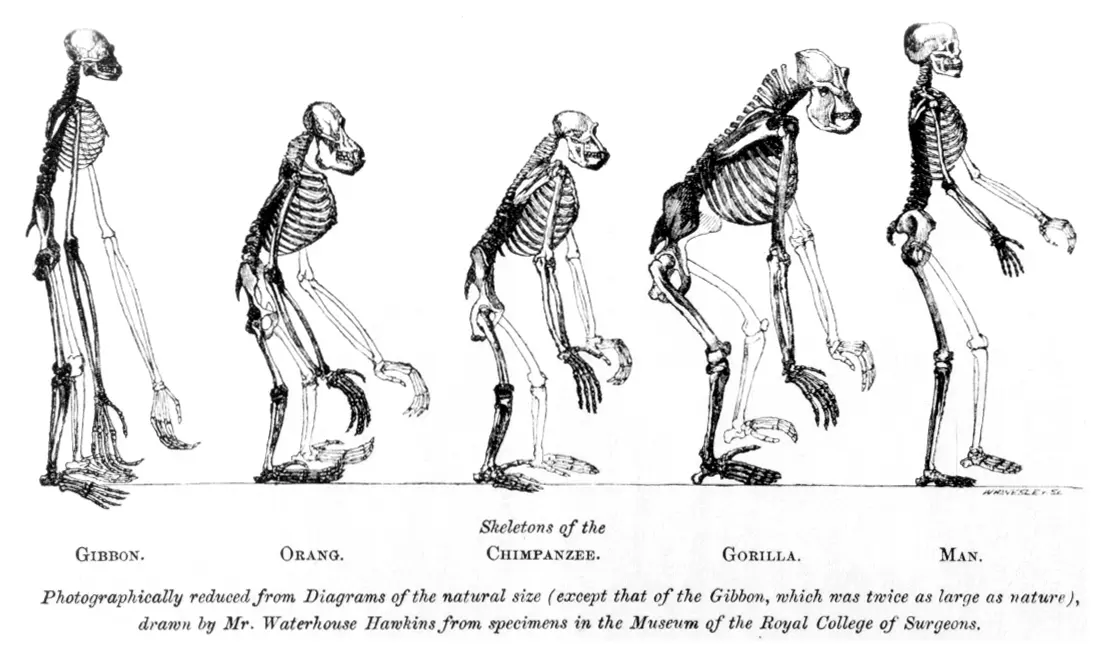
For most of history, people had no idea where humans, Homo sapiens, came from. Today the evidence of fossils, of comparative anatomy and of DNA all point the same way: humans are primates, the order of mammals that includes lemurs, monkeys and apes, and we share common ancestors with all of them.
The primates’ story begins with small, shrew-like, insect-eating placental (eutherian) mammals that lived alongside the dinosaurs in the Cretaceous period. After the dinosaurs died out, 66 million years ago, the first primate-like mammals appeared in the Paleocene epoch, and the first true primates, small tree-dwellers with grasping hands and forward-facing eyes, in the early Eocene, about 56 million years ago.
The primates are traditionally divided into two suborders:
- i.Prosimii (prosimians, “before monkeys”): small, mostly night-active tree-dwellers with long snouts, such as lemurs (only in Madagascar), lorises (the slow loris of Asia) and tarsiers.
- ii.Anthropoidea (anthropoids, “human-like”): the monkeys, apes and humans, with larger brains, flat faces and eyes facing forwards.
The anthropoids divide into two groups, named after the shape of their noses:
- Platyrrhini (“flat noses”): the New World monkeys of Central and South America.
- Catarrhini (“downward noses”): the monkeys of Africa and Asia, the apes and humans. The Catarrhini divide in turn into the Cercopithecoidea (the Old World monkeys: macaques, langurs, baboons) and the Hominoidea (the apes and humans).
The Hominoidea, which arose in the Miocene epoch, are of two families:
- Hylobatidae: the gibbons, the small apes of Southeast Asia, which swing through the trees by their long arms.
- Hominidae: the great apes and humans: orangutans, gorillas, chimpanzees and bonobos, and humans. Humans and their extinct close relatives, which walked upright on two legs, are called hominins.
In 1863, the English biologist Thomas Henry Huxley, comparing the skeletons, brains and teeth of apes and humans, showed in his book Evidence as to Man’s Place in Nature that humans are more like the African apes than the apes are like the monkeys. In The Descent of Man (1871), Darwin argued that humans and apes share a common ancestor, and predicted, because our closest relatives, the chimpanzee and gorilla, live in Africa, that humans had arisen in Africa. Fifty years later the fossils began to prove him right.
7.4.2 Differences between Platyrrhini and Catarrhini
| Platyrrhini (New World monkeys) | Catarrhini (Old World monkeys) |
|---|---|
| broad, flat nose, the nostrils wide apart and facing sideways | narrow nose, the nostrils close together and facing downwards |
| small to medium in size | medium to large in size |
| a long tail, which in some (the spider and howler monkeys) is prehensile: it can grip branches like a fifth hand | tail short or long, but never prehensile; some have almost none |
| thumb not fully opposable; many grip with the whole hand | thumb opposable in most: they can grip between thumb and fingers |
| 36 teeth: dental formula , three premolars in each half-jaw (marmosets 32, with two molars) | 32 teeth: dental formula , two premolars, as in apes and humans |
| no hard pads on the buttocks | hard sitting pads (ischial callosities) on the buttocks |
| arboreal: live only in the trees | arboreal or terrestrial: in trees or on the ground |
| native to Mexico, Central and South America | native to Africa and Asia |
| e.g. spider monkey, marmoset, capuchin, howler monkey | e.g. rhesus macaque, langur, baboon, proboscis monkey |
A dental formula gives the number of each kind of tooth in one half of the upper jaw over one half of the lower jaw, in the order incisors, canines, premolars, molars. The total number of teeth is twice the sum of the upper and lower numbers: for Old World monkeys, .
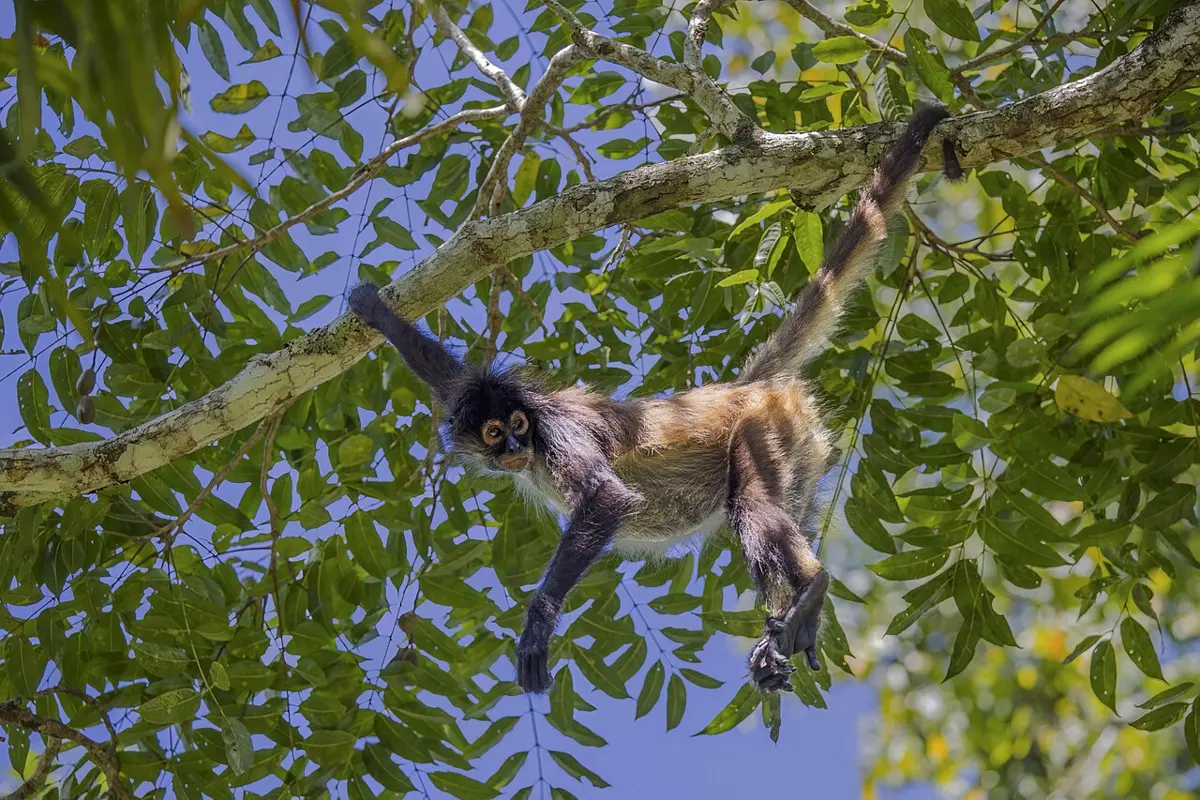
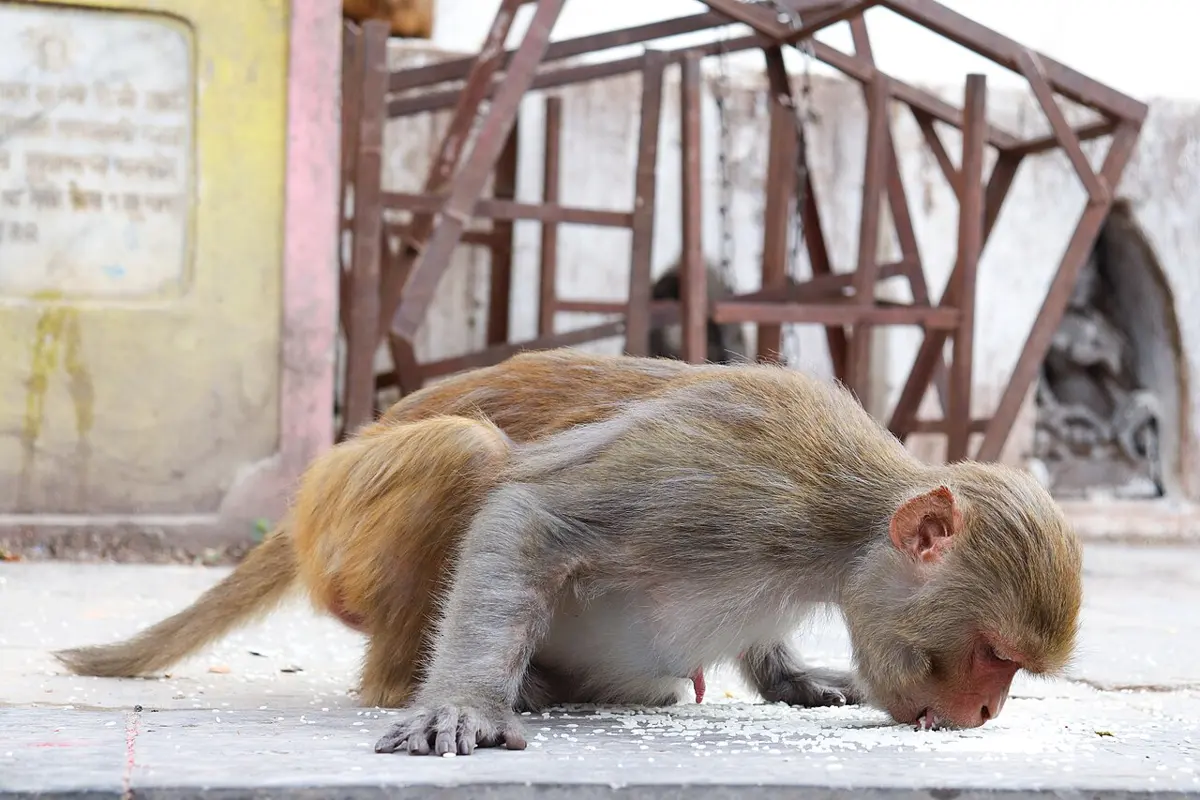
A monkey has 36 teeth and nostrils that face sideways. It is:
Pick an answer to see why.
7.4.3 Apes and man
Humans and the apes, especially the chimpanzee and gorilla, share many characters:
- i.Both lack a tail.
- ii.Both have large brains for their body size, larger than any monkey’s, and good memories.
- iii.Both have the same dental formula, 2.1.2.3, 32 teeth.
- iv.Both have flat nails, hands with an opposable thumb, and fingerprints.
- v.Both communicate with sounds, gestures and facial expressions, with well-developed face muscles showing anger, surprise, pleasure and laughter.
- vi.In both, females have a menstrual cycle.
- vii.Both have the ABO blood groups (chimpanzees have A and O, gorillas B), and very similar DNA: a human’s and a chimpanzee’s differ in only about 1.2% of the DNA letters in the stretches they share.
- viii.Both have a vermiform appendix and the same kinds of chromosomes (apes have 48, humans 46: two ape chromosomes are fused into our chromosome 2).
These likenesses show that apes and humans are cousins, descended from a common ancestor; they do not show that humans are descended from any living ape.
Table 7.2 Differences between apes and man
| Apes | Man |
|---|---|
| posture partly erect | posture fully erect |
| move on all fours (the African apes walk on their knuckles), or swing in trees; walk on two legs only for short distances | bipedal: walk and run on two legs |
| arms longer than legs | legs longer than arms |
| big toe (hallux) opposable, like a thumb; the foot grasps | big toe in line with the others, not opposable; the thumb (pollex) is opposable |
| foot flat, without an arch; the sole does not rest on the ground as a human’s does in walking | foot arched; heel and ball rest on the ground |
| vertebral column (backbone) with one gentle curve (C-shaped) | vertebral column with four curves (S-shaped), keeping the body balanced over the legs |
| pelvis long and narrow | pelvis short and bowl-shaped |
| foramen magnum (the hole for the spinal cord) towards the back of the skull | foramen magnum under the middle of the skull |
| skull with prominent brow ridges, low forehead | small brow ridges, high forehead |
| face and jaws project forwards | face flat, jaws not projecting |
| no chin | a prominent chin |
| large, projecting canines, with a gap (diastema) in the opposite jaw to fit them | small canines, no diastema |
| cranial capacity about 300–550 cc | cranial capacity about 1,350–1,450 cc |
| mainly plant-eaters (chimpanzees also hunt and eat some meat) | omnivores |
| make and use simple tools (chimpanzees use twigs to fish for termites, stones to crack nuts), but no spoken language | make complex tools; speak and write language |
| mostly forest-dwelling, partly in trees | live on the ground, in every habitat on Earth |
As ape-like ancestors evolved into humans, these were the main changes:
- i.walking on two legs (bipedalism), freeing the hands;
- ii.the big toe coming into line with the others, losing its grip;
- iii.an upright posture, with the lower back curve of the spine and a bowl-shaped pelvis;
- iv.a larger, more complex brain, from about 400 cc to about 1,350 cc;
- v.smaller brow ridges, canines and incisors, and a shorter face;
- vi.a distinct chin.
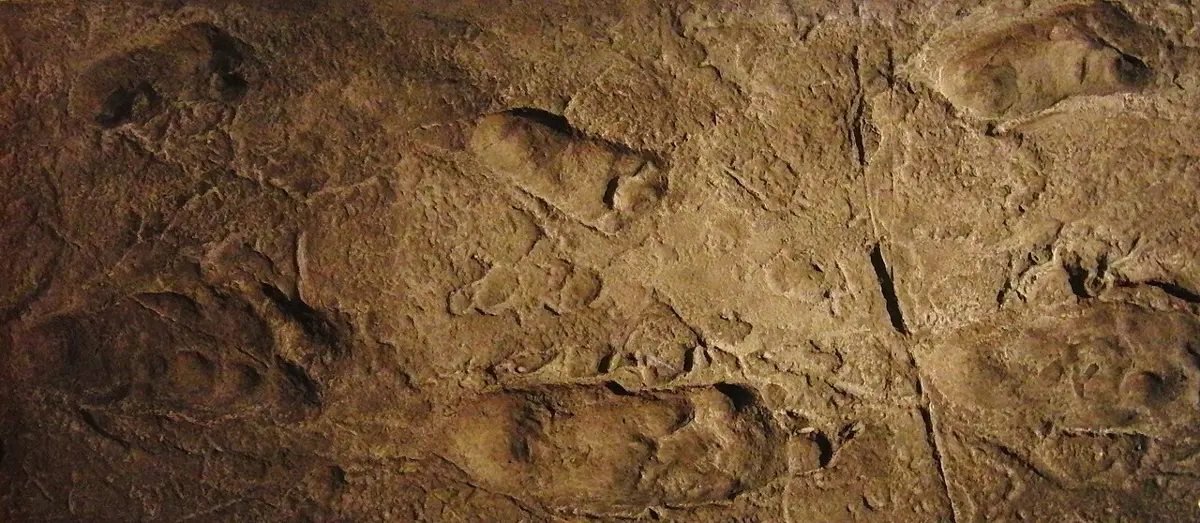
Walking upright came first, millions of years before the large brain: the Laetoli walkers had brains the size of a chimpanzee’s.
Which of these is a character that humans share with apes, but not with monkeys?
Pick an answer to see why.
7.4.4 Position of modern man in the animal kingdom
| Rank | Name |
|---|---|
| Kingdom | Animalia |
| Phylum | Chordata |
| Subphylum | Vertebrata |
| Class | Mammalia |
| Order | Primates |
| Family | Hominidae |
| Genus | Homo |
| Species | sapiens |
| Subspecies | sapiens |
So the scientific name of modern man is Homo sapiens, and of the subspecies, Homo sapiens sapiens. Homo is Latin for “man”, sapiens for “wise”.
7.4.5 Evolution of modern man
Fossils of human ancestors and relatives have been found in Africa, Europe and Asia, including India and Nepal’s Siwalik hills. They are told here in eight stages, from the earliest apes to modern man. The stages are a simplified line: in reality, the family tree of humans is a bush, with many branches that died out, and often several kinds of humans living at the same time.
1. Dryopithecus and Proconsul
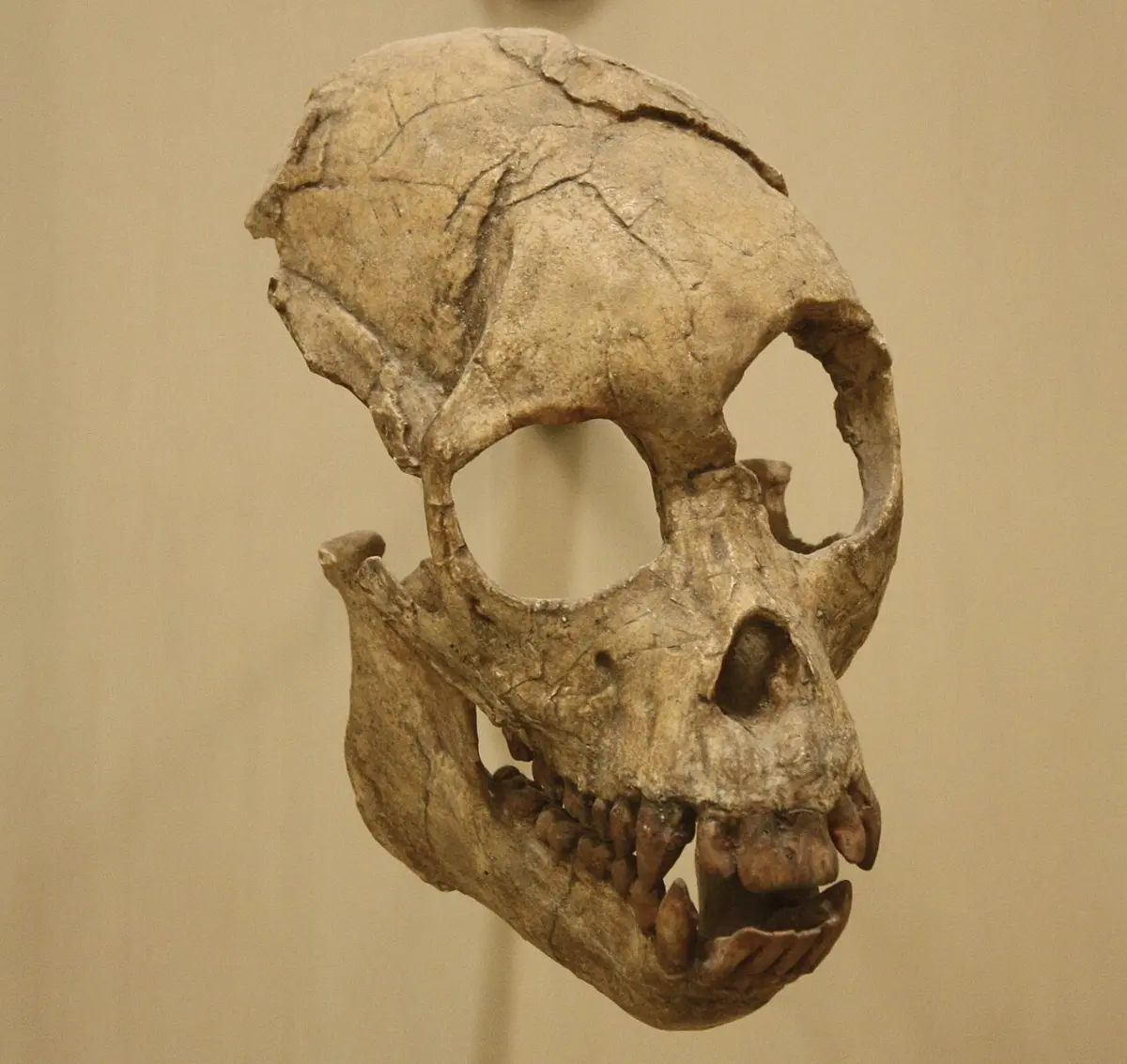
These were early apes of the Miocene epoch. Proconsul lived in East Africa about 20 to 17 million years ago. Mary Leakey found its first nearly complete skull on Rusinga Island in Lake Victoria, Kenya, in 1948. In the 1960s it was classed for a time as a species of Dryopithecus, D. africanus, which is why the two names are often given together. Dryopithecus itself was a later ape of Europe, about 12 to 9 million years ago, first found in France in 1856.
Features of Proconsul:
- i.It had no tail, like apes, but a body like a monkey’s, and walked on all fours along the tops of branches.
- ii.It lived in forests and ate soft fruit and leaves.
- iii.Its teeth were ape-like, with large canines; its brain was small, about 170 cc.
- iv.Its arms and legs were about equal in length, with no specialization for swinging or for walking on the ground.
Proconsul was close to the common ancestor of the apes and humans, but it is not thought to be a direct ancestor of humans.
2. Ramapithecus
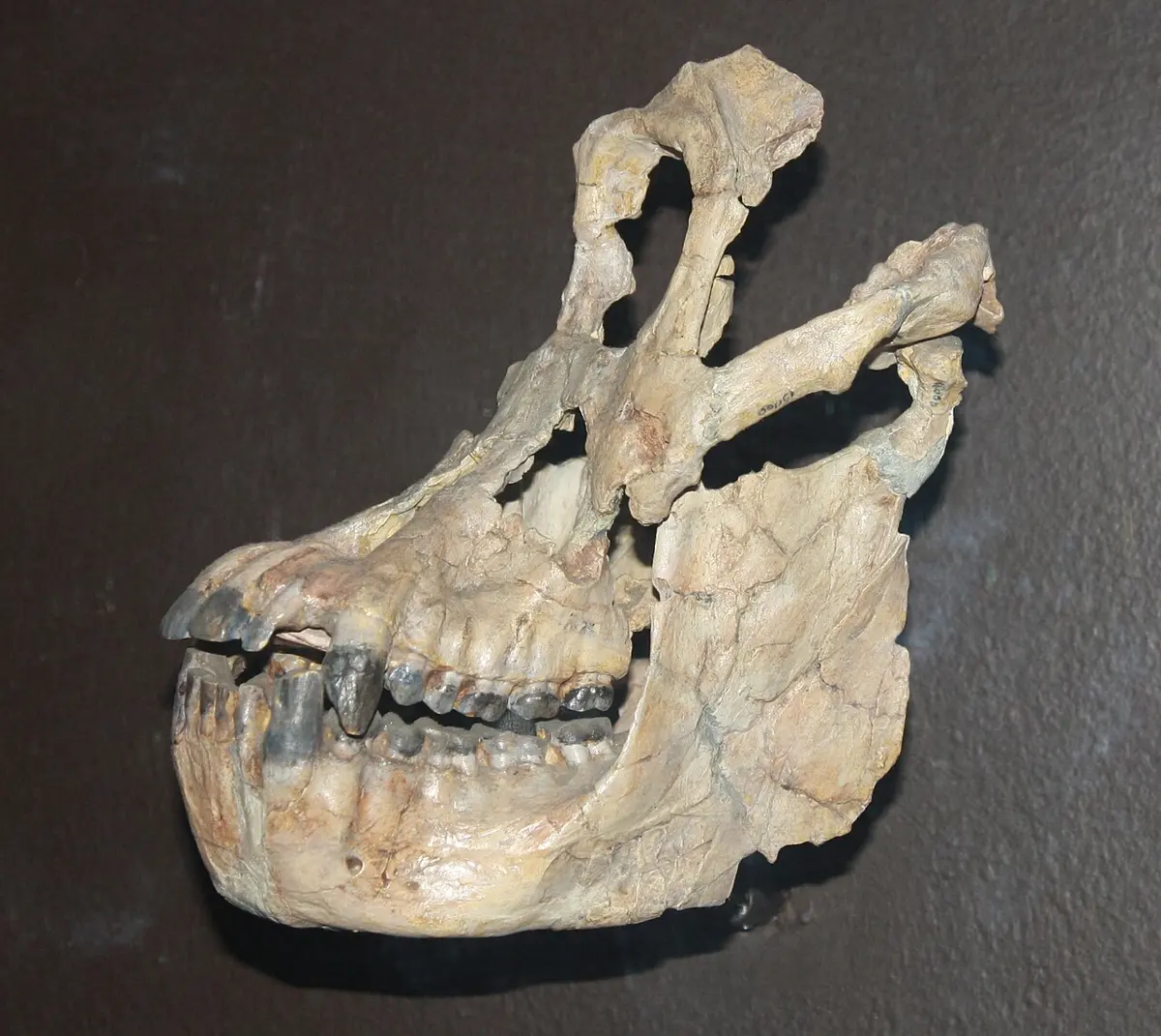
Ramapithecus was described from jaws and teeth found in the Siwalik hills of India by the American geologist G. Edward Lewis in 1932, in Miocene rocks about 12 to 8 million years old. More teeth were found later in Pakistan, Kenya and China, and in Nepal: an upper molar from the Tinau Khola near Butwal, reported in 1983, about 9 million years old.
Features as they were understood in the 1960s and 1970s:
- i.It had small canines and large, flat molars with thick enamel, like a human’s, suited to chewing hard seeds and nuts.
- ii.Its jaw, as reconstructed from pieces, seemed curved like a human’s, not U-shaped like an ape’s.
From these teeth, it was put forward as the first ancestor on the human line, after the human and ape lines had split. But in 1982, the paleoanthropologist David Pilbeam described a fine face of Sivapithecus from Pakistan, the same kind of ape, which looked strikingly like an orangutan’s. Today Ramapithecus is regarded as part of Sivapithecus, an ape on or near the orangutan’s line, and not a human ancestor. Studies of proteins and DNA, from 1967 on, had already shown that humans and the African apes split only about 6 to 7 million years ago, too recently for a 12-million-year-old ancestor.
The old books said there was a gap in the fossil record between Ramapithecus and Australopithecus. Fossils found since 2000 fill much of that gap (see the end of this unit).
3. Australopithecus: the southern apes (ape-men)
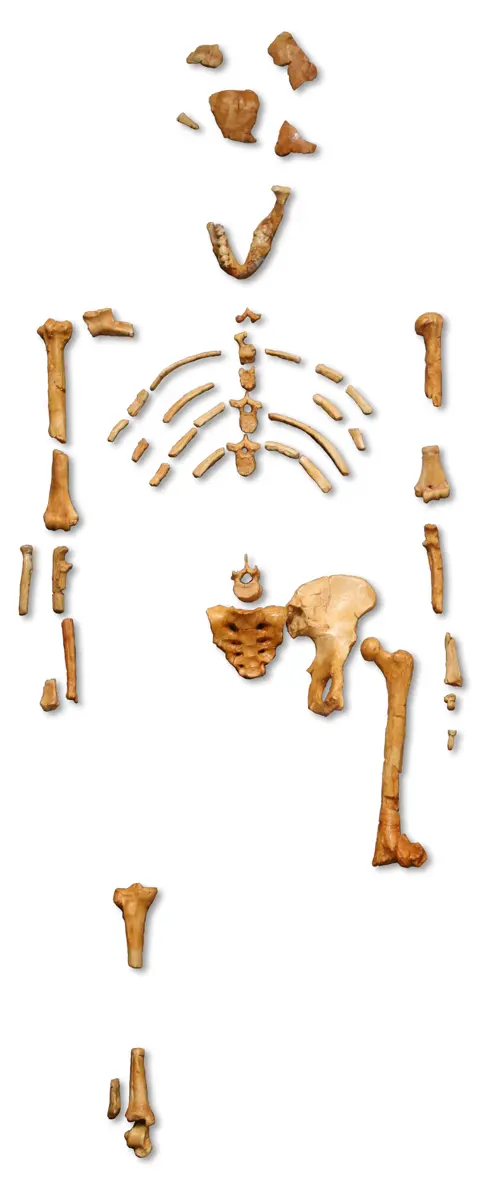
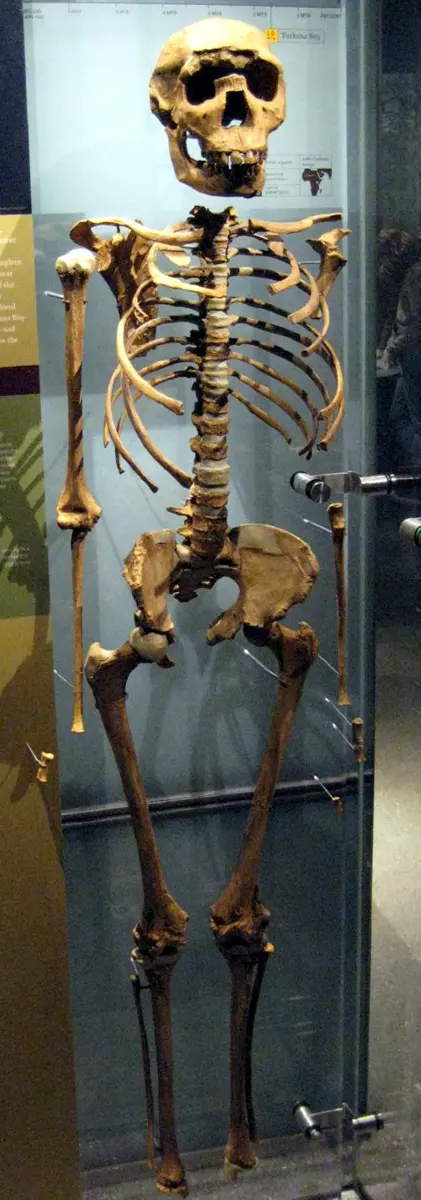
In 1924, quarrymen at Taung in South Africa sent a block of rock with a small skull in it to the anatomist Raymond Dart. It was the skull of a child of about three, and in 1925 Dart named it Australopithecus africanus, “the southern ape of Africa”. The hole for its spinal cord was under its skull, as in a human: it had walked upright. Few scientists believed him for twenty years; then more skulls were found, and he was proved right.
The australopithecines lived in eastern and southern Africa from about 4.2 to 2 million years ago. There were several species, of which these are best known:
- A. afarensis, 3.9–2.9 million years ago, in East Africa. Lucy, a 40% complete skeleton of a small adult female, 3.2 million years old, was found by Donald Johanson at Hadar in Ethiopia in 1974. The Laetoli footprints were made by her kind.
- A. africanus, 3.3–2.1 million years ago, in South Africa.
Features of A. africanus:
- i.It walked upright on two legs, with a human-like pelvis and knee, though it still had long arms and curved fingers and probably climbed trees too.
- ii.Its brain was about the size of a chimpanzee’s, about 450 cc, with a projecting face and jaws, brow ridges and no chin.
- iii.Its canines were small, like a human’s, but its molars large.
- iv.It ate mostly plant food (fruit, leaves, seeds, roots), with some insects and meat.
- v.It was small: males about 1.4 m tall, females about 1.15 m.
A second, heavier kind with huge jaws and molars and a crest on top of the skull for big chewing muscles was named Australopithecus robustus; it is now usually put in a genus of its own, Paranthropus. The robust ones were a side branch that died out about 1 million years ago.
Which australopithecine gave rise to the genus Homo is still debated; A. afarensis or a species close to it is the likeliest.
4. Homo habilis: the handy man
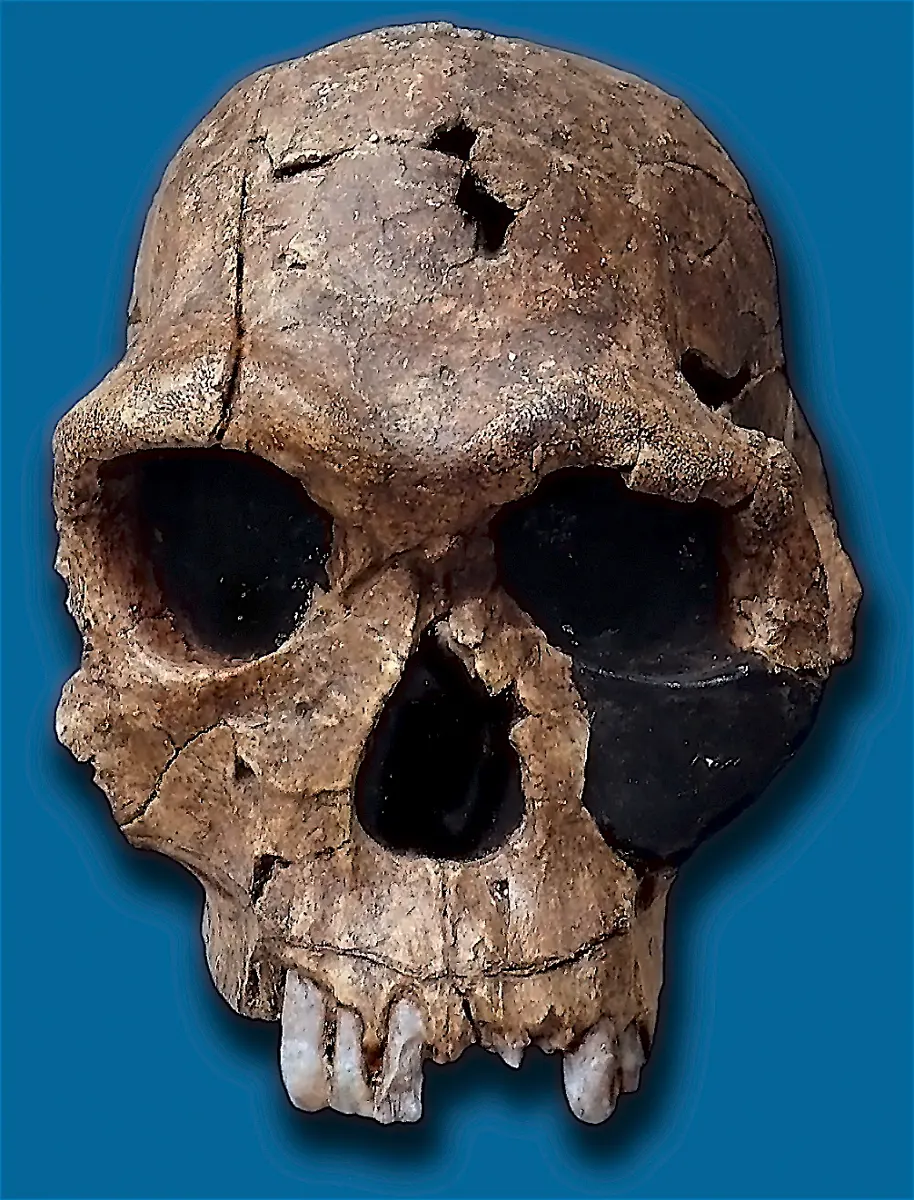
Between 1960 and 1963, at Olduvai Gorge in Tanzania, the team of Louis and Mary Leakey found pieces of skulls and hands of a hominin with a larger brain than any australopithecine, beside simple stone tools. In 1964 Louis Leakey, Phillip Tobias and John Napier named it Homo habilis, “handy man” (also called “skillful man” or “the tool maker”), as the maker of the tools.
- i.It lived in East and South Africa from about 2.4 to 1.4 million years ago.
- ii.It was small, about 1 to 1.35 m tall, with long arms, and walked upright.
- iii.Its brain was about 500 to 800 cc (about 610 cc on average), larger than an australopithecine’s.
- iv.Its face was smaller and less projecting, its teeth smaller.
- v.It made the simple Oldowan stone tools: pebbles with a few flakes knocked off to give a sharp edge, used to cut meat from carcasses and to break bones for marrow.
- vi.It was omnivorous, eating meat (much of it scavenged) as well as plants.
Homo habilis is the earliest well-known member of the genus Homo.
5. Homo erectus: the upright man
Homo erectus lived from about 1.9 million years ago until perhaps 110,000 years ago, longer than any other kind of human. It was the first human to leave Africa: its fossils have been found from Georgia to China and Indonesia.
- i.It was about as tall as a modern human, 1.45 to 1.85 m, with long legs and a body built for walking and running long distances.
- ii.Its brain grew over time from about 600 cc to 1,100 cc, about 900 cc on average.
- iii.Its skull was long and low, thick-boned, with heavy brow ridges, a sloping forehead, projecting jaws and no chin; its teeth were smaller than H. habilis’s.
- iv.It made more elaborate tools: the Acheulean hand axe, a stone shaped on both sides into a teardrop, from 1.76 million years ago.
- v.It ate much meat and hunted large animals.
- vi.It probably controlled fire: burnt bones and ash in a cave in South Africa are about a million years old, and hearths in Israel about 790,000.
Its best-known fossils were first described under other names:
(i) Java man (Pithecanthropus erectus, now Homo erectus erectus). In 1891, on the island of Java in Indonesia, the Dutch doctor Eugène Dubois, who had gone there to look for the “missing link”, found a skullcap and a thigh bone by the Solo river at Trinil. In 1894 he named it Pithecanthropus erectus, “upright ape-man”. Its brain was about 900 cc, and its thigh bone showed that it walked upright. The Trinil fossils are about half a million years old; H. erectus lived on Java from more than a million years ago until about 110,000 years ago.
(ii) Peking man (Sinanthropus pekinensis, now Homo erectus pekinensis). In the caves of Zhoukoudian near Beijing (then Peking), China, a tooth was found in 1927 and named Sinanthropus pekinensis by Davidson Black; in 1929 the Chinese paleontologist Pei Wenzhong found the first skullcap. In 1950 the biologist Ernst Mayr placed it with Java man in the one species, Homo erectus. Remains of about 40 individuals were found, with stone tools, from about 750,000 to 400,000 years ago. Their brains were 850–1,200 cc. The original fossils were lost in 1941, during the Second World War, and only casts remain.
(iii) Heidelberg man (Homo heidelbergensis). In 1907 a workman digging in a sandpit at Mauer near Heidelberg, Germany, found a large, heavy lower jaw without a chin, but with teeth like a human’s; it was described in 1908. It is about 600,000 years old. It was once called Homo erectus heidelbergensis, but most experts now treat it as a species of its own, Homo heidelbergensis, which lived in Europe and Africa from about 700,000 to 200,000 years ago, with a brain of about 1,250 cc. It is thought to be the ancestor of the Neanderthals in Europe and perhaps of Homo sapiens in Africa.
Which of these was the first kind of human known to have spread out of Africa?
Pick an answer to see why.
6. Neanderthal man (Homo neanderthalensis)
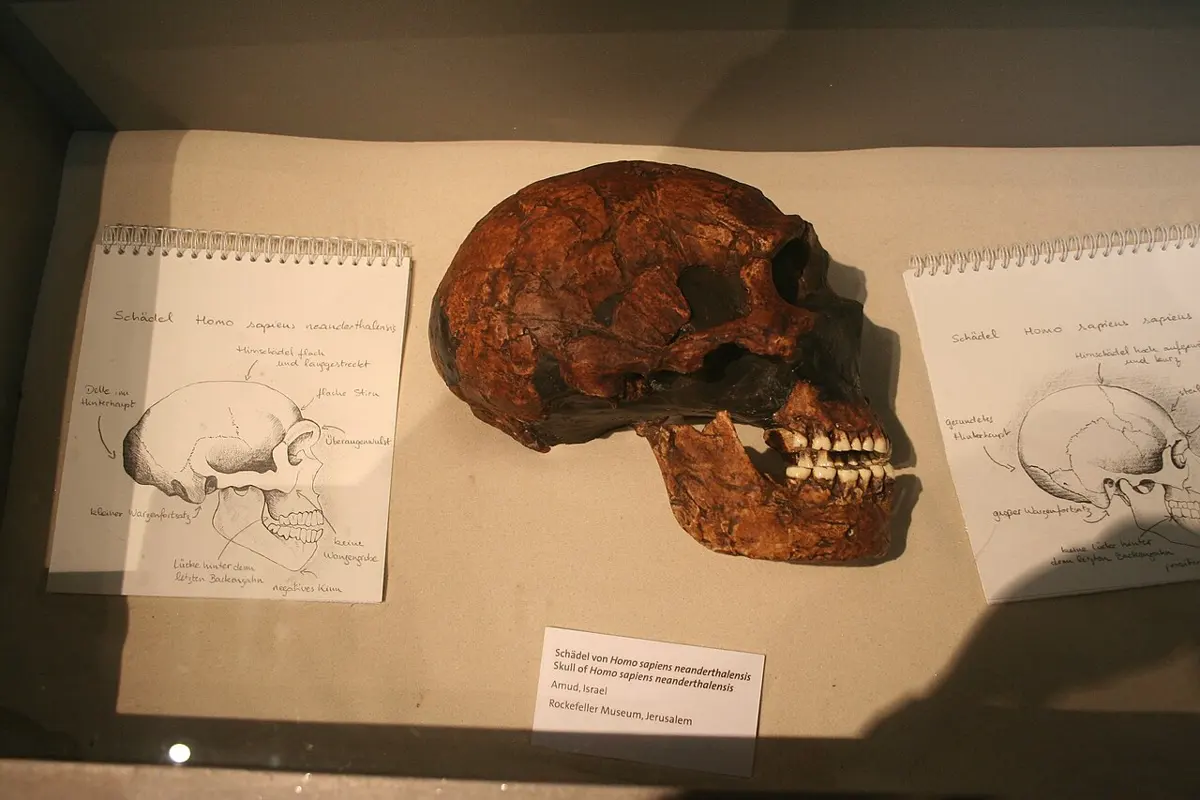
In 1856, quarry workers in a cave in the Neander valley near Düsseldorf, Germany, found a skullcap and bones, which the teacher Johann Carl Fuhlrott recognized as an ancient human. It was named Homo neanderthalensis in 1864. (Some scientists call it Homo sapiens neanderthalensis, a subspecies of our own species.) Hundreds of Neanderthals have been found since.
Neanderthals lived in Europe and western and central Asia, as far east as Siberia, from about 400,000 to 40,000 years ago. They were adapted to the cold of the ice ages.
- i.They were short and stocky, about 1.65 m (men) and 1.55 m (women), with thick bones and strong muscles: a body that kept heat in.
- ii.Their brain was large, about 1,450 cc on average, as large as ours or larger.
- iii.Their skull was long and low, with a bulge at the back, heavy brow ridges, a low, sloping forehead, a large face and nose projecting forward, large front teeth, and no chin.
- iv.They made skilled stone tools (the Mousterian tools: points and scrapers struck from prepared cores), and hunted large animals such as mammoths, bison and deer with spears.
- v.They lived in caves and rock shelters, controlled fire, and probably wore clothes of skins.
- vi.They buried some of their dead, cared for the sick and injured (one man at Shanidar in Iraq lived for years with a withered arm and a blind eye), and at some sites made ornaments of shells and eagle claws.
Neanderthals died out about 40,000 years ago, soon after modern humans arrived in Europe. Why is still debated: competition with Homo sapiens, small and scattered populations, and the sharp swings of the ice-age climate all probably played a part. But they did not vanish completely: modern humans interbred with them, and about 1–2% of the DNA of everyone whose ancestors lived outside Africa today is Neanderthal. This was shown by Svante Pääbo, who read the Neanderthal genome from their bones in 2010 and won the Nobel Prize in Physiology or Medicine in 2022.
7. Cro-Magnon man
In 1868, workmen building a railway at Les Eyzies in France opened a rock shelter called the Cro-Magnon, and the geologist Louis Lartet dug out the skeletons of at least five people, buried with shell ornaments, about 28,000 years old. Cro-Magnon man (sometimes Homo sapiens fossilis) is the name given to these and the other early modern humans of Europe, who lived there from about 45,000 to 10,000 years ago, in the late Pleistocene, the last ice age. They were Homo sapiens, people like us.
- i.They were tall, often 1.7–1.8 m, with long legs.
- ii.Their skulls were high and rounded, with a vertical forehead, small brow ridges, a short, flat face, a narrow nose and a prominent chin.
- iii.Their brains were large, about 1,500 cc on average (the old man of Cro-Magnon about 1,600 cc), a little larger than ours, as were the brains of most people of the ice age, who were bigger and heavier than people are now.
- iv.They made fine tools of stone blades, and of bone, antler and ivory: spear-throwers, harpoons, and needles with eyes for sewing clothes.
- v.They lived as hunter-gatherers in groups, in caves, rock shelters and huts, and did not yet farm or keep animals (except perhaps the dog).
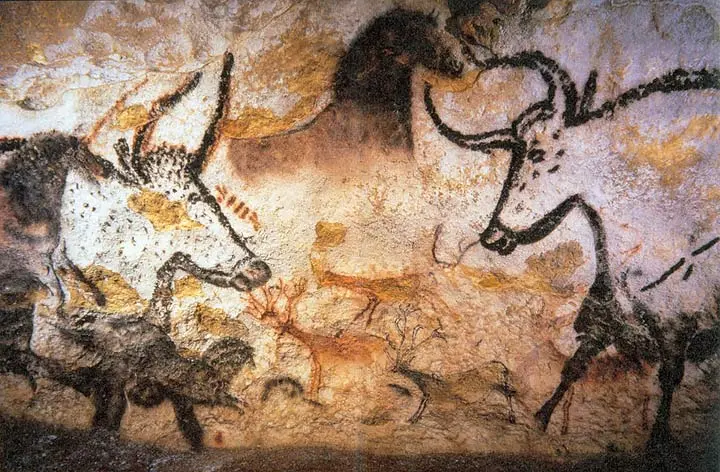
- vi.They made art: paintings of horses, bison, aurochs and deer deep in caves such as Lascaux (about 17,000 years ago) and Chauvet (over 30,000 years ago) in France, carvings of ivory, and ornaments of shells and teeth.
Cro-Magnon man did not go extinct: they are among the ancestors of the people of Europe today.
8. The living modern man (Homo sapiens sapiens)
Modern humans arose in Africa: the oldest fossils of Homo sapiens, from Jebel Irhoud in Morocco, are about 300,000 years old, and early modern skulls are known from Ethiopia from about 230,000 and 160,000 years ago. Groups of modern humans moved out of Africa more than once; the move from which all people outside Africa today descend happened about 70,000 to 60,000 years ago. From there they spread along the coasts of Asia and reached Australia by about 50,000 years ago (perhaps 65,000), Europe about 45,000 years ago, and the Americas, across a land bridge from Siberia, at least 20,000 years ago.
Modern humans have:
- i.a high, rounded skull, thin-boned, with a high forehead;
- ii.a cranial capacity of about 1,350 cc on average (books give 1,350 to 1,450; from about 1,100 to 1,700 in different people), a little less than the people of the ice age;
- iii.small brow ridges, a flat face under the forehead, small teeth, and a prominent chin;
- iv.a backbone with four curves, and a fully upright body.
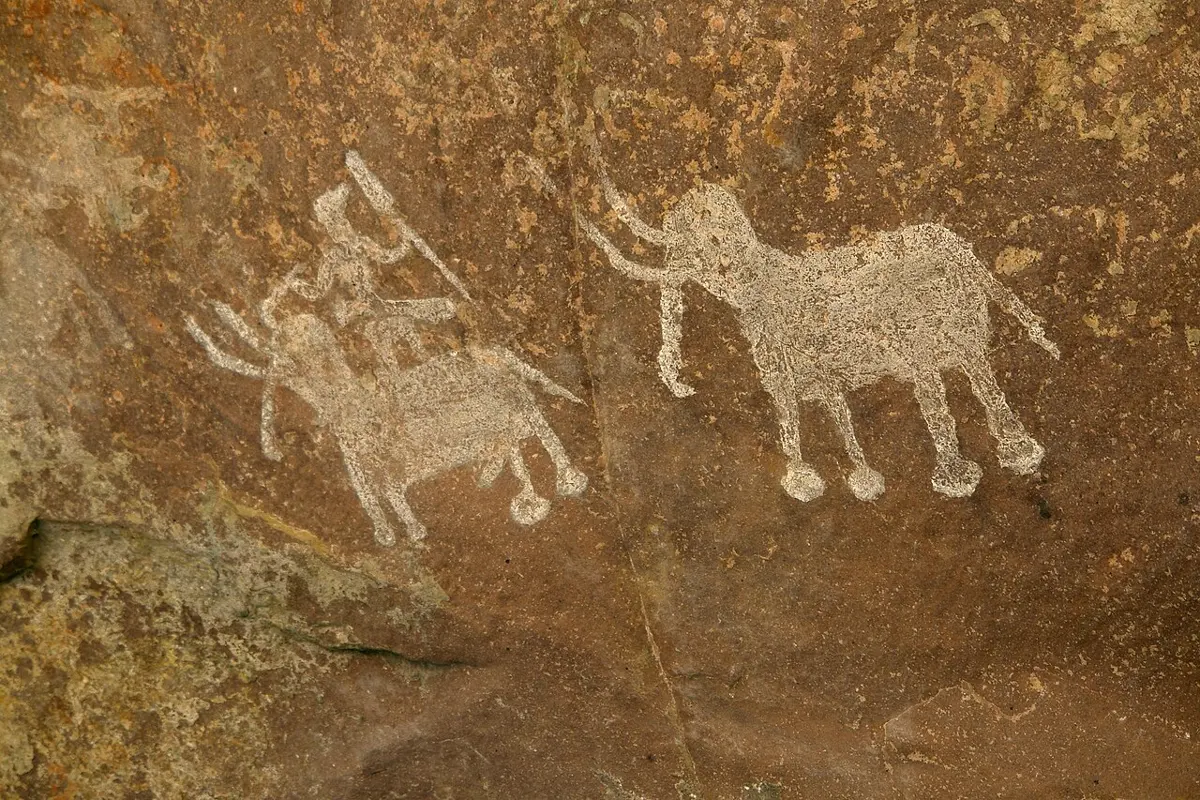
After about 50,000 years ago, the evolution of humans has been more cultural than anatomical: tools, language, art, clothing and settlement have changed far faster than bodies. People painted the rock shelters of Bhimbetka, in the Raisen district of Madhya Pradesh in India, from more than 10,000 years ago. About 11,000 to 10,000 years ago, people in the Fertile Crescent of western Asia, and later elsewhere, began to farm crops and keep animals; villages, then towns, followed.
What newer finds have added
The eight stages above follow the order of the fossils as they were known about fifty years ago. Since then, three discoveries have changed the picture.
1. The gap is filling. Fossils from just after the human and chimpanzee lines split have been found in Africa: Sahelanthropus from Chad, about 7 million years old; Orrorin from Kenya, about 6 million; and Ardipithecus, from Ethiopia, about 4.4 million, a partly upright walker that could still grasp with its big toe. The “gap” between Ramapithecus and Australopithecus was really a gap in what had been found, and in the wrong place: the human line began in Africa, not in Asia.
2. Many kinds of humans lived at once. Two million years ago, Homo habilis, Homo erectus and Paranthropus all lived in East Africa together. As recently as 50,000 years ago, there were at least five kinds of humans on Earth: Homo sapiens, the Neanderthals, the Denisovans, and two small-bodied island species, Homo floresiensis on Flores in Indonesia (about 1 m tall) and Homo luzonensis in the Philippines. We are the only one left.
3. DNA from the past. Since 2010, the genomes of Neanderthals and Denisovans have been read from their bones. They show that our species interbred with both, and that their genes live on in people today, as the gene for life at high altitude does in Tibetans and Sherpas.
Exercise
A. Tick the correct alternative
- Which epoch of the Cenozoic era saw the evolution of the first primates resembling present-day tree-shrews?
Pick an answer to see why.
- What is the characteristic feature that distinguishes Platyrrhini (New World monkeys) from Catarrhini (Old World monkeys)?
Pick an answer to see why.
- Which feature is a distinguishing characteristic of Platyrrhini (New World monkeys)?
Pick an answer to see why.
- Which of the following primates is classified under the suborder Prosimii?
Pick an answer to see why.
B. Answer the following questions
What is the dental formula for Catarrhini?
Answer
Compare the nasal structure and dental characteristics of Platyrrhini and Catarrhini.
Answer
Describe two similarities and two differences between apes and modern humans.
Answer
Explain the significance of the fossils of Dryopithecus and Ramapithecus in understanding human evolution.
Answer
Describe the main characteristic features of Australopithecus and its importance in human evolutionary history.
Answer
Discuss the key differences between Neanderthal man and Cro-Magnon man, highlighting their respective contributions to human evolution.
Answer
Trace the evolutionary lineage from Dryopithecus to Homo sapiens sapiens, detailing the major milestones and characteristic adaptations that occurred during this journey.
Answer
Compare and contrast Homo habilis and H. erectus in terms of their physical characteristics, behavior, and cultural advancements.
Answer
Printable PDFs
- Study notes 4 pages
- Worksheet 5 pages Answer key
Quiz yourself: Heredity and Evolution, Grades 5–12 →
Practice every question in the book, and keep track of the ones you miss →
A companion to your textbook, not a replacement for it: study from the book your school uses, and where the two differ, follow your teacher. Found a mistake? Please tell us.