
A tiger in Chitwan has never eaten a blade of grass, yet without the grass it would starve. It eats chital, and the chital eat grass, and the grass lives on sunlight. Follow the sunlight’s energy from the grass to the tiger and you find that only a tiny part of it ever arrives. Where does the rest go? And why does the carbon in the tiger’s body, unlike its energy, come back round to the grass again?
This unit is about those connections: how living things depend on each other and on the non-living world, how energy flows through an ecosystem in one direction, how nutrients cycle round and round, and how a bare landslide scar turns, over many years, into a forest.
4.1.1 Concept of ecology
Everything in the world falls into two groups. The living things, of every kind, make up the biotic components. The non-living things, such as soil, water, air and light, make up the abiotic components.
The study of how living things are related to each other and to their non-living surroundings is called ecology. The word comes from the Greek oikos, a house or home, and logos, study: literally, the study of organisms “at home”. Their home includes the whole physical environment and all the other organisms living in it. So ecology is the branch of biology that studies the interrelationships between organisms and their environment.
The German biologist Ernst Haeckel first used the word, as Oecologie, in his book Generelle Morphologie der Organismen in 1866. In 1885 the German writer Hanns Reiter used it in the title of a book, which is why some books name Reiter as the one who coined it.
Ecology is divided into two parts:
| Autecology (autoecology) | Synecology | |
|---|---|---|
| Studies | one species, or a population of one species, and its environment | groups of different species living together (a community) and their environment |
| Asks, for example | How does the rhododendron Rhododendron arboreum respond to altitude, frost and soil? | How do the trees, shrubs, herbs, deer, birds and fungi of a Mahabharat oak forest live together? |
| Also concerned with | the life history and adaptations of that species | the structure, development and causes of distribution of a whole community |
A student spends a year recording how the flowering time of laligurans changes with altitude on one hillside. Which kind of ecology is this?
Pick an answer to see why.
The word ecology comes from the Greek oikos. What does oikos mean?
Pick an answer to see why.
4.1.2 Ecological factors
Any factor, non-living or living, that affects living things is an ecological factor (environmental factor). Alone or together, these factors decide whether a plant community can live in a place at all, and if it can, whether it grows strong or weak, and how successful it is. They fall into two groups.
1. Abiotic factors
The non-living things of the environment are abiotic factors. Those that affect living things fall into three groups: climatic, topographic and edaphic factors.
a. Climatic factors
i. Sunlight. The most important factor, because it is the source of energy for almost all living things. Plants need it for photosynthesis and to make chlorophyll; it controls the opening of stomata and so transpiration. Animals need it to see; it sets their daily and seasonal rhythms, affects the color of their skin and fur (pigmentation), their metabolism, and when they move and migrate.
ii. Temperature. Almost every process in a living thing is driven by enzymes, which work only within a range of temperature. In plants it affects transpiration, respiration, photosynthesis, seed germination, flowering, growth and development. In animals it affects reproduction and coloration, and some animals escape the extremes: hibernation (a winter sleep, as in Himalayan black bears), aestivation (a summer sleep, as in some snails and lungfish) and migration to warmer places.
iii. Pressure. Atmospheric pressure falls with height: on the summit of Everest it is only about a third of what it is at sea level, so each breath holds about a third as much oxygen. Plants and animals that live high up must cope with this thin air, so the life of a place changes with its pressure.
iv. Rainfall. The type of vegetation and how dense it is depend on how much rain falls, and when. Heavy rain all through the year favors evergreen forest; little rain slows plant growth and favors xerophytic vegetation (plants of dry places). Nepal shows both within a short distance: the southern slopes of the Annapurna range are among the wettest places in the country, while Jomsom and Upper Mustang, just behind the range in its rain shadow, are almost a desert.
v. Humidity. The amount of water vapor in the air. It directly affects the rate of transpiration, and through it the absorption of water and photosynthesis: in humid air a leaf loses water slowly; in dry air, fast.
b. Topographic factors
These are the features of the land’s surface: altitude (height above sea level), latitude, the slope and its steepness, and which way the slope faces (its aspect). They act mostly by changing the climatic factors. Going up a mountain, the air cools by roughly 6 °C for every 1,000 m. A south-facing slope in Nepal gets more sun and is warmer and drier than a north-facing one beside it, which is why you often see pine on one side of a ridge and dense, mossy oak forest on the other.
c. Edaphic factors
These are the factors of the soil (Greek edaphos, ground): its texture (sand, silt, clay), the organisms living in it, its temperature, its pH, and the air and water held between its particles.
2. Biotic factors
The living things of the environment are the biotic factors. By how they get their food, they are grouped as producers, consumers and decomposers.
a. Producers. Green plants (and other photosynthetic organisms) make their own food from carbon dioxide and water using sunlight. In a forest or grassland the main producers are herbs, shrubs and trees; in water they are the phytoplankton (tiny floating algae and cyanobacteria), larger algae and water plants.
b. Consumers. Animals can’t make their own food, so they depend, directly or indirectly, on plants: they are heterotrophs. They are grouped by what they eat:
- i. Primary consumers (herbivores) eat the producers: rats, rabbits, deer, grasshoppers.
- ii. Secondary consumers eat primary consumers: frogs, insect-eating birds, predatory insects such as dragonflies, small fishes.
- iii. Tertiary consumers eat secondary consumers: snakes, big fishes, tigers, leopards, hawks.
c. Decomposers. Bacteria and fungi feed on the dead bodies and wastes of other organisms. They break the complex organic matter down into simple inorganic substances (carbon dioxide, water, ammonia, mineral salts), which plants can use again.
Jomsom gets very little rain although it lies only about 50 km from some of the wettest slopes in Nepal. Which kind of factor mainly explains this?
Pick an answer to see why.
In a forest, a fungus grows on a fallen sal log and slowly turns it into crumbly soil. What is its role?
Pick an answer to see why.
4.1.3 Species interaction
All the living organisms of a place together form a biotic community. Every organism in it affects others, directly or indirectly, and no living thing survives without interacting with others. An interaction can be between members of the same species (an intraspecific interaction, such as two tigers fighting over a territory, or bees working together in a hive) or between different species (an interspecific interaction, such as a tiger hunting a chital).
The clearest way to sort interactions is to ask what each partner gets out of it: does it gain (+), lose (−), or is it not affected (0)?
1. Positive interactions
In a positive interaction, one or both partners gain, and neither is harmed.
a. Mutualism (symbiosis). Two species live together and both gain, and the relationship is obligatory: neither can live well without the other. Rhizobium bacteria live in the root nodules of legumes such as gram, lentil and soybean: the plant gives them food and a home, and they fix nitrogen from the air for the plant. Mycorrhiza is a fungus living on or in a plant’s roots: it brings the root water and phosphate from the soil, and gets sugar in return. A lichen is an alga and a fungus so closely joined that they look like one organism.
b. Commensalism. One partner gains and the other is neither helped nor harmed (+, 0). Epiphytes, such as the orchids on the branches of sal and chilaune trees, get a place in the light; they make their own food and take nothing from the tree. The sucker fish (remora) holds on to a shark with a sucker on its head, gets a free ride and the scraps of the shark’s meals; the shark loses nothing.
c. Protocooperation. Both gain, but the relationship is not obligatory: each can live without the other. Bees and butterflies take nectar from flowers and carry their pollen. A myna or a drongo riding on a buffalo picks ticks off its skin: the bird gets food, the buffalo is cleaned, and either can manage alone.
d. Colonization. Individuals of the same species grow together in a group, a colony, which gives better protection and food. Volvox is a ball of hundreds of cells; Nostoc is a chain of cells in a jelly.
e. Social organization. Individuals of the same species live in a group with a division of labor: honey bees, wasps, ants and termites, where the queen lays eggs, workers gather food and build, and soldiers defend.
2. Negative interactions
In a negative interaction, at least one partner is harmed.
a. Parasitism. One organism, the parasite, lives on or in another, the host, and feeds on it; the parasite gains and the host is harmed, but usually not killed at once (+, −). A mosquito sucking blood, a leech on cattle, a tapeworm in the gut, Cuscuta (akashbeli) twining round a hedge.
b. Predation. One organism, the predator, kills and eats another, the prey (+, −). A tiger and a chital, a frog and an insect, an owl and a mouse.
c. Competition. Organisms of the same or different species need the same limited resource (food, water, light, space, mates), so each gets less because of the other: both are harmed (−, −). Weeds compete with rice for light and nutrients; seedlings on a forest floor compete for the light coming through a gap; lichens spreading over a bare rock compete for space; tigers and leopards in Chitwan hunt the same deer.
| Interaction | Partner 1 | Partner 2 | Example |
|---|---|---|---|
| Mutualism | + | + (obligatory) | Rhizobium and a legume |
| Protocooperation | + | + (not obligatory) | a myna and a buffalo |
| Commensalism | + | 0 | an orchid on a tree |
| Parasitism | + | − | a leech and a cow |
| Predation | + | − (killed) | a tiger and a chital |
| Competition | − | − | weeds and rice |
| Amensalism | 0 | − | Penicillium and the bacteria it kills |
The last row is one more kind that ecologists name: amensalism, where one partner is harmed and the other is not affected. The mold Penicillium gives off penicillin, which kills bacteria near it; the mold gains nothing in particular from it.
Bees visit the flowers of a mustard field, taking nectar and carrying pollen, but the mustard can also be pollinated by the wind and the bees can feed elsewhere. What is this interaction?
Pick an answer to see why.
Which of these is an intraspecific interaction?
Pick an answer to see why.
4.1.4 Concept of ecosystem
No organism lives alone. A plant depends on the air for light, carbon dioxide and a suitable temperature, and on the soil for water and minerals. An animal depends on plants, directly or through other animals, for food and shelter. Microorganisms feed on the dead matter of plants and animals and, as they break it down, release the nutrients locked in it for plants to use again. So the living things and their surroundings are always acting on each other, and together they make one integrated, working unit.
That unit is an ecosystem: the structural and functional unit of ecology, in which living organisms interact with each other and with their surrounding environment. The word was coined by the British botanist A. G. Tansley in 1935. An ecosystem can be any size, from a small pond or a rotting log to a forest, a lake or the sea. Ecosystems are of two basic kinds:
- terrestrial (on land): forest, grassland, desert;
- aquatic (in water): pond, lake, river, sea.
Structural and functional aspects of a pond ecosystem
A pond is a small body of fresh water, which may or may not dry up in the dry season. Left alone, a pond keeps itself going: it is self-sustaining and self-regulating. Like every ecosystem, it can be described in two ways: what it is made of (its structure) and what it does (its function).
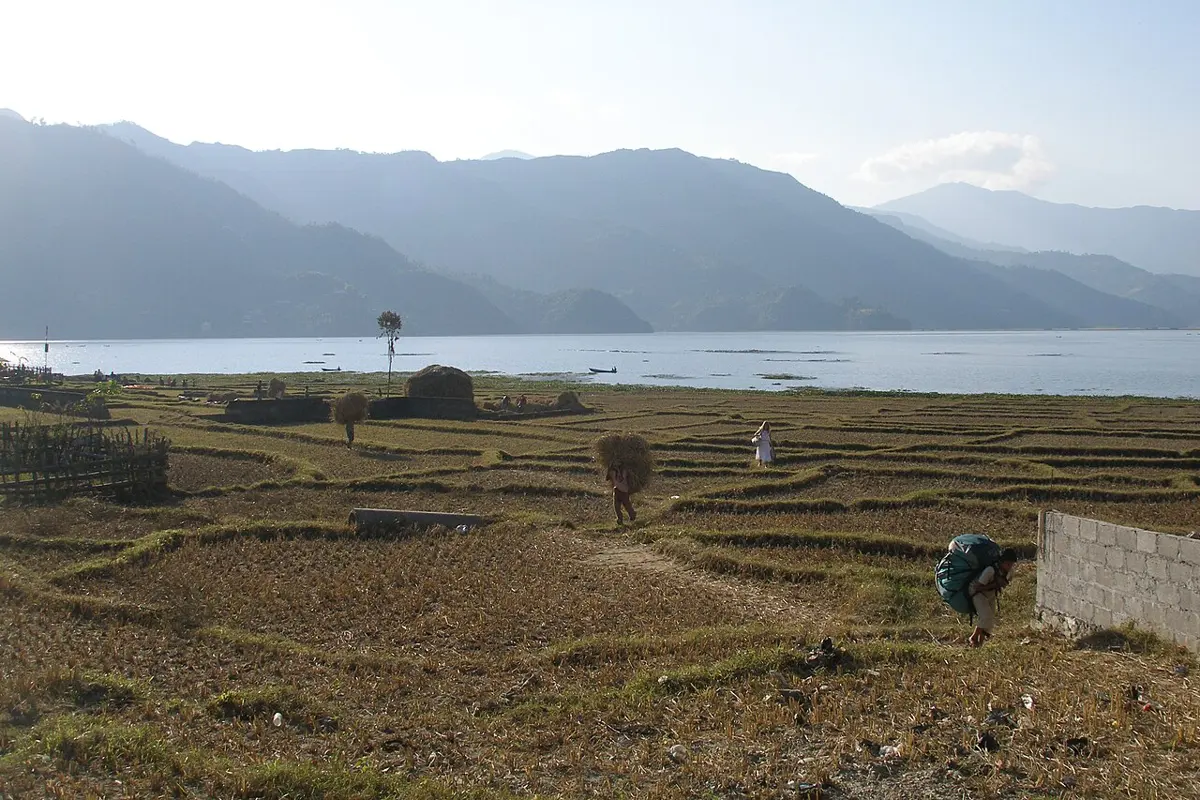
Structural components
A. Abiotic components. The non-living things of the pond: water, the minerals dissolved in it, oxygen, carbon dioxide, the mud at the bottom, and the energy of sunlight.
B. Biotic components. The living things of the pond:
- Producers. Algae and other water plants, which make food by photosynthesis. They are of two sizes:
- phytoplankton, tiny floating or suspended algae and cyanobacteria such as Volvox, Spirogyra, Anabaena and Ulothrix;
- macrophytes, larger plants that may float, be suspended, or be rooted and submerged: Chara (a large alga), Hydrilla, Marsilea, Eichhornia (water hyacinth) and Lemna (duckweed).
- Consumers.
- Primary consumers (the herbivores of the pond) eat green plants and algae: tadpoles, small fishes, and zooplankton such as Daphnia.
- Secondary consumers eat the primary consumers: frogs, big fishes, crabs.
- Tertiary consumers eat the secondary consumers: water birds such as egrets and kingfishers, water snakes, crocodiles.
- Decomposers. When pond plants and animals die, great numbers of bacteria and fungi in the water and mud attack their bodies and turn the complex organic substances into simple inorganic compounds and elements.
Functional components
What the pond does comes down to two things:
- the flow of energy;
- the flow (cycling) of nutrients.
The green plants and algae of the pond capture solar energy and turn it into the chemical energy of food, stored in their bodies, by photosynthesis. The rate at which they do this is the pond’s primary productivity (4.1.8).
The primary consumers (tadpoles, small fishes) get their energy by eating the plants. They are eaten by secondary consumers (frogs, crabs), which are eaten by tertiary consumers (water birds, snakes). In this chain of eating and being eaten:
- the green plants are the first trophic level;
- the primary consumers, the second;
- the secondary consumers, the third;
- the tertiary consumers, the fourth.
This line of trophic levels is a food chain, and energy flows along it. At each level, much of the energy is used in respiration and lost as heat, so less and less energy is left as you move away from the first level. The heat can’t be used again by any living thing, so the flow of energy is one-way (unidirectional).
Organisms at every level also die and produce wastes (fallen leaves, droppings, dead bodies). This dead organic matter, detritus, feeds a second kind of chain, the detritus food chain. A real ecosystem has many food chains of both kinds, linked together into a food web.
The nutrients behave quite differently. The producers take carbon dioxide and minerals from the water, air and mud, the nutrients pass from organism to organism along the food chains, and in the end the decomposers break down the organic compounds of every level and release the nutrients back into the water, mud and air, where the producers take them up again. Because the same nutrients are used again and again, this is called biogeochemical cycling (4.1.9).
Structural and functional aspects of a forest ecosystem
A forest is a terrestrial ecosystem. It has the same two kinds of components.
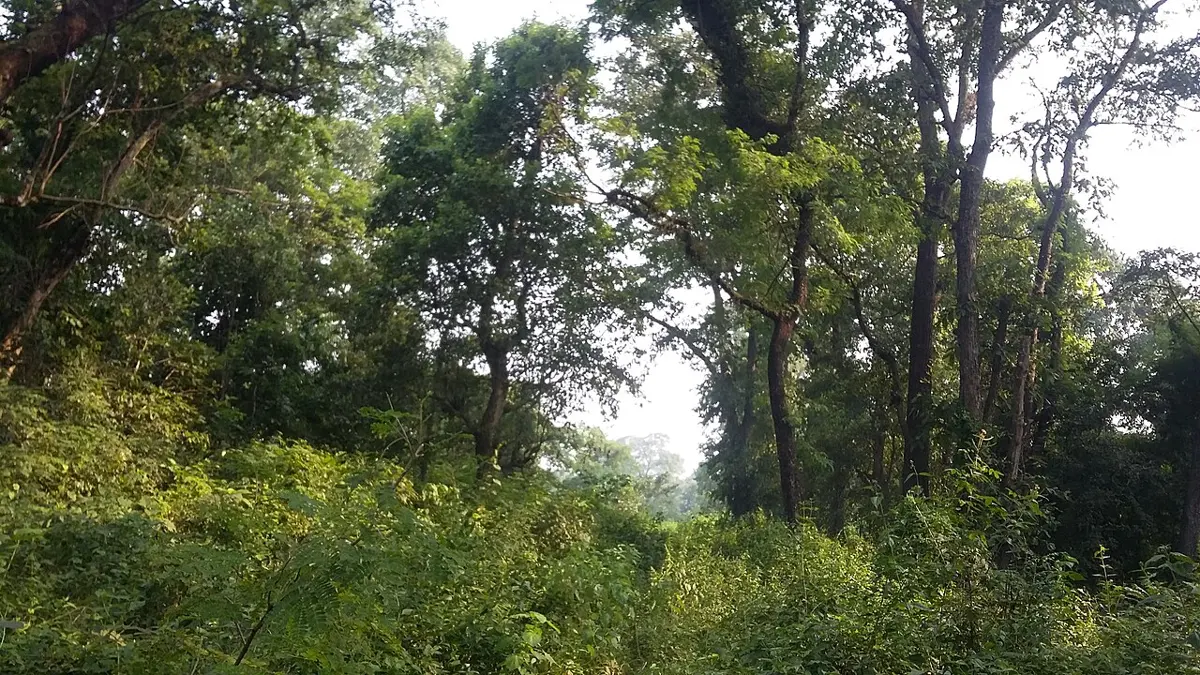
Structural components
A. Abiotic components. The non-living things of the forest: soil, water (moisture), air, minerals and sunlight.
B. Biotic components.
- Producers. All the green plants of the forest: trees, shrubs, herbs, climbers, lichens, mosses and algae. They are the source of food for every animal in the forest.
- Consumers. All the animals, which can’t make their own food:
- primary consumers take their food straight from the producers: grasshoppers and caterpillars, rabbits, deer, monkeys, fruit- and seed-eating birds;
- secondary consumers eat primary consumers: wolves and jackals, frogs, lizards, insect-eating birds;
- tertiary consumers eat secondary consumers: tigers, leopards, hawks and eagles.
- Decomposers. Bacteria and fungi in the soil and the leaf litter break down the dead bodies of producers and consumers into simple inorganic compounds and elements, which the producers take up again.
Functional components
As in the pond, the forest’s function is the flow of energy and the cycling of nutrients.
The forest’s green plants capture solar energy and store it as the chemical energy of food (primary productivity). Grasshoppers, rabbits and deer eat the plants; wolves and frogs eat them; tigers and hawks eat those. The plants form the first trophic level, the herbivores the second, their predators the third and the top predators the fourth. At every step energy is lost as heat, so it flows one way; the leaves, wood, droppings and bodies that fall to the forest floor feed the detritus food chain; and the chains are linked into a food web. The nutrients go round: from soil and air into the plants, along the food chains, and back to soil and air through the decomposers.
Which statement about a pond ecosystem is correct?
Pick an answer to see why.
Which of these is an abiotic component of a pond ecosystem?
Pick an answer to see why.
In a pond, what returns the nutrients locked in dead plants and animals to the water?
Pick an answer to see why.
4.1.5 Trophic level
The trophic level (Greek trophe, food) of an organism is the position it occupies in a food chain or food web. It shows where the organism stands in the transfer of energy and nutrients through the ecosystem.
| Trophic level | Who is there | Examples (forest) | Examples (pond) |
|---|---|---|---|
| First (T₁) | producers: green plants, algae, photosynthetic bacteria | grass, trees | phytoplankton, Hydrilla |
| Second (T₂) | primary consumers (herbivores) | grasshopper, deer | zooplankton, tadpoles |
| Third (T₃) | secondary consumers | frog, jackal | small fish, frog |
| Fourth (T₄) | tertiary consumers | snake, tiger, hawk | big fish, egret, snake |
An animal that eats at more than one level, like a bear that eats fruit and fish, or a person who eats rice and chicken, belongs to more than one trophic level at once. That is one reason a real ecosystem is a web, not a single chain.
A person eats a meal of rice and fish curry. The fish had eaten smaller animals that fed on algae. At which trophic levels is the person feeding?
Pick an answer to see why.
Grass is eaten by grasshoppers, grasshoppers by frogs, and frogs by snakes. At which trophic level is the frog?
Pick an answer to see why.
Why are there seldom more than four or five trophic levels in a food chain?
Pick an answer to see why.
4.1.6 Food chain and food web
In an ecosystem, energy passes from one trophic level to the next by eating and being eaten. The line it follows is a food chain. The arrows in a food chain point from the food to the eater: the way the energy goes. There are basically three types of food chain.
1. Grazing food chain. It starts from living green plants, passes through herbivores, and ends with carnivores (the top consumer). In Chitwan: grass → chital → tiger. In a paddy field: rice → grasshopper → frog → snake → eagle. In a pond: phytoplankton → zooplankton → small fish → big fish → kingfisher.
2. Detritus food chain. The dead organic matter and wastes left by the grazing chain (fallen leaves, dead bodies, dung) are detritus. A food chain that starts from detritus is a detritus food chain: fallen leaves → earthworm → blackbird → hawk; or dead leaves → woodlouse → frog. In a forest, far more energy flows through the detritus chain than the grazing chain, because most leaves fall uneaten.
3. Parasitic food chain. It starts from a producer or a consumer and passes from a large host to smaller organisms living on or in it, without killing it. A parasite may itself carry a parasite, a hyperparasite. A tree → Loranthus (aijeru) growing on it; a dog → fleas → Leptomonas (a protozoan living in the flea’s gut).
Food web
Most animals eat more than one kind of food, and most are eaten by more than one kind of enemy. So the food chains of an ecosystem are not separate: they cross and join into a network, a food web.
A food web makes an ecosystem stable. If one kind of food becomes scarce, an animal that eats several kinds can switch to another, so its population doesn’t crash. The more links in the web, the more stable the ecosystem.
Which is a detritus food chain?
Pick an answer to see why.
What is the first link of a detritus food chain?
Pick an answer to see why.
4.1.7 Ecological pyramid
At each step of a food chain, a large part of the energy is used for living and lost as heat. So each trophic level passes on less energy to the next than it received. This limits the number of steps in a food chain (rarely more than four or five): the longer the chain, the less energy is left for its last members.
If the amount of energy at each level is drawn as a bar, the producers’ bar at the bottom, each bar is narrower than the one below, and the stack tapers like a pyramid. An ecological pyramid is the graphical representation of a quantity (number, biomass or energy) at the successive trophic levels of an ecosystem, in the form of a pyramid. The producers form the base, and each level above makes the next step towards the apex.
There are three types:
- pyramid of number;
- pyramid of biomass;
- pyramid of energy.
1. Pyramid of number
The pyramid of number is the graphical representation of the number of organisms at each trophic level of an ecosystem. It shows how the numbers of producers, herbivores and carnivores compare.
In a grassland or a pond, producers (grass plants, phytoplankton) are far more numerous than the herbivores that eat them, and the herbivores more numerous than the carnivores, so the pyramid is upright. But numbers don’t take size into account:
- in a forest, a single large tree feeds thousands of insects, so the producers are fewer than the herbivores and the base is narrow: the pyramid is spindle-shaped (partly inverted);
- in a parasitic food chain (one tree, many birds, thousands of lice), each level is more numerous than the one it lives on: the pyramid is inverted;
- in a detritus food chain, many small organisms feed on one dead plant or animal, which also gives an inverted shape.
So the pyramid of number is usually upright, but it can be spindle-shaped or inverted.
2. Pyramid of biomass
Biomass is the total mass of living matter, usually weighed dry, in each square meter. The pyramid of biomass is the graphical representation of the biomass of organisms at each trophic level of an ecosystem.
- In grasslands and forests, the producers have by far the largest biomass, and it decreases at each level up, so the pyramid is upright.
- In a pond, a lake or the sea, the producers are the tiny phytoplankton. At any moment their total mass is less than that of the zooplankton and fish that eat them, so the pyramid is inverted.
How can a smaller mass of food support a larger mass of eaters? Phytoplankton live only a few days and divide very fast: the same small mass is eaten and replaced again and again. In the English Channel, ecologists measured about 4 g of phytoplankton in every square meter against 21 g of zooplankton. A pyramid of biomass shows only what is there at one moment (the standing crop), not how fast it is made.
3. Pyramid of energy
The pyramid of energy is the graphical representation of the energy flowing through each trophic level of an ecosystem, usually in kJ per square meter per year. It is always upright and can never be inverted. Producers trap solar energy in photosynthesis and store it in organic matter; that energy passes to the next level when they are eaten, and at every step much of it is used in respiration and lost as heat. So each level always receives less energy than the level below it. Even in a pond, where the biomass pyramid is inverted, the fast-growing phytoplankton make more energy available in a year than the zooplankton receive.
The ten percent law
How much energy passes from one level to the next? In 1942 the American ecologist Raymond Lindeman measured the energy at each level of a lake and found that only a small part passed on. As a rough rule, about 10% of the energy at one trophic level reaches the next; the other 90% is used in respiration, lost as heat, or left uneaten for the decomposers. This is the ten percent law. Real values range from about 5% to 20%, but 10% is a good rule of thumb.
In a lake, the phytoplankton present at one moment weigh less than the zooplankton. Which pyramid will be inverted?
Pick an answer to see why.
Why can a pyramid of energy never be inverted?
Pick an answer to see why.
In the sea, the biomass of the phytoplankton at any moment is less than that of the zooplankton that eat them. How is that possible?
Pick an answer to see why.
4.1.8 Productivity
The productivity of an ecosystem is the rate at which biomass (organic matter) is produced in a given area over a given time. It is measured as dry mass, in g/m² a year, or as the energy stored in it, in kJ/(m² year), kilojoules per square meter per year.
1. Primary productivity is the rate at which the producers make organic compounds from inorganic ones (carbon dioxide and water) using solar energy. It is of two kinds:
- a. Gross primary productivity (GPP): the total organic matter (or energy) made by the producers in photosynthesis.
- b. Net primary productivity (NPP): what is left after the producers have used part of it in their own respiration. Only the NPP is available to the herbivores and decomposers.
where R is the energy the producers use in respiration.
2. Secondary productivity is the rate at which energy is stored in the bodies of consumers (as new tissue: growth and young).
Which quantity is the food actually available to the herbivores of a grassland?
Pick an answer to see why.
A grassland’s producers have a GPP of 25,000 kJ/(m² year) and use 10,000 kJ/(m² year) in respiration. What is the NPP?
Pick an answer to see why.
Which of these ecosystems has the highest net primary productivity on each square meter?
Pick an answer to see why.
4.1.9 Biogeochemical cycle
Living things need many chemical elements: carbon, hydrogen, oxygen, nitrogen, phosphorus, sulphur, calcium and more. Some build their bodies (structural parts); others are parts of enzymes that control their life processes. These elements are exchanged all the time between living things and their physical environment, never used up.
The biogeochemical cycle is the cyclic movement of inorganic nutrients (essential elements) between the abiotic environment and the biotic community. The name tells the story: bio (living things), geo (rocks, soil, air and water) and chemical (the elements).
Biogeochemical cycles are of three types:
- the hydrological cycle (the water cycle);
- gaseous cycles, whose main reservoir is the air (or the sea): the carbon, oxygen and nitrogen cycles;
- sedimentary cycles, whose main reservoir is the rocks and soil: the phosphorus, calcium and sulphur cycles. They are slow, because an element locked in a rock is released only when the rock is weathered.
Carbon cycle
Carbon is the building block of life: every biological compound (carbohydrate, fat, protein, nucleic acid) is built on a frame of carbon atoms, and carbon is also in many minerals. The carbon cycle is the cyclic movement of carbon compounds between the biotic and abiotic components. Its main reservoirs are the carbon dioxide in the air, about 0.04% of it (427 parts per million in 2025, up from 0.03% a century ago), the CO₂ dissolved in water, and the carbonate rocks such as limestone.
The carbon cycle has these processes:
1. Photosynthesis. Producers use carbon dioxide from the air or water to make carbohydrates:
Part of this fixed carbon the plant uses for its own life processes; the rest is stored in its body (its biomass), food for the heterotrophs. In this way carbon fixed by producers enters the food chain and passes to consumers and decomposers.
2. Respiration. Every living thing oxidizes food to release energy, giving out carbon dioxide and water:
At each trophic level some carbon goes back to the air this way; the rest is stored in the body and may be eaten by the next level.
3. Decomposition. When organisms die, decomposers break down the dead organic matter and, by their own respiration, release its carbon to the air as carbon dioxide (or, where there is no oxygen, as in a marsh or a rice field, as methane, CH₄).
4. Combustion (burning). Wood, and fuels made from once-living things, give out carbon dioxide when burned. Over millions of years, the bodies of plants and animals buried before they could fully decay (in swamps, or under sea and lake mud) were turned by heat and pressure into the fossil fuels, coal, petroleum and natural gas. Burning them puts back into the air, in a few centuries, carbon that was taken out over millions of years. Forests are large stores of carbon too: forest fires and burning firewood return their carbon to the air.
Nitrogen cycle
Nitrogen is part of many biomolecules: amino acids and proteins, nucleic acids (DNA and RNA), chlorophyll, ATP and some vitamins. The air is about 78% nitrogen, but almost no living thing can use the nitrogen gas (N₂) directly: its two atoms are held by a very strong triple bond. Plants can take up nitrogen only as nitrate (NO₃⁻) or ammonium (NH₄⁺) from the soil. So nitrogen must first be fixed, turned into these compounds.
The nitrogen cycle has these steps.
1. Nitrogen fixation
The conversion of free nitrogen gas from the air into nitrogen compounds that living things can use is nitrogen fixation. It happens in three ways.
a. Biological nitrogen fixation. Certain microorganisms turn atmospheric nitrogen into ammonia with an enzyme, nitrogenase. Some live in symbiosis with plants: Rhizobium in the root nodules of legumes (gram, lentil, beans, peas, soybean, clover); Anabaena inside the leaves of the water fern Azolla, which farmers grow in rice fields; Nostoc in the coralloid roots of Cycas. Others are free-living in the soil and water: the bacteria Azotobacter and Clostridium, and cyanobacteria such as Nostoc and Anabaena.
b. Atmospheric nitrogen fixation. The great heat of a lightning flash makes nitrogen and oxygen in the air combine, forming nitric oxide, which is oxidized further to nitrogen dioxide:
Nitrogen dioxide dissolves in the moisture of the air, forming nitric acid, which falls with the rain:
In the soil, the nitric acid reacts with minerals such as calcium carbonate to form nitrates:
c. Industrial nitrogen fixation. In factories, nitrogen and hydrogen are made to combine into ammonia by the Haber process (about 450 °C, about 200 times the pressure of the air, with an iron catalyst):
The ammonia is made into nitrogenous fertilizers such as urea, ammonium sulphate and ammonium nitrate.
2. Nitrogen assimilation
Plants take up nitrate and ammonium from the soil through their roots and use them to make organic nitrogen compounds: amino acids, proteins, nucleic acids. The nitrogen passes to animals along the food chain, and they build their own proteins and nucleic acids from it. This is assimilation.
3. Ammonification
When organisms die, and in their wastes (urine, dung), the nitrogen of proteins and other compounds is turned into ammonia by ammonifying bacteria and fungi, decomposers such as Bacillus ramosus, Bacillus mycoides and Proteus vulgaris. This is ammonification. In the soil, ammonia dissolves to form ammonium ions:
4. Nitrification
Nitrification is the conversion of ammonia (ammonium) into nitrite and then into nitrate, by nitrifying bacteria, in two steps. They are chemosynthetic: they get their energy from these very reactions.
5. Denitrification
Denitrification is the conversion of nitrate in the soil back into free nitrogen gas, which returns to the air:
It is done by denitrifying bacteria such as Pseudomonas and Thiobacillus denitrificans, in waterlogged soils with little oxygen, where they use nitrate instead of oxygen to respire. This closes the cycle. (A little of the nitrous oxide, N₂O, escapes on the way: it is a greenhouse gas, Unit 15.)
6. Sedimentation
Some nitrate is washed out of the soil by rain (leaching) into rivers and the sea, and down into deep layers of the earth, where it may become part of sediments and rocks. This nitrogen is released only when the rocks are exposed again and weathered, so it is out of the cycle for a very long time.
Which group of bacteria turns ammonium into nitrate in the soil?
Pick an answer to see why.
Which process returns carbon to the air as carbon dioxide?
Pick an answer to see why.
Rice fields that stay waterlogged lose nitrogen to the air. Which process is responsible?
Pick an answer to see why.
4.1.10 Concept of succession
Picture a bare patch of land: a fresh landslide scar on a hillside, or a field the family has stopped farming. At first it seems empty. But within a year mosses and grasses appear; then shrubs; years later young trees; and after many decades the patch is forest again, much like the forest around it. Nature is always changing, and this slow, orderly change of the living community of a place is succession.
Succession is the gradual replacement of one biological community by another in an area over time, leading to the establishment of a stable and mature community, the climax community.
- The first community to grow in a bare area is the pioneer community.
- Each passing community is a seral community (or seral stage), and the whole series is a sere.
- The final community, more or less stable as long as the climate stays the same, is the climax community.
Succession starts because bare areas are made by erosion, landslides, deforestation, fire, floods and volcanic eruptions; it is driven by biological interactions (competition, the changes organisms make to their surroundings, predation, the grouping of plants) and by changes of climate.
Moss: Jan Kops, Flora Batava vol. 8 (1846), public domain
Grass: O. W. Thomé, Flora von Deutschland (1885), public domain
Shrub: Andy Wilson, CC0, via PhyloPic
Young tree: G. B. Sudworth, The Forest Nursery (1900), public domain
Sal tree: ᱤᱧ ᱢᱟᱛᱟᱞ, CC BY-SA 4.0, via Wikimedia Commons
Types of succession
1. Primary succession takes place in an area where no life existed before and there is no soil: bare rock, cooled volcanic lava, sand dunes, the ground left by a retreating glacier. The pioneers are usually lichens (on rock) and then mosses. It is very slow, because the soil must be made first: often hundreds of years.
2. Secondary succession takes place where soil already exists but the earlier community has been removed or disturbed: by a landslide that left soil behind, a fire, a flood, or a field left fallow. The pioneers are usually mosses, grasses or fast-growing herbs, from seeds and roots already in the soil, and it is much faster: decades rather than centuries.
| Primary succession | Secondary succession | |
|---|---|---|
| Starts on | bare area with no soil and no life before | an area with soil where life was removed or disturbed |
| Examples | bare rock, lava, glacier foreland | abandoned field, burnt forest, cleared land |
| Pioneers | lichens, then mosses | mosses, grasses, herbs |
| Speed | very slow (centuries) | faster (decades) |
Process of succession
Succession runs through these steps:
- Nudation. A bare area is formed, by natural causes (landslide, volcanic eruption, flood, glacier retreat) or human ones (deforestation, construction, forest fire).
- Invasion. A species establishes itself in the bare area. Invasion has three parts: migration (seeds and spores arrive, by wind, water or animals), ecesis (they germinate and grow into adult plants) and aggregation (they increase in number and form groups).
- Competition and coaction. As their number grows, the individuals compete for light, water and nutrients. The ways in which individuals of a species, and of different species, affect each other’s lives are called coaction.
- Reaction. The living organisms change their own environment: they add humus to the soil, hold more water, cast shade. The changed conditions suit new species better than the old, so the existing community is replaced by another. Reaction drives succession on, step after step, until the climax.
- Stabilization. The community becomes stable under the conditions of the place and stays so for a long time: the climax community.
A field in Syangja is left unfarmed. Grasses come first, then shrubs, and after thirty years young chilaune and oak trees grow there. What is this?
Pick an answer to see why.
Which step of succession is the change that living things make in their own surroundings, which then lets other species replace them?
Pick an answer to see why.
Exercise
A. Tick the correct alternative
- What is the primary source of energy for all living organisms in an ecosystem?
Pick an answer to see why.
- What is the role of decomposers in ecosystems?
Pick an answer to see why.
- Which of the following is an example of mutualism?
Pick an answer to see why.
- What is the term for the linear arrangement of trophic levels in an ecosystem along which energy flows?
Pick an answer to see why.
- What is nudation in the process of succession?
Pick an answer to see why.
- What is the first biological community that develops in a bare area called?
Pick an answer to see why.
- Which of the following best defines nitrogen fixation?
Pick an answer to see why.
- What is the role of nitrifying bacteria in the nitrogen cycle?
Pick an answer to see why.
B. Answer the following questions
Who coined the term “ecology”? Define the term.
Answer
Explain the importance of sunlight in an ecosystem.
Answer
How does temperature affect plant and animal life in an ecosystem?
Answer
What role does rainfall play in determining vegetation types in an ecosystem?
Answer
Define positive interaction. Differentiate between mutualism and protocooperation.
Answer
Explain the concept of predation and provide an example.
Answer
How do intraspecific interactions differ from interspecific interactions?
Answer
What are the structural components of a pond ecosystem, and how do they contribute to its functioning?
Answer
What is succession? Describe the types and process of succession.
Answer
What is a biogeochemical cycle? Describe the nitrogen cycle in detail.
Answer
Printable PDFs
- Study notes 4 pages
- Worksheet 5 pages Answer key
Quiz yourself: Environment and Biodiversity, Grades 5–12 →
Practice every question in the book, and keep track of the ones you miss →
A companion to your textbook, not a replacement for it: study from the book your school uses, and where the two differ, follow your teacher. Found a mistake? Please tell us.