
Walk past a field of mustard near Pokhara in January and it hums: bees go from one yellow flower to the next, and each flower already has a thin green pod growing below it. In a few weeks the pods will split and scatter seeds. That flower, that pod and those seeds are what make a flowering plant. Nine out of every ten kinds of land plant on Earth are flowering plants: the rice and wheat you eat, the sal and the rhododendron in the forest, the grass in the playground, the marigolds of Tihar.
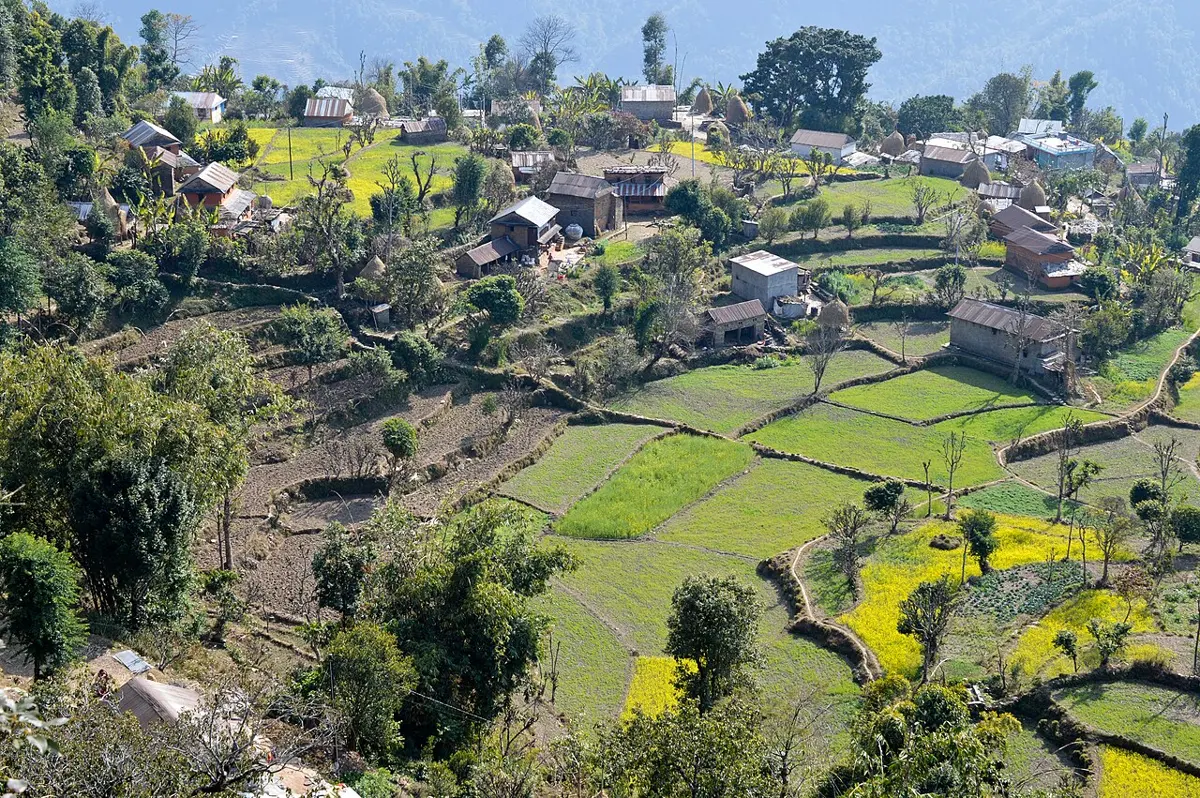
This unit is about the parts of a flowering plant, how botanists describe and name them, and how they sort plants into families. You will learn a short code, the floral formula, that fits a whole flower into one line, and use it for four families every Nepali farmer knows: mustard, pea, potato and onion.
2.8.1 Introduction to angiosperms
The word angiosperm comes from Greek: angeion, a vessel or case, and sperma, seed. It means “seed in a case”, because the ovules, and later the seeds, are enclosed in a hollow ovary. Compare a pine (a gymnosperm, “naked seed”): its seeds lie open on the scales of a cone.
Angiosperms are the largest group of the plant kingdom, about 300,000 known species. They live almost everywhere: in deserts and in rivers, in the Tarai’s heat and above 6,000 m on the Himalaya. They may live for one season, two, or many years, and come in every form and size:
| Life span | Meaning | Examples |
|---|---|---|
| annual | finishes its life (seed to seed) in one season or year | rice, mustard, maize |
| biennial | grows leaves and stores food in the first year, flowers and dies in the second | radish and carrot grown for seed, cabbage |
| perennial | lives for many years, flowering again and again | mango, sal, bamboo, rhododendron |
| Habit (form) | Meaning | Examples |
|---|---|---|
| herb | soft, green, non-woody stem | coriander, mustard |
| shrub | woody, many branches from near the ground, below about 5 m | hibiscus, rose |
| tree | woody, with one main trunk | sal, peepal, mango |
| climber | a weak stem that climbs on a support | pea, cucumber, Bauhinia vahlii (भोर्लो) |
2.8.2 Morphology of angiosperms
Morphology is the study of the outer form and features of an organism’s parts. In plants, it describes the roots, stems, leaves, flowers, fruits and seeds. (The study of the inside, the cells and tissues, is anatomy.)
The body of a typical flowering plant has two parts:
- the root system, below the ground;
- the shoot system, above it: the stem with its branches, leaves, flowers and fruits.
Tori: C. A. M. Lindman, Billeder af Nordens Flora (1901), public domain
Mustard root: C. A. M. Lindman, Billeder af Nordens Flora (1901), public domain
Root tip: New Student's Reference Work (1914), public domain
We will look at six organs in turn: the root, stem, leaf, inflorescence, flower and fruit.
1. The root
The root is the part of the plant that usually grows underground. It is not green, it is roughly cylindrical, and it has no nodes or internodes and no leaves or buds. It grows from the radicle of the embryo when the seed germinates. Roots grow away from light (they are negatively phototropic) and towards gravity (positively geotropic).
All the roots of one plant together are its root system. There are two kinds.
a. Tap root system. The radicle grows straight down into the main or primary root. From its sides grow secondary roots, from these tertiary roots, and then fine rootlets. The primary root and all its branches make the tap root system. Most dicots have one: mustard, pea, mango.
b. Fibrous root system. In monocots, the primary root from the radicle lives only a short time. It is soon replaced by a bunch of thin roots of about equal size growing from the base of the stem: the fibrous root system, as in rice, wheat, maize and onion.
Roots that grow from any part of the plant other than the radicle (the stem, a node, even a leaf) are called adventitious roots. The fibrous roots of grasses and sugarcane are adventitious; so are the prop roots that hang from the branches of a banyan (बर) and become new trunks.
Mustard root: C. A. M. Lindman, Billeder af Nordens Flora (1901), public domain
Onion: O. W. Thomé, Flora von Deutschland (1885), public domain
The roots of a maize plant all grow from the lowest nodes of its stem. What are they called?
Pick an answer to see why.
The regions of a root
Look at the tip of a growing root under a hand lens: a root grows only at its tip, and the tip has four regions, one behind the other.
- Root cap. A cap of loose cells over the very tip. It protects the tender tip as the root pushes between soil grains; its outer cells rub off and are replaced, and their slime helps the root slide through.
- Meristematic zone (region of cell division). Just behind (inside) the cap: small cells with thin walls, dense cytoplasm and large nuclei, that divide again and again, adding new cells.
- Region of elongation. The new cells stop dividing and grow longer, taking in water into large vacuoles. This lengthening pushes the tip forward: the root grows in length here.
- Region of maturation (region of differentiation). The cells become the root’s mature tissues. Many of its outer (epidermal) cells grow out as thin tubes, the root hairs, which give the root a huge surface for absorbing water and minerals from the soil.
Root tip: New Student's Reference Work (1914), public domain
Functions of the root
- Anchorage: roots fix the plant in the soil and hold up the parts above it.
- Absorption of water and minerals from the soil.
- Holding the soil, which prevents soil erosion. Grass and trees on a slope keep it from washing away in the monsoon.
- Breathing: in swamps the soil has little air, so the mangroves of the sea coast send up pneumatophores, respiratory roots that grow upwards out of the mud and take in air through pores.
- Photosynthesis: some roots are green and make food, the assimilatory roots. Gurjo (Tinospora cordifolia), the climber of Nepal’s hedges, hangs long green roots in the air.
- Vegetative propagation: the roots of sweet potato and dahlia grow buds that become new plants.
- Storage of food: carrot, radish, turnip and sweet potato are roots swollen with stored food.
2. The stem
The stem is the main axis of the shoot. It grows from the plumule of the embryo, upwards, towards light (positively phototropic) and away from gravity (negatively geotropic). Unlike a root, it has nodes and internodes:
- a node is the point where one or more leaves grow; branches, buds, flowers and bracts also grow from nodes;
- an internode is the length of stem between two nodes.
A young stem is usually green; many later become woody and brown, covered by a protective layer, the bark. The bark of a woody stem has tiny raised pores, the lenticels, through which the living cells inside exchange gases with the air. (Look for them as small pale dots or lines on a young mango, peach or cherry branch.)
The stem grows from buds, its growing points:
- the terminal (apical) bud at the tip makes the stem longer; its growing point is arched over and protected by tiny young leaves;
- an axillary bud grows in the axil of a leaf, the upper angle between the leaf and the stem; it can grow into a side branch (or a flower).
Mint: H. A. Köhler, Medizinal-Pflanzen (1887), public domain
Shoot tip: L. H. Bailey, Beginners' Botany (1909), public domain
How can you tell that a potato is a stem and not a root?
Pick an answer to see why.
Functions of the stem
- Support: the main stem, usually thick and strong, holds the plant upright and holds the leaves up to the light, and the flowers and fruits where animals can find them.
- Conduction: it carries water and minerals from the roots up to the leaves (in the xylem), and food made in the leaves to the rest of the plant (in the phloem).
- Storage of food: underground stems store food: the potato (a tuber), ginger and turmeric (rhizomes), and taro (a corm).
- Storage of water: the fleshy stems of cacti store water in dry places.
- Photosynthesis: in some plants the green stem takes over from the leaves, as in the flattened green stems of a cactus such as Opuntia, whose leaves are spines.
- Protection: thorns are stems changed into hard, sharp points that keep grazing animals off, as in bougainvillea and lemon. (A thorn grows from an axil, where a branch would; that is how you know it is a stem.)
- Vegetative propagation: many stems can grow into new plants, whether above ground (a rose cutting), along the ground (the runners of strawberry and of Oxalis) or below it (potato, ginger).
3. The leaf
A leaf is a flat, green, sideways outgrowth of the stem, borne at a node, with a bud in its axil. Its main work is photosynthesis. Leaves are formed at the shoot’s growing tip, so on a stem the youngest leaves are at the top and the oldest at the bottom: they are in acropetal order. All the leaves of a plant together are its phyllome.
Parts of a leaf
A typical leaf has three parts:
- Leaf base (hypopodium): where the leaf joins the stem at the node. Many leaves have two small leaf-like outgrowths on either side of the base, the stipules. A leaf with stipules is stipulate (pea, rose, hibiscus); one without is exstipulate (mango, mustard). In grasses, maize and banana the leaf base spreads into a sheath that wraps round the stem.
- Petiole: the leaf’s stalk, which holds the blade out into the light. A leaf with a petiole is petiolate; one without, its blade joined straight to the stem, is sessile.
- Lamina (leaf blade): the broad, flat, green part, where most of the plant’s food is made. Its tip is the apex and its edge the margin. Down its middle, from the petiole to the apex, runs the midrib (main vein); from it branch thinner veins, and from them still finer veinlets.
Peepal leaf: traced from a nature print of 1858 (public domain)
Grass leaf: traced from A. B. Rendle's drawing in the Encyclopaedia Britannica, 1911 (public domain)
Stoma: photo on Wikimedia Commons, CC0 (traced)
Venation
The pattern of veins in the lamina is its venation. There are two main kinds:
- Reticulate venation: the veinlets join into a network, as in nearly all dicots (mango, peepal, hibiscus).
- Parallel venation: the veins run side by side from the base to the tip (or from the midrib to the edge, as in banana), as in nearly all monocots (rice, maize, grasses, bamboo).
Types of leaf
A simple leaf has one lamina. Its edge may be whole or cut in, even deeply, but the cuts never reach the midrib or the petiole, so the blade stays in one piece: mango, peepal, guava.
A compound leaf has its lamina cut right down to the midrib, so it is broken into separate small blades, the leaflets. How do you tell a leaflet from a whole leaf? A whole leaf has a bud in its axil; a leaflet never does. Compound leaves are of two kinds:
- Pinnately compound: the leaflets are arranged on both sides of a common axis, the rachis (the midrib carried on), like the parts of a feather.
- By pairing of leaflets: paripinnate (an even number of leaflets, ending in a pair: tamarind, Cassia) or imparipinnate (an odd number, ending in one leaflet at the tip: neem, rose).
- By how often the rachis branches: unipinnate (leaflets on the rachis itself: neem), bipinnate (the rachis branches once, and the leaflets sit on the branches: Mimosa (लजालु), gulmohar) or tripinnate (it branches twice: drumstick tree, Moringa, सजिवन).
- Palmately compound: all the leaflets grow from one point, the tip of the petiole, like fingers from the palm of a hand. By the number of leaflets: unifoliate (one, jointed to the petiole: lemon), bifoliate (two), trifoliate (three: clover, bel), quadrifoliate (four: Marsilea, a water fern) and multifoliate (five or more: simal, Bombax ceiba, and Schefflera).
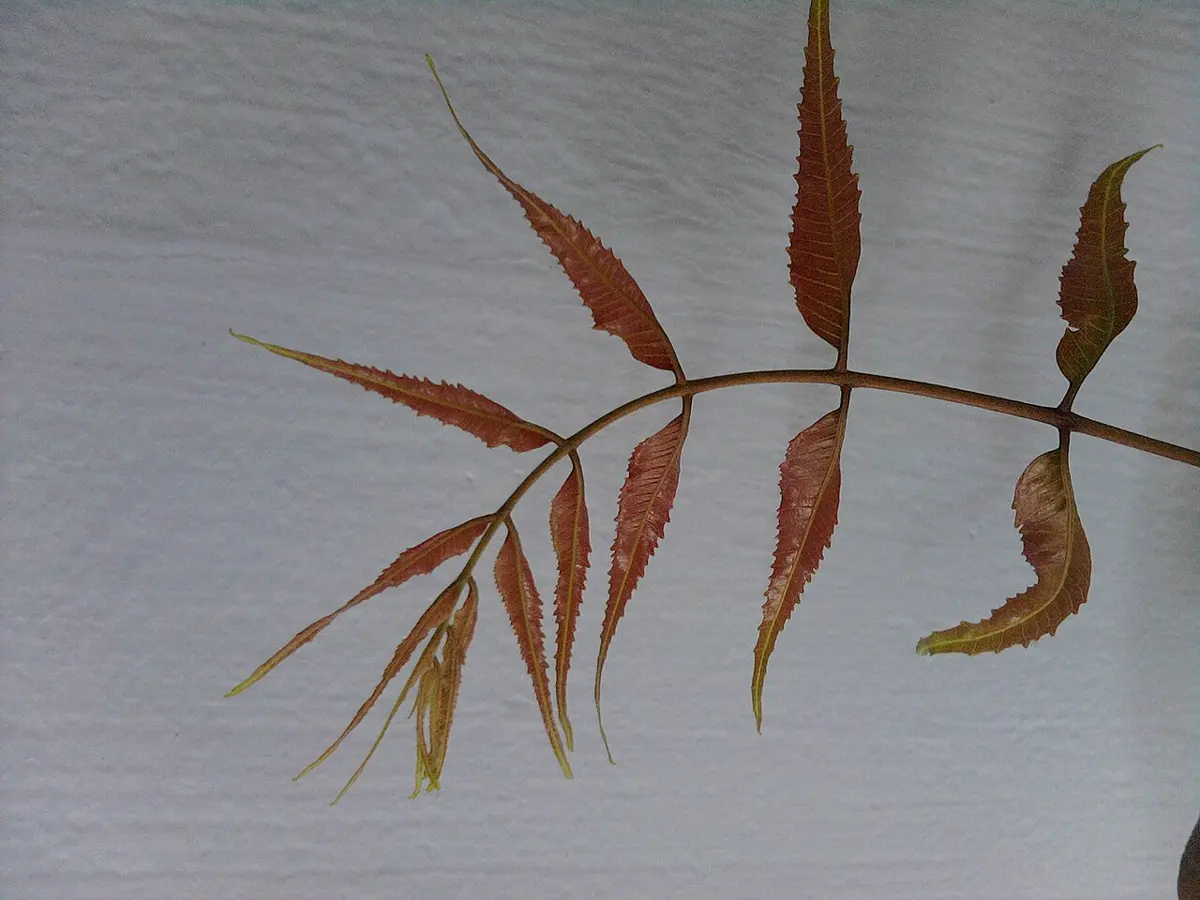
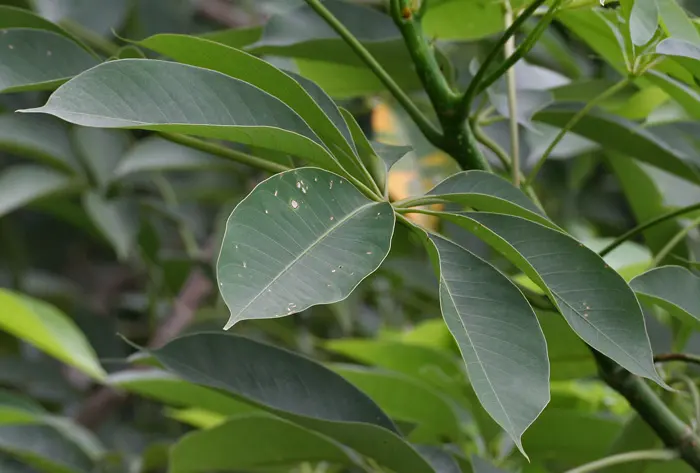
A leaf has a rachis bearing nine leaflets, with one leaflet at its tip. What kind of leaf is it?
Pick an answer to see why.
Phyllotaxy
Phyllotaxy (Greek phyllon, leaf, and taxis, arrangement) is the arrangement of leaves on a stem or branch. Leaves are arranged so that each gets enough sunlight and they don’t crowd one another. There are three kinds:
- Alternate: one leaf at each node, the leaves of successive nodes turning round the stem in a spiral: mustard, hibiscus, mango.
- Opposite: two leaves at each node, facing each other: guava, Calotropis (आँक). Often each pair is at right angles to the pair below (decussate), as in the mint and the tulsi, so that the leaves don’t shade one another.
- Whorled: three or more leaves at each node, in a ring: oleander (करबिर), the devil’s tree Alstonia (छतिवन).
Functions of the leaf
- Photosynthesis, its main work: making food for the whole plant.
- Exchange of gases with the air, through the stomata.
- Transpiration: losing water as vapor from the plant’s aerial parts, which keeps water and minerals flowing up from the roots and cools the leaf.
- Storage of food: the fleshy leaves of an onion bulb and the thick leaves of aloe.
- Vegetative propagation: the leaves of Bryophyllum (अजम्मरी) and Begonia grow buds on their margins that become new plants.
- Protection of the axillary bud in its axil.
4. The inflorescence
Some plants bear a single flower on a stalk (the hibiscus); most bear many. The stalk that carries a group of flowers is the peduncle (the floral axis), and the arrangement of flowers on the floral axis is the inflorescence.
There are two kinds, depending on whether the main axis ends in a flower or keeps growing.
a. Racemose inflorescence. The main axis keeps growing and never ends in a flower. The flowers grow from its sides, so the oldest flowers are the farthest from the growing tip and the youngest the nearest to it:
- on a long axis, the older flowers are at the base and the younger ones towards the tip: acropetal order (mustard, radish);
- on a flattened axis, as in the head of a sunflower or marigold, the older flowers are at the edge and the younger ones in the center: centripetal order.
b. Cymose inflorescence. The main axis ends in a flower, so it stops growing. Further growth comes from side branches below it, and each of these too ends in a flower. So the oldest flower is at the tip and the younger ones are towards the base: basipetal order (jasmine, potato, Calotropis (आँक)), or from the center outwards (centrifugal) when the axis is short.
On a mustard plant, the lowest flowers have already become pods while buds are still forming at the top of the axis. What kind of inflorescence is it?
Pick an answer to see why.
5. The flower
A flower is a condensed, modified shoot that does the work of sexual reproduction. Condensed: its axis is so short that its nodes are packed together; modified: its leaves have become sepals, petals, stamens and carpels. (Some books call the study of flowers anthology, from Greek anthos, flower.)
- Bracts are small, reduced leaves at the base of a flower or of its stalk. A flower with a bract is bracteate, one without is ebracteate.
- The flower’s stalk is the pedicel. A flower with a pedicel is pedicellate; one without, sitting straight on the axis, is sessile.
- The top of the pedicel is swollen into a rounded or cone-shaped base, the thalamus (receptacle), which bears the floral parts in whorls.
Flower: after Mariana Ruiz (LadyofHats), Mature flower diagram (public domain)
Parts of a flower
A typical flower has four whorls on its thalamus, from the outside in:
- Calyx, made of sepals: the outermost whorl, usually green (sepaloid), sometimes colored like petals (petaloid); it protects the flower while it is a bud. The sepals may be free (polysepalous) or joined (gamosepalous).
- Corolla, made of petals: usually brightly colored and often scented, to attract the insects and birds that carry pollen. The petals may be free (polypetalous) or joined (gamopetalous).
- Androecium, made of stamens: the male whorl.
- Gynoecium, made of carpels: the female whorl.
The calyx and corolla don’t make gametes, so they are the accessory whorls; the androecium and gynoecium are the essential (reproductive) whorls. In some flowers, such as the lily and onion, the sepals and petals look alike and can’t be told apart. Together they are then called the perianth, and each of its members is a tepal.
A flower with all four whorls is a complete flower (mustard, pea); a flower lacking any one of them is incomplete (a lily has no separate calyx and corolla; a male maize flower has no carpels). A flower with both stamens and carpels is bisexual; one with only one of them is unisexual: male (staminate) or female (pistillate).
Symmetry of the flower
- Actinomorphic (radially symmetrical): the flower can be cut through its center into two equal halves along more than one plane, as in mustard, hibiscus, Datura and the potato’s flower.
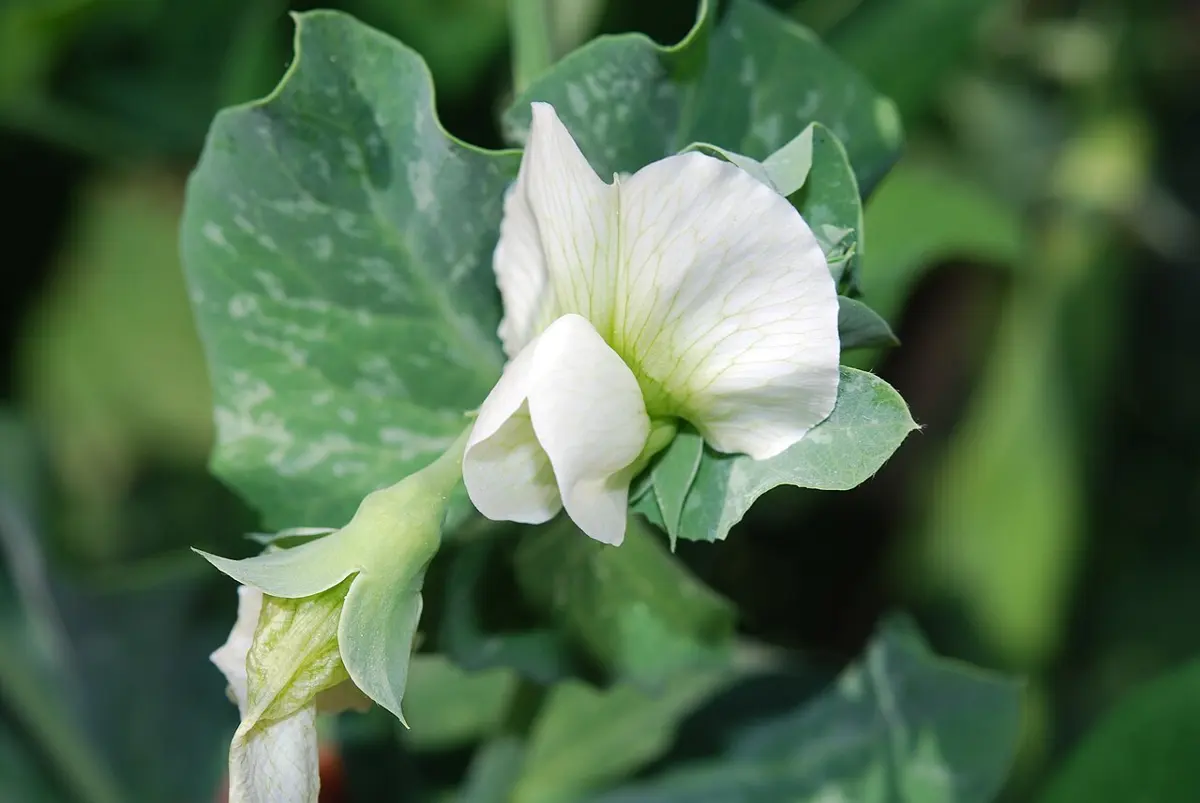
- Zygomorphic (bilaterally symmetrical): it can be cut into two equal halves along only one plane, as in pea, bean and gulmohar.
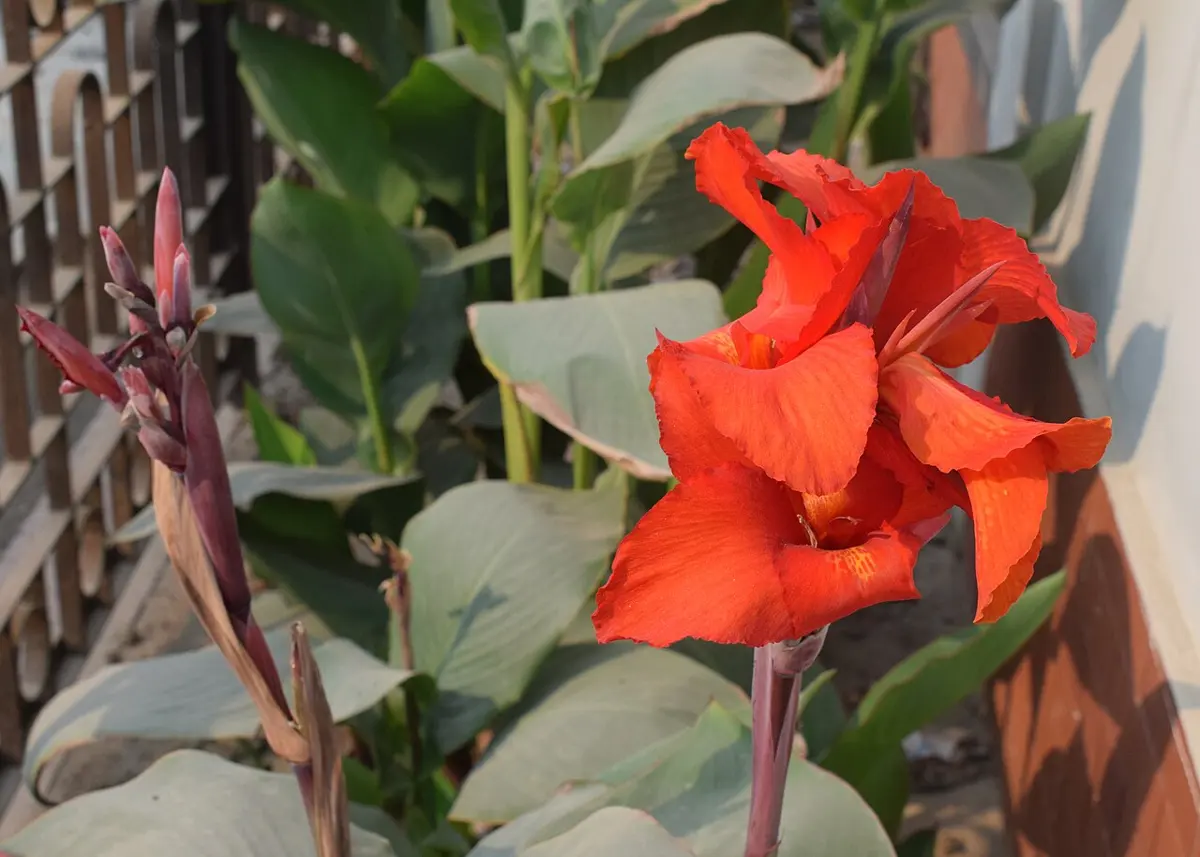
- Asymmetric (irregular): it can’t be cut into two equal halves along any plane, as in Canna.
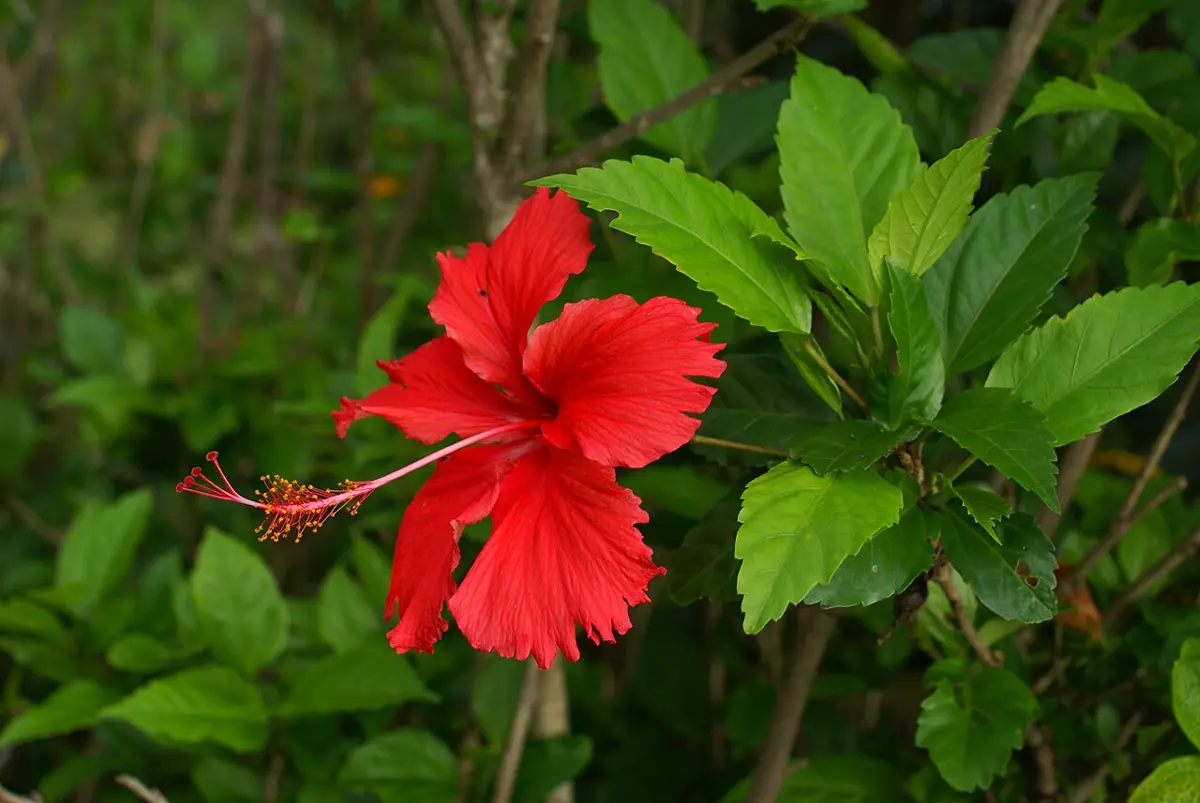
Insertion of floral parts on the thalamus
The four whorls can sit below, around or above the ovary, depending on the shape of the thalamus:
- a.Hypogynous flower: the thalamus is a dome or cone, with the ovary on top; the calyx, corolla and androecium are attached below the ovary. The ovary is superior. Examples: mustard, brinjal, Hibiscus.
- b.Perigynous flower: the thalamus grows up round the ovary into a cup. The ovary sits in the middle of the cup, and the other parts are attached on its rim, at about the same level as the ovary. The ovary is half-inferior. Examples: rose, plum, peach.
- c.Epigynous flower: the thalamus grows right up round the ovary and fuses with its wall, and the other parts are attached above the ovary. The ovary is inferior. Examples: sunflower, cucumber, guava, apple.
In an apple blossom, the dried sepals end up at the top of the fruit, opposite its stalk. What is the position of the ovary?
Pick an answer to see why.
Aestivation
Aestivation is the way the sepals or petals of one whorl are arranged in the bud, relative to one another. (Prise open a flower bud and look at the edges of its petals.) The main types:
- a.Valvate: the edges of neighboring sepals or petals just touch, without overlapping: custard apple, the calyx of Datura, Calotropis.
- b.Twisted (contorted): each petal overlaps the next with one edge and is overlapped by the one before it with the other, all the way round in one direction, like a fan that has been spun: hibiscus, lady’s finger (भिन्डी), cotton.
- c.Imbricate: the edges overlap, but not in one regular direction: one petal is fully outside (both edges overlapping), one is fully inside (both overlapped), and the rest are overlapped on one side only: gulmohar, Cassia.
- d.Vexillary (descending imbricate): in a pea-type flower of five petals, the largest (the standard) overlaps the two side petals (the wings), and these overlap the two smallest, front petals (the keel): pea, bean.
In a bud, petal 1 overlaps both its neighbors, petal 3 is overlapped by both of its neighbors, and the rest overlap on one side only, in no fixed direction. What is the aestivation?
Pick an answer to see why.
The androecium
The stamen is the unit of the androecium, the flower’s male whorl. Each stamen has a thin stalk, the filament, and at its top the anther. A typical anther has two lobes (it is bilobed, or dithecous), and each lobe has two chambers, the pollen sacs (microsporangia), in which the pollen grains are made. So a typical anther has four pollen sacs.
The stamens may be free from one another (polyandrous) or joined. When they are joined:
- by their filaments, into one bundle (monadelphous: hibiscus, cotton), two bundles (diadelphous: pea, 9 + 1) or several bundles (polyadelphous: lemon, Bombax);
- by their anthers only, the filaments staying free (syngenesious: sunflower, marigold);
- along their whole length, anthers and filaments (synandrous: cucumber, pumpkin).
Stamens attached to the petals are epipetalous (potato, brinjal, Datura); stamens attached to the tepals are epiphyllous (lily, onion).
The filament can be attached to the anther in four ways:
- Basifixed: the filament is attached to the base of the anther (mustard, Datura).
- Adnate: the filament runs up the whole length of the back of the anther, from its base to its top (lotus, Magnolia).
- Dorsifixed: the filament is attached firmly to the middle of the back of the anther (passion flower, pea).
- Versatile: the filament is attached to the back of the anther at one point only, so the anther swings freely on it, shaking out pollen in the wind (grasses, lily).
An anther whose slits open towards the center of the flower is introrse; one that opens outwards, away from the center, is extrorse.
The gynoecium
The carpel (also called the pistil) is the unit of the gynoecium, the flower’s female whorl. It has three parts:
- the stigma at the top, which receives the pollen;
- the style, a stalk that joins the stigma to the ovary;
- the ovary, the swollen base, which contains the ovules. The ovules are attached to a cushion of tissue on the ovary’s wall, the placenta.
A gynoecium of one carpel is monocarpellary (pea). One with two or more carpels may have them free from one another (apocarpous: lotus, strawberry) or joined (syncarpous: mustard, tomato). The chambers of the ovary are its locules: an ovary is unilocular, bilocular, trilocular and so on.
Placentation
The placentation is the arrangement of the ovules inside the ovary, which follows from where its placentas are:
- Marginal: the ovary has one chamber, with the placenta forming a ridge along one side (where the edges of the single carpel meet), bearing the ovules in two rows: pea, bean. (Open a pea pod: the peas hang in a row from one seam.)
- Axile: the carpels are joined and the ovary is divided by walls (septa) into chambers; the placentas are on the central axis where the walls meet: tomato, lemon, potato, orange.
- Parietal: the ovary has one chamber, and the ovules grow on placentas on its inner wall (paries, wall), where the carpels join: cucumber, papaya, Argemone. In mustard a false septum (the replum) grows across between the two placentas, so the one-chambered ovary becomes two-chambered.
- Free central: the ovary has one chamber with no septa, and the ovules are borne on a central column that stands free of the wall: Dianthus (carnation), Primula.
- Basal: the ovary has one chamber with a single ovule at its base: sunflower, marigold.
A cucumber cut across shows one chamber, with its seeds attached to three ridges on the inside of its wall. What is its placentation?
Pick an answer to see why.
Functions of the flower
- a.It makes the male and female gametes, in its anthers (pollen) and ovules, which fuse to form the zygote.
- b.After fertilization, the ovary becomes the fruit and the ovules become the seeds.
- c.Many flowers give nectar to attract pollinators such as bees, which turn it into honey.
- d.Brightly colored, scented petals attract the insects and birds that carry pollen from flower to flower: pollination, which leads to fertilization.
- e.People grow and use flowers for their beauty: for weddings and funerals, for worship, and as a sign of love and respect; the garlands of marigold and makhamali (globe amaranth) at Tihar.
6. The fruit
After fertilization, the ovules become seeds and the ovary becomes the fruit. So a fruit is a mature (ripened) ovary, developed after fertilization. Only flowering plants have fruits: having their seeds in a case is what angiosperm means.
- A fruit that forms without fertilization has no seeds: it is parthenocarpic (seedless banana, seedless grapes, cucumbers grown in greenhouses).
- A fruit made only from the ovary is a true fruit (mango, litchi, tomato).
- A fruit in which other parts of the flower, especially the thalamus, also grow into the fruit is a false fruit (apple and pear, whose flesh is mostly thalamus; strawberry, whose red part is the swollen thalamus).
Parts of a fruit
A fruit has two parts: the pericarp, the fruit’s wall, which grows from the wall of the ovary, and the seeds, which grow from the ovules. The pericarp may be dry (pea pod, mustard pod) or fleshy. A thick, fleshy pericarp often has three layers:
- epicarp (exocarp): the outer layer, the fruit’s skin;
- mesocarp: the middle layer, usually the fleshy, edible part (mango, peach, plum);
- endocarp: the innermost layer, round the seed; in a drupe such as the mango or plum it is the hard stone, but in other fruits it is thin and papery (the core of an apple) or juicy (the juice-filled hairs of an orange).
Mango: Wellcome Collection (V0042597), CC BY 4.0
Types of fruit
- Simple fruit: develops from the ovary of one flower (a single carpel, or several joined ones). It may be dry (pea, mustard, rice) or fleshy (mango, tomato, apple, lemon).
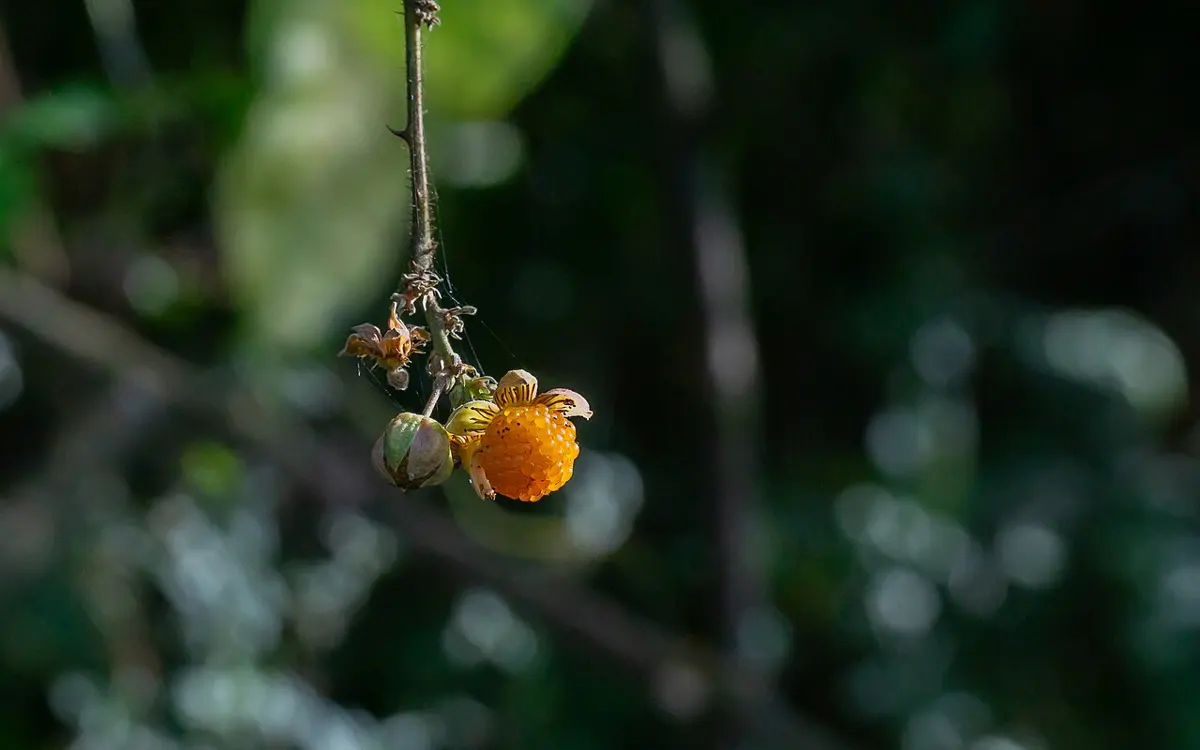
- Aggregate fruit: develops from one flower with many free carpels (an apocarpous gynoecium); each carpel becomes a small fruit, a fruitlet, and the fruitlets stay together as a cluster called an etaerio: strawberry, raspberry and Nepal’s yellow ainselu (Rubus ellipticus), custard apple (सरिफा).
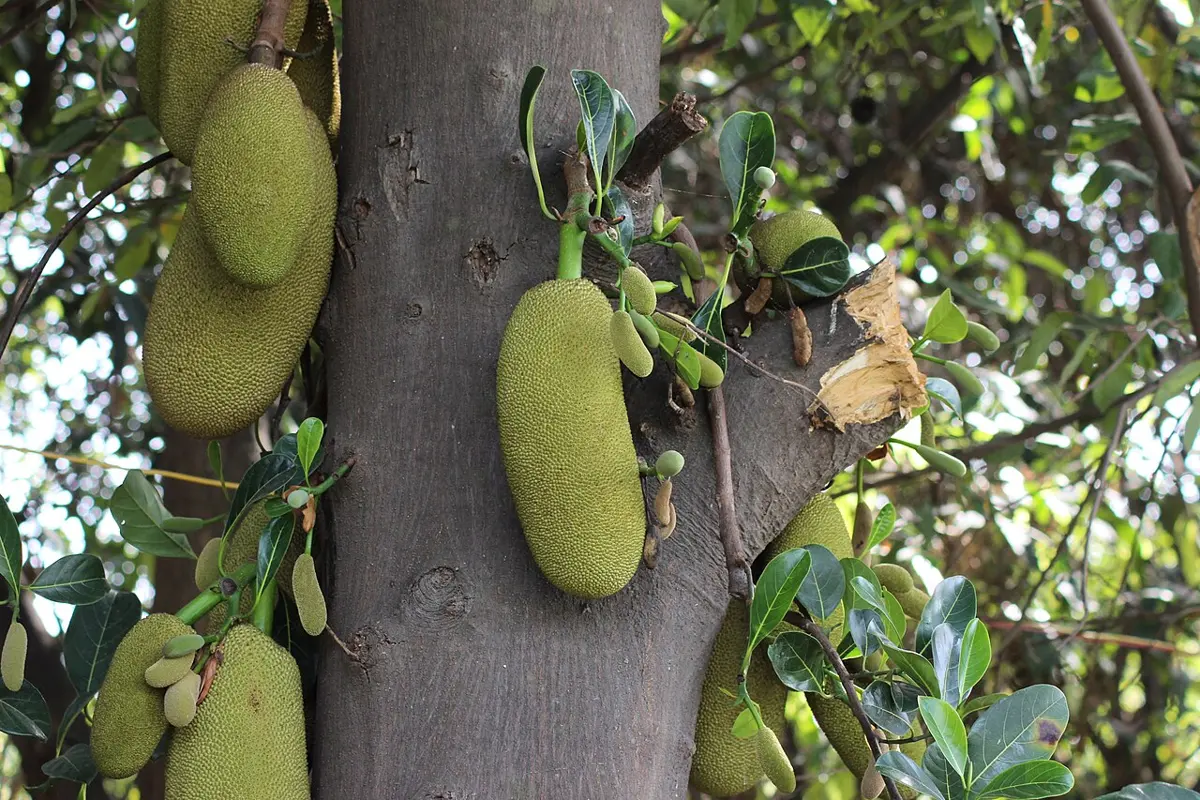
- Multiple (composite) fruit: develops from a whole inflorescence, many flowers fused together: jackfruit, pineapple, mulberry (किम्बु).
Why is a strawberry not a true fruit?
Pick an answer to see why.
Functions of the fruit
- a.It protects the seeds from drying out, from being eaten too early, and from bad weather.
- b.Its stored food and bright colors attract animals, which eat the fruit and spread the seeds in their droppings: seed dispersal. (Dry fruits spread seeds in other ways: the pods of mustard and pea split open; the fruits of Bidens (कुरो) hook onto clothes and fur.)
- c.Its fleshy part stores food.
- d.In some plants it stays with the seed and helps the young seedling start: the coconut’s thick, fibrous husk keeps the seed afloat on the sea and holds water while it sprouts. (The food the seedling uses is in the seed itself: the coconut’s water and white flesh are its endosperm.)
2.8.3 Concept of taxonomy
Taxonomy (Greek taxis, arrangement, and nomos, law) is the science of identifying, naming, describing and classifying organisms: plants, animals and microorganisms, by their form (morphology), behavior, genes and chemistry. In short, taxonomy is the branch of biology that deals with identification, nomenclature and classification of organisms:
- Identification: finding an organism’s correct name and its place in a system of classification (comparing a plant with descriptions and specimens until you find what it is).
- Nomenclature: giving each organism its proper scientific name, so that it can be told apart from all others, by the binomial system and its rules.
- Classification: arranging organisms in groups by the features they share and the ways they differ.
The Swedish botanist Carolus Linnaeus (1707–1778) is called the father of taxonomy. He made the two-word scientific name the standard way to name a species, in Species Plantarum (1753) for plants and Systema Naturae (10th edition, 1758) for animals, and arranged organisms in ranks.
Systematics is wider: it is the science of the diversity of organisms and the relationships among them. It covers identification, nomenclature, description and classification, using the features of every species and group at every level from species to kingdom, and asks how the groups are related by descent. Taxonomy is the part of systematics that names and classifies.
2.8.4 Taxonomic hierarchy
A taxon (plural taxa) is a group of organisms classified together as a unit, at any rank: the species Brassica rapa, the genus Brassica, the family Brassicaceae are each a taxon. The rank (level) itself is a taxonomic category.
Arranging the categories in order from the highest to the lowest is the taxonomic hierarchy. It has seven obligatory categories, which every organism is placed in:
Kingdom → Phylum (Division) → Class → Order → Family → Genus → Species
Linnaeus used five of them (kingdom, class, order, genus, species); family came into use in the late 1700s and phylum in 1866. Extra ranks can be fitted between them where needed (subclass, superorder, subfamily, tribe), the intermediate categories. Some books call the five upper ranks the major categories and genus and species the minor ones.
Taxonomic categories
- a.Species: the basic unit of classification. A group of individuals that resemble one another closely, interbreed freely in nature and produce fertile offspring, and that don’t breed with other such groups. (The horse and the donkey are separate species: their offspring, the mule, is sterile.)
- b.Genus: a group of closely related species with many features in common. Brassica includes mustard, cabbage and turnip.
- c.Family: a group of related genera (one or more). Brassicaceae includes Brassica, Raphanus (radish) and Lepidium (cress).
- d.Order: a group of related families.
- e.Class: a group of related orders.
- f.Phylum or division: a group of related classes. For plants, botanists used division; for animals, zoologists use phylum. (The rules for plant names now accept either word.)
- g.Kingdom: the highest category, a group of related phyla or divisions: Plantae, Animalia.
Going down the hierarchy, each taxon holds fewer organisms, which share more features; going up, each holds more organisms, which share fewer.
Which taxon is formed by grouping related families?
Pick an answer to see why.
2.8.5 Classification system
Classification is grouping organisms by their likenesses and differences. People have classified plants for different purposes and in different ways over time. There are three kinds of system.
a. Artificial system. It uses one or a few features that are easy to see, such as habit (herb, shrub, tree), habitat or size, without regard to how the plants are related. It is quick and useful in the field. But it puts unrelated plants together (a heterogeneous group) and separates related ones, and tells little about them. Example: Linnaeus’s sexual system (1735, used in his Species Plantarum of 1753), which grouped plants by the number of their stamens and carpels, putting very different plants together because each had, say, five stamens.
b. Natural system. It uses as many features as possible, all that is known at the time, and groups plants by their overall likeness. It shows natural relationships much better and avoids heterogeneous groups. Example: Bentham and Hooker’s system (Genera Plantarum, 1862–1883), still used to arrange the specimens in many herbaria, including in South Asia.
c. Phylogenetic system. It is based on evolutionary relationships (phylogeny): plants are grouped by common descent, so that each group contains an ancestor and its descendants, and the system can show which taxa came from which. Example: Engler and Prantl’s system (Die natürlichen Pflanzenfamilien, 1887–1915). Fossils are too incomplete to settle many questions, so older systems were partly natural and partly phylogenetic. Since the 1990s, comparisons of DNA have made phylogenetic classification far more reliable: the APG system (Angiosperm Phylogeny Group, fourth version 2016) is the one botanists now use.
| Artificial system | Natural system | |
|---|---|---|
| Based on | one or a few easily seen features | as many features as possible |
| Groups | often unrelated plants together | plants that are naturally alike |
| Relationships | not shown | shown by overall likeness |
| Use | quick sorting in the field | a lasting, informative classification |
| Example | Linnaeus’s sexual system | Bentham and Hooker’s system |
2.8.6 Taxonomic description of families
To describe a flowering plant, botanists use its morphological features, written briefly, in semi-technical terms and in a fixed order: its habit and habitat; the root, stem and leaves (the vegetative characters); the inflorescence, flower, each whorl, the fruit and pollination (the floral characters); and at the end, its floral formula and floral diagram.
The floral formula
A floral formula sums up a flower in one line of symbols:
| Symbol | Meaning | Symbol | Meaning |
|---|---|---|---|
| Br | bracteate | Ebr | ebracteate |
| actinomorphic | % | zygomorphic | |
| ♂ | unisexual, male | ♀ | unisexual, female |
| ⚥ | bisexual | ||
| K | calyx (sepals) | C | corolla (petals) |
| P | perianth (tepals) | ||
| A | androecium (stamens) | G | gynoecium (carpels) |
| superior ovary | inferior ovary |
- The number of parts in a whorl is written after its letter, small: K₅ means five sepals.
- Parts fused together have their number in brackets: K₍₅₎ means five sepals joined into one calyx.
- Parts in two whorls are written with a plus: A₂₊₄ means two stamens in one whorl and four in another.
- “Many” (more than about ten) is written ∞.
- The line under or over G shows where the other parts are attached: a line below G () means they are below the ovary (superior ovary); a line above () means they are above it (inferior ovary).
- Epipetalous stamens (attached to the petals) are shown by an arc joining C and A: . An arc joining P and A means stamens on the tepals (epiphyllous).
The floral diagram
A floral diagram is a plan of the flower as if cut across, seen from above: each whorl is drawn as a ring of symbols, sepals outermost, then petals, stamens (each drawn as an anther cut across) and the ovary cut across in the middle, showing its carpels, chambers and placentation. A small circle or dot at the top marks the position of the mother axis (the stem the flower grows from), so the top of the diagram is the flower’s posterior side, nearest the stem, and the bottom its anterior side. Joined parts are drawn joined; a bract, when there is one, is drawn at the bottom, outside everything.
1. Family Brassicaceae (Cruciferae): the mustard family
Habit and habitat. Annual, biennial or perennial herbs, with a pungent, sulphurous smell when crushed (from their mustard oils). Found worldwide (cosmopolitan), most common in the north temperate region; in Nepal they are winter crops of the Tarai and the hills.
Vegetative characters
- a.Root: a tap root, branched; in some swollen with food: fusiform (thick in the middle, tapering at both ends: radish, Raphanus sativus) or napiform (round like a top, narrowing suddenly below: turnip, Brassica rapa).
- b.Stem: herbaceous, erect (rarely lying along the ground, prostrate), branched, solid, cylindrical, often pubescent (hairy).
- c.Leaves: radical (growing from the base of the stem, in a rosette near the ground) and cauline (on the main stem) or ramal (on the branches); simple, alternate, exstipulate, petiolate or sessile, often lyrate (deeply lobed with a large end lobe, like a lyre), with reticulate venation.
Floral characters
- a.Inflorescence: racemose, a raceme (often a corymb at first, lengthening later).
- b.Flower: mostly ebracteate, pedicellate, bisexual, complete, actinomorphic (rarely zygomorphic), hypogynous, with four parts in each whorl of the perianth (tetramerous).
- c.Calyx: 4 sepals, free (polysepalous), in two whorls of two, sepaloid or petaloid, imbricate.
- d.Corolla: 4 petals, free (polypetalous), each with a narrow claw and a broad limb, spread like a cross: cruciform; valvate or imbricate.
- e.Androecium: 6 stamens in two whorls: the outer two short, the inner four long: tetradynamous; anthers bilobed, basifixed, introrse.
- f.Gynoecium: 2 carpels, joined (bicarpellary, syncarpous); the ovary is one-chambered at first and becomes two-chambered by a false septum (the replum); ovary superior; placentation parietal.
- g.Fruit: a siliqua (a long, thin pod that splits from below upwards into two valves, leaving the seeds on the replum: mustard, radish) or a silicula (a short, broad one: candytuft, Capsella).
- h.Pollination: by insects (entomophilous).
- i.Floral formula:
Economic importance
- i.Oil: mustard (tori, Brassica rapa var. toria, and Indian mustard, B. juncea, whose leaves are also eaten as rayo saag) is grown for its seeds, pressed into Nepal’s main cooking oil, also used for massage and lamps.
- ii.Vegetables: turnip, radish, cabbage, cauliflower, broccoli and rayo sag.
- iii.Condiments: mustard seeds are used whole or ground in pickles and curries.
- iv.Medicine: the seeds of garden cress, chamsur (Lepidium sativum), are eaten as a vegetable and used in traditional medicine for cough and asthma, and given to new mothers.
- v.Ornamentals: candytuft (Iberis), stock (Matthiola) and wallflower are grown in gardens.
Some important plants
- a.Mustard: Brassica rapa (tori; also written B. campestris)
- b.Cauliflower: Brassica oleracea var. botrytis
- c.Cabbage: Brassica oleracea var. capitata
- d.Turnip: Brassica rapa (subsp. rapa)
- e.Radish: Raphanus sativus
2. Family Fabaceae (Leguminosae): the pea or legume family
This is the pea-flower group of the legumes, the subfamily Papilionoideae (papilio, butterfly, for the shape of its flower).
Habit and habitat. Herbs, shrubs, climbers and rarely trees; grown for pulses (dal) and as green manure. Found worldwide, in tropical and temperate regions of both hemispheres.
Vegetative characters
- a.Root: a tap root, branched, with root nodules that hold nitrogen-fixing bacteria (Rhizobium).
- b.Stem: herbaceous or woody, erect or climbing, branched, angular or cylindrical.
- c.Leaves: cauline and ramal, usually compound (pinnate), rarely simple; alternate, rarely opposite or whorled; stipulate (pea has big leafy stipules), petiolate, with reticulate venation; in pea the end leaflets become tendrils.
Floral characters
- a.Inflorescence: racemose, a raceme, or a single flower in the axil of a leaf.
- b.Flower: bracteate or ebracteate, pedicellate, zygomorphic, bisexual, complete, hypogynous or slightly perigynous.
- c.Calyx: 5 sepals, joined (gamosepalous), the odd sepal at the front (anterior); valvate or imbricate.
- d.Corolla: 5 petals, unequal and free, papilionaceous (butterfly-like): one large posterior petal, the standard (vexillum); two side petals, the wings (alae); and two front petals joined along their lower edge into a boat-shaped keel (carina), which holds the stamens and carpel; vexillary (descending imbricate) aestivation.
- e.Androecium: 10 stamens, diadelphous: (9) + 1, nine with their filaments joined into a sheath round the ovary, and one free (the posterior one, next to the standard); anthers bilobed, basifixed or dorsifixed, introrse.
- f.Gynoecium: 1 carpel (monocarpellary), the ovary one-chambered, superior, with marginal placentation; style bent, stigma simple.
- g.Fruit: a legume (pod), which splits along both seams (unlike a siliqua, it has no replum).
- h.Pollination: by insects; many, such as the garden pea, pollinate themselves inside the closed keel before the flower opens.
- i.Floral formula:
Economic importance
- i.Pulses: the seeds of pea, gram, lentil (मसुरो), black gram (मास), mung bean and pigeon pea (रहर) are dal, the protein of the Nepali meal.
- ii.Fodder for livestock (berseem clover, cowpea).
- iii.Oil: soybean (Glycine max) and groundnut (Arachis hypogaea) are pressed for edible oil.
- iv.Condiments: the seeds of fenugreek, methi (Trigonella foenum-graecum), go into pickles and curries.
- v.Soil fertility: the nitrogen-fixing bacteria of their root nodules enrich the soil, so legumes are grown in rotation with rice and wheat, and dug in as green manure (dhaincha).
- vi.Timber, dyes and ornamentals: sissoo (Dalbergia sissoo), indigo, Erythrina (फलेदो).
Some important plants
- a.Pea: Pisum sativum
- b.Soybean: Glycine max
- c.Cowpea (बोडी): Vigna unguiculata (older name Vigna sinensis)
- d.Gram (चना): Cicer arietinum
- e.Black gram (मास): Vigna mungo (older name Phaseolus mungo)
3. Family Solanaceae: the potato family
Habit and habitat. Annual or perennial herbs and shrubs, rarely trees. Found worldwide, most common in the tropical and subtropical regions, especially Central and South America, where potato, tomato and chilli were first grown.
Vegetative characters
- a.Root: a tap root, branched.
- b.Stem: herbaceous, rarely woody; erect or climbing; branched; cylindrical; solid or rarely hollow (fistular); hairy (pubescent) or smooth (glabrous); sometimes with underground stems: the potato’s tuber.
- c.Leaves: cauline and ramal, exstipulate, simple (rarely pinnately compound, as in potato and tomato), alternate (in the flowering part sometimes nearly opposite, rarely whorled), petiolate, with reticulate venation.
Floral characters
- a.Inflorescence: cymose, or a single flower in an axil (Datura).
- b.Flower: ebracteate, usually pedicellate, actinomorphic, bisexual, complete, hypogynous, with five parts in each outer whorl (pentamerous).
- c.Calyx: 5 sepals, joined (gamosepalous), persistent (staying on the fruit: look at a brinjal’s cap), valvate.
- d.Corolla: 5 petals, joined (gamopetalous), wheel-, bell- or funnel-shaped; valvate or twisted.
- e.Androecium: 5 stamens, alternating with the petals and attached to them (epipetalous); anthers dithecous, basifixed, introrse.
- f.Gynoecium: 2 carpels, joined (syncarpous), bilocular, ovary superior, placed obliquely (its septum at about 45° to the front-to-back line of the flower); axile placentation, with large, swollen placentas bearing many ovules.
- g.Fruit: a berry (tomato, brinjal, chilli) or a capsule (Datura, tobacco).
- h.Pollination: by insects.
- i.Floral formula:
Economic importance
- i.Vegetables: potato, tomato, brinjal and capsicum.
- ii.Spices: chillies (Capsicum), among them the round, fiery dalle or akabare khursani of Ilam and the eastern hills.
- iii.Medicines: Atropa (belladonna) gives atropine, used to widen the pupils and to treat poisoning; Datura and Hyoscyamus give drugs for motion sickness. (These same plants are poisonous: Datura’s seeds can kill.)
- iv.Tobacco: the dried leaves of Nicotiana tabacum; it is the leading cause of preventable death worldwide.
- v.Ornamentals: Petunia, Datura and Cestrum nocturnum (रातकी रानी).
Some important plants
- a.Tomato: Solanum lycopersicum (older names Lycopersicon esculentum)
- b.Brinjal: Solanum melongena
- c.Potato: Solanum tuberosum
- d.Black nightshade: Solanum nigrum
- e.Tobacco: Nicotiana tabacum
4. Family Liliaceae: the lily family
This is the family as most textbooks describe it, which includes onion, garlic, asparagus and aloe (see the box below).
Habit and habitat. Annual, biennial or perennial herbs, rarely shrubs or climbers, often with underground bulbs or rhizomes. Found worldwide, mostly in tropical and temperate regions.
Vegetative characters
- a.Root: adventitious, fibrous (as in monocots).
- b.Stem: herbaceous, rarely woody; erect or climbing; often a short underground bulb (onion, garlic) or rhizome; the flowering stem above ground is often leafless (a scape).
- c.Leaves: radical (from the bulb) or cauline, exstipulate, usually simple, alternate (rarely whorled), sessile with a sheathing leaf base, with parallel venation; fleshy in aloe, hollow tubes in onion.
Floral characters
- a.Inflorescence: racemose: a raceme, a spike, or an umbel-like head at the top of a scape (onion).
- b.Flower: bracteate or ebracteate, pedicellate, actinomorphic (rarely zygomorphic), bisexual, hypogynous, with its parts in threes (trimerous, as in monocots). With no separate calyx and corolla, it is incomplete.
- c.Perianth: 6 tepals in two whorls of three, free (polytepalous: lily) or joined at the base into a tube (gamotepalous: onion, aloe), petaloid; valvate or imbricate.
- d.Androecium: 6 stamens in two whorls of three, free (polyandrous), each standing in front of a tepal and attached to it (epiphyllous); anthers dithecous, basifixed or versatile, introrse.
- e.Gynoecium: 3 carpels, joined (syncarpous), trilocular, ovary superior, axile placentation, two or more ovules in each chamber.
- f.Fruit: a capsule (onion, lily) or a berry (asparagus).
- g.Pollination: by insects.
- h.Floral formula: (with P₍₃₊₃₎ where the tepals are joined)
Economic importance
- i.Vegetables and spices: onion and garlic are in almost every Nepali curry; asparagus, kurilo, is eaten as a vegetable, and its wild cousin Asparagus racemosus (सतावरी) is a valued medicinal herb.
- ii.Ornamentals: lily, tulip, hyacinth and Gloriosa are grown in gardens.
- iii.Medicines: Colchicum gives colchicine, used to treat gout; the gel of aloe is used for burns and in skin creams.
- iv.Cosmetics: aloe gel goes into many creams, gels and shampoos.
- v.Condiments: garlic and onion flavor food and pickles.
Some important plants
- a.Onion: Allium cepa
- b.Garlic: Allium sativum
- c.Asparagus (kurilo): Asparagus officinalis
- d.Aloe (घ्युकुमारी): Aloe vera
- e.Lily: Lilium (several species)
Exercise
A. Choose the correct option
- Name the taxon formed by grouping related orders.
Pick an answer to see why.
- Which botanical family does Capsicum belong to?
Pick an answer to see why.
- What type of placentation is characteristic of the family Solanaceae?
Pick an answer to see why.
- The tuber of a potato is a modification of which part?
Pick an answer to see why.
- Name the type of fruit formed from a whole inflorescence.
Pick an answer to see why.
- Look at the stamens in the figure above. Which option names them correctly?
Pick an answer to see why.
- What is the scientific name of cabbage?
Pick an answer to see why.
- What is meant by a cruciform corolla?
Pick an answer to see why.
B. Answer the following questions
Define:
- a.phyllotaxy
- b.zygomorphic
- c.complete flower
- d.genus
- e.taxonomy
- f.perianth
Answer
Differentiate between:
- a.tap root system and fibrous root system
- b.simple leaf and compound leaf
- c.cymose and racemose inflorescence
- d.artificial and natural systems of classification
Answer
Describe the family Solanaceae in semi-technical terms, with its floral formula and floral diagram, and give the scientific names of two economically important plants of this family.
Answer
Describe the family Liliaceae in semi-technical terms, with its floral formula and floral diagram, and give the scientific names of two economically important plants of this family.
Answer
Describe the floral characters of Fabaceae.
Answer
What is placentation? Describe the different types of placentation.
Answer
Explain the different regions of a root, with a diagram.
Answer
Describe the morphology of a leaf, with a diagram.
Answer
Define inflorescence. Explain the different types of inflorescence.
Answer
A group of botanists is classifying the plant species of a region. They are debating whether to use an artificial, a natural or a phylogenetic system. Which would be most suitable, and why?
Answer
Printable PDFs
- Study notes 5 pages
- Worksheet 5 pages Answer key
Quiz yourself: Classification of Living Beings, Grades 5–12 →
Practice every question in the book, and keep track of the ones you miss →
A companion to your textbook, not a replacement for it: study from the book your school uses, and where the two differ, follow your teacher. Found a mistake? Please tell us.