
A ship made of 50,000 tonnes of steel floats, yet one steel nail sinks. A mechanic lifts a whole bus with one hand on a small jack. A hen’s egg sinks in a glass of tap water, then floats after you stir in a few spoons of salt. And a bucket in a well feels light as long as it is under water, then suddenly heavy as it comes out.
All of these are about pressure in fluids: how liquids and gases push on everything they touch, how they pass a push from one place to another, and how they push things up. By the end of this unit you will be able to explain every one of them, and work out how big the forces are.
Pressure: a push spread over an area
Put a brick on a sponge or a piece of foam and it sinks in. The brick’s weight presses on the foam. A water pipe that bursts was pushed apart from the inside by the water. And in the trick of Figure 8.1, a card holds a glass of water upside down: the air pushes the card up. Solids, liquids and gases all push on the surfaces they touch.
A push that acts at right angles (perpendicular) to a surface is called thrust. It is a force, so its SI unit is the newton (N). The thrust acting on each unit of area is the pressure:
The SI unit of pressure is the newton per square meter (N/m²), called the pascal (Pa). One pascal is a small pressure: a sheet of paper lying on a table presses down with about 1 Pa.
The same force makes a much bigger pressure on a small area. That is why a sharp knife cuts (its edge is very thin), why a drawing pin goes into a board easily, and why a porter’s namlo (head strap) is made wide, not thin.
Liquids and gases can flow, so together they are called fluids. A solid presses only downward on what it rests on, but a fluid presses on the bottom and on every wall of its container, and on every surface of anything placed in it.
Push a balloon under water and you can feel the water pushing it back up. Fill a balloon with hydrogen or helium and let it go: the air pushes it up, and it rises. Air gets thinner as you go higher, so the push of the air gets weaker; the balloon stops rising at the height where the upward push of the air just equals its weight. You will see why later in this unit.
Two girls of the same weight stand on soft mud. One wears flat sandals; the other wears shoes with narrow high heels. Who sinks deeper, and why?
Pick an answer to see why.
Pressure in liquids and air
You met this in Grade 8; here it is again, because it explains so much of this unit.
The water at the bottom of a tank carries the weight of all the water above it. So the deeper you go, the greater the pressure. For a liquid of density (rho), at a depth :
where = 9.8 m/s². Pressure in a liquid depends only on the depth and the density of the liquid, not on the shape of the container. And at any point it pushes equally in all directions: up, down and sideways.
The air around us is a fluid too. The atmosphere is an ocean of air about a hundred kilometers deep, and we live at its bottom. At sea level it presses with about 101,325 Pa, which is about 10 tonnes on every square meter. We don’t feel crushed because the fluids inside our bodies push outward just as hard. As you climb, there is less air above you, so the pressure falls: in Kathmandu it is about 85,000 Pa, and on the top of Everest only about a third of the sea-level pressure.
In Figure 8.2, why does the water from the lowest hole travel farthest?
Pick an answer to see why.
Transmission of pressure
Why can a liquid pass on a push, while a solid can’t? Look at their particles (Figure 8.4). In a solid the particles are packed close and held in place: they can only vibrate. Push one side of a block of wood and the block just moves as a whole, or digs in where you push; the pressure does not spread out through it to all its surfaces. In a liquid and a gas the particles can move about, so a push on a fluid in a closed container spreads through all of it.
The particles of a liquid are already very close together, so pushing on it can’t move them closer, and its volume doesn’t change. A liquid in a closed vessel is incompressible, and so a pressure made at any point in it is passed on (transmitted) to every part of it, in all directions. When you squeeze a toothpaste tube at the bottom, the paste comes out at the top.
Gases are different. Their particles are far apart, so a push first squeezes the gas into a smaller volume. Pressure is transmitted through a gas too, but not as well as through a liquid. Squeeze a balloon in one place and it bulges everywhere else, but only once the air inside is already squeezed tight. That is why the hydraulic brakes of cars and motorbikes have a liquid in their pipes, not air. (Big buses and trucks often have air brakes, but those work differently: a compressor stores air at high pressure, and the driver’s pedal only lets it out.)
Why does toothpaste come out of the nozzle when you squeeze the bottom of the tube?
Pick an answer to see why.
Pascal’s law
The French mathematician and scientist Blaise Pascal described this in 1653. It is known as Pascal’s law:
When pressure is applied at any point of a liquid in a closed container, it is transmitted equally in all directions, throughout the liquid, and acts at right angles to the walls of the container.
Checking Pascal’s law
Take a round vessel full of liquid with four pistons A, B, C and D, of cross-sectional areas , , and (Figure 8.6). Push piston A in with a force . The other three pistons are pushed out. To stop them moving, you must push each one back with a force: , and . When you measure them, you find
Each of these is a force divided by an area, which is a pressure. So the pressure is the same at every piston: the pressure made at one point of a liquid in a closed vessel is transmitted equally everywhere. A piston with twice the area needs twice the force to hold it back.
Applications of Pascal’s law
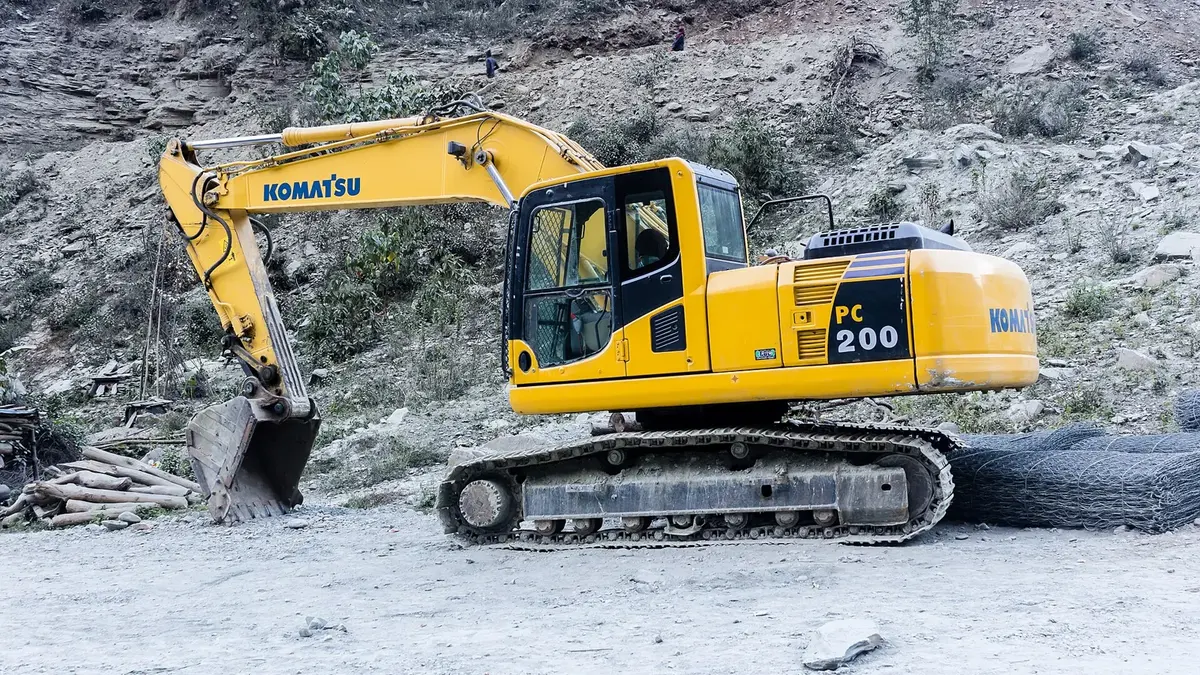
Pascal’s law is the idea behind hydraulic machines (from the Greek hydor, water): hydraulic brakes, hydraulic lifts, hydraulic jacks, hydraulic presses, and the arms of diggers and cranes.
Hydraulic machines
A hydraulic machine is a force multiplier based on Pascal’s law: a small force on a small piston becomes a large force on a large piston.
How a hydraulic machine is built and how it works
At least two cylinders of different cross-sectional areas are joined by a pipe and filled with a liquid, usually oil (Figure 8.8). Each cylinder has a piston that fits tightly, so no liquid leaks out. Let the small piston have area and the large piston area .
Push the small piston down with a force (the input force). This makes a pressure in the liquid:
The liquid can’t be compressed, so by Pascal’s law the same pressure reaches the large piston: . There it pushes on a bigger area, so it makes a bigger force (the output force):
Since is bigger than , the factor is always more than 1. If the large piston has twice the area of the small one, the force is doubled; with 50 times the area, the force is 50 times as big.
Some hydraulic machines
Hydraulic machines come in many shapes and sizes, but each one has a small piston where you push and a large piston where the work is done.
a. Hydraulic lift
The dentist’s chair goes up when the dentist pumps a pedal: the pedal pushes a small piston, and the large piston under the seat lifts the patient. In a garage, a hydraulic car lift raises a whole car so the mechanic can work under it; there the small piston is pushed by compressed air from a compressor instead of a foot. Hydraulic lifts lift heavy loads easily.
b. Hydraulic brakes
In a car, the brake pedal pushes the piston of a small master cylinder. In a motorbike or scooter with disc brakes, the brake lever on the handle does the same. The master cylinder is joined by thin pipes, full of a special brake fluid, to a brake cylinder at each wheel, whose larger pistons press the brake pads (or brake shoes) against a disc or drum fixed to the wheel. A small push on the pedal becomes a large force on the pads, so a fast vehicle can be stopped in a few seconds. And because pressure is transmitted equally, the same pressure reaches the brake at every wheel at the same moment.
c. Hydraulic jack
A hydraulic jack lifts a truck, a bus or a car a little above the ground, for example to change a tyre. It has a pumping piston with a small area and a lifting piston with a large area, an oil reservoir, and two one-way valves (Figure 8.10):
- The lower valve lets oil flow only from the pumping cylinder into the lifting cylinder.
- The upper valve lets oil flow only from the reservoir into the pumping cylinder.
First the release valve is closed tightly. Then:
- Push the lever down. The pumping piston pushes oil out: the upper valve shuts and the lower valve opens. Oil is forced into the lifting cylinder and the load rises a little.
- Pull the lever up. The high pressure under the load shuts the lower valve, so the load can’t come back down. The upper valve opens, and fresh oil is sucked from the reservoir into the pumping cylinder.
- Repeat. Each stroke lifts the load a little more, until it is high enough.
To lower the load, open the release valve: the oil flows from the lifting cylinder back into the reservoir.
d. Hydraulic press
In a hydraulic press, the thing to be pressed is placed between the large piston and a rigid plate fixed above it. A small force on the small piston becomes a huge force pressing up. Presses are used to fit tight parts of vehicles together, to bend metal sheets or punch holes in them, and to pack paper, cotton or straw into tight bales.
In a hydraulic press, the large piston has 30 times the area of the small one. You push the small piston with 50 N. What force does the large piston exert?
Pick an answer to see why.
Why is the liquid in a hydraulic machine not replaced by air?
Pick an answer to see why.
Upthrust
The water pushes the bottle up. The total upward force that a fluid exerts on an object in it is called upthrust (or buoyant force). Its SI unit is the newton (N).
Upthrust is the upward force exerted by a fluid (a liquid or a gas) on an object that is partly or completely immersed in it.
Every object in a fluid has two forces on it, in opposite directions (Figure 8.11):
- its weight (), the pull of gravity, downward;
- the upthrust () of the fluid, upward.
The upthrust works against the weight and makes it partly or completely “disappear”. What happens depends on which is bigger:
| Compare | What happens | Example |
|---|---|---|
| the object sinks (or falls) | the bottle let go in the air | |
| the object floats (or stays where it is) | the bottle floating on water | |
| the object rises | the bottle pushed under water and let go |
Air gives upthrust too, but air is about 800 times less dense than water, so its upthrust on a bottle or a bucket is tiny, and we usually ignore it. On a big balloon it matters, as you will see.
Why there is upthrust
Think of a cube held under water (Figure 8.12). The water presses on every face of it, at right angles to the face.
- The forces on the left and right faces are equal and opposite, so they cancel. So do the forces on the front and back faces.
- But the bottom face is deeper than the top face, and pressure grows with depth. So the water pushes up on the bottom face harder than it pushes down on the top face.
Subtract the downward force on the top from the upward force on the bottom, and what’s left is a force upward. That is the upthrust. It is always upward, because “deeper” is always below.
Measuring upthrust
The weight of an object measured in air () is its real weight. The weight it seems to have in a liquid () is its apparent weight. The stone has not lost any mass; the upthrust just takes part of the load off the spring. So
What decides how big the upthrust is
a. The density of the liquid
The upthrust on an object is directly proportional to the density of the liquid: the denser the liquid, the bigger the upthrust on the same object.
So an iron ball sinks in water but floats on mercury, which is 13.6 times as dense as water. A ship floats a little higher in seawater than in river water, because seawater is denser. And it is easier to swim in the sea than in a river or a pool.
b. The volume of liquid displaced
When an object goes into a liquid, it pushes the liquid out of the way: it displaces it. The part of the object under the surface takes up space that the liquid filled before.
Hang a metal cylinder from a spring balance and lower it into water, little by little (Figure 8.14). As more of it goes under, it displaces more water, and the balance reading falls. Once it is completely under, the reading stays the same, however deep you take it.
The upthrust on an object is directly proportional to the volume of liquid it displaces.
- Two cubes of the same volume but different weights (say one of iron and one of aluminium), completely under water, displace the same volume of water, so they get the same upthrust.
- A big closed plastic bottle is harder to push under than a small one: it displaces more water, so it gets more upthrust.
- In the same way, a big helium balloon gets more upthrust from the air than a small one.
A stone is weighed while hanging in air, in water and in salt water. Where does the balance show the smallest reading?
Pick an answer to see why.
A small iron cube and a large wooden cube are both held completely under water. Which gets more upthrust?
Pick an answer to see why.
Archimedes’ principle
How big, exactly, is the upthrust? Here is the experiment that answers it.
This was first stated by Archimedes, a Greek mathematician and engineer born in 287 BC in Syracuse, on the island of Sicily.
Archimedes’ principle: when an object is partly or completely immersed in a fluid, the upthrust on it is equal to the weight of the fluid it displaces.
It is true for all fluids, liquids and gases alike. In symbols:
The mass of the fluid displaced is its volume times its density, . So
where is the volume of fluid displaced (the volume of the part of the object under the surface), is the density of the fluid, and is the acceleration due to gravity. This one formula holds both factors you found above: the upthrust grows with the volume displaced and with the density of the fluid.
So whether an object floats or sinks depends on its weight and on the upthrust, which depends on the volume of liquid it can displace.
Relative density
Part (d) of that example is a neat trick: with just a spring balance and a bowl of water, you can find the density of a stone of any shape. The ratio of the density of a substance to the density of water is called its relative density:
The second form comes straight from Archimedes’ principle: is the weight of a volume of water equal to the volume of the object. Relative density is a ratio of two densities, so it has no unit. For the stone above it is : the stone is 3.3 times as dense as water.
A block weighs 12 N in air and 9 N in water. What is the weight of the water it displaces?
Pick an answer to see why.
Flotation
A simple rule works for a solid lump of one material: if the object is less dense than the liquid, it floats; if it is denser, it sinks. Wood (about 600 kg/m³) floats on water (1000 kg/m³); a stone (about 2,500 kg/m³) sinks. But comparing densities is not the whole story, as this activity shows.
Aluminium has a density of 2,700 kg/m³, 2.7 times that of water, so you’d expect it to sink, and the ball does. But the tray floats. So whether an object floats or sinks depends not only on the density of its material but also on its shape, which decides how much water it can displace. What really counts is the average density of the whole object, including the air inside it. The tray, with the air it holds, is on average less dense than water.
The weight and the upthrust act in exactly opposite directions. When the upthrust cancels the weight, the resultant force is zero, and the object floats.
A floating object may be partly or completely under the surface. Only the part under the surface displaces liquid. For an object to float, the weight of the liquid it displaces must equal its own weight. This is the law of flotation:
A floating object displaces a weight of liquid equal to its own weight.
a. Floating in liquids
Ships and boats
A block of iron sinks: the water it can displace (its own volume of water) weighs far less than the block. Beat the same iron into a bowl and it floats: the bowl displaces a much bigger volume of water, enough to weigh as much as the bowl (Figure 8.16). A ship is the same idea on a huge scale. Its hull is made wide, long and deep, so that it can displace enough water to give an upthrust equal to its weight. A ship of 50,000 tonnes must sit deep enough to push aside 50,000 tonnes of water. So iron sinks, but a ship of iron floats.
Ship: OpenClipartVectors, CC0, via Wikimedia Commons
A boat works the same way. When people climb in, the boat sinks a little deeper, displaces more water, and so gets more upthrust, just enough to carry the extra weight. But once the water reaches the top edge of the boat, it can’t displace any more. Add more weight and the upthrust can’t grow to match it, so water pours in and the boat sinks. And a hole in the bottom lets water in, which adds weight and takes away the air that made the boat’s average density low: the boat sinks.
Submarines and fish
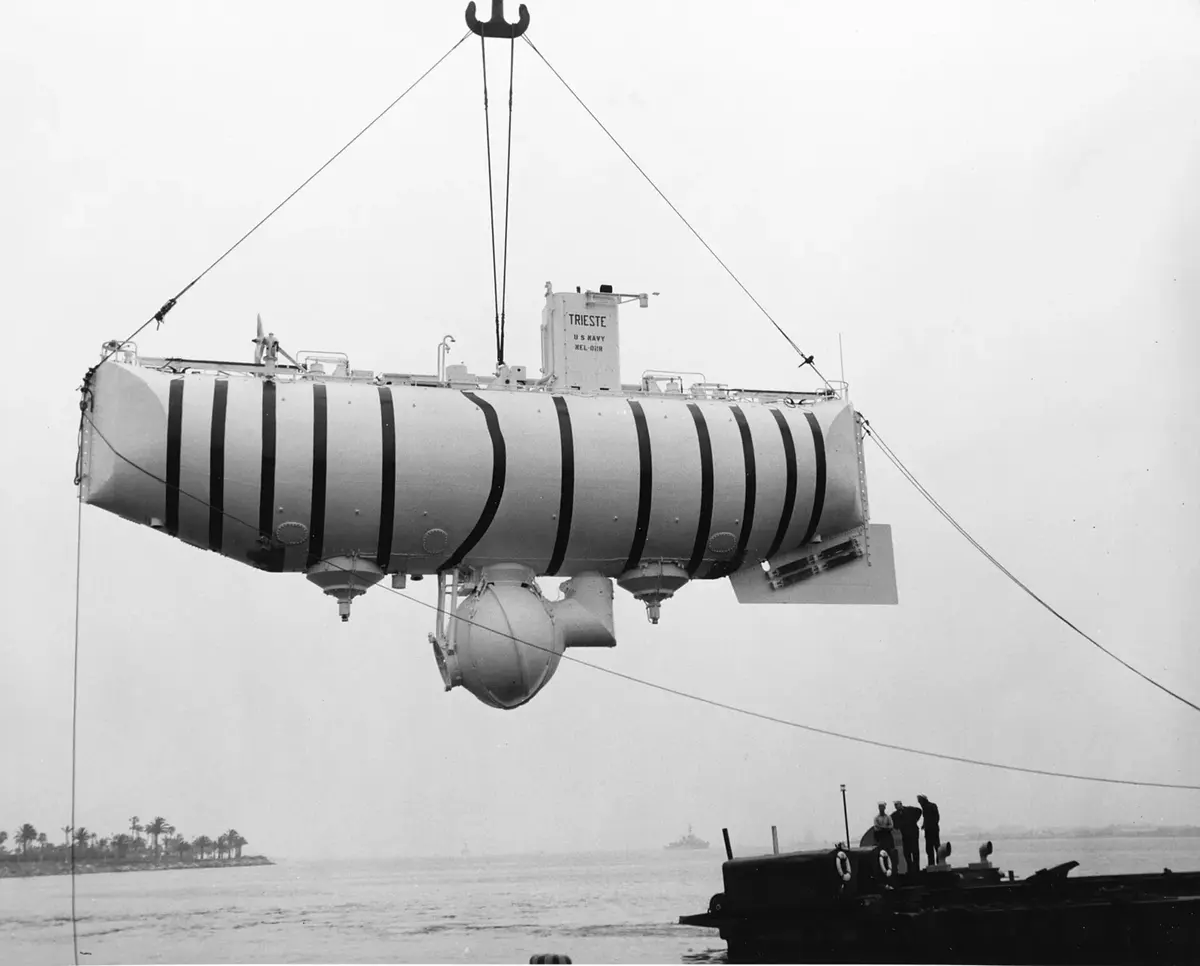
A submarine can float on the surface or travel deep under it. It has large ballast tanks. To dive, it lets seawater into the tanks: its weight increases, becomes more than the upthrust, and it goes down. To come up, compressed air blows the water out of the tanks: its weight decreases, the upthrust wins, and it rises to the surface. With the tanks partly full, it can hang still at any depth.
Submarine: traced from a drawing by Voytek S, CC BY 3.0, via Wikimedia Commons
Many fish use the same trick. They have a gas-filled bag in their bodies, the swim bladder. Filling it with more gas makes the body bigger, so it displaces more water and gets more upthrust: the fish rises. Letting gas out makes the body smaller, so the upthrust falls and the fish goes deeper. (Strictly, the submarine changes its weight and keeps its volume, while the fish changes its volume and keeps its weight. Both change the balance between weight and upthrust.)
The hydrometer and the lactometer
A hydrometer measures the relative density of a liquid. It is a sealed glass tube with a wide bulb at the bottom, weighted with lead shot or mercury so that it floats upright, and a thin stem marked with a scale. It sinks until it displaces its own weight of liquid. In a dense liquid, a small volume is enough, so it floats high; in a less dense liquid it sinks deeper. The reading at the surface gives the relative density, so the numbers on the stem get bigger towards the bottom.
A lactometer is a hydrometer made for milk. Pure cow’s milk is a little denser than water (relative density about 1.028 to 1.034). If water has been mixed into the milk, its density is lower, and the lactometer sinks deeper than it should. Dairies and milk collection centers check milk this way.

A lactometer floats lower in one sample of milk than in another. What does this tell you about the first sample?
Pick an answer to see why.
b. Floating in the air
Objects can float in gases just as in liquids. The air gives an upthrust equal to the weight of the air the object displaces. Air’s density is so small (about 1.2 kg/m³) that the upthrust matters only for objects that are very light for their size.
A balloon filled with helium or hydrogen is such an object. The air it displaces weighs more than the balloon and its gas, so the upthrust is greater than its weight, and it rises. But the air gets thinner as the balloon climbs, so the upthrust gets smaller. At some height the upthrust equals the weight, and the balloon floats there. Also, as the air pressure outside falls, the gas inside pushes the balloon’s skin outward and the balloon swells; a party balloon keeps growing until it bursts.
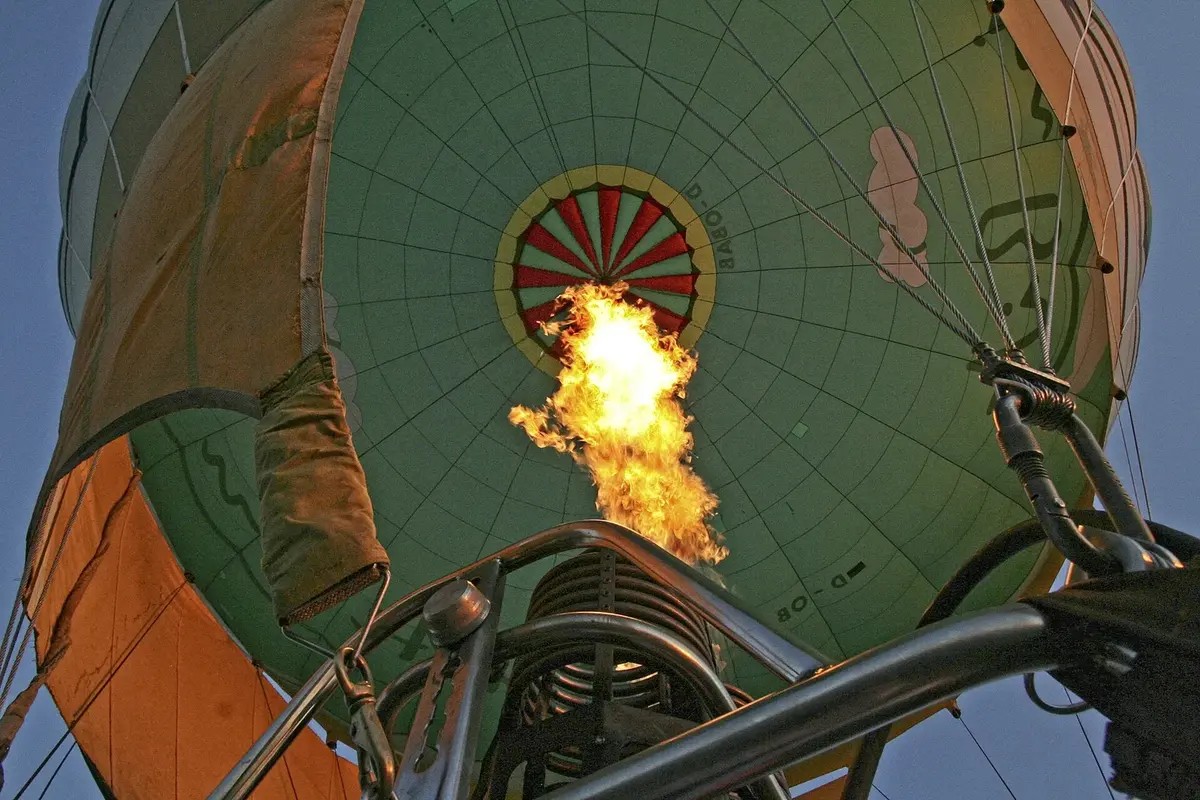
Hot-air balloons fly in the same way, but they use hot air instead of a light gas. When air is heated, it expands, so its density falls. The air inside the huge balloon is hot and less dense than the cool air around it. The balloon displaces a very large volume of cool air, so the upthrust becomes greater than the total weight of the balloon, its hot air, the basket and the people, and the balloon rises. As it climbs into thinner air, the upthrust falls, and at some height it equals the weight: the balloon floats there.
The pilot steers up and down with a burner. Turn the flame on: the air inside gets hotter and less dense, the balloon gets lighter, and it rises. Turn it off: the air inside cools, its density increases, and when the weight becomes greater than the upthrust, the balloon sinks slowly back to the ground.
A hot-air balloon is floating at a steady height. The pilot turns off the burner. What happens, and why?
Pick an answer to see why.
Project work
Exercise
1. Choose the correct option
a. On which law or principle is a lactometer based?
Pick an answer to see why.
b. What is the condition for a hydrogen balloon to fly upwards in the air?
Pick an answer to see why.
c. In a hydraulic machine, the cross-sectional area of the larger piston is twice that of the smaller piston. Which weights on the smaller piston () and the larger piston () keep the machine balanced?
Pick an answer to see why.
d. An object hung from a spring balance weighs in air, in water and in glycerine. Which order is correct, from smallest to largest?
Pick an answer to see why.
e. When a ship sails from the sea into a river, it sinks deeper into the water. Why?
Pick an answer to see why.
f. A hand pushes a ball down into water. Which statement is correct?
Pick an answer to see why.
g. Three cubes made of different materials get the same upthrust when they are put in water. Which quantity is the same for all three?
Pick an answer to see why.
What is the upthrust on the object in the figure when it is put in the liquid?
Choose one:
Pick an answer to see why.
2. Differentiate between
Pressure and upthrust
Answer
The reason a steel pin sinks in water and a steel plate floats
Answer
The processes of a hot-air balloon rising and sinking in the air
Answer
3. Give reasons
A special type of oil is used in hydraulic brakes.
Answer
A wooden cork pushed under the surface of water with a finger comes back to the surface when the finger is removed.
Answer
We feel lighter while floating in water.
Answer
When a stone is lifted out of water, it feels heavier as it comes out.
Answer
It is easier to float in the Dead Sea than in a swimming pool. (The density of water in the Dead Sea is 1,240 kg/m³.)
Answer
If more passengers climb into a boat than its maximum capacity, the boat is likely to sink.
Answer
4. Answer these questions
State Pascal’s law.
Answer
Write any two applications of Pascal’s law in daily life.
Answer
What is a hydraulic machine?
Answer
State Archimedes’ principle.
Answer
What is upthrust?
Answer
Name the forces acting on a floating object, and give their directions.
Answer
State the law of flotation.
Answer
Write any two applications of Archimedes’ principle.
Answer
Using materials you can find, describe one way to show upthrust in a liquid and one way to show it in a gas.
Answer
Explain, with a figure, why there is upthrust.
Answer
A stone dropped into water sinks. Is that because there is no upthrust on it?
Answer
A person is trying to lift a stone of 500 N by putting it on the smaller piston of a hydraulic machine and pushing on the larger piston. What would you suggest so that the load can be lifted easily? Explain, with a figure, how a hydraulic machine increases a force.
Answer
“A substance denser than a liquid sinks in it.” Is this statement always true? Justify with an example.
Answer
Two balloons that look identical are filled, one with air and the other with hydrogen. What difference will you notice when they are let go in the air? Explain why.
Answer
An object is floating just below the surface of water. If more and more salt is dissolved in the water, what will happen to the object? Explain why.
Answer
What does the weighing machine read in each picture of (a) and (b)? Explain why.
- a.A beaker of water that is not full weighs 20 N; blocks of 5 N and 8 N are floated on it.
- b.A beaker filled to the brim weighs 30 N; the same blocks are floated on it, and water overflows.
Answer
When a person puts a lactometer into some milk, the whole of its narrow stem sinks into the milk. What can you conclude?
Answer
5. Solve these problems
The figure shows a model of a hydraulic machine made from two syringes. How much force must be applied through syringe B to balance the 20 N force on piston A?
Answer
A pressure of 30,000 Pa is produced in the liquid of a hydraulic lift. If the cross-sectional area of the piston that lifts the load is 0.1 m², how much load can it lift?
Answer
Find the upthrust on the object in situations b and c of the figure. Why are the two upthrusts different?
Answer
Worksheet: Pressure: Pascal’s law and hydraulic machines (PDF, 4 pages)
Worksheet: Pressure: upthrust, Archimedes’ principle and flotation (PDF, 4 pages)
Quiz yourself: Force, Motion and Machines, Grades 5–10 →
Practice every question in the book, and keep track of the ones you miss →
A companion to your textbook, not a replacement for it: study from the book your school uses, and where the two differ, follow your teacher. Found a mistake? Please tell us.