
Drag a heavy sack of rice along a path with a rope. Hold the rope low and nearly all of your pull drags the sack forward. Hold it high, at a steep angle, and part of the same pull only tugs the sack upward: it slides no farther for all that effort. The pull and the distance moved are both arrows, vectors; the work you do is a single number.
So here is this unit’s question: how do two arrows multiply to give one number, and how much of a pull really moves a load? The same product tells a computer game how brightly to light the side of a hill, and arrows added and halved prove four old geometry theorems in a few lines each.
10.1 Introduction
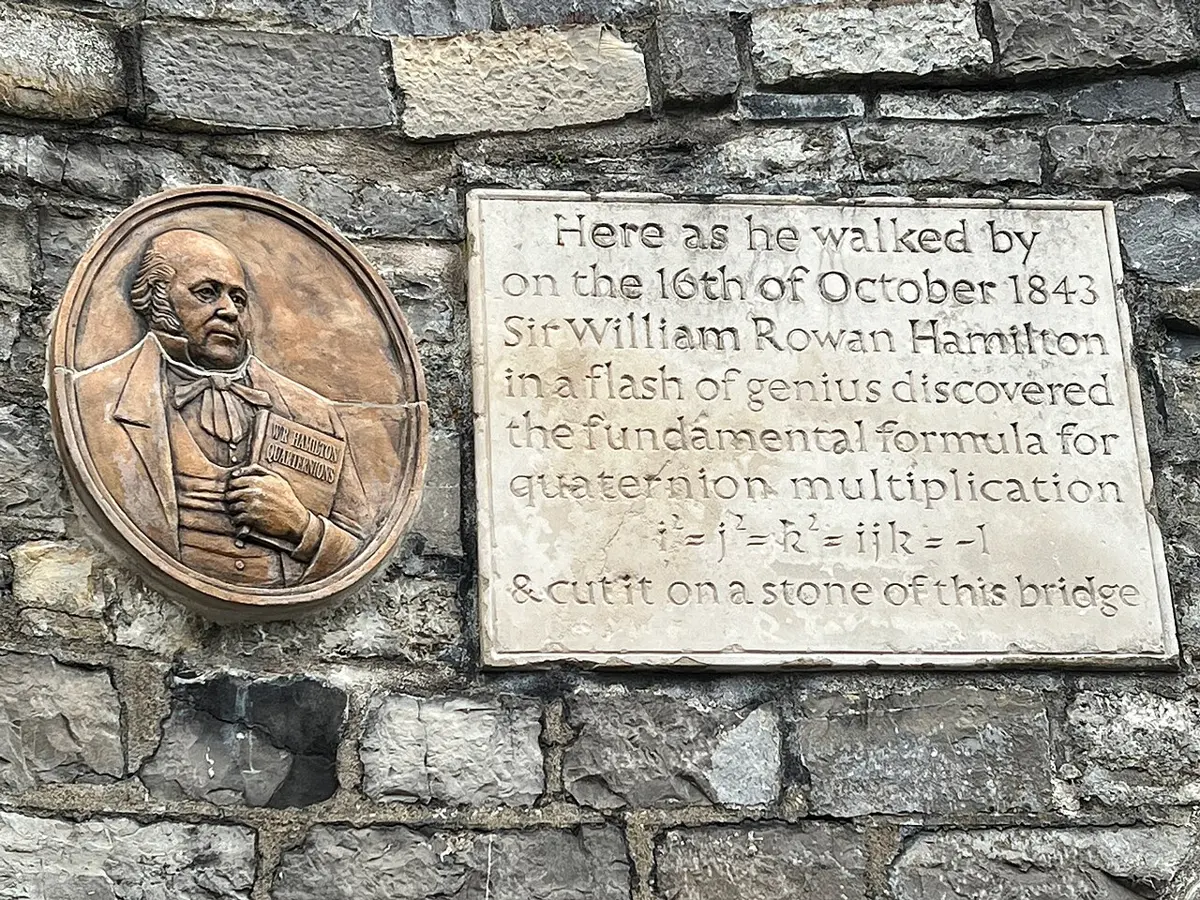
A vector is a quantity with both a magnitude (a size) and a direction: a displacement of 5 km to the north, a force of 20 N pulling down, the wind at 10 m/s from the west. A scalar has a size only: a mass of 3 kg, a temperature of 25 °C, a time of 10 s. The words are Hamilton’s (below); vector is Latin for “carrier”, since a vector carries a point A to a point B.
What you need from Grade 9
This unit builds on these, so keep them handy.
- A vector from A to B is written AB, and a vector with no named ends a. In the plane it is a column of two numbers, the move along the X-axis on top: , also written (3, 4).
- and are the unit vectors along the axes, each of length 1, so .
- The magnitude of is its length, (Pythagoras). For (3, 4) it is 5.
- The position vector of a point A is OA, the arrow from the origin O to A. Its column is A’s coordinates.
- End minus start: AB = OB − OA. For A(x₁, y₁) and B(x₂, y₂), .
- ka is a stretched k times (turned round if k is negative). Two vectors are parallel when one is a number times the other: EF = k BC.
- BA = −AB: the same length, the opposite way. And AA = 0, the zero vector.
Which of these is a vector?
Pick an answer to see why.
10.2 Scalar product
10.2.1 Introduction to scalar product
So the product of two vectors, the force and the displacement, has given a single number, the work. The work done by a force is the part of the force along the displacement times the distance moved:
Work is a scalar, measured in joules (J).
Power is the work done each second: the part of the force along the motion times the velocity, P = F · v = |F| |v| cos θ, a scalar measured in watts (W).
Both activities multiply two vectors and get a scalar, in the same way. That gives the definition.
If θ is the angle between two vectors a and b (), their scalar product is
It is called the scalar product because the answer is a scalar, and the dot product because of the dot. Read a · b as “a dot b”. Turned round, the same equation gives the angle between two vectors:
The angle between two vectors is measured with both of them starting from the same point, tail to tail.
Two forces of 4 N and 5 N act on a point at 60° to each other. What is their scalar product?
Pick an answer to see why.
10.2.2 Conditions for parallel and perpendicular vectors
a. Parallel vectors. When two vectors are parallel, the angle between them is 0° (the same direction) or 180° (opposite directions):
So if a and b are parallel, a · b = ±|a| |b|. In coordinates it is quicker to check that one vector is a number times the other: and are parallel when x₁/x₂ = y₁/y₂, that is, when x₁y₂ = x₂y₁.
b. Perpendicular vectors. When two vectors are perpendicular, the angle between them is 90°:
So if a and b are perpendicular, a · b = 0, and the other way round: if two vectors, neither of them zero, have a scalar product of 0, they are perpendicular. This is the test used most in this unit.
What the sign says, for any two vectors that aren’t zero:
| a · b | cos θ | the angle between them |
|---|---|---|
| positive | positive | acute (less than 90°) |
| zero | zero | a right angle (perpendicular) |
| negative | negative | obtuse (more than 90°) |
10.2.3 Scalar product in terms of coordinates
Let and . First, the unit vectors with each other: i and i point the same way and are 1 long, so , and likewise j · j = 1; i and j are perpendicular, so i · j = j · i = 0. Now multiply out, as with brackets:
For a = (x₁, y₁) and b = (x₂, y₂), a · b = x₁x₂ + y₁y₂: multiply the tops, multiply the bottoms, add. So the angle between two vectors comes from their coordinates alone:
What is ?
Pick an answer to see why.
10.2.4 Geometrical meaning of scalar product
Let PA = a and PB = b, with the angle θ between them. Drop a perpendicular from B to the line PA, meeting it at M, as in Figure 10.3. In the right-angled triangle PMB,
PM is the projection of b on a: the shadow b casts on a’s line when light falls straight down onto it. So
and in the same way, a · b = |b| (|a| cos θ), the magnitude of b times the projection of a on b.
The scalar product is the length of one vector times the projection of the other onto it. When the angle is obtuse, the projection falls behind P and counts as negative.
10.2.5 Properties of scalar product
- a.Commutative: a · b = b · a (the angle between them is the same either way).
- b.Distributive: a · (b + c) = a · b + a · c, so brackets multiply out as in algebra.
- c.A scalar comes out: (ka) · b = a · (kb) = k(a · b).
- d.The greatest (maximum) value: in the same direction (), a · b = |a| |b|. Since cos θ is never more than 1, no angle gives more.
- e.The least (minimum) value: in opposite directions (), a · b = −|a| |b|.
Two more follow, and the proofs of 10.4 use both:
- A vector dotted with itself () gives the square of its length: , also written . In coordinates, .
- A difference of squares: by b and a, .
If |a| = 3 and |b| = 4, which value can a · b not take, whatever the angle?
Pick an answer to see why.
10.2.6 Triangle law of vector addition
PQ is the displacement from P to Q, and QR the displacement from Q on to R. Together they make the displacement from P to R:
This is the triangle law of vector addition: if two vectors are drawn as two sides of a triangle, head to tail (in order), their sum is the third side, drawn from the start of the first to the end of the second. The middle letters meet: PQ + QR, Q to Q.
Worked examples
Back to the sack
The opening asked how much of a pull really moves a load. Pull with a force F along a rope at an angle θ to the ground, over a displacement d along it: the work is F · d = |F| |d| cos θ. Only the fraction cos θ of your pull moves the sack along. With 150 N of pull over 20 m:
| angle of the rope | cos θ | work done moving the sack along |
|---|---|---|
| 0° (level) | 1 | 3,000 J |
| 30° | 0.866 | 2,598 J |
| 40° | 0.766 | 2,298 J |
| 60° | 0.5 | 1,500 J |
| 90° (straight up) | 0 | 0 J |
At 30° you lose only about 13 %; at 60°, half. (A level pull isn’t always the easiest, though: a slight upward tug lifts some of the sack’s weight off the ground and so lessens the rubbing. The dot product says how much of the pull goes along the path; how much the ground holds back is a question for physics.)
Exercise 10.1
Question 1
A. If the angle between a and b is θ, which of these is their scalar product?
Pick an answer to see why.
B. If a = (x₁, y₁) and b = (x₂, y₂), what is a · b?
Pick an answer to see why.
C. If a · b = 0, |a| ≠ 0 and |b| ≠ 0, what is the angle between a and b?
Pick an answer to see why.
D. If a and b are parallel and point the same way, what is a · b?
Pick an answer to see why.
E. If and , what is a · b?
Pick an answer to see why.
F. If , what is ?
Pick an answer to see why.
G. If , and the angle AOB is 90°, what is m?
Pick an answer to see why.
Questions 2 and 3
What is meant by the scalar product of two vectors? Explain with an example.
Answer
Under what conditions are two vectors perpendicular, and when are they parallel? Give reasons.
Answer
Question 4
Find the scalar product of these vectors.
and
Answer
and
Answer
and
Answer
and
Answer
Question 5
Find the angle between the vectors of Question 4.
and
Answer
and
Answer
and
Answer
and
Answer
Question 6
Are these vectors perpendicular or parallel?
and
Answer
and
Answer
Question 7
If these vectors are perpendicular, find m.
and
Answer
and
Answer
a = 3i + mj and b = 6i − 2j
Answer
3i − 2j and mi + 3j
Answer
Question 8
If these vectors are parallel, find m.
and
Answer
and
Answer
a = 3i + mj and b = 6i − 2j
Answer
3i − 2j and mi + 3j
Answer
Question 9
and are two vectors.
What is the scalar product a · b?
Answer
If a · b = 0, how are a and b related?
Answer
If and , find a · b.
Answer
When is a · b greatest? Give a reason.
Answer
Question 10
Four points A(−2, 1), B(−1, −3), C(3, −2) and D(2, 2) are given.
If A(x₁, y₁) and B(x₂, y₂), what is the vector AB?
Answer
Write AB and BD as column vectors.
Answer
Find the angle between AC and BD.
Answer
Is ABCD a parallelogram or a rectangle? Decide from the lengths of its sides and its angles.
Hint
Answer
Questions 11 and 12
a + b + c = 0.
- a.What does a + b + c = 0 mean?
- b.If |a| = 3, |b| = 5 and |c| = 4, find a · c.
Answer
If |a + b| = |a − b|, prove that a and b are perpendicular.
Hint
Answer
10.3 Vector geometry
10.3.1 Mid-point formula
In any triangle, the median from a vertex is half the sum of the vectors along the two sides from that vertex: in △ABC, with D the midpoint of BC,
Proof. Let D, E and F be the midpoints of BC, CA and AB, so AD is a median. In △ABD, by the triangle law,
and in △ACD,
Adding (i) and (ii):
D is the midpoint of BC, so BD and CD are equal in length and point in opposite directions: BD + CD = 0. So
In the same way, for the other two medians, and .
The position vector of a midpoint. Put the vertex at the origin: if OA = a and OB = b, the midpoint M of AB is the end of the median from O in △OAB, so
Another way to see it: . With coordinates A(x₁, y₁) and B(x₂, y₂), this is the midpoint formula you know:
10.3.2 Internal division theorem
A point P on the segment AB divides it internally in the ratio m:n when AP:PB = m:n: cut AB into m + n equal parts, and P is m parts from A and n parts from B.
If the position vectors of A and B are a and b, and P divides AB internally in the ratio m:n, then the position vector of P is
Proof. Let O be the origin, with OA = a, OB = b and OP = p. P lies between A and B, so AP and PB point the same way along the line, and their lengths are in the ratio m:n:
End minus start: AP = p − a and PB = b − p. Put these in (i):
With m = n (a ratio of 1 : 1), P is the midpoint, and the formula gives , as in 10.3.1.
10.3.3 External division theorem
A point P on the line AB but outside the segment divides AB externally in the ratio m:n when AP:BP = m:n. With m bigger than n, P lies beyond B; with m smaller than n, beyond A.
If the position vectors of A and B are a and b, and P divides AB externally in the ratio m:n, then
Proof. Let OA = a, OB = b and OP = p. A, B and P lie on one line, with P outside AB, so AP and BP point the same way, with lengths in the ratio m:n:
AP = p − a and BP = p − b. Put these in (i):
The formula breaks down when m = n: the denominator is 0. No point outside AB is equally far from A and B.
A(2, 0) and B(6, 4). Which point divides AB internally in the ratio 1 : 3?
Pick an answer to see why.
10.4 Theorems
You may have met some of these theorems in geometry, proved with congruent or isosceles triangles. Vectors prove them another way: write each side as a sum of other sides (the triangle law), and use a scalar product of 0 for a right angle. The proofs are short, and they work without any figure-by-figure argument about which triangles match.
Theorem 1: the mid-point theorem
The line segment joining the midpoints of two sides of a triangle is parallel to the third side and half of it.
Given: in △ABC, E and F are the midpoints of AB and AC.
To prove: , so and .
Proof. In △AEF, by the triangle law,
E and F are midpoints, so and . From (i),
since BA + AC = BC in △ABC. EF is a number () times BC, so the two are parallel, and EF is half of BC. Hence proved.
Theorem 2: the midpoint of the hypotenuse
In a right-angled triangle, the midpoint of the hypotenuse is equally far from (equidistant from) all three vertices.
Given: △ABC with , so AC is the hypotenuse, and D the midpoint of AC.
To prove: AD = BD = CD.
Proof. The angle at B is 90°, so BA and BC are perpendicular:
By the triangle law, in △ABD, BA = BD + DA, and in △BCD, BC = BD + DC. D is the midpoint of AC, so DC = −DA. Put these in (i):
So BD = DA, lengths being positive. And DA = DC, since D is the midpoint. Hence AD = BD = CD.
This means the circle with the hypotenuse as its diameter passes through the right angle’s vertex: the reverse of Theorem 4.
Theorem 3: the midpoints of a quadrilateral
The quadrilateral formed by joining the midpoints of the sides of any quadrilateral, in order, is a parallelogram.
Given: a quadrilateral ABCD, with F, G, H and E the midpoints of AB, BC, CD and DA, joined in order to make EFGH.
To prove: EFGH is a parallelogram (EF = HG, or EH = FG).
Construction: join B and D.
Proof. In △ABD, F and E are the midpoints of AB and AD. By the mid-point theorem (Theorem 1),
In △CBD, G and H are the midpoints of CB and CD, so in the same way
From (i) and (ii), EF = HG: the sides EF and HG are equal in length and parallel. A quadrilateral with one pair of opposite sides equal and parallel is a parallelogram. (Joining A and C gives in the same way.) Hence EFGH is a parallelogram.
Theorem 4: the angle in a semicircle
The angle that a diameter of a circle makes (subtends) at any point on the circle (its circumference) is a right angle.
Given: O is the center of a circle, AB a diameter and C any other point on the circle.
To prove: .
Proof. Every point on the circle is a radius r from the center, so |OA| = |OB| = |OC| = r. O is the midpoint of AB, so OB = −OA. End minus start:
AC · BC = 0, so AC and BC are perpendicular, and . Hence proved.
Worked examples
Exercise 10.2
Question 1
A. In △ABC, what is AB + BC equal to?
Pick an answer to see why.
B. In △ABC, D, E and F are the midpoints of BC, CA and AB. What is 2AD equal to?
Pick an answer to see why.
C. If the position vectors of A and B are a and b, what is the position vector of the midpoint of AB?
Pick an answer to see why.
D. If OA = 4i + 3j and OB = 3i − 4j, what is the position vector of the midpoint of AB?
Pick an answer to see why.
E. P divides the line segment joining the points with position vectors a and b internally in the ratio m:n. What is p?
Pick an answer to see why.
Questions 2 to 4
- a.The position vectors of P and Q are 4i + 7j and 4i − 3j. Find the position vector of the midpoint R of PQ.
- b.The position vectors of R and S are 5i − 4j and 3i + 6j. Find the position vector of the midpoint T of RS.
Answer
A(2, −3) and B(3, 2) are the ends of the line segment AB.
- a.M divides AB internally in the ratio 2 : 3. Find the position vector of M.
- b.N divides AB externally in the ratio 3 : 1. Find the position vector of N.
Answer
The position vectors of A and B are OA = 6i − 2j and OB = 2i + 3j.
- a.P divides AB internally in the ratio 3 : 1. Find the position vector of P.
- b.Q divides AB externally in the ratio 2 : 1. Find the position vector of Q.
Answer
Question 5
In △ABC, F and E are the midpoints of AB and AC.
State the mid-point theorem in vector form.
Answer
Write BC in terms of AB and AC, using the triangle law.
Answer
Prove by the vector method that (or ).
Answer
If D is the midpoint of BC, prove that AD + BE + CF = 0.
Hint
Answer
Question 6
The position vectors of A and B are a and b. P divides AB internally in the ratio m:n, as in Figure 10.10.
Write the formula for the position vector p of P.
Answer
Why is nAP = mPB used when AP:PB = m:n? Give a reason.
Answer
If a = i + 2j and b = 4i + 8j, find the position vector of the point that divides AB internally in the ratio 1 : 2.
Answer
When does hold? Give a reason.
Answer
Question 7
P divides the line segment joining the points with position vectors a and b externally in the ratio m:n.
Write the formula for the position vector p for external division.
Answer
Prove by the vector method that .
Answer
If a = i + 4j and b = 5i − 3j, find the position vector of the point that divides AB externally in the ratio 1 : 2.
Answer
If m:n = 1:1, is there an external division point P? Give a reason.
Answer
Question 8
Prove by the vector method:
The quadrilateral formed by joining the midpoints of the sides of any quadrilateral is a parallelogram.
Answer
The angle in a semicircle (the angle a diameter makes at a point on the circle) is a right angle.
Answer
How the SEE asks it
In the SEE’s Optional Mathematics paper (75 marks, 3 hours), Vector is a content area of its own. CDC’s specification grid gives it 7 marks, in three kinds of question:
| Group | Kind of question | Vector’s marks | Levels |
|---|---|---|---|
| A | multiple choice, 1 mark | 1 | understanding 1 |
| B | within the content area: one question on vectors alone, in three 1-mark parts | 3 | knowledge 1, application 1, higher ability 1 |
| C | across content areas: parts of a longer question joining vectors with another area | 3 | application 2, higher ability 1 |
In CDC’s model paper, vectors turn up in all three groups: the scalar product of the two sides that make a right angle (group A, 1 mark); a triangle with its vertices given, the midpoint of a side as a position vector in terms of the ends’ position vectors and then in i and j, and the mid-point theorem proved by vectors (group B, 1 + 1 + 1); and, inside a question that starts with the conic sections, the angle in a semicircle proved by vectors and what happens when the point is inside the semicircle (group C, 2 + 1).
What each kind asks, and where its marks are:
- 1-mark questions: a scalar product from coordinates or from lengths and an angle, perpendicular means 0, the angle from cos θ, a midpoint or a median as a sum, the triangle law. Work them on rough paper.
- Formulas (knowledge): write them exactly, letters in the right places: , , , a · b = |a| |b| cos θ.
- Finding (application): turn coordinates into position vectors, use the formula, give the answer as xi + yj.
- Proofs (higher ability): write Given and To prove, then each step with its reason in brackets: [triangle law], [E is the midpoint of AC], [OB = −OA]. End with “Hence proved.”
Here is a question in the style of group B, written for this book, with how it is marked.
Miscellaneous exercise
These questions join the unit’s parts together, the scalar product with midpoints and section points, as the SEE’s longer vector questions do.
Two vectors are a = 3i + 4j and b = xi − 2j.
- a.If a = (x₁, y₁) and b = (x₂, y₂), write a · b using i and j, and in terms of x.
- b.If a and b are perpendicular, find x.
- c.For what value of x does b make an angle of 45° with the Y-axis?
- d.The position vectors of A and B are 2i + 4j and 4i − 2j. Find the position vector of the midpoint of AB.
Hint
Answer
In △ABC, the position vectors of the vertices are OA = 2i + 3j, OB = 4i + j and OC = 6i + 5j.
- a.D is the midpoint of AB. Write OD in terms of i and j.
- b.E is the midpoint of AC. Write OE in terms of i and j.
- c.Prove by the vector method that .
- d.Are DE and BC parallel? Check.
Answer
The position vectors of P and Q are p = 2i + j and q = i − 3j. R divides PQ internally in the ratio 3 : 2.
- a.Write the formula for the position vector of a point that divides the line joining two points internally in the ratio m:n.
- b.Find the position vector r of R.
- c.Find ∠POR.
- d.Compare ∠POR and ∠QOR.
Answer
The position vectors of A and B are 3i + 2j and i − 4j. P divides AB externally in the ratio 2 : 3.
- a.Write the formula for the position vector of a point that divides the line joining two points externally in the ratio m:n.
- b.Find the position vector of P.
- c.If m > n, on which side, A’s or B’s, does the external division point lie? Explain.
- d.Find ∠AOB.
Answer
Practice every question in the book, and keep track of the ones you miss →
Where these facts come from
- Hamilton’s discovery of quaternions on 16 October 1843, walking along the Royal Canal in Dublin with his wife, the rules carved on Brougham (now Broom) Bridge, the plaque; Heaviside’s “a positive evil of no inconsiderable magnitude”; Gibbs and Wilson’s Vector Analysis (1901) (10.1): Wikipedia, “History of quaternions”, read October 2026.
- Hamilton introducing the term vector, the Latin word meaning “carrier”; Gibbs’s Elements of Vector Analysis (1881) (10.1): Wikipedia, “Euclidean vector”, History, read October 2026.
- Hamilton’s first use of “scalar” in English, in 1846, for the real part of a quaternion, “on the one scale of progression of numbers” (10.1): Wikipedia, “Scalar (mathematics)”, Etymology, read October 2026.
- Gibbs (1839–1903) at Yale, his vector notes privately printed in 1881 and 1884 for his students, Heaviside’s similar work at the same time, Gibbs’s notation for the dot and cross products (10.1): Wikipedia, “Josiah Willard Gibbs”, read October 2026.
- Work as the dot product of force and displacement, W = Fs cos θ, in joules; no work by a force perpendicular to the motion; power as F · v (the opening, 10.2.1, Back to the sack): Wikipedia, “Work (physics)”, read October 2026.
- The names dot product and scalar product; (10.2): Wikipedia, “Dot product”, read October 2026.
- Brightness in computer graphics from the dot product of a surface’s unit normal and the direction to the light (10.2.4): Wikipedia, “Lambertian reflectance”, read October 2026; Lambert’s cosine law and Photometria (1760): Wikipedia, “Lambert’s cosine law”, read October 2026.
- Using the sign of a dot product to tell whether something is in front of or behind a game object, and its value for unit vectors (1, 0, −1) (10.2.2): Unity Scripting API, “Vector3.Dot”, read October 2026.
- Sunlight on a surface greatest when it faces the sun and falling with the cosine of the angle; solar panels mounted at an angle toward the sun (10.2.4): Wikipedia, “Solar irradiance”, read October 2026.
- Varignon’s theorem, its proof published in 1731 after his death, the area and perimeter of the parallelogram (10.4): Wikipedia, “Varignon’s theorem”, read October 2026.
- Thales’s theorem, its attribution to Thales or Pythagoras, Euclid’s Elements Book III, Proposition 31, “In a circle the angle in the semicircle is right” (10.4): Wikipedia, “Thales’s theorem”, read October 2026.
- The photo of the plaque on Broom Bridge: its Wikimedia Commons file page.
- CDC’s specification grid and model paper for Optional Mathematics, 2082 (How the SEE asks it): the textbook folder,
Specification Grids/grid-Opt. Math-G10.
A companion to your textbook, not a replacement for it: study from the book your school uses, and where the two differ, follow your teacher. Found a mistake? Please tell us.