
Fold an A4 sheet in half and you get an A5 sheet of exactly the same shape, only smaller. That works only because the long side is times the short one, and is a number no fraction can equal: its decimals never end and never repeat. Numbers like it are called surds.
Surds turn up as soon as the unknown hides under a root sign. A clock’s pendulum takes seconds to swing to and fro, so how long must it be to tick once a second? To answer, you have to get L out from under the root, and then check that the answer you get is a real one: squaring can invent answers that don’t work. This unit shows how, and answers the pendulum at the end of 5.2.
5.1 Introduction
What a surd is
and : some roots come out as whole numbers or fractions. Most don’t. Try on a calculator: 1.4142135623… The calculator stops because its screen is full, not because the number has ended. A root whose value is not a rational number (not a fraction p/q of whole numbers) is a surd. So
are all surds: none of them is a rational number. But , and are not surds, even though they are written with a root sign. A surd is an exact number all the same: is exactly the number whose square is 2. Only its decimal can’t be written down in full.
The small number on the root sign is the order of the surd: (that is, ) is of order 2, of order 3. The number under the sign is the radicand.
Why √2 can’t be a fraction
Suppose , a fraction already canceled down as far as it goes, so that p and q have no common factor. Squaring, , so . Then is even, so p is even (an odd number’s square is odd). Write p = 2k: then , so , and q is even too. But then 2 is a common factor of p and q, which we said had none. The only way out is that no such fraction exists: is irrational. The same argument works for , and the square root of any whole number that isn’t a perfect square.
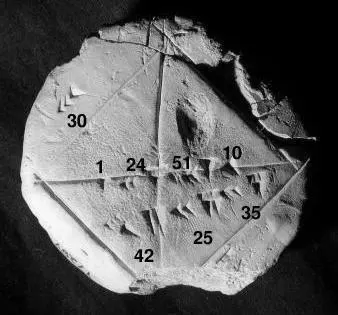
Lengths that are surds
Surds are not made up to make maths harder: they are lengths. A square tile of side 1 m has a diagonal of m, by Pythagoras. A square of side a has a diagonal of , and a rectangle 1 by 2 a diagonal of . You can draw these lengths exactly with a ruler and a set square, yet no ruler’s marks will ever fall exactly on them.
The paper in your printer is another. An A4 sheet is 210 mm by 297 mm, and 297 ÷ 210 = 1.414…: its sides are in the ratio . Why that ratio? Fold a sheet of sides 1 and r in half across its long side: the halves have sides r/2 and 1. For the half to have the same shape, 1 ÷ (r/2) = r ÷ 1, so and . An equation with a surd as its answer decides the shape of every A-size sheet.
Which of these is a surd?
Pick an answer to see why.
Pure and mixed surds
A surd written as a root alone, such as , or , is a pure surd. One with a rational number multiplying it, such as or , is a mixed surd. A pure surd often hides a mixed one: take out every square factor of the radicand.
Each pair of equal factors under a square root comes out as one factor, because (for a ≥ 0). For a cube root, each set of three equal factors comes out: .
Working with surds
Surds can be added, subtracted, multiplied and divided, exactly.
- Like surds have the same order and the same radicand after simplifying: and are like; and are unlike. Only like surds can be added or subtracted, the way 2x + 5x = 7x: , and .
- Multiplying and dividing surds of the same order: and (for a, b ≥ 0, b ≠ 0). So , and .
- Brackets multiply out as in algebra: , and .
Rationalizing: a bottom you can divide by
Before calculators, meant dividing 1 by 1.41421356…, a long division by a number that never ends. But multiply its top and bottom by , which is multiplying by 1, and
which is just half of 1.41421356…, easy by hand. Rewriting a fraction so that its bottom has no surd is rationalizing the denominator; what you multiply by is the rationalizing factor. For a bottom of two terms, or , the factor is its conjugate, the same two terms with the sign between them changed, because has no root left:
The same factorization, , simplifies fractions in the surd equations of 5.2.
What is the rationalizing factor of ?
Pick an answer to see why.
Where surds are used
Surds are written wherever an exact answer matters more than a decimal: in geometry and trigonometry (, the diagonal of a square), in physics formulas such as a pendulum’s swing or a falling stone’s time, , and in engineering and computing. Keeping as until the last step avoids rounding errors that grow: is exactly 2, but .
5.2 Equations Involving Surds
An equation with the unknown under a root sign, such as , is an equation involving surds (a surd equation, or radical equation).
The root sign is the obstacle, and the way past it is the opposite of taking a root: squaring undoes a square root, cubing undoes a cube root. But you must do the same to both sides, and it only works cleanly when the root is alone on its side.
The steps for solving an equation involving surds:
- Separate the terms with the root sign from the terms without it. For example, becomes .
- Square both sides to remove a square root (or cube both sides to remove a cube root). For example, becomes .
- Simplify and solve the new equation. For example, 2x − 1 = 9, 2x = 10, x = 5.
- Check every solution by putting it into the original equation. Squaring can produce solutions that don’t fit the original equation. Solving gives x = 5 and x = −2: x = 5 makes the equation true, x = −2 makes it false, so only x = 5 is a solution.
- If there are two terms with root signs, separate and square (or cube) twice: put one root alone, square, then put the root that is left alone, and square again.
Why squaring can invent an answer
If A = B then : squaring never loses a true answer. But the reverse fails: also holds when A = −B. 3 = 3 and 3 = −3 both square to 9 = 9. So the squared equation has every solution of , and also every solution of . At x = −2, but the right side is −2: it solves the second equation, not ours. A solution of the squared equation that fails the original is a false root (an extraneous root).
On a graph: is the upper half of a sideways parabola. Squaring turns it into , the whole parabola, and the false root is where the line meets the half we never had.
Solving , a student squares and gets , so x = 3 or x = −2. What should she write?
Pick an answer to see why.
Worked examples
Back to the pendulum
Exercise 5.1
Question 1
Solve the given equations and verify.
Answer
Answer
Answer
Answer
Answer
Answer
Question 2
Solve the given equations and verify.
Answer
Answer
Hint
Answer
Answer
Answer
Answer
Question 3
Solve the given equations and verify.
Hint
Answer
Hint
Answer
Answer
Hint
Answer
Hint
Answer
Answer
Answer
Questions 4 and 5
Prove that the value of x is 81 when solving the equation . For which values of x is the equation undefined? Give a reason.
Answer
Make up any five questions like those in this exercise, solve them, and present them in class.
Answer
Practice every question in the book, and keep track of the ones you miss →
How the SEE asks it
In the SEE’s Optional Mathematics paper (75 marks, 3 hours), Surd is one of the units of Algebra (Units 1 to 6 of this book). CDC’s specification grid gives Algebra 17 marks, in three kinds of question:
| Group | Kind of question | Algebra’s marks | Levels |
|---|---|---|---|
| A | multiple choice, 1 mark each | 2 | knowledge 1, application 1 |
| B | within the content area: questions on Algebra alone, each of 2 to 4 parts | 10 | knowledge 2, understanding 2, application 4, higher ability 2 |
| C | across content areas: one question joining Algebra with another area | 5 | understanding 2, application 2, higher ability 1 |
In CDC’s model paper, this unit is the last part of a group C question that starts with conic sections and vectors: a right-angled triangle whose two shorter sides squared are given as surd expressions, so that Pythagoras gives an equation with two root signs to solve (2 marks, application). It can also come as a 1-mark multiple-choice question (what a surd is, a false root) or a part of a group B question.
What each kind asks, and where its marks are:
- Solve and verify: separating and squaring (1 mark), solving (1 mark), and the check, with any false root rejected.
- Two root signs: square twice; the second root must be isolated before the second squaring.
- Fractions with surds: factorize , or rationalize, before squaring.
- From geometry: the equation comes from Pythagoras or a formula; write it down first.
Here is a question of this kind, written for this book, with how it is marked.
Where these facts come from
- The definition of surd as an unresolved irrational root; al-Khwarizmi’s “audible” and “inaudible” numbers (about 825), the Arabic asamm “deaf” translated as Latin surdus, and its use by Gerard of Cremona (about 1150), Fibonacci (1202) and Robert Recorde (1551) (5.1): Wikipedia, “Nth root”, History, read October 2026.
- Hippasus of Metapontum (about 530 to 450 BC), the weak evidence for crediting him with irrational numbers (the ancient sources either don’t name him or tie his drowning to the dodecahedron), and the drowning legend (5.1): Wikipedia, “Hippasus”, read October 2026.
- The tablet YBC 7289 (about 1800–1600 BC) and its 1;24,51,10, correct to about six decimal digits; √2 as the diagonal of a unit square; the proof that √2 is irrational (5.1): Wikipedia, “Square root of 2”, read October 2026.
- A-series paper: A4 210 mm × 297 mm, A0 of 1 m², the ratio √2 kept on halving, Lichtenberg’s letter of 1786, DIN 476 in 1922, ISO 216 (5.1): Wikipedia, “Paper size”, read October 2026.
- The pendulum formula , the seconds pendulum’s length of about 0.994 m, Talleyrand’s proposal of 1790, Richer’s 0.3% difference between Cayenne and Paris and the meter taken from the Earth’s quadrant instead (5.2, Back to the pendulum): Wikipedia, “Seconds pendulum”, read October 2026.
- The photo of YBC 7289: its Wikimedia Commons file page (Bill Casselman; Yale Babylonian Collection).
- CDC’s specification grid and model paper for Optional Mathematics, 2082 (How the SEE asks it): the textbook folder,
Specification Grids/grid-Opt. Math-G10.
A companion to your textbook, not a replacement for it: study from the book your school uses, and where the two differ, follow your teacher. Found a mistake? Please tell us.