
A girl is born in a village in Dhankuta who cannot speak, cannot walk, and cannot use her hands. People say she is paying for the sins of a past life. One day, with a twig held between her toes, she writes a letter in the dust. Years later her autobiography wins Nepal’s greatest prize for literature.
This unit reads the first chapter of that book, Jhamak Ghimire’s Jivan Kanda Ki Phul, and a short guide to a famous place on the other side of the world, Sugarloaf Mountain in Rio de Janeiro. Along the way you will learn to describe people and places, to say words that are spelled alike but sound different, to join ideas with who, which, whose, where and when (relative clauses), to use prepositions of time and place, and to write a biography and a letter to a friend about a place in Nepal.
Getting started
The unit opens with three famous Nepali writers and two famous places.
| Picture | Who or what | Something to say |
|---|---|---|
| A young man with dark hair | Bhupi Sherchan (1937–1989), poet, born in Tukuche, Mustang | His collection Ghumne Mechmathi Andho Manchhe (A Blind Man on a Revolving Chair, 1969) won the Sajha Puraskar; his poems mock injustice in plain, sharp words. |
| An old man with a long white beard | Lekhnath Paudyal (1885–1966), poet, born near Pokhara | Given the title Kavi Shiromani (the crest-jewel of poets) in 1951; his Pinjadako Suga (A Parrot in a Cage) was read as a hidden protest against the Rana rulers. |
| An older woman with glasses and a shawl | Parijat (1937–1993), novelist and poet, real name Bishnu Kumari Waiba | Her novel Shirishko Phool (The Blue Mimosa) won the Madan Puraskar in 1965. She was paralyzed from the age of 26 and kept writing. |
| A small plane on a short, sloping runway among mountains | Tenzing–Hillary Airport, Lukla, Solukhumbu | At about 2,845 meters, with a runway of just 527 meters that slopes uphill, it is the gateway for treks to Everest, and often called the world’s most dangerous airport. |
| Pagodas and a stone temple in a brick square | Bhaktapur Durbar Square | The old royal square of Bhaktapur, one of the seven World Heritage monument zones of the Kathmandu Valley. |
Reading I: Me at the Beginning of Life
Before you read
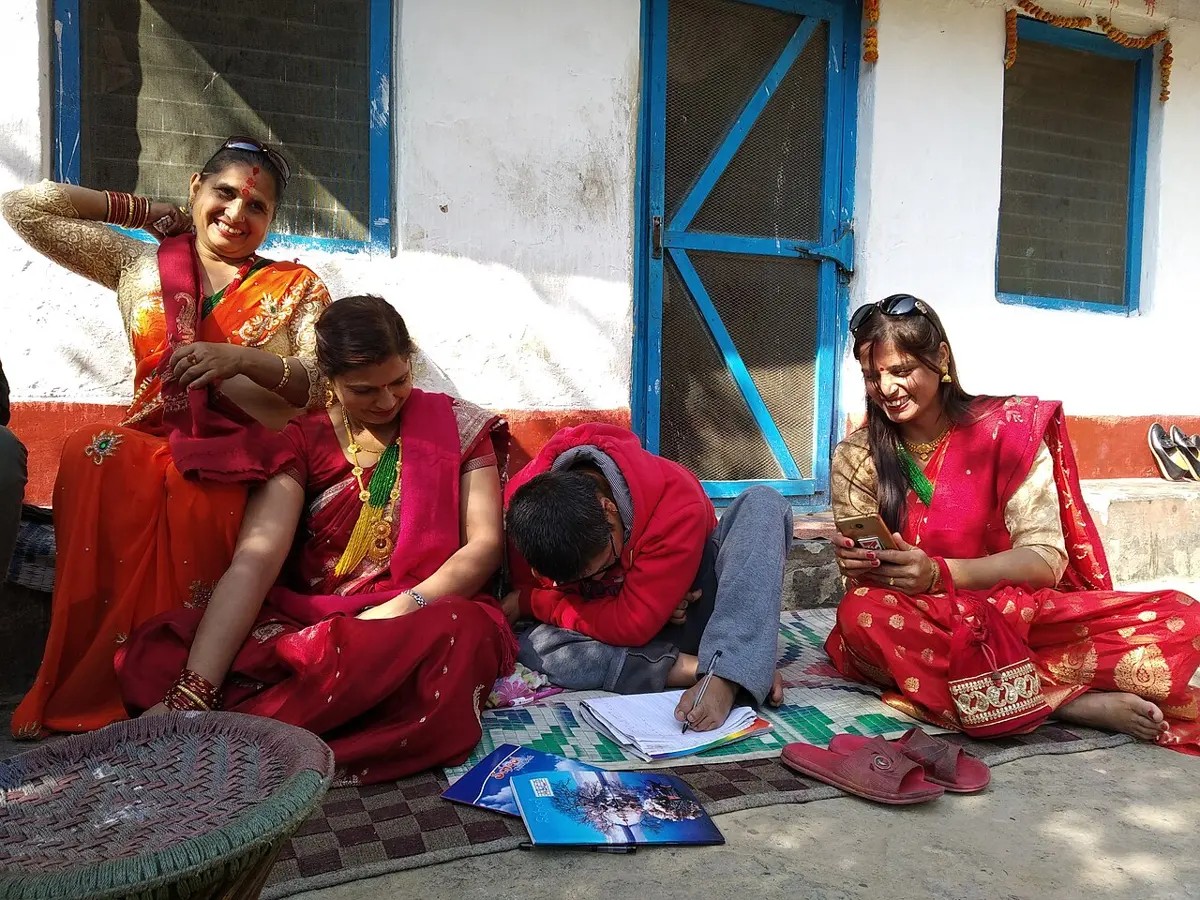
Look at the picture: a smiling young woman holding up a book with her own face on its cover. Who is the person in the picture?
Answer
What is she famous for?
Answer
What kind of text it is
The text is the opening chapter of an autobiography: a life story written by the person who lived it, in the first person (I, me). Jhamak Ghimire (born 1980, in Kachide, Dhankuta) wrote it in Nepali, and Michael Hutt, a British scholar of Nepali literature, translated it into English. It is not a plain list of events: she writes like a poet, talking to her mother, to Nature and to her grandmother, and asking questions no one could answer. Read it slowly: much of its meaning is in its images.
The chapter, part by part
1. Life, a beautiful flower
She begins with a thought she has reached now, as an adult: life is a beautiful flower of creation. But she does not know whether her own life fits that definition. She survived, she says, because even when her heart wept, laughter was restless (could not stay still) inside the pain. People will hardly believe how hard her life was; the truth is bitter and the reality insipid (tasteless, dull). Turning the pages of her memory, she has often cried. Her bad luck, she says, was inscribed (written) for her the moment she was born.
2. The sixth night
On the sixth day after her birth, her mother bathed her and put an exercise book and a pen under her pillow. It was a folk belief that on that night fortune (bhagya) writes a baby’s fate on its forehead. Speaking to her mother directly, Jhamak says her mother wished for a good line of fate to be drawn across her brow, but that was only a belief: that night, fortune did not write her a good fate.
3. A life robbed by fate
She felt like a girl robbed by fate, with none of the sweetness or joy of life. She had to live, so she did, but in a way she felt was no different from an animal’s, except that she ate rice. Her life had none of the invisible (unseen) feelings and sympathy of a human heart. A poet might write a beautiful poem about escaping such a life, but for her it was a burden that hurt and was hard to endure (bear).
4. The thorn in everyone’s eyes
People saw her as cursed by the gods, paying for sins she had committed in a former life, because her society believed that people are born again and again. So she was a thorn that pricked everyone’s eyes: when they looked at her, they felt no pity and no love, only displeasure and anger. She asks how that could be right towards an innocent child. She had to bear it in silence, though one question kept rising in her heart: How am I to blame for this? She had no way to ask it: no speech, no gestures, no strength. She had life and a little breath tangled (twisted) up with it, and life felt suffocating, as if she could not breathe, with no way out.
Why did people treat the young Jhamak badly?
Pick an answer to see why.
5. Nature, her mother
She turns to Nature and thanks it: Nature gave her life to endure people’s cruelty, but also woke her to the meaning of being herself, and wiped her tears like a mother. Her own mother, too, carried her for nine or ten months and gave birth to her; neither of them was at fault, she says: it was fate.
6. What is disability?
Now she asks a sharp question. Is disability only a matter of being born with a body that cannot do some things? If so, why does nobody call Homer, the ancient Greek poet said to have been blind, incomplete? Or Nikolai Ostrovsky, the Russian novelist who wrote How the Steel Was Tempered blind and paralyzed, or Helen Keller, the American writer who was deaf and blind? Their bodies were weak, like hers, but they wrote history, left the world a new perspective (way of seeing), and showed what it means to be human before they passed away (died).
7. Born in a different world
But she was born in a different world and a different geography from theirs (a poor village, with no help for children like her), so her life was so unequal and low that she felt only an animal could have lived it. When she became aware, it felt like a curse: she had no voice to speak, no strength in her legs to walk, and no strength in her hands to fill a basket with flowers (godavari, makhmali, sunakhari). Her mind was full of longing (strong wishes) to run on the hills and to talk with others; because those wishes could never come true, they fell back on her, wounded.
8. Grandmother
The chapter ends with love. She could not even get out of bed. Her white-haired grandmother, “like the moon over the hill”, must have carried her on her lap and wished that her son’s first offspring (child) would call her grandmother in a baby voice and pull at the wrinkles of her face. Jhamak could not do that; only her other grandchildren could.
The family was so poor that it was hard to find two meals a day, and her parents often went hungry so that the children could eat. Her grandmother went without food herself to feed Jhamak, slept beside her, and gave her something to eat every time she woke in the night: “how good it tasted!” She wrapped her in an old petticoat in a bamboo basket and kept her clean. Without her, Jhamak says, she might still be soiling (dirtying) her bed today, or might have died. Because of her grandmother she came to know the many colors of life. Her grandmother has died now (that is the old woman’s misfortune, she says, to have missed what Jhamak became), but she lives on in Jhamak’s heart and mind.
The writer’s devices:
- Apostrophe: she speaks directly to people and things who can’t answer: Mother, you wanted…, Blessed Nature!, Grandmother, I could not fulfil your wishes.
- Metaphor: life as a flower of creation; herself as a thorn that pricked everyone’s eyes; time that filled her pockets with packages of ill fortune.
- Simile: her grandmother, white-haired like the moon over the hill.
- Rhetorical questions: How am I to blame for all of this? Why do they not consider Homer incomplete? They make the reader think.
- Contrast: the beautiful flower of life against her bitter reality; the cruelty of people against the love of Nature and her grandmother.
- Allusion: Homer, Ostrovsky and Helen Keller, famous people whose bodies were weak but whose work changed the world.
Words from the text
Words linked here open in English Vocabulary, where you can see an example and practice them in the word game.
| Word | Meaning here |
|---|---|
| restless | unable to stay still or calm |
| insipid | lacking taste; dull |
| inscribed | written (or cut) in words |
| endure | to bear pain or difficulty patiently |
| invisible | impossible to see |
| tangled | twisted together in a messy way |
| suffocating | making it hard to breathe |
| foster | to bring up and care for a child |
| perspective | a particular way of seeing something |
| passed away | died (a gentle way to say it) |
| bereft | without something you need or love |
| longing | a strong wish for something |
| offspring | a person’s child or children |
| soil (verb) | to make dirty |
| misfortune | bad luck |
A. Find the words
Find the words from the text that have these meanings.
- a.lacking taste
- b.wrote words
- c.twisted together
- d.causing difficulty in breathing
- e.a particular attitude towards something
- f.a person’s child or children
- g.bad luck
Answer
B. Complete the sentences
Complete the sentences with the correct words from the text.
- a.The word calm is opposite in meaning to ……… .
- b.The phrase ……… means died.
- c.The word ……… means incapable of being seen.
- d.The word wish and ……… are synonyms.
- e.The word ……… means making dirty.
Answer
C. True or false?
Jhamak Ghimire defines her own life as a beautiful flower of creation.
Pick an answer to see why.
According to her, our fortune decides how our life will be.
Pick an answer to see why.
The author was happy with how she spent her childhood.
Pick an answer to see why.
People blamed Jhamak herself for her physical disability.
Pick an answer to see why.
According to the writer, Homer was incomplete because he was physically incapable.
Pick an answer to see why.
Jhamak could make her grandmother happy with her voice.
Pick an answer to see why.
Jhamak’s grandmother still looks after her.
Pick an answer to see why.
D. Answer the questions
Why does Jhamak think of her life as a burdensome life?
Answer
When does fortune draw the line of fate?
Answer
How did people respond to her life? Was she happy with their behavior?
Answer
Whom does Jhamak compare herself with? What made them different from Jhamak?
Answer
Did achieving awareness become a curse for her? Why?
Answer
How does Jhamak picture her family’s economic condition during her childhood?
Answer
E. Jhamak’s story in your own words
Read the opening chapter of Jivan Kanda Ki Phul in Nepali and narrate the story of Jhamak’s life in your own words.
A model answer
Pronunciation: same spelling, different sounds
Some words are spelled the same but said differently, and the sound changes the meaning. They are called heteronyms. You can tell which one is meant only from the sentence.
| Word | Meaning | Sound | Example |
|---|---|---|---|
| read | (verb, present) to look at and understand writing | /riːd/, like reed | I read the news every morning. |
| read | (verb, past) the past of read | /red/, like red | Yesterday I read her autobiography. |
| live | (verb) to be alive; to have your home | /lɪv/, like give | Rhinos live in Chitwan. |
| live | (adjective) alive; happening now | /laɪv/, like five | The match is shown live. A live wire is dangerous. |
| wind | (noun) moving air | /wɪnd/, like pinned | The wind blew the kites away. |
| wind | (verb) to turn or twist round something | /waɪnd/, like find | Wind the thread round the spool. |
| wound | (noun) an injury | /wuːnd/, like spooned | The wound on his leg healed. |
| wound | (verb) the past of wind | /waʊnd/, like found | The road wound up the hill. |
| tear | (verb) to rip | /teə(r)/, like bear | Don’t tear the page. |
| tear | (noun) a drop of water from the eye | /tɪə(r)/, like near | A tear ran down her face. |
| use | (verb) to make use of | /juːz/, ending in a /z/ sound | Can I use your pen? |
| use | (noun) a purpose; the act of using | /juːs/, ending in an /s/ sound | What is the use of this tool? |
Speaking: describing people and places
When you describe a person, go from the general to the details, in this order, which is also the order a listener can picture:
| What | Words to use |
|---|---|
| age | a young man, a teenager, middle-aged, in her twenties, elderly |
| height and build | tall, short, of medium height; thin, slim, well-built, stout, plump |
| skin | fair, wheatish, dark-skinned |
| face | round, oval, long, square; a beard, a mustache, a scar, a dimple |
| eyes | big, small, brown, black |
| hair | long, short, shoulder-length; straight, curly, wavy; black, brown, gray; in a ponytail, a plait, bald |
| clothes | a half-sleeved gray shirt, faded blue trousers, a kurta suruwal, rubber slippers |
| manner | walks fast, limps, smiles a lot, speaks softly |
A. A bag snatcher
The book’s model conversation: a woman tells a police inspector that someone snatched (grabbed and ran off with) her handbag. Asked to describe him, she gives a clear order: a young man, of medium height; she saw only the side of his face; he is rather dark-skinned, with short black hair; he had on a half-sleeved gray shirt and faded blue trousers; and when he slipped while running, she noticed yellow rubber slippers.
B. Describe someone you know
Ask and answer about your friends, teachers or parents. Describe their age, face, general appearance, build, manner of walking, hair, dress, etc.
A model description
C. Describe your village or town
The book’s model: Sukumaya describes her village. She starts with a general sentence (a very beautiful place), then gives details one by one: a big lake near her house where the full moon is reflected in the calm water, snowcapped mountains to see, a forest full of animals (wild pigs, leopards, tigers, deer), and pleasant evenings.
Now tell about your village or town in a similar way.
A model description
Grammar I: Relative clauses
A relative clause gives more information about a noun. It starts with a relative word: who, which, that, whose, whom, where, when. It comes straight after the noun it describes:
- the girl who plays the piano
- the book which / that she wrote
- the writer whose autobiography won the Madan Puraskar
- the village where she was born
- the year when the earthquake struck
Which relative word?
| Word | For | Example |
|---|---|---|
| who | a person (subject of the clause) | the woman who cooked our dinner |
| whom | a person (object of the clause, or after a preposition) | the guide whom we hired; the friend with whom I traveled |
| which | a thing or an animal | the bus which goes to Pokhara |
| that | a person or a thing, only without commas | the bus that goes to Pokhara; the man that I met |
| whose | belonging to (his, her, its, their) | a writer whose books are read in schools |
| where | a place | the village where my grandmother was born |
| when | a time | the morning when we saw the rhino |
When the relative word is the object of the clause, it can be left out: the book (that) she wrote; the guide (whom) we hired. When it is the subject, it can’t: the woman who cooked our dinner.
Two kinds: with and without commas
- A defining clause tells you which one is meant; without it, the sentence wouldn’t say who: The girl who won the singing competition is Reema. No commas. That is allowed.
- A non-defining clause adds an extra fact about someone or something already clear: Jhamak Ghimire, who was born in Dhankuta, writes with her foot. Commas round it; never that.
The commas can change the meaning: My brother who lives in Dharan is a teacher (I have more than one brother: the one in Dharan); My brother, who lives in Dharan, is a teacher (I have one brother, and by the way he lives in Dharan).
Parijat, ……… real name was Bishnu Kumari Waiba, wrote Shirishko Phool.
Pick an answer to see why.
This is the hospital ……… my sister was born.
Pick an answer to see why.
The tourists ……… we met at Sarangkot were from Korea.
Pick an answer to see why.
A. Find the relative clauses
Read the conversation and underline the relative clauses.
Swikriti: Abdul, look at this photo.
Abdul: Is this Sahara, the girl who plays the piano?
Swikriti: No, this is Reema, the girl who won the singing competition last year.
Abdul: I know her. She is the girl who has long brown hair.
Answer
B. Fill in the relative words
Fill in the gaps with the correct relative pronouns.
- a.I admired the player ……… performance was fantastic.
- b.We had some juice ……… was in the fridge.
- c.She didn’t tell her teacher about her problem, ……… was her mistake.
- d.My mother, ……… is a farmer, grows a lot of vegetables.
- e.You are my friend ……… I want to sit with.
- f.I want to help those children ……… economic condition is very bad.
- g.This is the road ……… the accident took place.
- h.The mobile phone, ……… I bought six years ago, is still working.
- i.It was in 2015 ……… the earthquake hit Nepal badly.
- j.Marima is a wonderful lady ……… everyone can trust.
Answer
C. Join the sentences
Join each pair of sentences with a relative word. Examples: I was a girl robbed by fate. I had neither the sweetness nor the joy of life. → I was the girl robbed by fate who had neither the sweetness nor the joy of life. The mother bore me. She also taught me values. → The mother who bore me also taught me values.
- a.The letter reached me this morning. My friend sent it from abroad.
- b.This is the palace. Bhimsen built it.
- c.The boy committed cybercrime. The judge sent him to jail.
- d.He is a liar. You should not believe him.
- e.I know an artist. He moves with an artificial leg.
- f.Bring me the file. The file is about our new project.
- g.We met a girl. The girl had lost her way.
- h.I saw a soldier. His bravery impressed everyone.
- i.Once upon a time there lived a giant in a forest. Nobody dared to go there.
- j.The dog took away the ball. The kids were playing with it.
Answer
Writing I: A biography
Write a short biography of the Nepali literary figure Til Bikram Nembang Limbu, also known as Bairagi Kainla, from these notes.
Birth: August 9, 1939, Panchthar, Nepal
Education: Bachelor of Arts; learned his letters at home, taught by local teachers
Publications: Bairagi Kainlaka Kavitaharu, Sappok-Chomen: Limbu Jatima Kokh-Puja, Nawacoit Mundhum and others
Contributions: poet; former Chancellor of the Nepal Academy; a pioneer of the Tesro Aayam (Third Dimension) movement
Awards: Jagadamba Shree Puraskar, 2076 BS; Sajha Puraskar, 2031 BS; Vishist Srasta Samman, 2066 BS, and others
Hint
A model biography
How to write a biography
A biography is the story of someone’s life written by someone else (an autobiography, like Jhamak Ghimire’s, is written by the person herself).
- Title: the person’s name.
- Opening: who the person is and why they matter, with their birth date and place.
- Early life and education.
- Work and achievements, in time order, with the most important ones explained.
- Honors and awards.
- Ending: what they are remembered for (and, for someone who has died, when).
Use the third person (he, she), mostly the past tense, and linking words of time (in 1939, as a boy, later, in the early 1960s, after that). Turn notes into full sentences: never copy the notes as a list.
Reading II: Sugarloaf Mountain: 5 Interesting Facts
Before you read
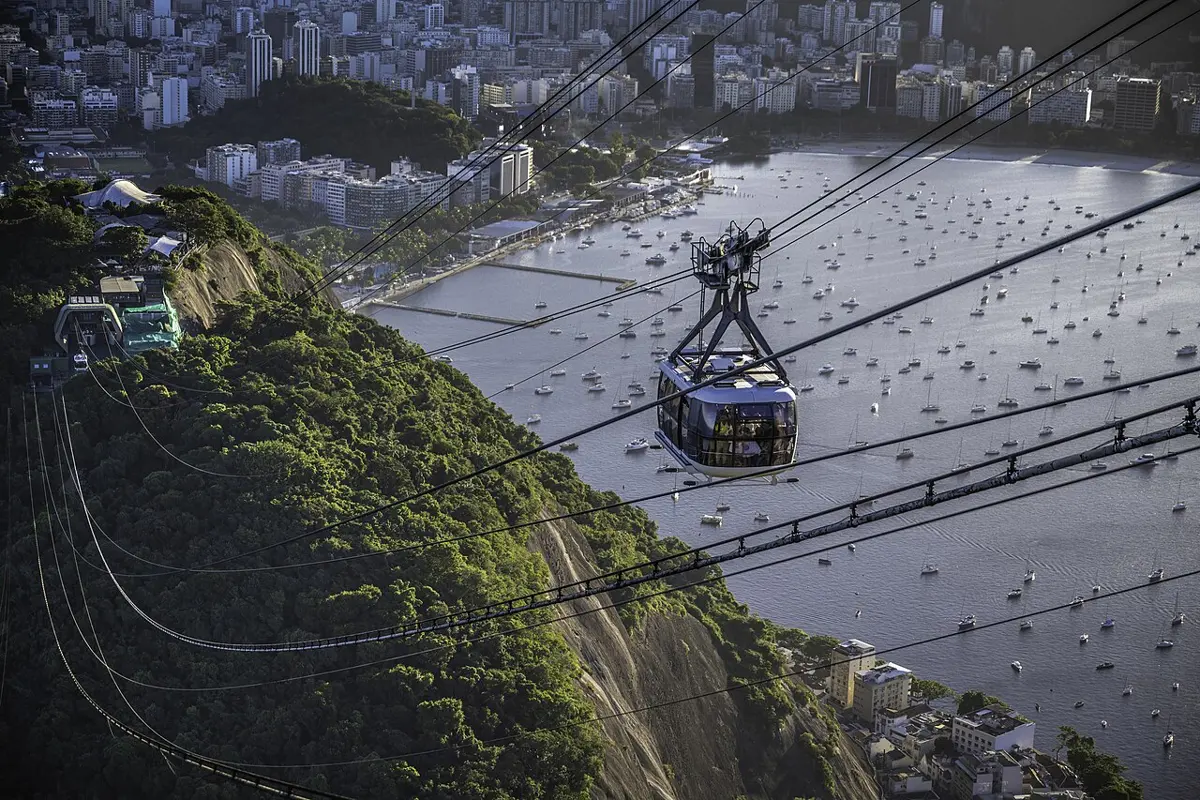
Look at the pictures before the text (a climber on a steep rock face, and a cable car above a bay and a city). What do you see in the first picture?
Answer
Do you think rock climbing is adventurous? Why?
A model answer
What kind of text it is
The text is a travel guide’s fact list from a website about Brazil’s culture and travel: a short introduction, then five paragraphs labeled A to E, each giving one interesting fact. Exercise C asks you to give each paragraph a heading.
The text, part by part
Introduction
Sugarloaf Mountain, in Portuguese Pão de Açúcar, is a striking natural landmark that looks over the city of Rio de Janeiro in south-eastern Brazil, at the entrance to Guanabara Bay. It is named for its shape: a tall cone of bare rock with a rounded top, like the cones of hard refined sugar, called sugarloaves, in which sugar used to be sold. It rises 396 meters (1,299 feet).
A. Rock climbing
Sugarloaf is one of the largest and most popular urban (in a city) rock-climbing places in the world, with 270 different routes to the top, high above the Atlantic and the sprawling city (spread out over a large area). You can try it yourself, or watch other climbers conquer the famous mountain.
B. Its neighbors
It is not the only landmark there. Two neighboring hills add to the calm beauty of the peninsula (land almost surrounded by water): Morro da Babilônia (Babylon Hill) and Morro da Urca (Urca Hill). Both are open to the public and to climbers; Morro da Urca has a play area for children and a restaurant.
C. In the movies
Sugarloaf has appeared in Hollywood blockbusters (very successful films). Its first appearance was in Now, Voyager (1942), with Bette Davis. In the James Bond film Moonraker (1979), a scene takes place in its cable car, and it has even been mentioned in the cartoon series The Simpsons.
D. Guanabara Bay
The historic Guanabara Bay stretches in front of the mountain. Its name is often translated as “the bosom of the sea”. In the 16th century the colonial government (Portugal ruled Brazil until 1822) built several fortifications (forts and walls against attack) around it. The bay has more than 130 islands, and you can see them from high above as you tour the mountain.
E. The cable cars
Two cable cars carry visitors to the summit, from which the view over Rio is stunning. The cars have glass walls, so as they climb, the views open up below you. Because the mountain sits on a peninsula reaching into the Atlantic, it offers a rare mix: a bustling (busy and lively) city, a tranquil bay and a sparkling ocean. The writer says the journey up is as enjoyable as the summit.
Words from the text
| Word | Meaning |
|---|---|
| landmark | a building or natural feature that is easy to see and recognize |
| spectacular | very impressive to look at |
| sprawling | spreading over a large area, often untidily |
| tranquil | calm, quiet and peaceful |
| blockbuster | a very successful film or book |
| fortification | a wall, fort or tower built to defend a place |
| peninsula | land almost surrounded by water, joined to a larger land at one end |
| bustling | full of busy, lively activity |
| iconic | very famous, a symbol of a place |
| accessible | easy to reach or enter |
| ascend | to go up |
| summit | the top of a mountain |
| debut | a first appearance in public |
A. Match the words and meanings
Match the words with their meanings.
- a.landmark b. spectacular c. sprawling d. tranquil e. blockbusters f. fortifications g. peninsula h. bustling
- i.walls or other constructions built to strengthen a place against attack
- ii.very successful films
- iii.a piece of land that is almost entirely surrounded by water and is attached to a larger land area
- iv.full of lively activity
- v.very impressive
- vi.an object or structure on land that is easy to see and recognize
- vii.covered with buildings across a large area
- viii.calm, quiet and peaceful
Answer
B. Adjectives with -ing and -ed
Many adjectives are made from verbs with -ing or -ed, and the two mean different things:
- -ing describes the thing or person that causes the feeling: The film was boring. (It made me feel bored.)
- -ed describes how a person feels: I was bored.
So a boring teacher makes the class bored; a bored teacher feels bored. The text has more: sprawling city, bustling city, views unfolding.
| Verb | -ing (causes the feeling) | -ed (feels it) |
|---|---|---|
| annoy | an annoying noise | I was annoyed. |
| interest | an interesting book | She is interested in poems. |
| surprise | a surprising result | We were surprised. |
| excite | an exciting trip | The students were excited. |
| terrify | a terrifying flight | He was terrified. |
| tire | a tiring walk | They were tired. |
The trek to Rara was long and ……… , and by evening we were all ……… .
Pick an answer to see why.
Complete the sentences by changing the verbs in brackets into adjectives with -ing or -ed.
- a.The children were ……… when they missed the beginning of the movie. (annoy)
- b.Have you read Agni by Nabaraj Lamsal? It’s a great book if you are ……… in reading poems. (interest)
- c.The result of the game was ……… . The best team didn’t win! (surprise)
- d.I don’t enjoy going out with Sumi. She’s the most ……… person I’ve ever met. (bore)
- e.The students were so ……… when their school decided to take them on a trip. (excite)
- f.Angeela was quite ……… when she was flying for the first time. (terrify)
- g.I love to go to fairs because they perform very ……… magic. (interest)
Answer
C. Match the paragraphs with their headings
Match the paragraphs A–E with their headings: i. Neighboring Mountains ii. Awesome Cable Car Ride iii. Guanabara Bay iv. Rock Climbing v. Hollywood Star
Answer
D. Answer the questions
Where is Sugarloaf Mountain located?
Answer
How did the mountain get the name Sugarloaf Mountain?
Answer
Do you think many people can do rock climbing at a time when they visit the mountain? Why?
Answer
Which of the sites do you think children would love to visit? Why?
Answer
Name the first film in which Sugarloaf Mountain was featured.
Answer
What is historic about Guanabara Bay?
Answer
What should you do to enjoy the best view of Guanabara Bay?
Answer
Do you think a visitor should ride the cable cars while visiting the mountain? Why?
A model answer
E. Your favorite fact
Which of the facts about Sugarloaf Mountain interested you the most? Give reasons.
A model answer
Listening: describing a friend
A. Before you listen
Look at the picture of the girl (a smiling young woman with long hair) and answer.
- a.How are the girl’s eyes?
- b.What shape is her face?
- c.Describe her hair.
A model answer
The textbook’s listening task is a short conversation: a boy has lost his friend in a crowd and asks Emma to help him find her. CDC’s own recording is below: read the sentences in B first, then listen, as many times as you need.
B. The textbook’s audio: answers
Listen and complete the sentences.
- a.The boy asks Emma to help him find ……… .
- b.His friend has a ……… body.
- c.The boy is looking for a girl who has ……… hair.
- d.The boy’s friend is wearing ……… and sporty shoes.
- e.The girl is friendly with a nice ……… .
- f.Emma sees the girl ……… whom the boy has been looking for.
Answer
Describe the physical appearance of one of your friends in five sentences.
A model answer
Practice listening alone
Grammar II: Prepositions
A preposition shows how a noun is related to something else: in time (at six), place (in Dharan), movement (to Pokhara), means (by bus), and in fixed pairs with verbs and adjectives (afraid of, pleased to).
Time
| Preposition | Use | Examples |
|---|---|---|
| at | a clock time, a moment | at 9:15, at noon, at night, at the weekend (British) |
| on | a day, a date | on Friday, on November 2, on my birthday |
| in | a month, a year, a season, a part of the day | in 2002, in winter, in the morning |
| for | a length of time | for two years, for ages |
| since | from a point in time until now | since 2002, since Monday |
| after / before | later or earlier than | a few days after his accident |
Place and movement
| Preposition | Use | Examples |
|---|---|---|
| in | inside an area: a country, city, building | in Nepal, in Dharan, in a beautiful house |
| at | a point, a place where something happens | at the gate, at school, at Tribhuvan University |
| on | a surface, a line, water | on the wall, on the road, boating on Phewa Lake |
| to | movement towards | travel to Pokhara |
| from … to | start and end | from one end of the lake to the other |
| across | on the other side of; from one side to the other | across the street |
| as far as / up to | to a certain point and no further | walk as far as the edge of the desert |
| by | next to; also means of transport | a house by the river; by bus, by plane |
Fixed pairs
- afraid of, interested in, pleased with (someone) / pleased to (meet), good at, proud of
- die of an illness or hunger (died of cancer), die from an injury or cause (died from a head injury); both are used, and exams usually expect of
- a girl with long hair, a man in a gray shirt
- by bus, by plane, but on foot, in a car, on a bus (inside it)
Our new semester starts ……… November 2.
Pick an answer to see why.
My uncle has worked in Qatar ……… 2019.
Pick an answer to see why.
A. Choose the prepositions
Complete the sentences with the correct prepositions from the brackets.
- a.I love traveling. Therefore, I went to Delhi ……… (on, by, at) plane last week.
- b.Namrata visited Lumbini ……… (in, since, from) 2002.
- c.My best friend lives ……… (in, at, on) a beautiful house ……… (across, at, on) the street.
- d.We had to walk ……… (until, as far as, up to) the edge of the desert to find water.
- e.The Prime Minister died ……… (from, with, of) a head injury a few days ……… (after, on, at) his accident.
- f.My family has been living ……… (on, in, at) Dharan ……… (since, for, in) two years.
- g.I am very pleased ……… (in, with, to) meet you.
- h.He is a tall boy ……… (in, with, on) long brown hair.
- i.Guman Singh is a student ……… (in, on, at) Tribhuvan University.
- j.……… (On, In, At) November 2, we will start our new semester.
- k.I love your house ……… (by, with, at) the river.
- l.She misses her grandfather because she has not met him ……… (in, for, on) ages.
Answer
B. A bus journey
Complete the text with the correct prepositions.
I live (a) ……… Bhairahawa, but every summer I like to travel (b) ……… Pokhara. I am afraid (c) ……… traveling by plane. Last summer I decided I would travel (d) ……… bus. According to the ticket I received (e) ……… the travel agency, the bus would leave Bhairahawa (f) ……… 9:15 p.m. (g) ……… Friday and arrive (h) ……… Pokhara the following day at 5:30 (i) ……… the morning. The trip would include boating (j) ……… Phewa Lake (k) ……… one end of the lake (l) ……… the other. We would also drive (m) ……… different beautiful places. It would be really wonderful.
Answer
Writing II: A letter or email to a foreign friend
There are many tourist destinations in Nepal. Choose one and write a letter or an email to your foreign friend about the interesting facts of the place. Also invite him or her to visit it.
Hint
A model email
How to write a letter or email to a friend
- Letter: your address and the date at the top. Email: the To and Subject lines instead (a short, clear subject).
- Greeting: Dear Emily, (or Hi Emily, in an email).
- Opening: a friendly line about your friend or their last letter.
- Body: the place, in two or three paragraphs: where it is, what is special, what to do there, the best time to visit and how to get there.
- Invitation: ask your friend to come, and offer to help.
- Closing: Write back soon. Then Love, With best wishes, Your friend, and your name.
Project work
Transition words
Transition words (also called linking words) join ideas in an essay or paragraph and show the reader how they are related: adding, contrasting, giving a reason, an example, a result, a sequence. Choose the one that says the relationship you mean.
| To… | Transition words |
|---|---|
| add information | and, also, too, besides, furthermore, moreover, in addition, what’s more, equally important, nor (after a negative), then, next, first, second, finally, lastly |
| contrast (show a difference) | but, yet, however, whereas, while, although, nevertheless, on the other hand, on the contrary, in contrast, conversely, by comparison, compared to |
| show similarity | similarly, likewise, in the same way, equally, by the same token, in like manner |
| give a reason or support an argument | because, since, for, as, for this reason, indeed, in fact, obviously, evidently |
| show an exception | except, apart from, yet, still, however, nevertheless, in spite of, despite |
| show time | immediately, soon, then, later, after a few hours, previously, formerly, meanwhile, finally |
| repeat an idea | in brief, as mentioned earlier, as I noted before, in other words |
| clarify | that is (i.e.), namely, specifically, more precisely, in other words |
| emphasize | indeed, in fact, certainly, definitely, obviously, undeniably, without a doubt, above all |
| show sequence | first, second, third, next, then, after that, afterwards, following this, subsequently, finally |
| give an example | for example (e.g.), for instance, such as, in this case, to illustrate, take the case of |
| show a result | so, therefore, thus, hence, consequently, as a result, accordingly |
| summarize or conclude | to sum up, in brief, on the whole, in conclusion, to conclude, all in all |
Jhamak Ghimire could not speak. ……… , she became one of Nepal’s best-known writers.
Pick an answer to see why.
Fill each gap with a suitable transition word.
Sugarloaf Mountain is famous for its views. (a) ……… , it is one of the world’s most popular places for rock climbing. Many visitors are afraid of heights; (b) ……… , they take the cable car. The ride is short. (c) ……… , the views are breathtaking. (d) ……… , Sugarloaf has something for everyone.
Answer
Exercise
SEE-style practice on this unit. Try each one as in the exam, then open the answer.
Put these events of Reading I in the order in which they come in the chapter.
- a.Jhamak asks why the world never considered Homer incomplete.
- b.Her mother puts a pen and an exercise book under her pillow.
- c.Her grandmother feeds her through the night.
- d.She says that life is a beautiful flower of creation.
- e.People look at her as if she were cursed by the gods.
Answer
Join the sentences with who, which, whose, where or when.
- a.Lukla has a famous airport. Trekkers start their walk to Everest from there.
- b.I met a guide. His father had climbed Everest.
- c.Bhupi Sherchan wrote this poem. He was born in Mustang.
- d.2010 was the year. Jhamak Ghimire won the Madan Puraskar then.
- e.The cable car has glass walls. It takes visitors to the summit.
Answer
Fill in the blanks with suitable prepositions.
We left Kathmandu (a) ……… six (b) ……… a cold morning (c) ……… January. We traveled (d) ……… bus and reached Dhulikhel (e) ……… two hours. My cousin, a girl (f) ……… short curly hair, was waiting (g) ……… the bus stop. She has lived there (h) ……… 2018.
Answer
Read the passage and answer the questions.
Laxmi Prasad Devkota was born in Kathmandu in 1909, on the night of Laxmi Puja during Tihar, which is why he was named after the goddess of wealth. He studied in Kathmandu and Patna, and taught in colleges for many years. He wrote quickly, sometimes finishing a long poem in a few days. His most famous work, Muna Madan, a long poem about a man who leaves his wife to earn money in Lhasa, is still one of the best-selling books in Nepali. He is remembered as Mahakavi, the great poet. He died in 1959.
- a.Why was Devkota named Laxmi Prasad?
- b.Where did he study?
- c.What is Muna Madan about?
- d.What title is he remembered by?
- e.Find a relative clause in the passage.
Answer
Write a short biography of about 150 words of a famous Nepali from these notes: Parijat (Bishnu Kumari Waiba); born 16 September 1937, Darjeeling; novelist and poet; paralyzed from the age of 26, looked after by her sister; novel Shirishko Phool (1964), Madan Puraskar 1965; wrote about the lives and struggles of ordinary people; died 4 December 1993, Kathmandu.
A model biography
Practice every question in the book, and keep track of the ones you miss →
A companion to your textbook, not a replacement for it: study from the book your school uses, and where the two differ, follow your teacher. Found a mistake? Please tell us.