
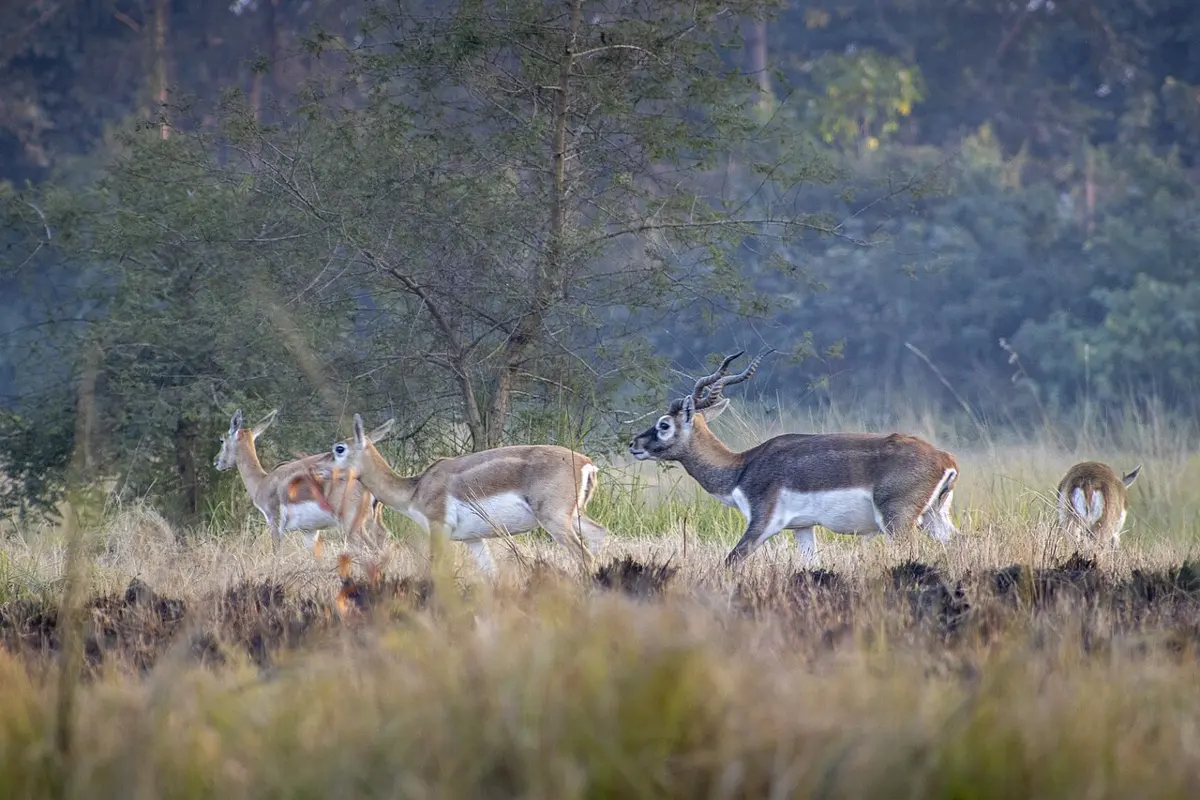
Walk into Basantapur Durbar Square in the morning and you will find hundreds of pigeons pecking at grain on the bricks. Walk too close and they all go up together, in one clattering rush, circle the temples and land again on the roofs. Climb the steps to Swayambhu and the rhesus monkeys are never alone: they sit, feed, groom and quarrel in troops of dozens. Down in Bardiya, blackbuck graze in herds, and wild elephants move through the grass as families.
Yet a tiger lives alone, and so does a leopard or a kingfisher. Living in a group has a price: every pigeon in a flock is competing with the others for the same grain. So why do so many animals live together? Does the group really help each one of them stay alive and raise young, or do they just happen to be in the same place? Biologists answer this the way you will learn to here: not with a nice-sounding story, but with evidence.

Group behavior, or just a crowd?
You saw in Grade 10 how a honey bee colony works: one queen, a few hundred drones and tens of thousands of workers, each with its own work Grade 10: Division of labor. The bees don’t just live in the same box; they constantly respond to each other. That is what makes a group.
Group behavior is what animals do together, each one responding to what the others do: a flock turning as one, a pack chasing prey, a troop answering an alarm call, bees following a dancer. Individual behavior is what an animal does on its own: a kingfisher diving for a fish, a tiger marking its home range.
Many animals in one place is not enough. Moths circling a street lamp are not a group: each moth is drawn to the light by itself, and one moth alone would circle just the same. Biologists call this an aggregation: animals gathered by the same thing, not by each other. The test is simple: are the animals responding to each other?
Group behavior comes in many kinds, and you have probably seen most of them:
- flocking (birds), schooling (fish) and herding (deer, blackbuck, buffalo): moving together;
- cooperative hunting: dholes, wolves and lions hunting as a pack or pride;
- migrating together: bar-headed geese crossing the Himalaya, elephant families walking to the same water every dry season;
- swarming: honey bees leaving their hive with a queen to found a new colony;
- signaling: alarm calls, the bees’ dance, a mob of crows chasing an owl.
Hundreds of frogs call from the same paddy field on a monsoon night. Which observation would show that this is group behavior, not just a crowd?
Pick an answer to see why.
Safety in numbers
The most common reason animals live in groups is the simplest: a predator. Being in a group protects each member in several different ways.
More eyes
A pigeon pecking at grain can’t watch the sky. Every few seconds it lifts its head and looks around. The more pigeons there are, the more likely it is that at least one has its head up at any moment, and when one takes off in alarm, the rest go too. This is the many-eyes effect: a group spots danger sooner than an animal alone.
In the 1970s, the British biologist Robert Kenward watched goshawks attack flocks of woodpigeons in fields in England. Attacks on single pigeons and small flocks succeeded far more often than attacks on flocks of more than ten. In big flocks, the pigeons took off while the hawk was still far away, so it lost the surprise it depends on.
There is a bonus. In a big group, each animal can afford to look up less often, and spend more of its time eating. This has been measured in many birds and mammals: the bigger the group, the less time each animal spends watching, and yet the group as a whole is watching more.
Dilution
Suppose a hawk does get through, and catches one pigeon. If you are alone, that one is you. In a flock of 20, your chance is 1 in 20. This is the dilution effect: the risk is shared, or diluted, among everyone in the group.
Confusion, and the selfish herd
A lion chasing a single zebra keeps its eyes on that one. Charging into a herd of zebras running in all directions, it finds it hard to pick one and follow it: the confusion effect. Fish in a school, all the same size and color, flashing and turning together, are hard to pick out for the same reason. In experiments with predatory fish in tanks, each attack was less likely to succeed against a bigger school.
There is also a less kind reason. In 1971 the British biologist W. D. Hamilton pointed out that an animal can make itself safer by putting another animal between itself and the danger. If every animal does this, they all crowd together, and the ones on the edge are the most at risk. He called it the selfish herd: a herd can form even if no animal is “trying” to help the others. In many herds and flocks, the animals in the middle really are safer, and the strongest push their way there.
You can work out what the widget should find, using what you know about chance. If each pigeon has its head up a quarter of the time, the chance that a particular pigeon is not looking is 3 in 4, or 0.75. For the hawk to arrive unseen, every pigeon must be looking down. When the pigeons look up independently, the chances multiply.
In a flock of starlings, each bird spends less time watching for predators than a starling feeding alone. Yet each bird in the flock is safer. Why?
Pick an answer to see why.
Hunting together
Groups can also help animals eat. A pack of dholes, the wild dogs of Asia’s forests (they still live in a few of Nepal’s protected areas), can bring down a sambar deer many times heavier than any one dog. Some dogs chase the deer while others run ahead to cut off its escape. This is cooperative hunting: the hunters coordinate their moves, and catch prey that none of them could catch alone.
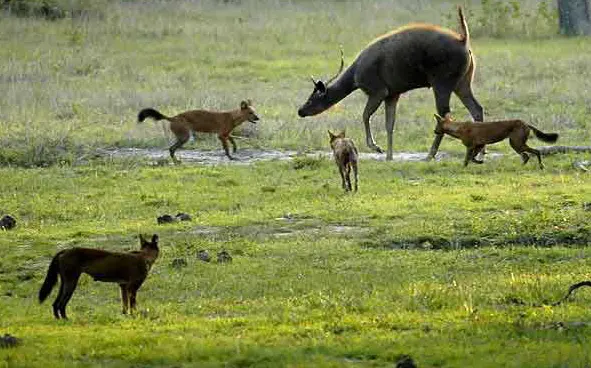
But a pack must share what it catches. Whether hunting together helps each hunter depends on how much more the pack catches, compared with how many mouths it has to feed. So the number to work out is the food for each animal.
Moving together
Watch a flock of starlings in the evening, thousands of birds wheeling and folding like smoke, and it looks as if someone must be in charge. No one is.
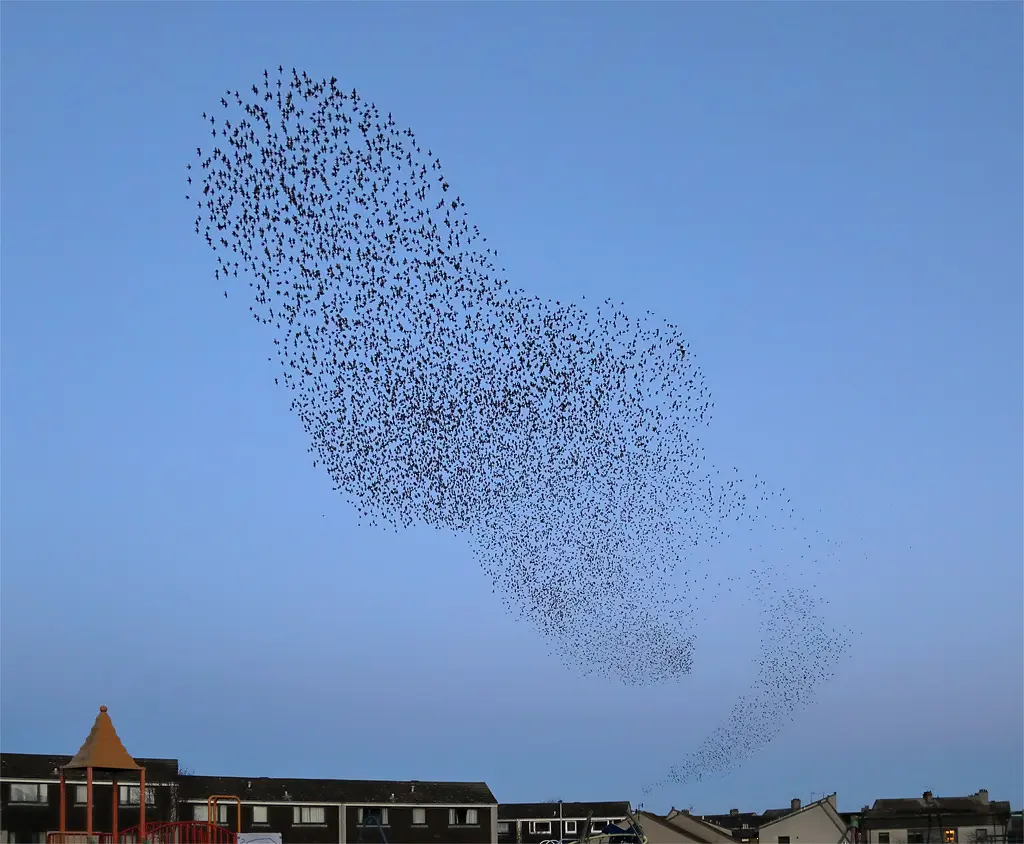
In 1986 the computer scientist Craig Reynolds made a flock on a computer (he published it the next year). Each simulated bird, which he called a “boid”, looked only at the few birds near it and followed three rules: stay close to them, line up with them, and keep space so as not to bump into them. Nothing else. On the screen, the boids gathered into flocks that swooped and split and joined up again, just like real ones. The flock’s behavior emerges from the simple rules each bird follows.
Real birds turned out to be close to the model. In 2008, Italian physicists filmed starling flocks over Rome with several cameras at once and worked out where every bird was in three dimensions. Each starling kept track of about six or seven of its nearest neighbors, however near or far they were. That is enough to pass a turn through the whole flock in a fraction of a second.
Why fly in a V?
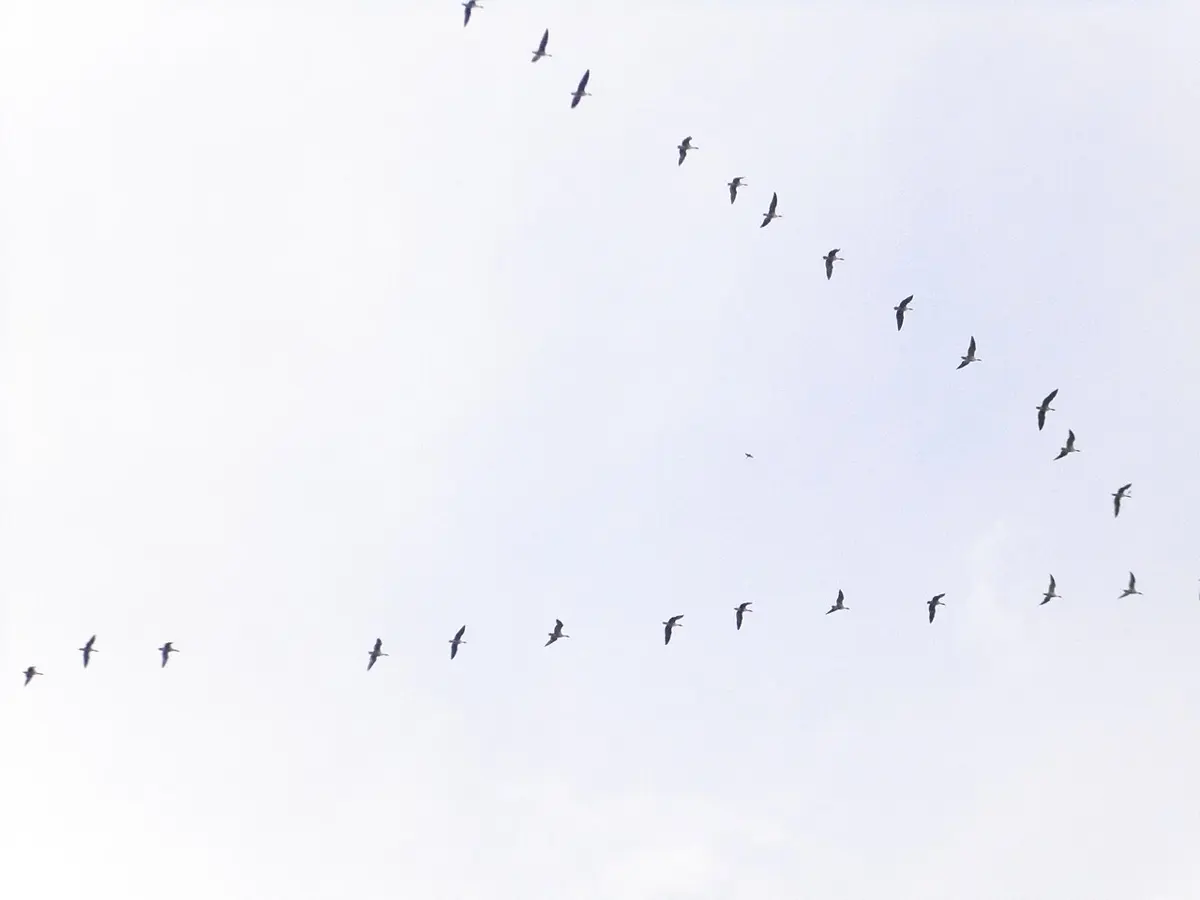
Geese, ducks and cranes on long journeys fly in a V or a slanting line. A flying wing pushes air down behind it, but at each wingtip some of the air spills round the tip and swirls upwards. A bird flying just behind and to the side of another, with its wingtip in that rising air, gets some of its lift for free.
Is there evidence that the birds really save energy? In 2001 French biologists trained great white pelicans to fly behind a microlight aircraft and a boat, and fitted them with heart-rate monitors. Flying in a V, the pelicans’ hearts beat about 11–14 % slower than when they flew alone, and they glided more between flaps. In 2014 a team of British and Austrian scientists put tiny GPS loggers on young northern bald ibises being taught to migrate behind a microlight. On average, each bird placed its wingtip close to where the theory says the upwash is strongest, and even timed its wingbeats to match the bird ahead.
Knowing the way
Migrating together has another advantage: young animals learn the route from older ones. Asian elephants live in families led by the oldest female, the matriarch, with her daughters and their calves; the herds of Chitwan and Bardiya walk routes that their families have used for generations.
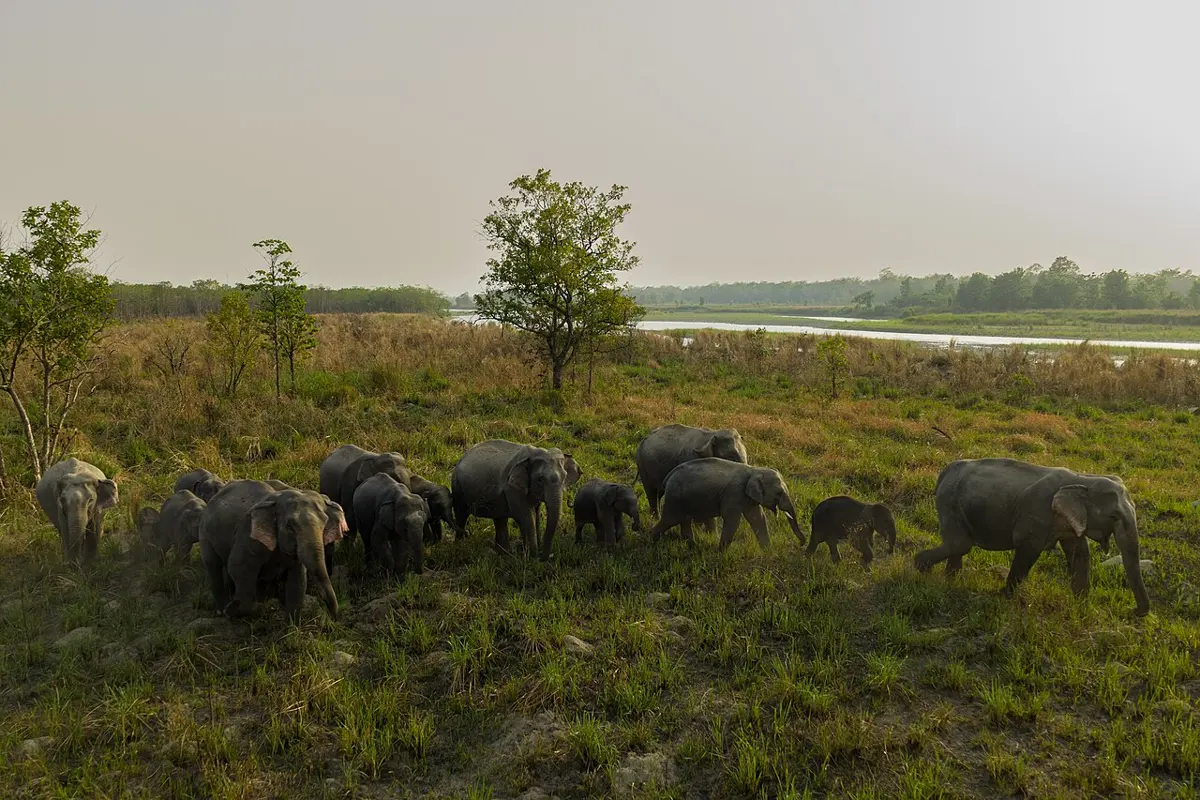
In Kenya’s Amboseli National Park, Karen McComb and her colleagues played recorded calls of other elephants to African elephant families through a loudspeaker (published in 2001). Families led by an older matriarch were better at telling the calls of strangers (which could mean trouble) from the calls of families they knew, and bunched together only when it mattered. The same families also had more calves for each adult female. The old matriarch’s memory seems to help the whole family to survive and breed.
In Reynolds’ model, the birds form a flock that turns together. Which of these does the model show?
Pick an answer to see why.
The honey bee colony, as evidence
A honey bee colony is the most closely knit group you met in Grade 10. A worker almost never lays eggs of her own; she works all her life for the colony, and if she stings a person or another mammal, her barbed sting tears out and she dies. Why should a bee do that? And does the group behavior you learned about, like the dance, really help?
Does the dance help?
In Grade 10 you learned how a forager tells her sisters where the flowers are with the waggle dance Grade 10: How bees talk: the dance language. A clever experiment asked whether the colony actually gathers more food because of it.
In California, Gavin Sherman and Kirk Visscher turned some observation hives on their side, so that the comb lay flat. On a flat comb there is no “up”, and the dances point in all directions, so they no longer give a direction. In other hives the comb was laid flat too, but with a lamp the bees took for the sun, so their dances still pointed the right way. Everything else was the same. Then they weighed the hives to see how much food each colony brought home.
The result, published in 2002: in winter, when the flowers were few and far apart, the colonies with dances that pointed the right way gathered clearly more food. In summer the difference was small, and in autumn there was none. The dance helps most when food is scarce and patchy, and hard to find by searching alone.
Swarming: a group decision
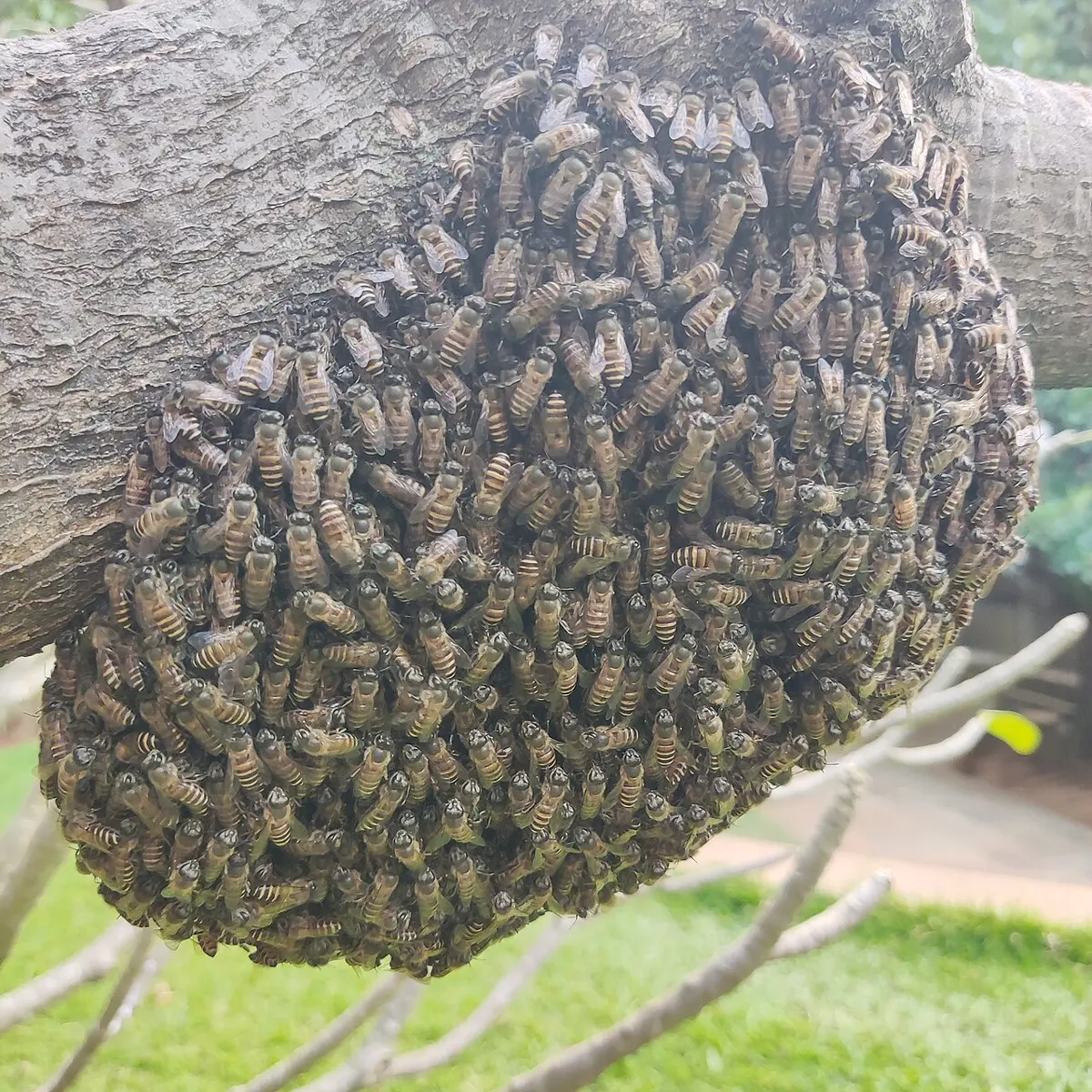
In spring a strong colony divides. The old queen leaves with thousands of workers, and the swarm hangs from a branch in a buzzing cluster while it chooses a new home. A few hundred older bees, the scouts, fly off to inspect hollow trees and holes in walls, come back and dance for the sites they found, longer and harder for better ones. Other scouts go to check. Support for poor sites dies away, and support for the best grows, until enough scouts are gathered at one site. Then the whole swarm takes off together and flies there, guided by the few that know the way. The American biologist Thomas Seeley, who spent decades studying it, found that swarms usually choose the best site they were offered.
Why do workers give up having young?
Workers in a colony are all daughters of one queen: sisters, or half-sisters where their fathers were different drones (a queen mates with many). When a worker helps raise the colony’s new queens and drones, she is helping to pass on genes that she shares with them, even though she has no young herself. Helping your relatives to survive and reproduce is a way of passing on your own genes. This idea, worked out by W. D. Hamilton in 1964, is now called kin selection, and it explains why so many close-knit groups, from bee colonies to elephant families, are made of relatives.
In Sherman and Visscher’s experiment, why did they give some flat combs a lamp, rather than comparing flat combs with ordinary upright hives?
Pick an answer to see why.
The cost of living together
If groups were always good, every animal would live in one. They don’t, because a group has costs as well as benefits.
- Competition. Everyone in the group wants the same food, and the best of it goes to the strongest. The rhesus monkeys at Swayambhu live by a strict ranking (a dominance hierarchy): a high-ranking monkey takes the best food and the safest place, and a low-ranking one waits, or gets chased off. In Grade 9 you called this competition Grade 9: Competition: within a group, it is between the members.
- Disease and parasites. Animals packed close together pass on germs, lice, fleas and worms.
- Being seen. A big herd is easier for a predator to find than one animal hiding alone.
- Stealing and fighting. Group members steal food and mates from each other.
The clearest evidence for a cost comes from an experiment with cliff swallows in Nebraska, in the USA. These swallows build mud nests side by side under cliffs and bridges, in colonies from a few nests to thousands. Their nests are home to the swallow bug, a small relative of the bedbug that sucks the chicks’ blood. Charles and Mary Brown found that the bigger the colony, the more bugs there were in each nest. Was that harming the chicks, or did the chicks of big colonies differ in some other way?
To find out, they sprayed half of the nests in each colony with an insecticide that killed the bugs, and left the other half alone. Spraying was the only difference, so any difference in the chicks must come from the bugs.
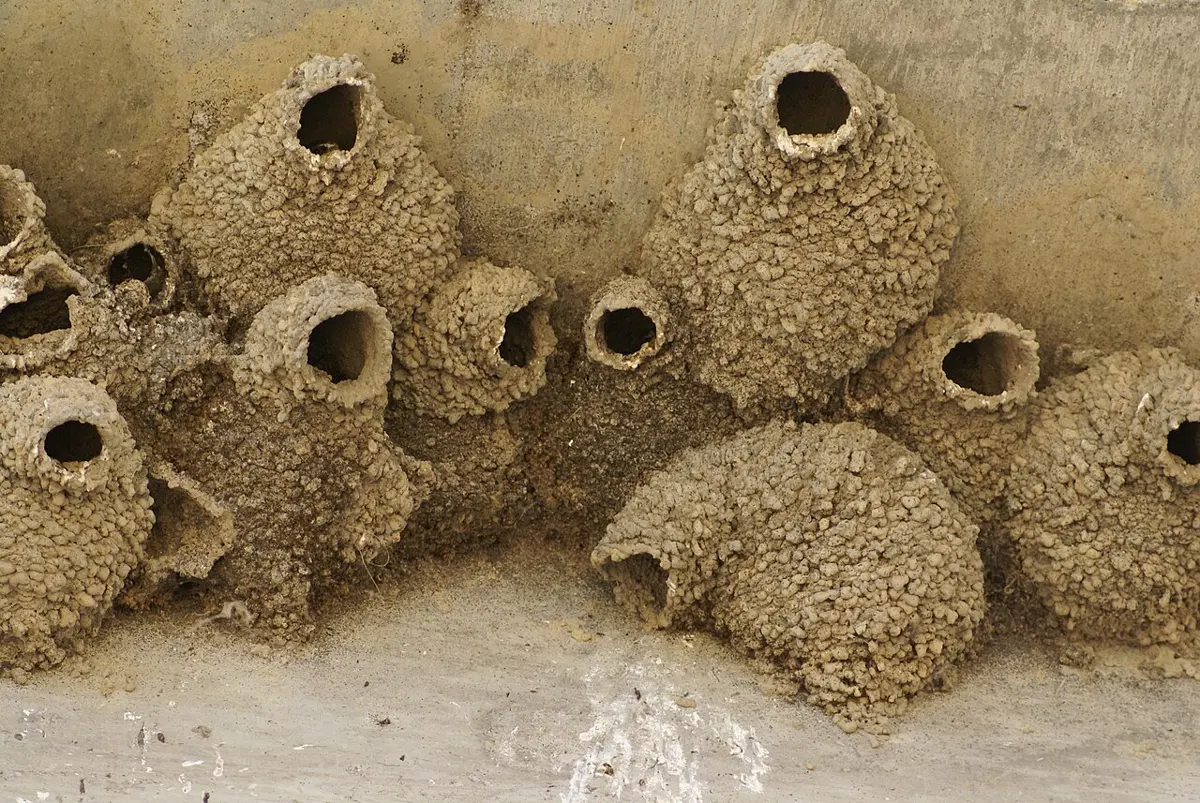
Swallows in big colonies find food more easily (they follow each other to swarms of insects) and are better at spotting hawks. But they pay for it in bugs. Whether living in a group is worth it depends on which is bigger, the benefits or the costs, and that changes with the group’s size, the food and the predators. That is why the same species can live in groups of different sizes in different places, and why some animals live alone.
Is it good for the species?
People often say that animals do things “for the good of the species”. A bird gives an alarm call to save its species; a herd forms to protect the species. Biologists are careful with this. Natural selection works on individuals: an animal whose behavior helps it, or its close relatives, to survive and have young passes on the genes behind that behavior, and the behavior spreads Grade 9: Natural selection. A behavior that helped the species but cost each individual who did it would soon disappear, because the animals that didn’t do it would leave more young.
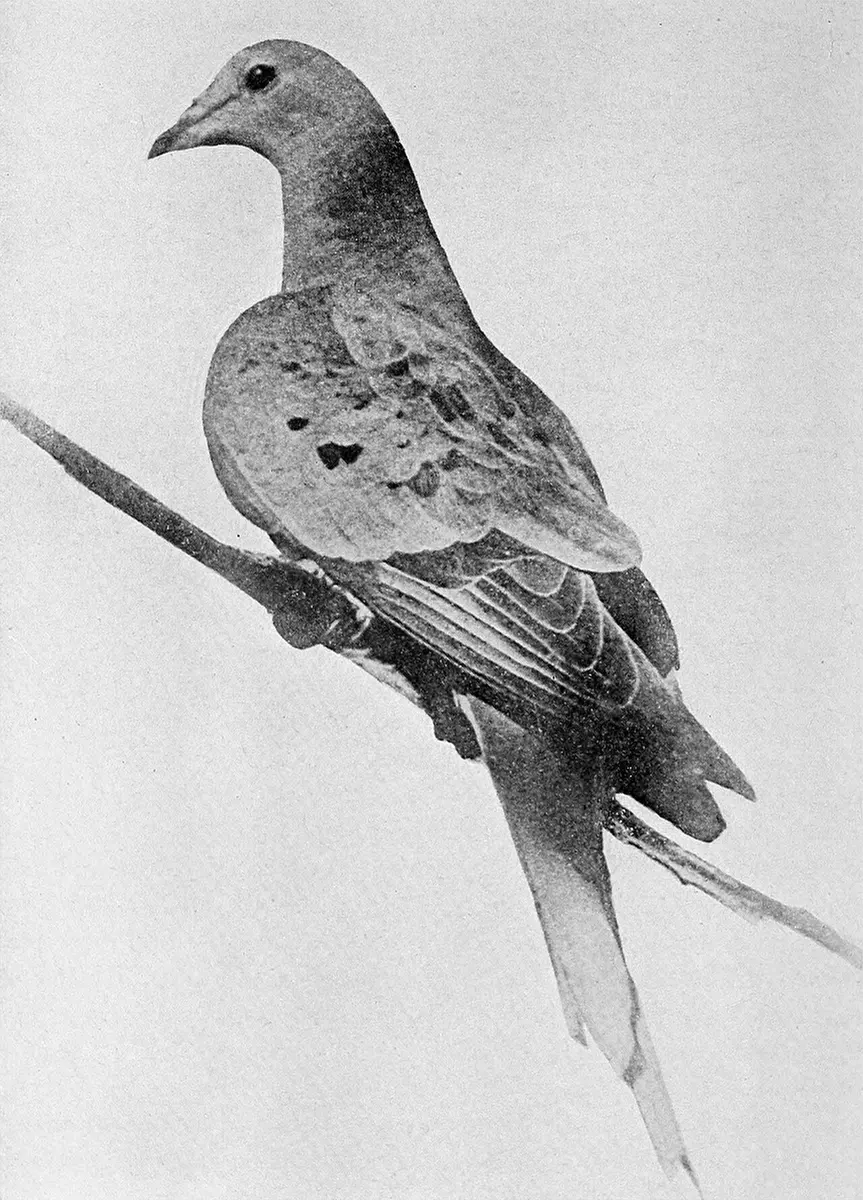
So group behavior exists because it helps the individuals in the group, or their relatives. A species survives when enough of its individuals do. And sometimes a behavior that served individuals well for millions of years can help to doom a species.
Questions
Which of these is group behavior?
Pick an answer to see why.
A biologist finds that in a herd of 50 blackbuck, each animal raises its head to look around 6 times a minute; alone, a blackbuck does it 15 times a minute. What is the best conclusion?
Pick an answer to see why.
Explain the difference between group behavior and an aggregation, with one example of each from Nepal.
Answer
In group behavior the animals respond to each other: what one does changes what the others do. Example: rhesus monkeys at Swayambhu, where one monkey’s alarm call sends the whole troop up the trees, though most never saw the danger. In an aggregation many animals are in one place because each is drawn there by the same thing, not by the others. Example: moths round a street lamp in a Kathmandu street, or flies on rotting fruit at a market; take the other animals away, and each one would still come.
In the model of the widget, each pigeon has its head up a quarter of the time. a. Work out the risk for a pigeon in a flock of 2 (0.75² = 0.5625). b. How many times safer is it than a pigeon alone (risk 75 %)? c. Name the two effects that make it safer.
Answer
- a.The hawk arrives unseen with a chance of 0.5625, and then takes one of two: 0.5625 ÷ 2 = 0.28, about 28 %.
- b.75 % ÷ 28 % ≈ 2.7 times safer.
- c.Many eyes (detection): two pigeons are more likely to spot the hawk, so it arrives unseen only 56 % of the time instead of 75 %. Dilution: if it isn’t spotted, the hawk takes only one of the two.
Here are some made-up observations of a hawk hunting finches at a feeding place.
| Flock size | Attacks per day on the flock | Finches caught per attack |
|---|---|---|
| 1 | 0.5 | 0.4 |
| 10 | 2 | 0.2 |
| 40 | 4 | 0.1 |
- a.Work out, for each flock size, the chance per day that a particular finch is caught.
- b.Bigger flocks are attacked more often. Does that make a finch in a big flock less safe? Use your answers.
Answer
a. Finches caught per day = attacks per day × caught per attack; risk for each finch = that ÷ flock size.
Flock of 1: 0.5 × 0.4 = 0.2 caught per day; ÷ 1 = 0.2 (20 % a day).
Flock of 10: 2 × 0.2 = 0.4 caught per day; ÷ 10 = 0.04 (4 %).
Flock of 40: 4 × 0.1 = 0.4 caught per day; ÷ 40 = 0.01 (1 %).
b. No. The bigger flocks are easier to find and are attacked more often, but each attack succeeds less often (many eyes) and the catch is shared among many more birds (dilution). A finch in the flock of 40 is 20 times safer than one alone. To judge a group’s value, you must work out the risk for each animal, not for the group.
A student says: “Lions hunt in groups, so lions live in groups because it gets them more food.” Use the evidence from this topic to argue against this, or to improve it.
Answer
The claim sounds sensible, but it was tested. Packer, Scheel and Pusey measured the food each lioness got in groups of different sizes in the Serengeti, and found that lionesses in middle-sized groups got less food each than lionesses hunting alone; many group members held back during hunts. So the evidence does not support food as the main reason. A better claim, supported by their other evidence: lionesses live in prides because a pride can defend its territory against other prides, and can protect its cubs against males from outside, which kill cubs when they take over; cubs survive much better in a pride. Hunting together may still help with large prey such as buffalo, but that alone doesn’t explain why lions live in groups.
In the cliff swallow experiment, why did the Browns spray only half the nests in each colony, instead of spraying all the nests in small colonies and none in large ones?
Answer
To make a fair test in which the bugs were the only difference. If they had sprayed every nest in the small colonies and none in the large ones, any difference in the chicks could have come from colony size itself (more competition for food, different places, different parents), not from the bugs. By comparing sprayed and unsprayed nests in the same colony, everything else (the place, the weather, the food, the size of the colony) was the same for both, so a difference in the chicks’ weight and survival could only come from the bugs.
Design an investigation to find out whether Basantapur’s pigeons are safer in bigger flocks, without harming any bird. Say what you would measure, how you would make it fair, and what result would support the idea.
Answer
One good design, using the many-eyes idea:
- a.Measure how far away a person (or a remote-controlled toy, or a dog on a lead) can walk towards a feeding flock before the first pigeon takes off: the take-off distance, measured by pacing or with a tape. Also count the flock.
- b.Make it fair: always approach the same way, at the same walking speed, wearing the same clothes, at the same time of day, from the same starting distance; test many flocks of different sizes, and repeat several times for each.
- c.Results: plot take-off distance against flock size. If bigger flocks take off when the approaching “predator” is farther away, the flock spots danger sooner, which supports the idea that pigeons in bigger flocks are safer (this is what Kenward found with goshawks). It doesn’t prove it on its own: you would also need to show that taking off earlier means fewer pigeons are caught.
Where to go next
- How Many Tigers Can Chitwan Hold? Tigers live alone, but their numbers still have a limit. How food and space set the most a park can hold.
- Why Aren’t You Exactly Like Your Brother or Sister? You share half your genes with a brother or sister, which is why helping relatives can pass on your own genes. How the sharing works.
- How Do New Species Begin, and End? The passenger pigeon was one of many species that have ended. How new species form, and why others die out.