
A motorbike and a big truck bump into each other at a crossing in Bhaktapur. Nobody is going fast, but the motorbike is knocked back and its rider falls off. The truck hardly rocks, and its driver barely notices. So who pushed harder: the truck on the motorbike, or the motorbike on the truck?
Almost everyone says the truck. The answer is surprising: they pushed each other exactly equally hard. In this topic you will find out why that must be true, why the motorbike still came off so much worse, and how engineers use this to design a crash that hurts less. Then you will design one yourself.
Pushes come in pairs
Press your hand flat against a wall and push. You feel the wall pushing back on your hand. Push harder, and the wall pushes back harder. You can’t push the wall without the wall pushing you.
It is the same with everything. A force is always between two things. When you step out of a small boat on Phewa Lake onto the shore, your feet push the boat backwards, and the boat pushes you forwards. That is why the boat drifts away behind you, and why it is easy to fall in if you step off too quickly.
When two things push or pull on each other, the two forces are always the same size, and they point in opposite directions. This is Newton’s third law. It is true for every pair of things, big or small, moving or still, and it is true at every moment, not just on average. The two forces are called a force pair (or an action and a reaction).
Notice something important. The two forces of a pair act on two different things: one on you, one on the boat. So they never cancel each other out. To find out what happens to the boat, look only at the forces on the boat, as you did in Adding up forces.
A tiny mosquito hits the windscreen of a bus going along the highway. Which is true?
Pick an answer to see why.
You push a heavy box across the floor. The box pushes back on you just as hard. Why can the box move at all?
Pick an answer to see why.
You will meet Newton’s third law again in Grade 9: Newton’s third law of motion.
Equal pushes, different changes
Now back to the crash. In a crash, the two vehicles push on each other. By the third law, those two pushes are always the same size. They also start at the same moment (when the two touch) and stop at the same moment (when they come apart). So both vehicles get the same push for the same time.
But the same push doesn’t do the same thing to both. You found in How much change? that the more mass a thing has, the less its motion changes:
So in a crash, the vehicle with less mass has its motion changed more. If the truck has nine times the mass of the car, the car’s velocity changes nine times as much as the truck’s.
Remember that velocity is speed in a particular direction Grade 8: Velocity. A car going east at 10 m/s that ends up going west at 8 m/s has had its velocity changed by 18 m/s: 10 m/s to stop, and 8 m/s more to go the other way.
Car: publicdomainvectors.org, CC0, via Wikimedia Commons
Truck: traced from a photo by Exynoss78739, CC BY 4.0, via Wikimedia Commons
Working it out
In Figure 6.2 the crash lasts 0.1 s, and the push between the car and the truck averages 234,000 N. You can work out what this push does to each of them in two steps.
- Find the acceleration: force ÷ mass.
- Multiply by the time. You learned in Grade 8 that acceleration is how much the velocity changes every second Grade 8: Acceleration, so the change in velocity = acceleration × time.
Try it on a track. The left trolley has a spring bumper, and runs at 1 m/s into the other one, which is standing still. The graph below the track shows the push on each trolley while they touch: the push on trolley 2 is drawn upwards (to the right) and the push on trolley 1 downwards (to the left).
What you should notice:
- Whatever the masses, the two curves are mirror images: at every moment, the push on trolley 1 is exactly as big as the push on trolley 2, in the opposite direction.
- The trolley with less mass always has the bigger change in velocity. Twice the mass, half the change; four times the mass, a quarter.
- A heavier trolley makes the pushes bigger (for both), and makes the crash last a little longer.
A loaded truck of 12,000 kg and a car of 1,200 kg crash. Which statement is right?
Pick an answer to see why.
Who feels the push inside?
So who feels the bigger push in a crash? The two vehicles push on each other equally. But the people inside are a different story.
The people in a car move along with it. When the car’s velocity changes by 18 m/s in 0.1 s, the people’s velocity must change by the same amount in the same time, or they fly forward into the dashboard. So their seat belts must push them just as hard as needed to change their motion that much. In the truck, the velocity changes only 2 m/s, and the driver’s seat belt pushes far more gently.
So the honest answer to the title is: the vehicles push each other equally, but the people in the lighter vehicle feel the bigger push. This is why, in crashes between two vehicles, the people in the lighter one are hurt much more often, and why people on bicycles and motorbikes, and people walking, need the most protection on the road.
Spreading out the push
You can’t make a crash push one side harder than the other: the third law doesn’t allow it. But you can make the push smaller for both sides. Here is how.
Think about catching a hard cricket ball. A good fielder doesn’t hold their hands stiff. As the ball arrives, they let their hands move back with it. Why?
Whatever you do, the ball has to stop: its velocity has to change by the same amount. If the hands are stiff, it stops in a very short time, so the push must be big. If the hands move back with it, the stop takes longer, and a smaller push is enough.
So: to make a crash gentler, make the stop take longer. That usually means letting something give way over a longer distance. You already do this:
- When you jump down from a wall, you bend your knees as you land. Your body stops over a longer time, and the ground’s push on your feet is smaller.
- A high jumper lands on a thick soft mattress, not on the ground.
- A helmet has a layer of stiff foam inside that crushes in a crash, so the head stops a little more slowly.
- An egg packed in a tray of soft card survives being carried home in a bag.
Why does a fielder pull their hands back while catching a fast ball?
Pick an answer to see why.
Design a softer crash
Car makers can’t change the third law, or the mass of the car that hits you. But they can design what happens at the place where the two things meet. That is engineering: using a scientific idea to solve a real problem.
In Design a hand warmer you met the loop engineers follow: set the goal, plan and build, test, and improve. The goal is written as criteria (what the design must do) and constraints (the limits it must work within).
The car’s crumple zone
The front and back of a modern car are designed to crush in a crash, while the middle part, where the people sit, is a strong, stiff cage. The front that crushes is the crumple zone. As it folds up, the car stops over a longer distance and a longer time, so the push on the car, and on the people inside, is smaller. You met crumple zones in When a crash happens, where they take away the car’s kinetic energy.
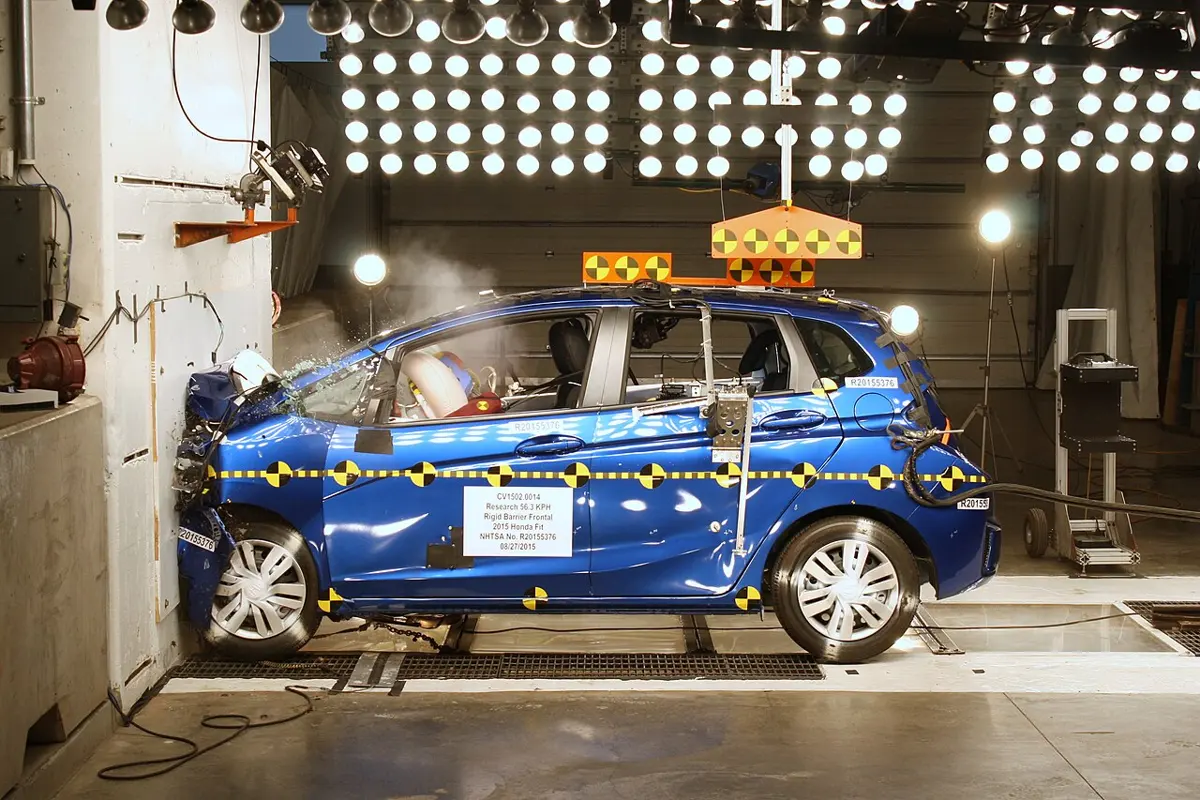
But a crumple zone can’t just be as soft as possible. Design one yourself and you will see why.
Here is the problem. A 1,200 kg car hits a concrete barrier at 50 km/h. You choose how long its crumple zone is, and how hard it is to crush (its crush force: how hard it pushes back while it is crushing). By the third law, the crumple zone pushes on the barrier and the barrier pushes on the car with this same force.
Criteria:
- a.The car must stop before the crumple zone is used up. If it isn’t, the stiff cabin hits the barrier and is crushed.
- b.The push on the people inside must be no more than 20 times their weight.
Constraint: the crumple zone must fit in the front of the car: no more than 80 cm.
(The 20 times is our own goal for this game. Real crash tests measure many things, such as the push on the head and chest, using crash-test dummies full of sensors.)
What you should find:
- A stiff zone (a big crush force) stops the car in a short distance and a short time, with a big push: the cabin is safe, but the people are hurt.
- A soft zone (a small crush force) gives a gentle push, but it may be used up before the car has stopped. Then the cabin hits the barrier and is crushed, and unless the car was nearly stopped, the push shoots up, far higher than a stiff zone’s.
- The best design is a zone that is soft enough, and long enough to stop the car in. The longer the zone, the softer it can be. With this car, a zone shorter than about half a meter can’t meet both criteria at all, whatever its crush force.
- At every moment, the red and blue arrows are the same length. The design changes how big the pushes are, never which one is bigger.
Real engineers have one more problem: a car must also be safe when it is hit by a heavier car, or hits a lighter one. A car with a very stiff front is safer for the people inside it, but pushes harder on whatever it hits. So designs try to protect the people on both sides of a crash.
Shields in space
The same idea protects spacecraft. In space, tiny specks of rock and old bits of rocket fly around at many kilometers a second. A speck hitting a spacecraft’s wall directly would punch a hole in it.
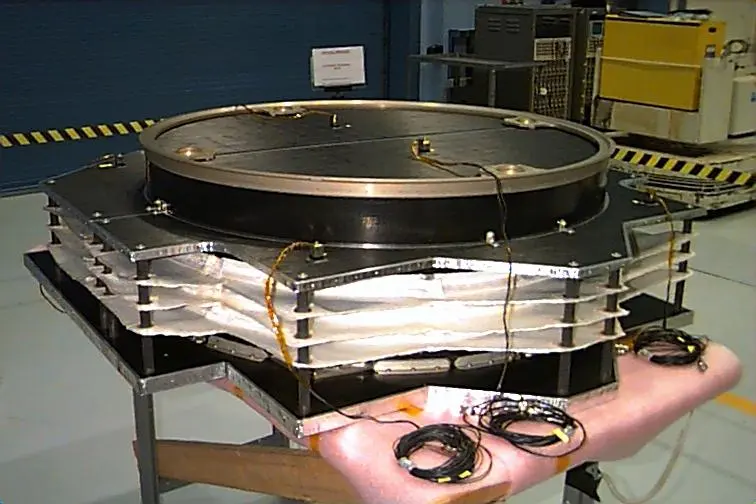
Build and test a crash bumper
Now design one for real.
Here are one class’s results (made up for this book, but typical):
| Design | Highest start with the egg unbroken |
|---|---|
| No bumper | 4 cm |
| A ball of cotton wool | 5 cm |
| A sponge, 3 cm thick | 12 cm |
| Paper folded into a concertina, 5 cm long | 25 cm |
| Four straws in a square frame, 5 cm long | 20 cm |
In the table, why does the paper concertina do better than the cotton wool?
Pick an answer to see why.
Questions
A boy of 30 kg on a skateboard pushes off a wall. Which force makes him move away from the wall?
Pick an answer to see why.
Two ice skaters, a 40 kg girl and an 80 kg man, stand facing each other on smooth ice and push each other apart. Which is right?
Pick an answer to see why.
A car hits a buffalo standing on the road. a. Compare the force of the car on the buffalo with the force of the buffalo on the car. b. The car has a mass of 1,000 kg and the buffalo 500 kg. Whose velocity changes more, and by how many times? c. Why might the car’s front be badly damaged even though the car’s velocity changes less?
Answer
In a crash test, a trolley of mass 2 kg moving at 3 m/s hits a trolley of mass 4 kg at rest. They push each other with an average force of 80 N for 0.05 s. a. Find the change in velocity of each trolley. b. The first trolley started at 3 m/s to the right. What is its velocity after the crash? c. What is the second trolley’s velocity after the crash?
Answer
A student crashed trolleys of different masses into each other in the widget, and recorded the change in velocity of each (trolley 1 always runs at 1 m/s into trolley 2 at rest):
| Trolley 1 (kg) | Trolley 2 (kg) | Change in velocity of 1 (m/s) | Change in velocity of 2 (m/s) |
|---|---|---|---|
| 1 | 1 | 1.00 | 1.00 |
| 1 | 2 | 1.33 | 0.67 |
| 1 | 4 | 1.60 | 0.40 |
| 2 | 1 | 0.67 | 1.33 |
| 4 | 1 | 0.40 | 1.60 |
a. In each row, divide the bigger change by the smaller one, and compare it with the masses. What pattern do you see? b. Use Newton’s third law to explain the pattern. c. Predict the changes for a 2 kg trolley into a 4 kg one, and check with the widget.
Answer
On some highways, a set of plastic barrels filled with sand stands in front of the end of a concrete wall, where a car that leaves the road might hit it. When a car hits the barrels, it pushes the sand in each one out of the way, one after another, and slows down. a. Use the third law to explain what slows the car. b. Why does this hurt the people in the car less than hitting the concrete wall? c. The barrels at the front have less sand than the ones at the back. Suggest why.
Answer
A cycle helmet maker tests two designs. Each is fixed to a head-shaped weight and dropped onto concrete from the same height. (Made-up data.)
| Design | Foam thickness | Time for the head to stop | Biggest push on the head |
|---|---|---|---|
| A: hard plastic shell, no foam | 0 cm | 0.002 s | 25,000 N |
| B: shell with stiff foam | 3 cm | 0.008 s | 6,000 N |
The criteria for a safe helmet: the biggest push on the head must be under 10,000 N. The constraints: it must be light and not too big to wear. a. Which design meets the criteria? b. Explain, using what you know about crashes, why B gives a smaller push. c. Someone suggests making the foam 10 cm thick to do even better. Give one reason for and one against.
Answer
A small meteorite falls straight down and hits the ground. a. Name the force pair at the moment it hits. b. The ground (the Earth) has an enormous mass. What happens to the Earth’s motion? c. A spacecraft engineer wants to protect a space station from small, fast specks of rock. Using the third law, explain why a thin sheet a few centimeters in front of the wall protects it better than making the wall itself a little thicker.
Answer
Where to go next
- Why Does a Rolling Ball Stop? Balanced and unbalanced forces, and how a net force changes a thing’s motion: the rule you used here.
- Why Is Speeding So Dangerous? The faster a thing moves, the more energy it carries into a crash, and the farther it goes before its brakes can stop it.
- How Can Something Push Without Touching? Magnets, electric charges and gravity push and pull across empty space, and they come in pairs too.