
For a long time, people in Kathmandu said that Kasthamandap, the great wooden hall the city may be named after, was built in the early 1600s. The old chronicles said so, and they named the king. Then historians found the name in a palm-leaf book copied in Kathmandu centuries before that king was born. And after the earthquake of 2015 brought the hall down, archaeologists dug under it and dated its brick foundations to about the year 700. A building everyone thought they knew turned out to be three or four times older than they had been told.
That is how it goes with the Valley’s cities. They feel as if they were made all at once, with their squares, temples and fountains fitting together so well, but they grew over more than a thousand years, each king and each family adding to what was already there. Still, for three centuries they were shaped with unusual care, by kings who ordered their kingdoms around a center, a little as a mandala is ordered around its god.
Three kings, three cities
In 1482 the king Yaksha Malla died, and the Valley that he had ruled as one kingdom was split among his heirs. For almost three hundred years after that there were three kingdoms, each with its capital: Kathmandu, Patan and Bhaktapur, a few hours’ walk apart. Their kings were rivals, for power and for the favor of the gods, and above all they built. Each city filled with palaces, temples and open squares, and each king tried to outdo the others. A Nepali painter who studies the period put it simply: the kingdoms were wealthy, “and the kings were competing with one another to build more temples and create more art.”
The race may have started before the split. Yaksha Malla himself built, in Bhaktapur, a copy of the great temple of Pashupati, so that his own city would have one, and a big rest house in its eastern square. Each later king of each city wanted his own versions of what the others had: a palace with courtyards, a tall temple for the royal goddess beside it, a square in front where the whole town could gather for festivals. That is why the three Durbar Squares look so alike and yet are each so clearly their own.
What the kings built wasn’t random. They ordered their kingdoms by tantra, the secret rites that promised power to those initiated into them, with the royal palace and the gods who protected it at the center. For the Malla kings the protector was Taleju, the royal family’s own goddess, who had her temple in each palace. She also had a secret form, Siddhi Lakshmi, kept for the king: only the royal tantric priests could come before her. Everyone else worshipped the goddess in her open forms, as Taleju, Durga, Lakshmi or the living goddess Kumari, in temples and festivals open to all.
Around that center, a city’s other gods kept their places. In Patan, eight goddesses guard the town, each in a shrine of her own. Once a year all of them are worshipped together in the courtyard of the temple of Purnachandi, and then people walk the whole round of them in a single day, making offerings at each in turn. A king of Patan consecrated that temple in the 1600s. How the three kingdoms rose and fell is told in Nepal’s History, for the Curious; here the question is what their kings left standing.
A royal square
Bhaktapur’s Durbar Square, the square in front of the palace, shows the plan most clearly, partly because so much of it was lost and the space left behind is easier to read. The palace runs along one side. Its long brick front, broken by carved windows, is the Palace of Fifty-five Windows, rebuilt by Bhupatindra Malla, the king who also built the Nyatapola. He still sits in the square, in gilded metal on top of a tall pillar, his hands joined, as Who Made It, Who Paid tells.

Behind the front, out of sight, is a maze of courtyards. The holiest is the one around Taleju’s shrine, and the way to it from the square is through a gate. The Golden Gate is dated a little differently from one account to the next, but they agree it was finished in the 1750s, under Ranajit Malla, Bhupatindra’s son, who turned out to be Bhaktapur’s last king. Nepal’s Grade 10 history book counts it among Bhupatindra’s own works, so it may have been begun in his time. It is a doorway in the palace’s brick wall, and it looks small until you are close. Then you see that every part of its frame, its door and the arch above it is covered in gilded metal, worked into gods, serpents, beasts and flowers, under a little roof of its own.
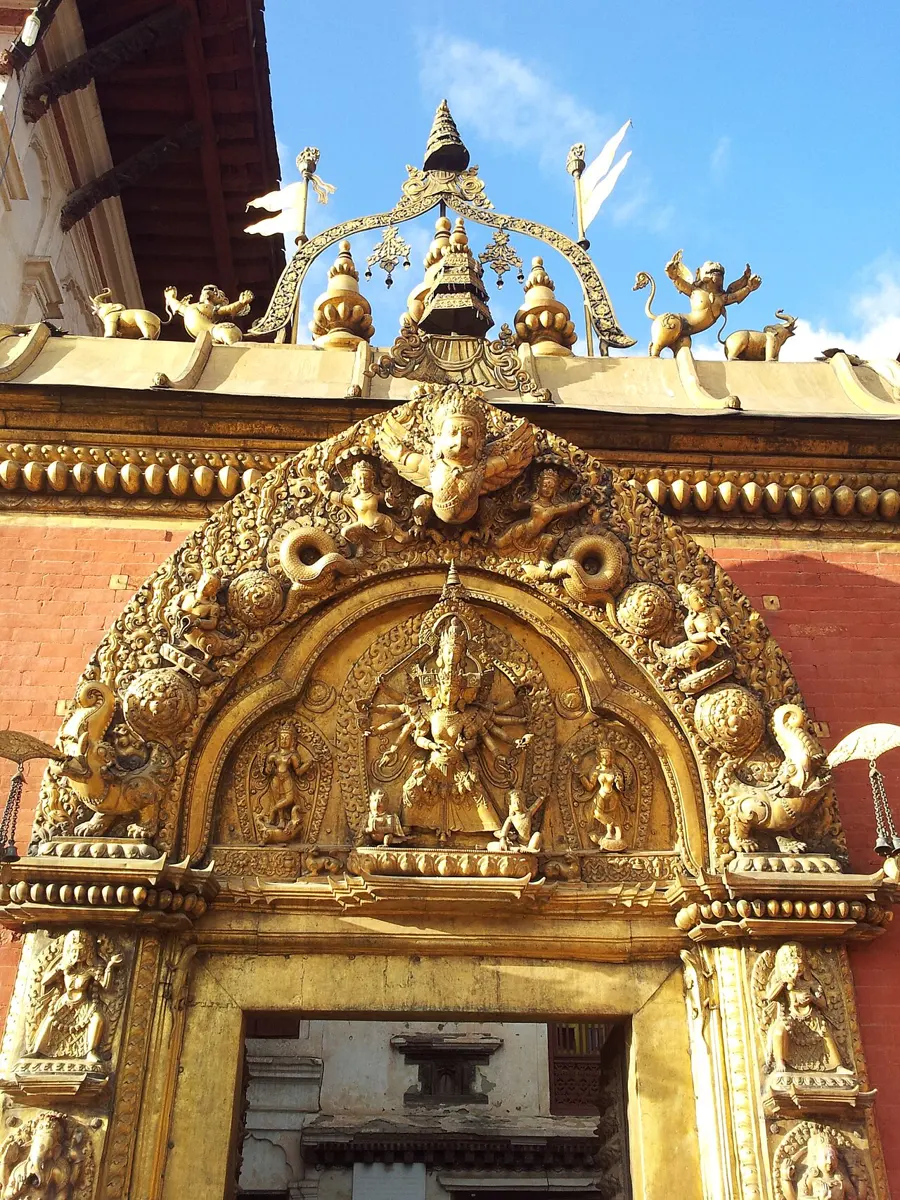
The arch over a doorway like this is a तोरण (toraṇa), and like a paubha it is a picture of who lives inside. At the very center of this one is the goddess herself, Taleju, many-headed and many-armed, her hands full of weapons. Above her, at the top of the arch, Garuda, Vishnu’s bird-man, grapples with serpents, and smaller gods and creatures crowd all around. A torana tells you who the building belongs to before you go in, and this one says plainly that past this gate the palace belongs to Taleju. Your Town’s Past has a guide to reading one.
The square around has lost many of its buildings. The earthquake of 1934 brought down a good part of it, and an eight-sided wooden pavilion, the Chyasilin Mandap, that stood in front of the palace was only rebuilt in the late 1980s, with the help of photographs taken a century before. A stone still standing there records a contest of poetry between Bhupatindra and his courtiers. When Ranajit Malla lost his kingdom to the Gorkha king Prithvi Narayan Shah, who had once spent three years as a guest at Ranajit’s court, the square stopped being the center of a kingdom. It kept its gods.
Beaten metal
The gold on the Valley’s gates, roofs and toranas is very often not cast at all. It is beaten. In Lost Wax, a god is made by pouring molten metal into a mold. In repoussé, a French word meaning pushed back, the metal is a sheet, usually copper, and the picture is hammered into it from behind.
That sounds simple and isn’t. Each bulge on the front, a cheek, an arm, a petal, has to be pushed out from the back, where the worker sees it as a hollow. So while shaping, the worker has to hold in mind a face that can’t be seen, every bump the reverse of what will show, which may be why Newar artists have their own name for the work, one that means something like echo work. It is so demanding that the makers of cast gods, who know just how hard their own work is, say repoussé is harder.
One of the finest pieces of it is right inside Bhaktapur’s palace. Its spout is a stone makara, the sea monster with a curling snout that is the mouth of almost every old water spout in the Valley, as Stone tells. Here the whole spout is covered in gilded beaten copper, crowded with frogs, snakes, water creatures and, leaping from the makara’s mouth, a goat. Older people in Bhaktapur still call it the Goat Fountain, and Patan’s palace has its own, the Cow Fountain, though its cow has gone.
The creatures aren’t there only for decoration. Frogs, snakes and water beasts belong to the monsoon, to the rain that fills the ponds and canals that feed the spouts, and they stand for plenty. Under the spout, in stone, is a prince holding a lotus and blowing a conch. He is Bhagiratha, who in the old story brought the river Ganga down from the sky when all the water on earth had dried up, so every drop that falls from the makara’s mouth is the Ganga arriving. A fountain like this is a small picture of how the world gets its water.
The best-known maker of repoussé in modern times came from Patan. Kuber Singh Shakya was born around 1881 into a family the Malla kings of Patan had chosen as their royal workers in beaten metal, and he learned in his father’s workshop. He made the silver doors of the inner shrine at Pashupatinath and much of the gilded copper on the stupa at Svayambhu. In Kathmandu’s square, after the earthquake of 1934, he made a new figure of King Pratap Malla and his family, in gilded copper, to replace the damaged one on its tall pillar. And he built a Buddha more than three meters tall out of many beaten pieces, fitted together or joined with rivets, assembled over three years where it was to stand. His son and grandson carried on the work.
Rest houses
Between the temples, the Valley’s cities are full of a kind of building that has no god in it at all, or only a small one, and is just as important. These are shelters, open on the front, roofed, often raised on a plinth: a place to sit out of the sun and rain. The smallest, a पाटी (pāṭī), may be no more than a covered platform at a crossroads or beside a spout. The larger is a सत्तल (sattal), a rest house of two or three floors. All of them were gifts, given for merit like a temple or a book, for anyone who needed them.
And people did need them. A farmer walking in to market, a pilgrim, a holy man, a traveler from the hills could rest, sleep, cook and stay the night. Neighbors met there to talk, storytellers to tell, singers to sing their hymns, children to learn, and the people of a neighborhood to decide on their festivals. Some served as markets. A shelter was where a city’s life went on outside its houses. Who built the one in your own neighborhood is often written on a stone or a beam inside, and a guide says how to find out.
Kasthamandap, the hall in Kathmandu, was a sattal too, the biggest of them all. Its roof was held up by four tall pillars in the middle, each a single tree trunk, with more posts around them, and its floor was open to all. It stood at a crossroads of the old trade road between India and Tibet, which is where a rest house should stand. A small shrine was added inside, and over the centuries people came to think of it as a temple. Bhaktapur’s great sattal, the one Yaksha Malla built in its eastern square, became a temple too, the Dattatreya. When the community of Kathmandu rebuilt Kasthamandap after 2015, its people carried the new central pillars, each seven meters of carved timber, through the streets on a bamboo cradle on their shoulders.
So a Malla city is a designed thing, but not designed by one hand. Its kings set a center, a palace with the royal goddess inside it, and arranged their gods around it. Their families and their subjects filled in the rest over centuries, with temples and statues, spouts and gates, rest houses and the tiny shrines at every corner. The result has a plan you can feel as you walk through it, from the goddesses’ shrines around the town to Taleju’s hidden courtyard at the middle. And it was made with all the Valley’s crafts at once, brick and timber, stone and wood, cast and beaten metal, paint on cloth and walls, all brought together in one place.
Found a mistake? Please tell us.