
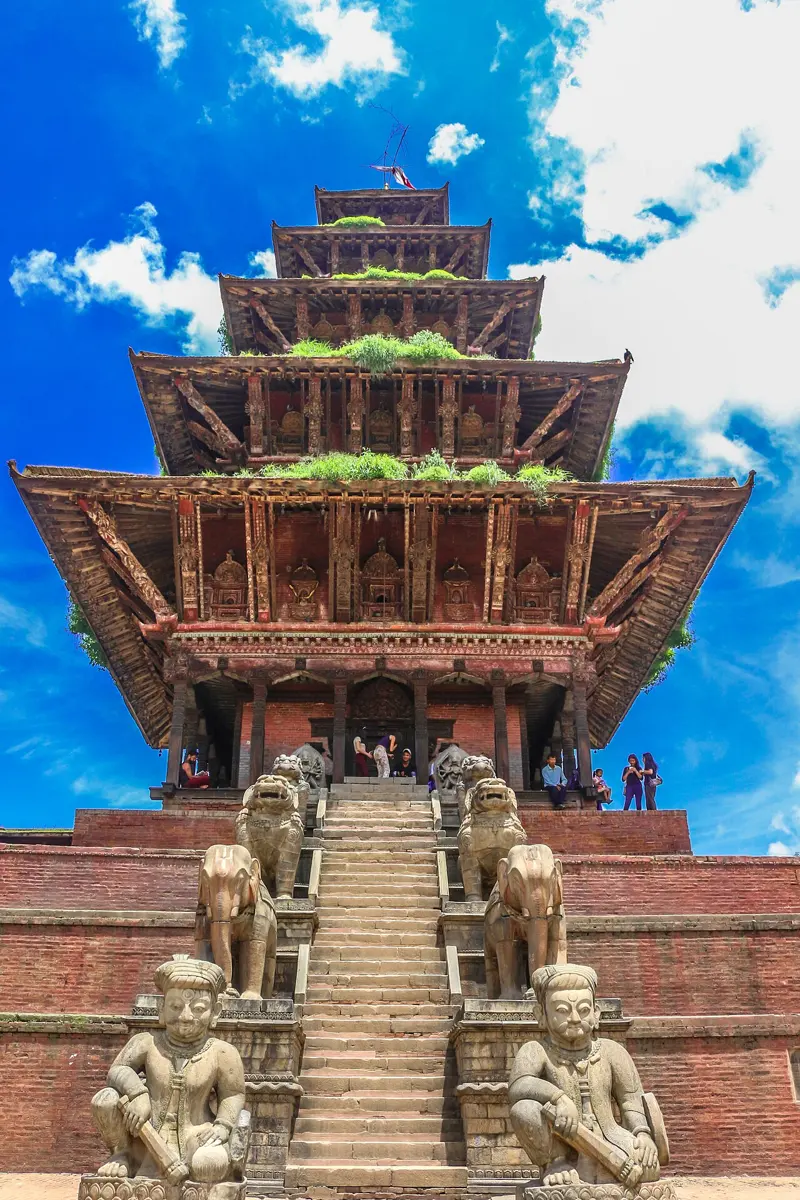
Walk into Taumadhi Square in Bhaktapur from any of its lanes and one building takes the sky. A steep stair climbs a stepped brick base, past ten stone figures in pairs, to a temple with five roofs, one above the other, each a little smaller than the one below, with a gilded spike on top. People sit on the steps and watch the square. Across it stands the temple of Bhairav, as if the two were keeping an eye on each other.
This is the Nyatapola, न्यातपोल, and it’s the tallest temple in Nepal: about 33 meters from the paving to the top of the spike, roughly the height of an eleven-story building. Its name doesn’t tell you which god lives inside. It tells you what it looks like. In Newar it means five roofs, and as far as anyone knows it’s the only temple in the country named for its shape rather than its god.
This book is about how to look at things people have made: temples, statues, paintings, houses, posters. It starts here, with one building, because nearly everything the book does can be done standing in this square. You can stand in front of almost anything made by hands and ask it seven plain questions. What do I see? What is it made of? How was it made, and how does it stand up? Who made it? Who paid? What was it for, and who was allowed to see it? What has happened to it since? Some answers come from looking, some from old papers, some from people who know the place. A few never come at all, and those are worth knowing too.

Looking first
The easiest way to see a building is to count. Count the steps of the base: five, each a broad brick terrace narrower than the one below. Count the roofs: five again. Count the pairs of figures on the stair: five once more. The builders clearly liked the number, and once you notice it you start seeing it everywhere.
Then look at the shape as a whole. The base takes up a big share of the height, about 9 of the 33 meters. That’s one reason the temple looks so tall from the square: its door is already about as high as the top of a three-story house. The roofs grow smaller as they rise and their edges tilt down, so the whole thing narrows like a pointed hat. The lowest roof has the deepest shadow under it, and in that shadow are the struts, the slanting carved timbers, called टुँडाल (tũḍāl), that run from the wall out to the roof’s edge. Each one is a carved figure: forms of the goddess, and lesser gods with her. You can’t read them all from the ground, but you can see that there are many, close together all the way round, and that they repeat. Small bells hang from the roof edges, for the wind to ring.
The stair is the part people remember. At the bottom kneel two wrestlers, said to be two famous strongmen, though their names are told several ways. Above them stand two elephants, then two lions, then two griffins, beasts with a lion’s body and a bird’s beak, and at the top two goddesses, one a lioness and one a tigress. Bhaktapur says that each pair is ten times as strong as the pair below it, so that the wrestlers have the strength of ten men and the goddesses at the door the strength of a hundred thousand. Nobody has to believe this to see what it does. Every few steps you pass something stronger, and the door at the top is the most guarded place on the stair.
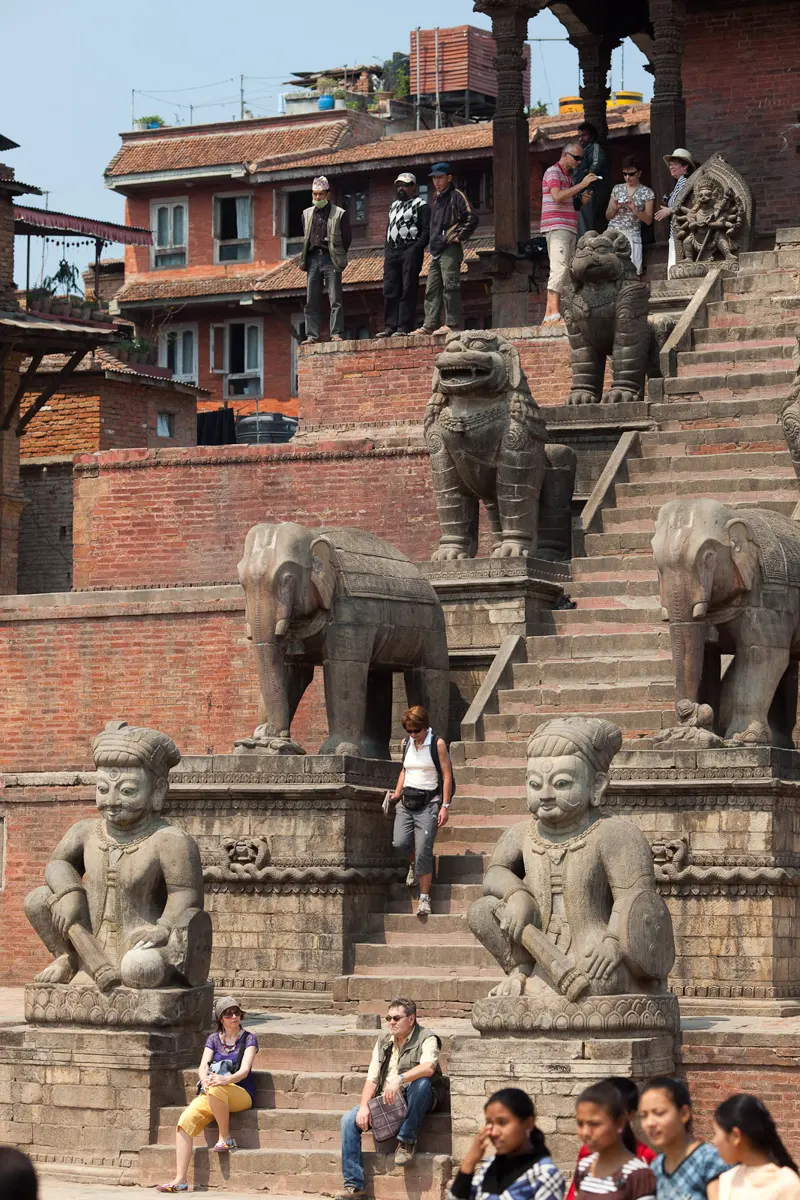
That’s a surprising amount to learn without reading a word: a building made in fives, standing high on purpose, decorated most where people’s eyes fall, and guarded more strongly the closer you get to its door. Looking can’t tell you whether any of that was meant. It can tell you what to ask next.
What holds it up
The materials are mostly the ones you’d find in an old Bhaktapur house, used on a grander scale: burnt brick, mud for mortar, stone, wood, clay tiles called झिँगटी (jhĩgaṭī) on the roofs, and copper and brass for the spike and fittings. The builders used five kinds of timber, among them sal and pine.
Most of this you can check with your eyes. What you can’t see is how it stands. Not long after the 2015 earthquake, a team of engineers from Canada and the United States, working with engineers from Bhaktapur’s own Khwopa colleges and the town, measured the temple with a laser scanner, a drone and a camera, and looked inside its walls with ground radar, which bounces radio waves off whatever is hidden in a wall. What they found turns the temple from a picture into a machine.
The ground floor’s walls are about one and a half meters thick, solid brick in mud. Each wall above is built a step further in, so that the outside edge of an upper wall sits roughly over the middle of the wall below. That’s how the temple narrows: not by tapering walls but by a stack of smaller boxes, each resting on timber beams that sit on the box below, the walls tied to the beams with wooden pegs. Above the first floor there are no floors at all. Inside, the temple is a tall, empty well, which is why no one could carry the scanner up to measure the upper levels. The base hides another surprise: its outer faces are proper brick walls laid in mud, but between them, the radar suggested, the bricks seem to be stacked dry, with no mortar at all.
So the Nyatapola is a heavy brick tower threaded with timber, probably with more timber running up inside its walls, sitting on a mountain of brick, and it’s built more like a nest of boxes than a single shell. Whether that’s why it has stood through every earthquake is another question, and it comes later in this book. The honest answer for now is the one the engineers gave: nobody has yet shown why it held.
Who built it, and who paid
Here looking runs out, and paper takes over. The temple was put up for Bhupatindra Malla, king of Bhaktapur, and finished in 1702. We know a great deal more than that because someone at the court kept a day-by-day record of the work. It survives in the National Archives in Kathmandu: 264 leaves of yellow Nepali paper, coated with orpiment, a yellow mineral that keeps insects away, written in Newar script in a fine hand. Some leaves are ink-stained and a few have been nibbled by rats.
The record begins with the trees. On a Thursday late in the autumn, a party was sent into the forest to cut timber, and the carpenters started work twenty-five days later. Then the dates come thick and fast. Digging the foundation took seven days. The terraces of the base went up in thirty-one. The temple itself rose in thirty-four, and the record notes the day the windows went into each story in turn, one after another, a few days apart. Then the roofs were laid with tiles, starting from the top and working down, all five in sixteen days. From the first spadeful to the last tile took eighty-eight days. After that came thirty-eight days of waiting for an auspicious day to install the goddess and lift the spike into place, while a great fire sacrifice burned below.
The record says a lot about faith and very little about how. It lists rituals, many of them, including one in which the hands of the carvers in metal, stone and wood were worshipped. When it was all over, the court held a sacrifice of repentance for all the creatures, seen and unseen, that might have been killed during the building, knowingly or not. A year after the digging began, the ashes of the sacred fire were carried down to the Hanumante river south of the city and set floating.
The last of its summary pages turns to the sacred fire and keeps count of the firewood offered to it, bundle by bundle: the king gave seventeen, and others gave fewer or more than he did, 1,102 bundles in all. The carpenters, bricklayers, carvers and smiths are there in the dates, but not as people. The record’s other pages hold more, and only parts of them have been published. So from the summary we know to the day when each window went in, and almost nothing about the hands that set it.
Why did the king want it? Bhaktapur tells it two ways, and both involve Bhairav across the square. In one, the king enlarged Bhairav’s temple, the god was angry at being disturbed, and drought, sickness and earthquake followed until the priests advised a finer temple for a goddess. In the other, the king built the Nyatapola first, and Bhairav, outdone, demanded in a dream that it house a goddess powerful enough for him to worship too. Neither story is in the building record. Nor is a third that Bhaktapur tells, that to hurry the work along the king himself led processions of workmen carrying bricks. Kings in the Valley paid for temples to gain merit, to please the gods who guarded their cities, and to be seen doing both. The Nyatapola did all three, in the middle of the town, where everyone could see.

Who it is for
Climb the stair and you reach a locked door. Inside is the goddess the temple was built for, Siddhi Lakshmi, the family goddess of Bhaktapur’s Malla kings and still one of the most honored in the town. Her image is kept hidden. Only priests of the Karmacharya families may go in to worship her. A guide whose father once served as its priest told researchers that she can’t go in now, though on one day a year, at Dashain, a person may ask the caretakers to be taken along.
So the tallest building in Nepal was built around something almost nobody may look at. That’s less strange than it sounds. Many temples in the Valley work this way: the outside is for everyone, the inside for a few, and the carvings on the struts and the panel above the door show the goddess’s forms to people who will never see the image itself. What the image looks like is not for this book to show.
Meanwhile the outside belongs to everybody. Four small shrines to Ganesh stand at its corners and get their offerings every day. Every year, on the temple’s birthday in early summer, the Awal community, by tradition the town’s bricklayers and masons, climb to the top and raise a flag. Bisket Jatra, the town’s great spring festival, fills the square around it, and tourists pose with the guardians, which locals frown on. And for some people who live there, it’s simply on the way. A Muslim grocer in his seventies told the same researchers that he crosses the square twice a day going to the mosque, and to him the square and the temple are just places on the way. That’s a true answer to “who is it for?” too.
Three hundred years since
The last question is the one people forget: what has happened to it since? A building isn’t finished when it’s built. Big earthquakes struck the Valley in the 1830s and the 1930s, and the second one damaged the topmost story and the spike, which were repaired. The town replaced rotten timber in the upper stories in the mid-1990s, and more old wood again in the 2000s.
Then came 2015. The Nyatapola stayed standing while temples fell all around the Valley, and that has made it a symbol of the town’s strength. Up close, the engineers found that the top story’s wall had partly fallen, and the whole top level had twisted by about three and a half degrees, enough to see on their scan. Cracks had opened around the doorways on all four sides. The top was leaning to the east, and the story below had begun to follow.
Bhaktapur fixed it itself. The city turned down foreign donors for its temples and put the work in the hands of committees of local people instead of contractors. The plan was to take down the top two stories and rebuild them, and in the spring of 2020, when the whole country was locked down for the pandemic and the monsoon was coming, the town went back to work anyway. Over four thousand volunteers came, many of them women, who have long had less access to the town’s temples than men. People brought old roof tiles from their own houses and sheds. The work was finished that July. The mayor said afterward that if anyone now asked who built the Nyatapola, the answer was no longer a king: “it is every single one of us.”
That’s the seventh question’s answer, and it’s never final. The temple you can visit is the one Bhupatindra Malla paid for, in the sense that its plan and most of its bricks are his. But its top has been rebuilt more than once, its timbers replaced, its tiles carried up the stair by people alive today. A mason in her sixties told researchers that the temple has never fallen, not in this earthquake and not in 1934, and that some say it goes down five stories underground as well. The radar went about a meter and a half into the base and found only brick. Both are true in their way.
So that’s one temple, seen seven ways. Looking told you its shape, its numbers, and how it draws you to the door. The scan told you how it stands. A royal record told you who paid and how fast it rose, and the people of Bhaktapur told you who it’s for and who saved it. What none of them could tell you is why it held in 2015 when so much fell, what the goddess inside looks like, or who the carvers of the struts were and what they had in mind. Some of that the rest of this book can answer. Some of it no one can, and that’s worth knowing too. Next comes the simplest question of all, and it’s harder than it looks: what does the eye actually get?
If you want to try this on a temple near you, Your Town’s Past, in Practice has a way to read a temple from the plinth to the top, and the manners for going into one.
Found a mistake? Please tell us.