
In 2016, after the earthquake, workers taking down a wall in Guita Bahi, a Buddhist courtyard in Patan, found writing on the back of a stone base. It is short, and it is crowded with people. It names a monk, यशोमित्र (Yaśomitra), and calls the image he set up his देयधर्म (deyadharma), his gift of merit, given so that his parents, his teachers and all living beings might reach the highest knowledge. It names the king, Ramadeva, by whose leave the image was consecrated, and a great lord under him, Kramalila, as a well-wisher. It gives the date, down to the day of the moon: in our calendar, December 542.

It leaves out one person. Somebody modeled that Buddha in wax, packed it in clay and poured the metal, and the stone says nothing about who. How the metal was poured is told in Lost Wax. This chapter is about the people around it: the one who paid, who is remembered, and the ones who made it, who mostly are not.
The most famous history of art in English begins: “There really is no such thing as Art. There are only artists.” Ernst Gombrich wrote that in 1950, in The Story of Art, a book read by millions, and he went on to say that once these were people who “took coloured earth and roughed out the forms of a bison on the wall of a cave”. He meant something wise: that art is always somebody’s work, never a ghost in a museum. But most books of art history then tell the story as a string of named masters, and that story runs into trouble in Patan. For most of history, and in most of the world, the name that was written down was the name of the person who paid. The makers were trained workers, often families who passed the trade from parent to child, and they were rarely named. The idea of the artist as a special kind of person, whose name matters as much as the work, is fairly new, and it grew up mostly in Europe.
So in front of almost anything old, there are two questions, not one. Who made it? And who paid for it? Usually they are different people, with different reasons.
Why people paid
The monk of Guita Bahi said why in his own inscription: merit, पुण्य (puṇya), the good that comes back to a giver, here shared out with his parents, his teachers and everyone else. Giving an image, a temple, a water spout or a resting shelter was one of the surest ways to earn it, and it could be earned for someone else. King Manadeva set up his striding Vishnus in 467 for his mother Rajyavati’s merit, as Signs and Stories tells. Twelve centuries later, Bhupatindra Malla built the Nyatapola for merit, for a goddess who protected his town, and to be seen doing both.
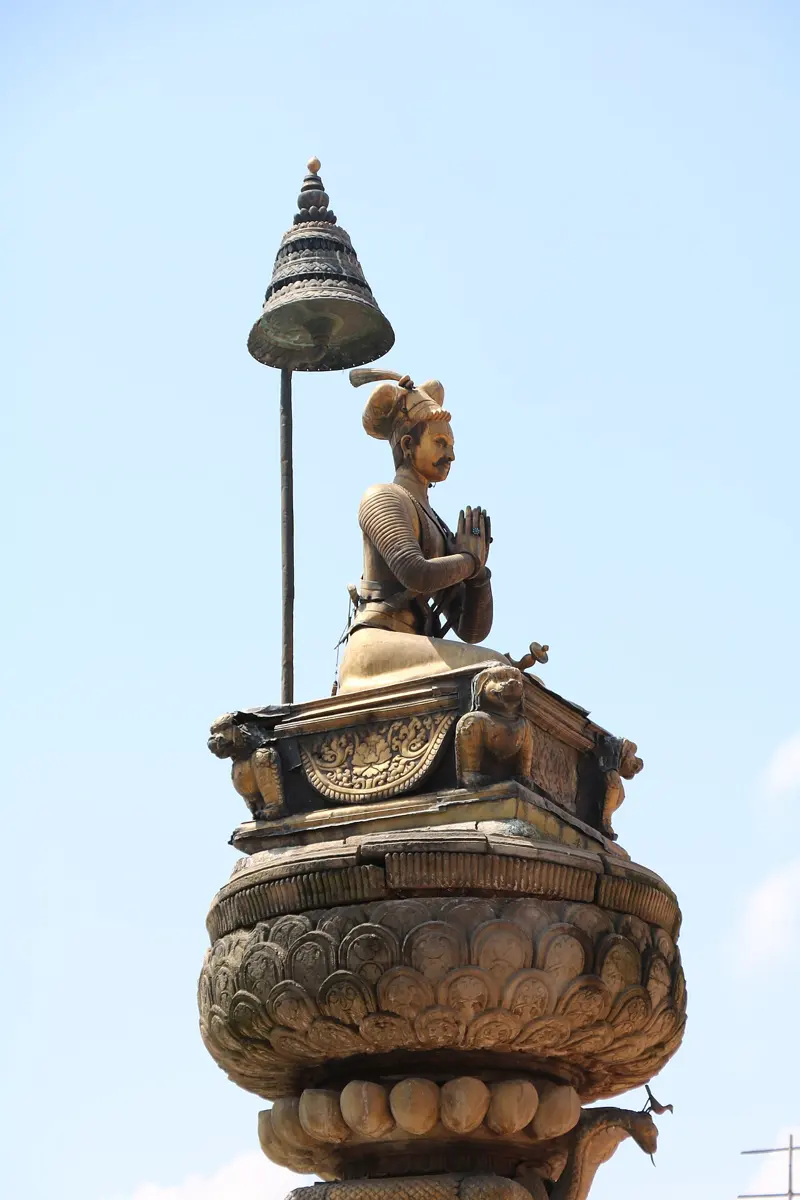
Being remembered was the other reason, and it is no less human. Bhupatindra still sits in gilded metal on top of a tall pillar in Bhaktapur’s Durbar Square, his hands joined in front of him. Newar paintings, too, can carry a line of writing that names the givers and says what the painting was for. One, dated 1512, records the gift of a man who seems to have been a chief minister, and a ceremony for someone who had reached the age, a little over eighty-three, at which a person is said to have seen a thousand moons. The givers can be in the picture as well, small, near the gods they paid to have painted: in one painting of 1443 a whole family kneels in the lower part, and in another, made in memory of a famous monk, four small figures sit in a corner.
Europe did exactly the same. In Rome, a French cardinal wanted, as one early writer put it, “some worthy memorial of himself” in that famous city, and paid a sculptor from Florence to carve the dead Christ lying across his mother’s knees. In the Flemish city of Ghent, a rich citizen named Joos Vijd and his wife, Elisabeth Borluut, paid for a great folding altarpiece for their chapel in the church of Saint John. When its wings are closed, the two of them kneel there with their hands joined, painted so exactly that they look like people you might pass in the street, on either side of two saints. Donors in Flemish churches had themselves painted beside the saints to show how devout they were, and to make sure the people at Mass saw how high they stood in the town.
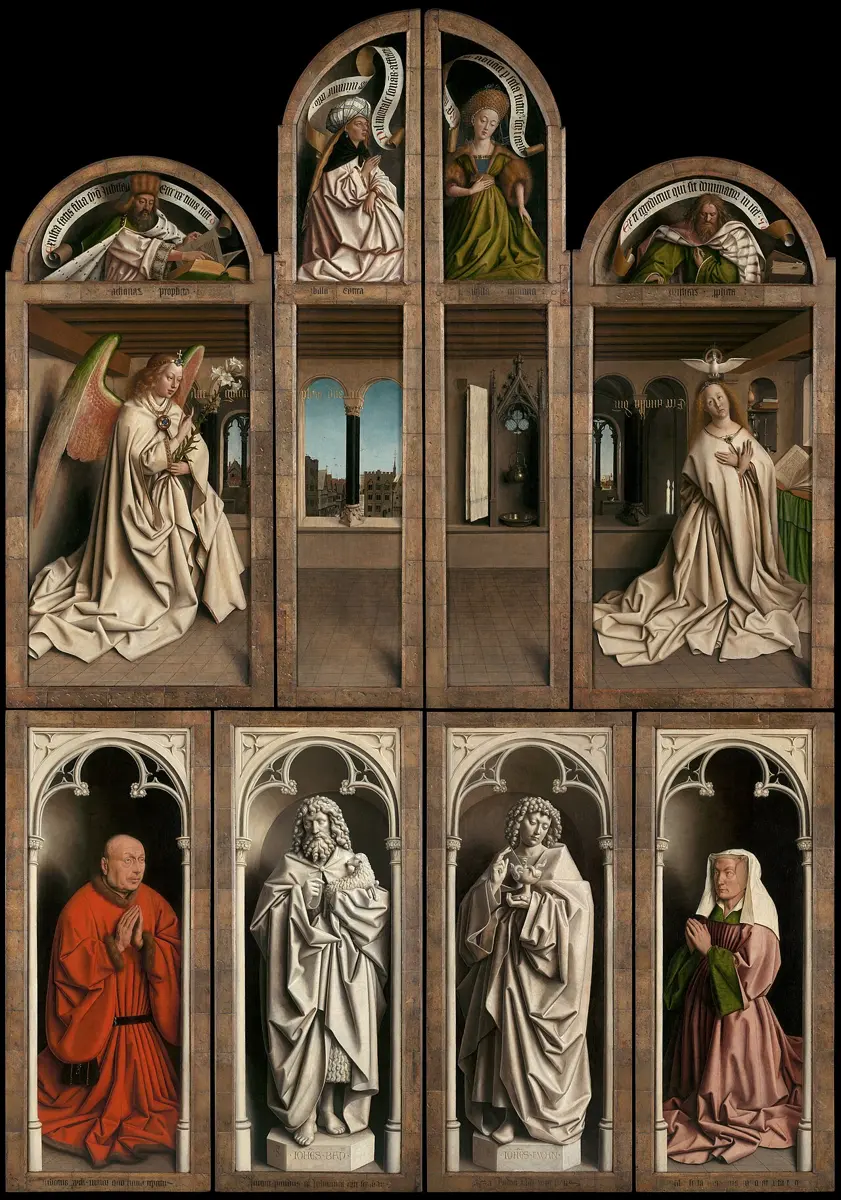
The frame of that altarpiece carries a short verse in Latin, and it is one of the rare places where the payer and the makers share a line. The painter Hubert van Eyck, “greater than whom no one was found”, began the work; his brother Jan, “second in art”, finished it, at the expense of Joos Vijd; and the verse invites you, on the sixth of May, to look at what has been done. The year, 1432, is hidden in the verse itself, in red letters that are also Roman numerals.
Who made it
Nobody makes a temple alone, and hardly anyone made a painting or a cast god alone either. Most things in this book came out of workshops, and most workshops were families. In Patan’s Oku Bahal, the casting of metal gods passes from father to son among Shakya households. In Bhaktapur, the Awal community, by tradition the town’s bricklayers and masons, still climb the Nyatapola each year to raise its flag. चित्रकार (citrakār), the surname of Newar families of painters, simply means picture-maker, and painting was the family’s trade. A craft handed down this way keeps knowledge alive for centuries, and it also keeps it in a few hands. How trades, families and castes fit together, and who ranked where, belongs to another book. Here, what matters is that the skill was real and that it was carried by people, generation after generation.
The Nyatapola’s own building record shows how they were seen. It lists a ritual in which the hands of the carvers in metal, stone and wood were worshipped: the skill was honored as something holy. And it names none of them. Now and then a painting’s inscription does give the painters’ names. That painting of 1443 names six painters beside the family who paid. More often, scholars have to follow a workshop by its style from one unsigned painting to the next. A name is the exception, not the rule. Today, when the Patan Museum shows the steps of casting an image, it lists every member of the workshop who made the display, wax makers, mold makers, casters, finisher and gilder, one by one.
Europe’s painters worked the same way until quite late. Hubert and Jan van Eyck were brothers. In Venice, the painter Tintoretto kept his daughter, Marietta Robusti, in his studio as an assistant for years. A master took in apprentices, boys who ground the colors and swept the floor, learned to draw, then painted the less important parts of the master’s pictures, and the finished picture went out of the door as the master’s.
Michelangelo, the sculptor from Florence who carved that statue for the cardinal, signed it, and there is a story about why. It is told by Giorgio Vasari, a painter who knew him. One day, Vasari says, Michelangelo walked into the chapel where the statue stood and found a group of visitors from Lombardy admiring it. One asked who had made it. Another answered: “Our Gobbo from Milan”, a sculptor of their own. Michelangelo said nothing. That night he shut himself in with a lamp and his chisels and carved his name across the sash that runs over the chest of Mary. It was, says Vasari, the only work he ever signed.

Whether it happened just so, nobody can check. But Vasari’s book did more than tell stories. His Lives of the Most Excellent Painters, Sculptors and Architects, first printed in 1550, told the history of art as the lives of great men, one after another, each better than the last, and that is the shape the story has kept ever since, down to Gombrich. Even so, the word Vasari used for Michelangelo, in the old English translation, is craftsman. To him there was no shame in it.
Art and craft
The sharp line between the two came later. In 1746 a French writer, Charles Batteux, sorted the arts by their purpose. Some, like music, poetry, painting, sculpture and dance, he said, are there to give pleasure. The others, the mechanical arts, are there to be useful. From that sorting, and others like it, came the idea of the “fine arts” that hang in galleries, set apart from “crafts” sold in shops. It is less than three hundred years old.
Nepali never drew the line so sharply. Its words for this are older and wider. कला (kalā) can mean any skill done well, and an old list of the sixty-four कला, given in Nepal’s big dictionary, puts singing and painting side by side with cooking, sewing, carpentry, building a house, working metal, telling good gems from bad, teaching a parrot to talk, and even gambling. शिल्प (śilpa) is skilled work with the hands, and the everyday Nepali word for a skill, सिप (sip), comes from it. A कालिगड (kāligaḍ), a skilled worker, a word Nepali took from Persian, is what most of the makers in this book would have called themselves. A Newar caster finishing the face of a god would have had no use for the question “Is this art or craft?” It was work, and it was worship, and it was done as well as he knew how.
Who is missing
If makers in general are hard to find, women makers are harder. In 1971 an American art historian, Linda Nochlin, asked in a famous essay why there had been no “great” women artists, and her answer was not about talent. It was about doors. To become a painter in Europe you had to be taken into a workshop, or later into an art school, and both were run by men for men. For a long time women students weren’t allowed to draw from a nude model, the training every serious painter had. The women who did break through were mostly painters’ daughters, like Marietta Robusti, or Artemisia Gentileschi, whose father taught her in his own studio.
In Nepal the same silence has a different shape. In Janakpur and across Mithila, it was the women of the family who painted the walls and floors of the house for weddings, festivals and feasts, in flour, clay and cow dung, and nobody wrote down their names. Those paintings were made for the day, and many walls are concrete now. For more than thirty years, a women’s center in Janakpur has trained women to carry the same designs onto paper and canvas, and their work travels with their names, Madhumala Mandal’s and others’. The work didn’t change. What changed is that someone began to record who did it.
In the glass case
Then there is what happens when a thing leaves home. In a museum, a god from a shrine goes into a glass case beside a bowl or a vase, lit the same way, with the same kind of label: what it is, where it’s from, the century, the material, and often “maker unknown”. It is a way of seeing too, one that asks of everything who made it and when, and not what it was for. For an image that people bathed, fed and prayed to, that is a big change. It stops being someone and becomes something.
And the label has one more line, which brings us back to the monk of 542. Almost every museum label ends with a credit line: whose money bought the object, or who gave it. One Nepali bronze of about 1500, now in the Cleveland Museum of Art in the United States, is called simply Royal Female Donor: a richly dressed woman holding a lamp, who the museum thinks was once part of a group of images that she herself paid for. Its label says it was the gift of an American woman, in memory of her mother. So the person who paid is remembered twice, five centuries apart, and the maker not at all. Where the image was in between, and how it left Nepal, its record doesn’t say. That question, for many images like it, is the subject of Stolen Gods.
So behind almost every old thing stand two groups of people. The ones who paid gave for merit, for protection, for show and to be remembered, and their names are on the stone, in the corner of the painting and on the museum label. The ones who made it worked in families and workshops, were honored for their skill and were rarely named, and the women among them least of all. The habit of telling art as the lives of famous artists began in Europe only a few centuries ago. Ask both questions, who made it and who paid, and you see much more of the thing in front of you. The nearest resting shelter is a good place to begin: Your Town’s Past has a way to find out who built your पाटी, and who looks after it now.
Found a mistake? Please tell us.