
Set into the outer wall of the old palace in Kathmandu, just left of its famous gate, is a long, low slab of black stone covered in writing. Look closely and the writing keeps changing. Here the letters are Devanagari, there they are Tibetan, then the curls of Persian and Arabic, then scripts most visitors have never seen. The last of them is European. Near the bottom, in capital letters, are the words AVTOMNE, WINTER and LHIVERT: autumn in French, winter, and winter again in French, a little oddly spelled. Below them is a spout, because the slab was also a public drinking fountain.
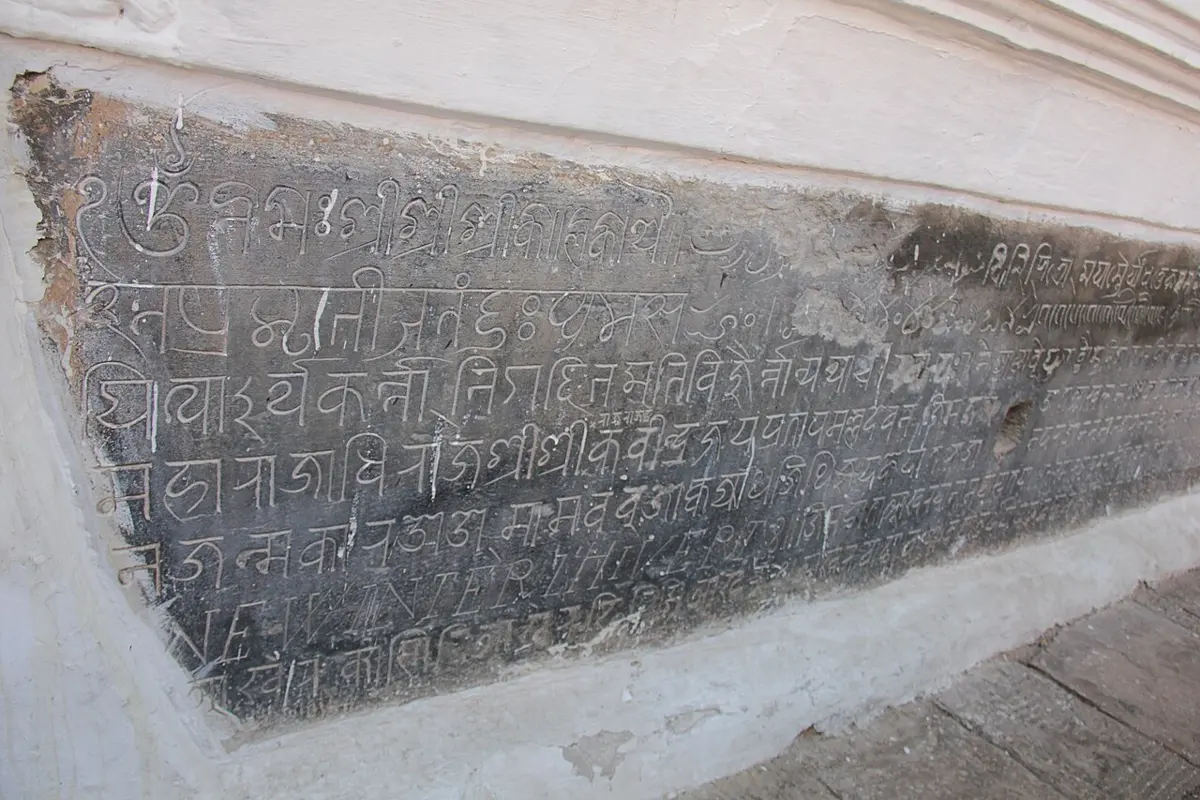
The stone’s first line names the goddess Kalika, and further along it names its author, “the king of poets”, Pratap Malla, king of Kathmandu. The stone is dated to the day of Shree Panchami, the festival of Saraswati, goddess of learning, in January 1654, and the city’s old chronicle says the king had his prayer cut “in fifteen different characters, all of which he had studied”. Nobody has fully read it since. People in Kathmandu still say that whoever manages to read every script will see milk run from the spout instead of water.
Why would a king carve a prayer in fifteen kinds of writing that hardly anyone could read? He didn’t say. It honored a goddess, and it showed off a learned king. A guess, and only a guess, is that he also had his neighbors in mind, for there was an audience close at hand. An hour’s walk to the south, across the Bagmati, sat Patan, with a king of its own. A few hours to the east sat Bhaktapur, with a third. By Pratap Malla’s day the small Valley that people called Nepal had three kingdoms, three palaces, three royal families who were cousins, and three courts watching one another. This chapter is about how one kingdom became three, how the three lived side by side, and what life was like in their cities.
One kingdom becomes three
When Jayasthiti Malla died in 1395, he left the Valley as one kingdom, ruled from Bhaktapur. His grandson Yaksha Malla came to the throne in 1428 and reigned for more than fifty years. More of his documents survive than of anyone before him: about fifty dated stones, copper plates and notes in books. They show a king who built. In Bhaktapur he put up the Mul Chok, today the oldest part of the palace there. He gave the care of Pashupati to Bhatta Brahmins from south India, whose families still serve the temple today. And in his time the Valley’s own language, Newari, took over the stones and the notes in books from Sanskrit, keeping Sanskrit only for the prayers and the king’s titles.
Many books add that Yaksha Malla conquered a great empire, from Bengal in the east to Gorkha in the west, and from Tibet down to the Ganga. That comes from a poem written at the court of Bhaktapur about a hundred and thirty years after his death, by a king proud of his great ancestor. He may well have raided into the plains or the nearby hills, but no record of his own time says he ruled anything like that much land, and historians read the poem as a boast.
The kingdom broke up quietly, through family custom. The Malla kings had a habit of letting several sons rule together, and when Yaksha Malla died in 1482, his three senior sons, Raya, Ratna and Rana, took the throne jointly, as their great-grandfather’s sons had done. But each brother soon settled in a part of the kingdom and ran it as his own. Within two years Ratna Malla held Kathmandu; the later chronicles say he took it by poisoning its leading nobles at a feast. Raya stayed in Bhaktapur, and Rana took Banepa, east of the rim. After Raya died, nobody pretended any more. Banepa didn’t last: when Rana died without a son, it went back to Bhaktapur.
Patan’s path was different, and so the three kingdoms of the school books, Kathmandu, Patan and Bhaktapur, took more than a century to appear. Patan had long been the largest of the Valley’s towns, and for much of its history it was run by its nobles. Seven leading families sat as a kind of town council with three chairmen, a little like the merchant republics of Italy in the same centuries. By Yaksha Malla’s death they ran the city almost as a country of their own. A generation later they stopped even naming the Malla kings as their lords, and in about 1530 one noble got rid of the council and made himself Patan’s king. His family held Patan, sometimes free and sometimes bowing to Kathmandu, until a king of Kathmandu took the city around 1600 and gave it to his sons and grandson to govern. Only in 1641 did that grandson, Siddhinarasimha Malla, make Patan a kingdom of its own again, and the three Malla kingdoms were complete.
Three kings, a few hours apart
Kathmandu and Patan stood about four kilometers apart, and Bhaktapur only about twelve from Kathmandu. Their royal families married one another, worshipped the same goddess, Taleju, and spoke the same language. They were also rivals, all the time.
Pratap Malla shows how it went. He came to power in 1641 by locking up his own father, whom the chronicles call mad; nobody can now say whether that was true or only Pratap’s excuse. His uncle Siddhinarasimha, who governed Patan, used the moment to make his own city a kingdom. The two had clashed before, while Pratap was still a prince. In 1637 Siddhinarasimha finished the stone temple of Krishna that still stands in Patan’s palace square, and on the very day its god was set in place, his own inscription says, an enemy attacked and seized his forts. The inscription names no enemy, but Pratap later boasted on a stone of his own of taking forts from Patan.
The wars between the three were small: a village burned, a few men killed, a fort taken and given back. In 1660 Bhaktapur’s soldiers set fire to a village near Changu, killing eight people and carrying off twenty-one. Kathmandu and Patan, together, pushed back until Bhaktapur’s king sent money and elephants to make peace. The fighting flared again, and in the winter of 1661–62 two Jesuit priests, on their way home from China to Rome, walked into it. One of them later told how he gave a small telescope to Shrinivasa, Patan’s king, who was leading the two cities’ army, and pointed it at the enemy’s camp. The lens made the enemy look so close that the king ordered his men forward at once. In Kathmandu, Pratap was so taken with the telescope and the priests’ other instruments that he wanted to keep them, and let them go only when they promised to come back.
What decided these quarrels was usually not fighting but friendship. Three kingdoms of about equal strength meant that any two together could beat the third, so alliances changed all the time, sealed with oaths and broken within a few years. Roads were the weapon. A king could close his paths to a neighbor’s traders, or arrest them when they came to his market. Pratap is said to have tried to choke Patan’s trade this way, and Patan answered by sending its traders through Gorkha instead.
By about 1700 the kings were bringing in outsiders. One agreement between Bhaktapur and Patan, made around 1701 as historians describe it, said that if Patan went to Kathmandu for help without asking Bhaktapur, it would pay a fine of 40,000 rupees, to Bhaktapur and to its friends outside the Valley, the kings of Gorkha, Makwanpur and, it seems, Tanahu. Eighteen months later Bhaktapur’s king signed a new agreement with Kathmandu, against Patan. Each such paper pulled the hill states a little further into the Valley’s affairs.
Who really ruled
Behind the three thrones stood the nobles, and they often mattered more than the kings. Kathmandu’s nobles more than once chose the king: from the 1710s one of them ran the kingdom for about twenty years and chose who sat on its throne.
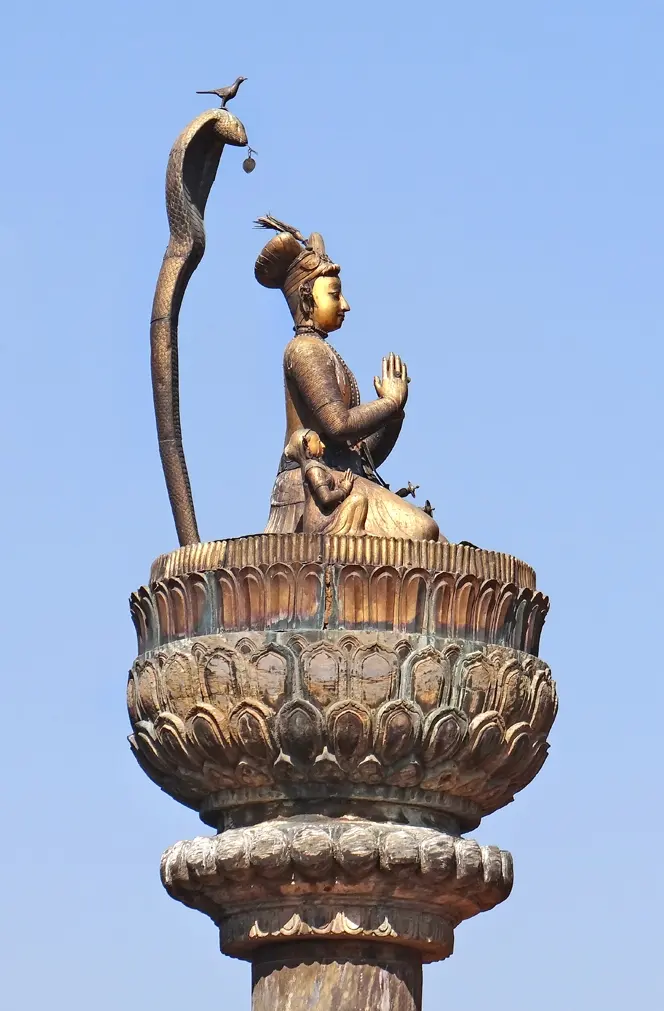
Kings died young, and not always naturally. Patan’s Yoganarendra Malla, who had his statue put up on a pillar in front of his palace, was leading an attack on a fort of Bhaktapur’s in 1705 when he died suddenly at Changu. The chronicles say he was poisoned, some say in the tobacco he smoked, and the story told in Patan, which many readers will have learned, blames spies from Bhaktapur. Nobody can check it now. More than twenty of his wives and concubines were burned on his funeral fire, a custom called सती (satī). He left no son whom everyone accepted, and for ten years Patan could hardly keep a king. Its coins tell the story, because each claimant struck coins in his own name: one king after another, some of them boys. One of these was Yogamati, Yoganarendra’s daughter, whose name appears on Patan’s coins of 1707 and 1709 beside that of her son and then of another boy. For a few years she seems to have been the power in Patan. Then, in 1717, Patan fell to Kathmandu’s king for five years, and after that it took its kings from wherever its nobles could find them, nephews and cousins from Kathmandu and Bhaktapur.
The pillar has its own legend: as long as the bird stays on the cobra’s head, Yoganarendra is alive, and so, the story goes, a window of the palace is kept open and a bed made for him. Some think the story was put about in the confused years after his death, by claimants who wanted to rule in the name of a king who had never quite died.
Women appear in these records more often than in older ones, mostly as mothers ruling for young sons. In Kathmandu, Queen Bhuvanalakshmi ran the kingdom with the ministers after her husband died in about 1700, while her son was a boy.
Life in the cities
The best picture of the Malla cities comes from an Italian priest who lived in Patan for about four years at the very end, in the 1760s. He was taken with them. The three cities and the large towns, he wrote, were well built, of brick, three or four stories high, with doors and windows of wood, “well worked”. The streets were paved with brick or stone and sloped so that rain ran off. In almost every street of the capitals there were stone wells, with stone channels carrying the water on “for the public benefit”. In every town stood open halls, पाटी (pāṭī), where travelers and anyone else could rest, and outside the big towns were square tanks with steps for bathing. Kathmandu’s, he said, was at least two hundred feet along each side.
Each city had grown out of older villages pressed together, and the old villages lived on as its टोल (tol), its neighborhoods, each with its own shrines, wells and squares. Patan’s neighborhoods were often named after their Buddhist monasteries, and Patan was mostly Buddhist; Bhaktapur was the most strictly Hindu of the three, and Kathmandu was a mix, though the same families honored the Buddha and Shiva, and the kings gave to both.
Most people in these cities were farmers. The Newar farmers, the ज्यापु (Jyāpu), worked the fields around the cities, and the rice they grew fed everyone else. A British officer who came in 1793, a generation after the Malla kings fell, was surprised to find that they hardly used the plow. They dug their fields with a heavy spade, the कोदालो (kodālo). It was very hard work, he wrote, but it was said to give as much as plowing, and he was told they avoided the plow out of reverence for the bullock.
Everyone else’s work was, for the most part, set by birth. A visitor of 1802 listed the Newar castes by trade: carpenters and bricklayers, potters, barbers, washermen, oil-pressers, painters, and families who worked gold, silver and copper and traded. That ladder of castes is not something to admire, and the people near its bottom had hard lives, but it also kept skills alive in families for generations. Tibetan monasteries sent for Newar artists, and the carved windows, gilded roofs and temples that visitors still come to see were made by Newar craftsmen working for these three courts.
What held a neighborhood together was the गुठी (guthi). The word comes from the Sanskrit goṣṭhī, an assembly, and guthis are older than the Mallas: some are mentioned in Licchavi stones. A guthi is a group of people who share a duty, and usually some land or money given to pay for it, so that the duty outlives any one of them. Some guthis looked after a temple’s worship or a festival. Some kept up a water spout or a rest house; in 1415 a man in Patan built a spout, gave farmland to pay for its upkeep and set up a guthi to look after it. The most important were the funeral guthis. Their members carried and cremated one another’s dead, and belonging to one was part of belonging to the town at all. Many guthis still meet today.
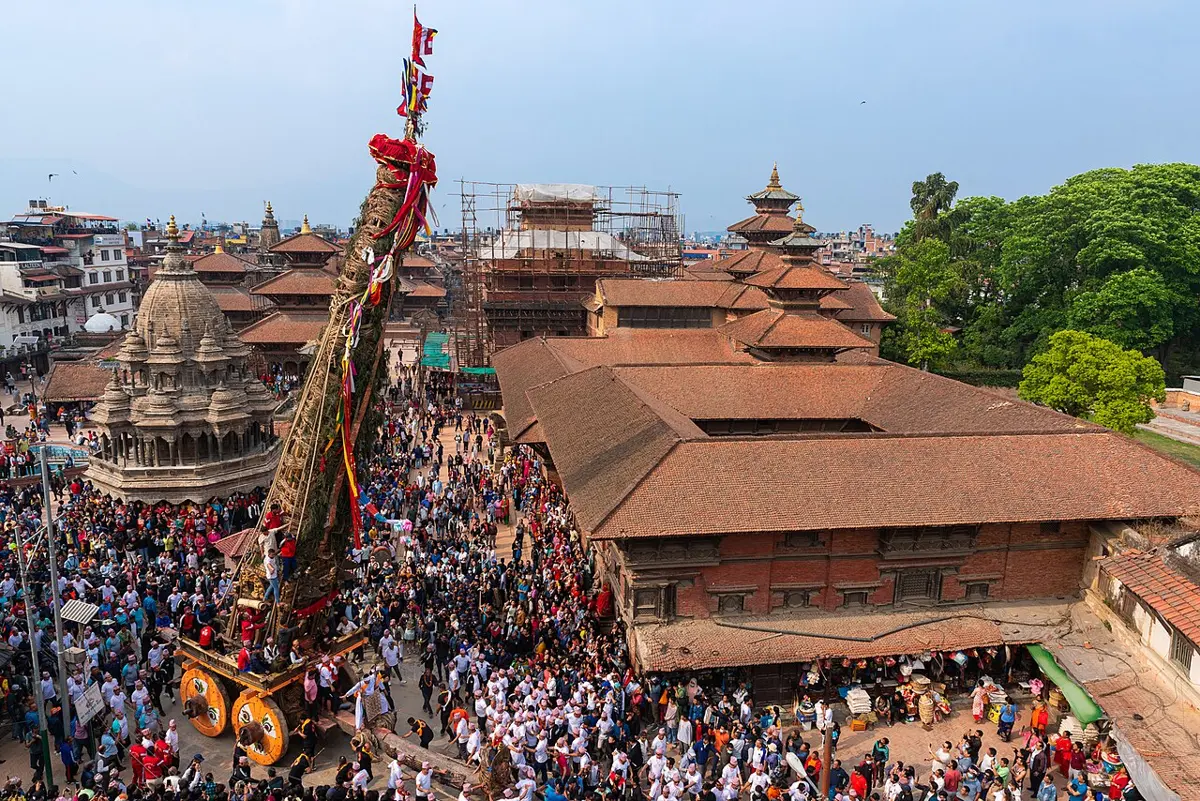
Festivals were where the cities and their kings met. The priest described Patan’s great chariot festival, still held today, when a god sits in a tall gilded car that the townspeople pull through the streets “almost every day”, for a month or more, with the king standing beside the god and the crowd playing every instrument the country had. Kings started festivals, or claimed to have. Bhaktapur’s chronicles say its king Jagajjyotir Malla began the city’s new-year festival, Bisket. One of Kathmandu’s kings of the 1500s is said to have revived its masked dances, and its great festival of Indra Jatra came, in later tradition, to include the chariot of the living goddess Kumari, which is said to go back to Jaya Prakash Malla, the last king. Like most stories of how festivals began, these come from chronicles written long after, not from records of the time. Each court staged plays and sang songs, and each king tried to outdo his neighbors in temples, tanks and processions. The rivalry that cost the Valley in wars gave it many of the buildings and festivals that make it famous now.
The last years
By the 1700s the three kingdoms were still quarreling. In 1716 and 1717 a plague struck the Valley; a Christian priest passing through was told it had killed 20,000 people in three months, and the chronicles count 18,714 dead, over three years. In Kathmandu, the kings kept soldiers from the hills, and in the 1740s, after a quarrel with them, Jaya Prakash Malla raised soldiers from the Tarai instead. And on the hills to the west, the king of Gorkha was watching, for reasons the next chapters tell.
Some historians have thought the Mallas were ruined by their own quarrels. Others point out that the same three courts, competing, made the Valley what it was. Both can be true.
So the Valley’s one kingdom became three, not in one blow but in steps, and the three Malla kings who ruled it from the 1600s were cousins and rivals who fought small wars, closed roads and drew outsiders into their quarrels. Behind them stood nobles who often chose the king; below them, the farmers and craftsmen of brick cities, whose guthis looked after their temples, water and dead. The Grade 7 सामाजिक book tells the same kings more briefly.
Found a mistake? Please tell us.