
Around the courtyard of Uku Bahal, a Buddhist monastery near Patan’s palace square, the roofs rest on carved wooden struts. Those on the north side show young women reaching up into the branches of trees, each standing on a squat little spirit who holds her up. For a long time, experts dated them to the thirteenth century, and that seemed old enough: no Nepali wood carving was thought to be older than the twelfth or thirteenth century, apart from some reliefs of about the seventh in Lhasa, carved by Nepali carvers for a temple there.
Then the art historian Mary Slusser began testing. A radiocarbon laboratory needs only a sliver of wood not much bigger than a toothpick, and her first tests, on two carvings elsewhere in the Valley, one of them a strut, came back centuries older than anyone expected. So she turned to the struts of Uku Bahal. After careful talks with the monastery’s elders, the director of a conservation trust climbed a ladder and took a sample from one. Its wood dates from between 690 and 890. Four of its neighbors are so alike that they were almost certainly carved by the same hand, so five of the Valley’s carvings were several hundred years older than anyone had thought. The monastery itself is said to have been founded by a king who reigned around 700.
Wood rots, burns and gets eaten. Yet the Valley has carvings more than a thousand years old, still doing their work under the roofs. That says something about the wood, and about the people who carved it.
Sal, and the rest
The timber that lasts is sal, heavy and hard. Its heartwood, the dark core of the trunk, lasts very well and is hard for termites to eat; why is told in Woods of Nepal. It is the carver’s first choice for anything outdoors, in the sun, wind and rain. It is also a hard wood to work. Its resin makes it hard to plane, it tends to split when nailed, and carving it takes far more time and care than carving a softer wood.
Fresh sal can’t be carved at once, either. A newly cut tree is full of water, and wood that dries after it is carved cracks and warps. So the timber is first left to dry, for years: one rule of thumb among carvers is a year for every inch of thickness. Only then does the carving begin.
For work kept out of the weather, carvers use softer woods: चाँप (cā̃p), from the forests of the south, pine, cedar and sissoo. A woodcarver in Nabaha, from a family of carvers that goes back more than ten generations, uses soft चाँप for the fine carving and harder wood for parts that must last, such as window frames, and finishes his work with linseed oil.
A strut
A strut, the टुँडाल (tũḍāl), is a long timber set slanting between the wall and the edge of the roof, at about 45 degrees. It isn’t fixed into the wall. Its foot is braced against the wall and its head against the roof, and the weight of the roof itself holds it in place. So the strut is a working part of the building, and a carving as well.
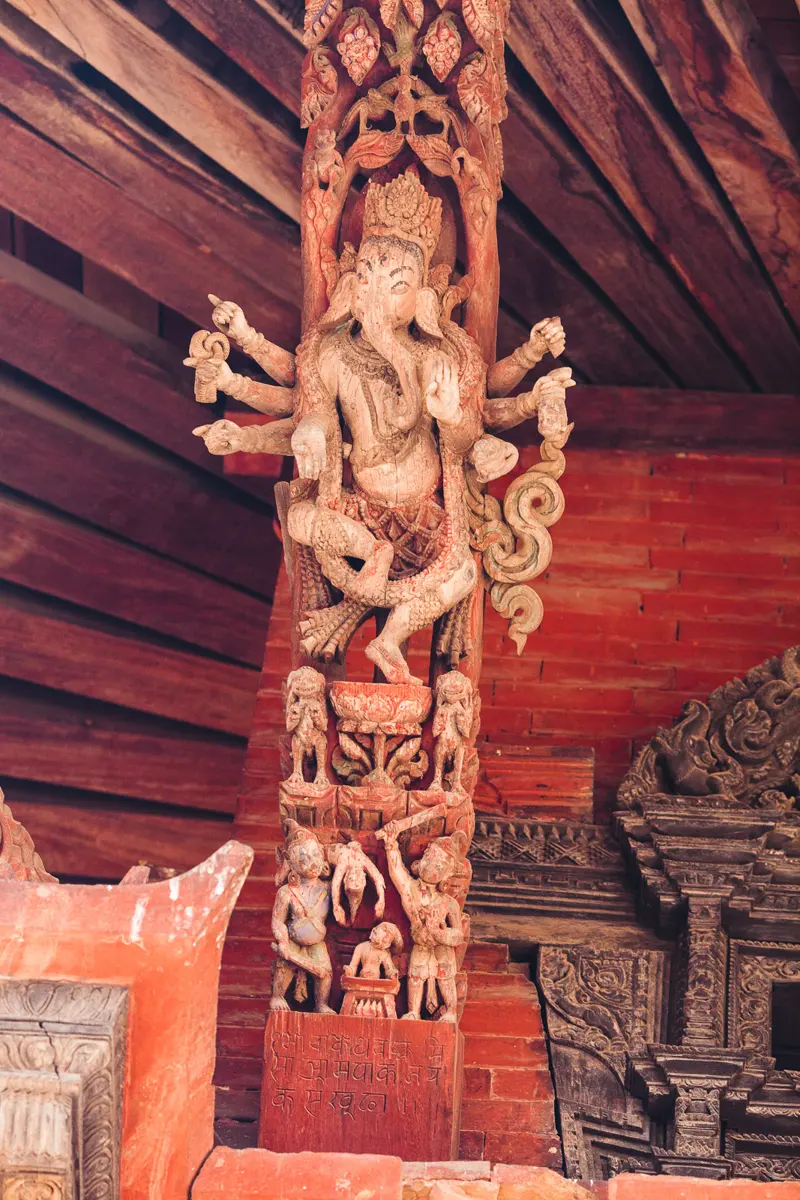
Most struts are carved the same way. Most of the length is one large figure, usually a god or goddess. Below it, at the foot of the strut, is a small panel of smaller, livelier figures: holy men, a musician, the god of wealth. In the oldest struts, the figure is a young woman held up by a dwarf seated at her feet, as at Uku Bahal. There she is a शालभञ्जिका (śālabhañjikā), “the one who breaks the branch of the sal tree”, a tree spirit reaching for its fruit and flowers. Every fruit, flower and leaf is carved with care, on the sides of the strut as well as the front.
The gods on later struts often have many arms, sometimes sixteen. Arms reaching that far out are the first thing to be lost. On many old struts, arms are missing, or newer ones have been fitted. Struts have been moved, too, from one building to another, and shortened or lengthened to fit; at a monastery in Kathmandu, Itum Bahal, some show the cuts. And the bright paint many of them wear now is mostly not old at all. Painting struts seems to have begun only about the end of the nineteenth century.
To see these figures close up, the Your Town’s Past guides say how to look at the struts of a temple near you, and where to find struts you can see at eye level.
Windows, doors and the torana
A Newar window looks like one piece of carving. It is really many pieces, cut separately and fitted together, traditionally without metal nails or glue. Joints hold it: a tongue cut on one piece slides into a slot cut in the next, and where a joint needs locking, a wooden peg is driven through. A cross-shaped joint lets two pieces cross and lock into each other. So a frame can be taken apart and put back together.
Doors are made the same way, with one leaf or two, of a softer wood where they are sheltered from sun and rain. Their frames are carved with signs of good fortune: flowers, gods and goddesses, the Buddha’s eyes, fish, and the water pot called कलश (kalaśa).
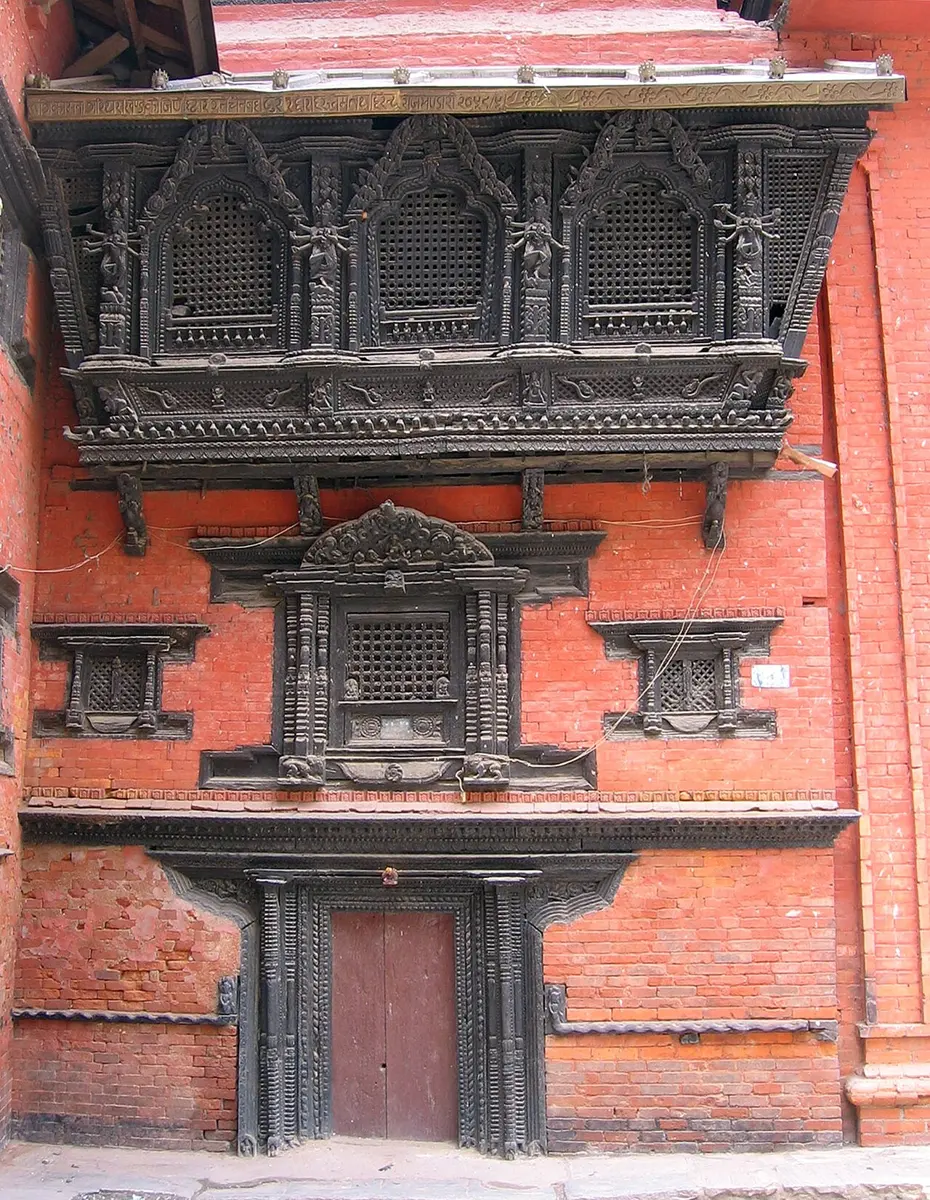
The lattice is cleverer still. The fine grid of a latticed window isn’t carved out of one board. Three kinds of thin strip are sawn from a plank, each carved with its own pattern, and the strips are slotted into one another, at right angles or at 45 degrees. Then the finished grid is fitted tightly into the window frame, so tightly that it can’t be taken out without taking the whole frame apart.

Over a door or a window, or over the image in a shrine, there is often a half-round carved panel, the तोरण (toraṇa). Often a god sits in the middle, with a मकर (makara), a beast of the waters, curling up from each lower corner. The oldest known wooden one in the Valley is in Kathmandu, over the door of the main shrine of Yetakha Baha. Radiocarbon dates its wood between 900 and 1030. It is long and low, with the Buddha teaching among rocks and hills, the only torana known that shows a mountain scene, and it was probably made by one of the Sthapit, the Newar woodworkers. The Your Town’s Past guide to a torana says how to read the one nearest you.
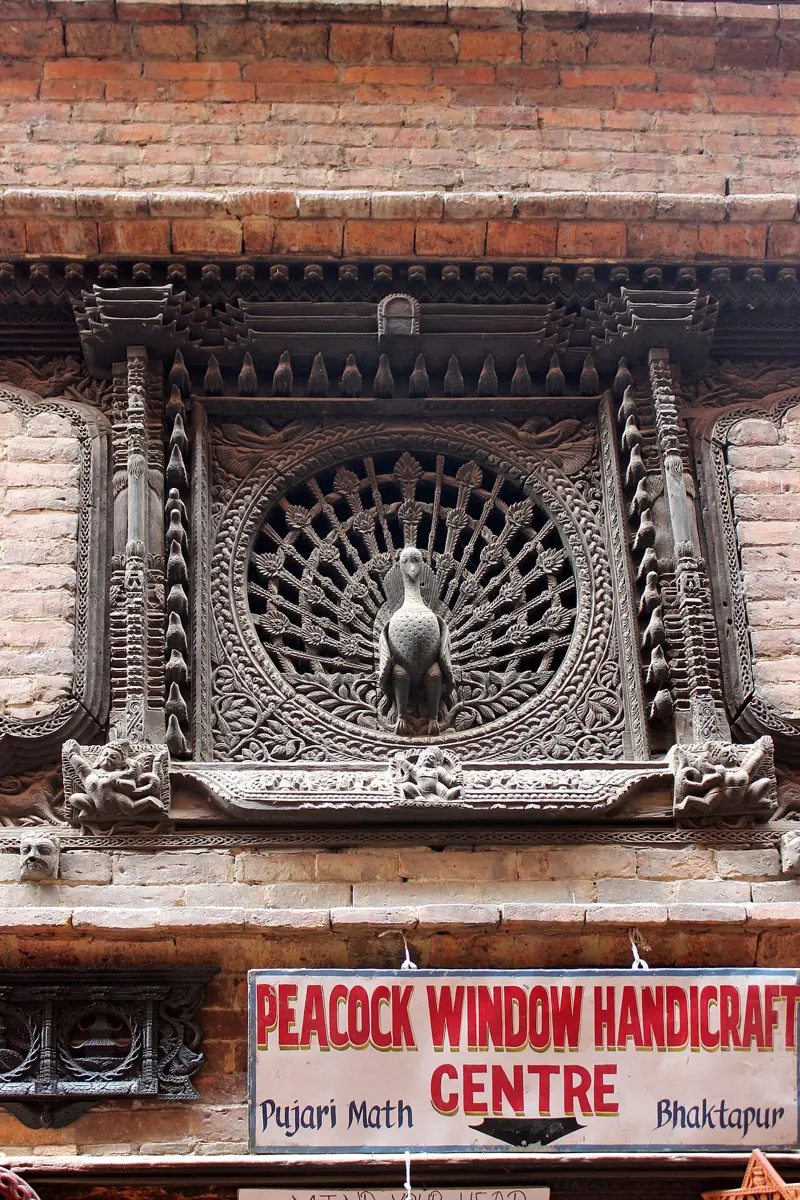
One window in Bhaktapur is famous enough to have a shop named after it. In a brick wall of the Pujari Math, an old Hindu monastery, is a small window whose lattice is a peacock. The bird stands in the middle with its tail spread out behind it in a circle, and the feathers of the tail are the bars of the window, carved through so that light and air come in between them. Around the circle, carved leaves fill the square frame, and rows of small birds sit along its sides. Nobody has yet settled when it was carved. Guidebooks give a century for it, but we have found no inscription or study that does, so the date is better left open. The building it is in was restored about half a century ago by the Nepali government with help from West Germany.
How old is old wood?
Radiocarbon dating is what changed the story of the Valley’s carving. Every living tree takes in a little radioactive carbon from the air, and once the wood stops growing, that carbon slowly decays at a known rate. Measure what is left, and you know when the wood grew.
But when the wood grew is not quite when it was carved. A tree grows outward, ring by ring, so the wood at the center of a big old tree was laid down in its first years, often a century or more before the tree was cut. A sample can come out as much as 200 years older than the carving. One scholar has also argued that carvers kept old timber for years before carving it. The carvers themselves say they always use freshly cut wood, after it has dried. So a radiocarbon date gives a carving’s earliest possible age, and the truth may be some years, or a century, later. Even so, the Uku Bahal struts and the Yetakha torana are older than anyone thought before they were tested.
The workshop today
In the earthquake of 2015, temples fell across the Valley, and their carvings came down with the beams. On Patan’s Durbar Square, Char Narayan and Harishankar collapsed. From the rubble of the two temples, 162 carved arms were rescued. Not all could be matched back to their struts: the 102 that couldn’t are now in the Patan Museum. Harishankar came back over four years from about 2,000 sorted and repaired parts, nine-tenths of the material its own. The posts and beams of its lowest story were first put together in a workshop, then taken apart and put up again on the temple’s own base. The struts of Char Narayan were restored with the help of old photographs.
The carvers who did it learned in their families. Indra Kaji Shilpakar learned as a boy from his father and uncle, with traditional tools. He draws each figure straight onto the wood, working from his grandfather’s drawings, and other carvers then cut out the details, before he or his son Indra Prasad finishes the finest work and fits the piece in place. A whole torana takes up to five months, and one carved panel beside a door or window five or six weeks. Working on the fallen temples taught them something about their ancestors too. The finest carving was put lowest, where people can see it best: a god might be on a first-floor window, a lion on the floor above, a bird above that, and only a small pattern at the top.
So a carving that must stand the weather is sal, dried for years, and every piece of it was cut down from something larger. A strut carries the roof and the gods together, the main figure above and the small scenes below; a window is dozens of pieces locked together with pegs and joints, its lattice slotted from strips. Wood, unlike stone, can be dated by its carbon, and the dates have shown that some carvings are far older than anyone thought, though a date tells when the tree grew, not when it was carved. Stone and wood are both carved by taking away. The Valley’s third great craft, in metal, works the other way, by building up a figure in wax.
Found a mistake? Please tell us.