
Beside the Minanath temple in Patan, next to a water spout called Tunga Hiti, stands a slab of gray stone. Its top half has worn smooth, and much of the rest is broken off in the middle of sentences. But near the bottom, where the letters can still be read, is an order about a canal. Its water, it says, is to be divided into seven parts. One part goes to the village council of Gigval, one to the council of Jajje, one to the council of Tegval, three to the councils of Yugval, and the last to a council whose name is lost. Anything to do with the canal is to be decided by the king’s own court. Nobody may break the order, and future kings are asked to keep it.
The stone was set up in the year we call 724, under one of the last Licchavi kings. In a few lines it says a great deal. There were villages in the Valley that ran their own affairs through councils. Water was precious enough to be counted out in shares and argued over. And when villages couldn’t agree, the king stepped in, and the answer was cut in stone where everybody could see it.
Most of what we know about ordinary life in Licchavi times comes from stones like this one. About two hundred survive from मानदेव’s (Mānadeva’s) time to the end of the Licchavi kings, and they were not written to describe daily life. They are orders, gifts and boundaries. But an order about a canal has to name the villages that share it, and a gift to a temple has to say what the farmers owe it. Read together, the stones show how people farmed, paid, traded, prayed and drew their water, almost by accident.
A village and its stone
Picture the Valley in the 600s: rice fields on the flat land between the rivers, villages of farming families on the higher ground, and a few larger places, the royal palace among them, near Pashupati and in what are now Kathmandu and Patan. Besides rice, the stones mention garlic, onions and mustard seed. (You may have read that potatoes were grown then too. The potato came from South America, though, and reached India only in the 1600s, a thousand years later.) The stones call a village a ग्राम (grām) and a larger settlement a द्रङ्ग (draṅga). Most of the villages carried names in an older, non-Sanskrit language, like Theñco, Joñjodiṅ and Lembaṭi, which is today’s Lele, even though the stones about them were written in Sanskrit.
A village was run by its own people. The stones address “the households, with their elders in front”, and they mention councils called पाञ्चाली (pāñcālī), which settled small disputes and looked after land and temples, something like a village पञ्चायत. A village had its headman and its priest, and alongside them a whole web of local groups that kept things going, from temples to water spouts. Most of the time, the palace seems to have left it alone.
The palace reached the village mainly through its stones. A royal order of this kind, called a charter, followed a set pattern. It began with the king’s titles and the name of his palace. It greeted the villagers and asked after their health. Then it said what favor was being done: a tax lifted, a piece of land given to a temple, the village’s rights confirmed. It walked the boundaries of the land, landmark by landmark: from a sour mango tree to the spring of white earth, down a stream, past the place where cows were given salt, to where three villages met. It warned that anyone who broke the order would not be tolerated, and reminded future kings that a king who takes back a gift will be born a worm. And it was cut on a stone slab and set up in the village it spoke to.
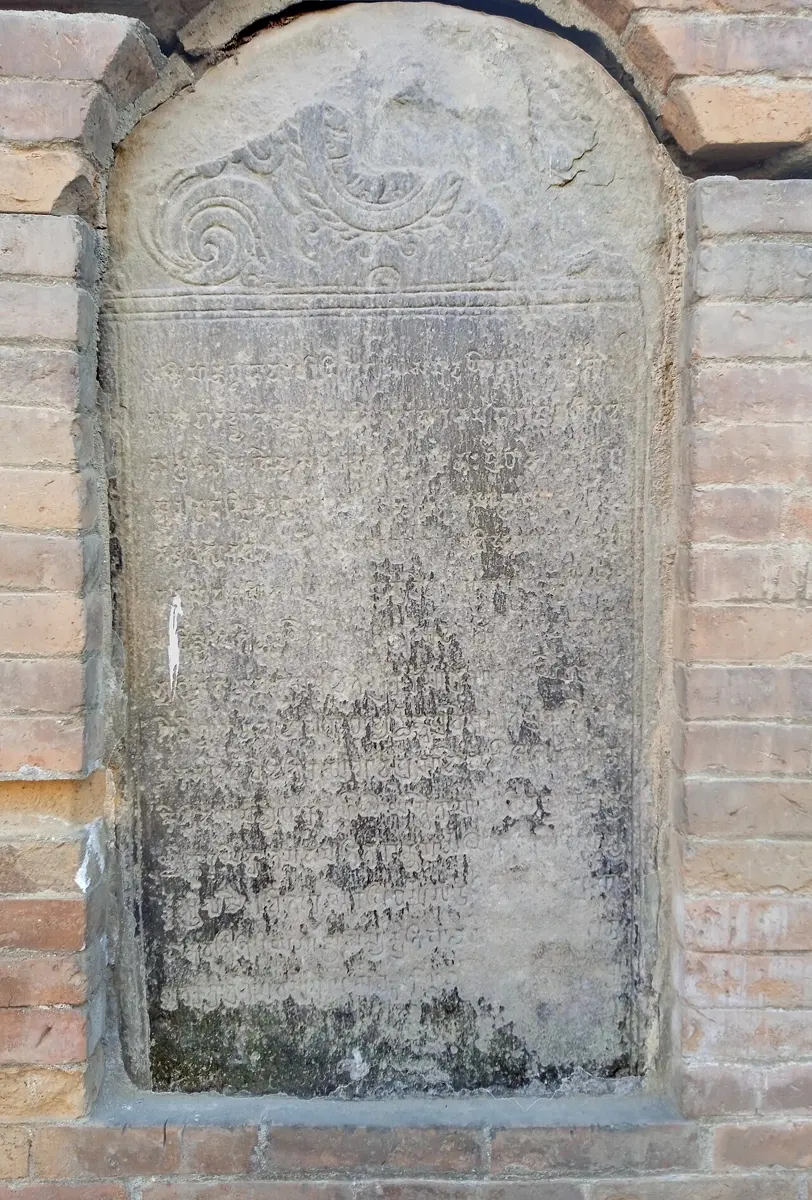
Nearly all these stones come from the Valley itself: Kathmandu, Patan, the villages around Thankot, Sankhu and Bhaktapur. A handful stand just outside it, at Lele, Banepa, Nuwakot and as far as Gorkha. Of the hills beyond and the Tarai, where people certainly lived and farmed, these centuries tell us almost nothing. Life in Licchavi times, as far as anyone can see it, means life in and around the Valley.
What the village owed
A farming family worked land that was mostly not its own. The king held land, and so did nobles, priests, temples and rich traders, and most land had tenants who paid part of their harvest to whoever held it. How large a part is not known: the stones give amounts of grain, but nobody can now say how big their measures were. One historian, Kamal Malla, puts it at anything from 40 to 75 percent of the crop. Another, D. R. Regmi, thought the stones’ measures too uncertain for anyone to say.
On top of the rent came what the stones call the three just and proper dues: भाग (bhāg), the king’s share of the crop; भोग (bhog), supplies sent to the palace; and कर (kar), taxes in cash and kind. Together they were the त्रिकर (trikar), the three dues. And beneath those three ran a long tail of smaller taxes, which turn up one by one as kings lifted them. One village was let off its tax on garlic and onions, another on cloth. A village on Sanga hill no longer had to send twelve jars of oil. Fishermen coming home from market paid a few copper coins less on each load of fish. A village near Thankot had its tax on bullfights halved.
Then there was work. The stones call it विष्टि (viṣṭi): unpaid labor that a village owed, most often carrying loads. Each village had to send men, and a stone that frees a village from carrying loads to a place called Phalanju shows how welcome that freedom was.
Behind all this stood the palace offices. Four turn up again and again, and their names are not Sanskrit, which has led some historians to think they were older than the Licchavis themselves. The कुथेर (Kuthera) collected taxes and looked after the king’s land. The शुल्ली (Śullī) dealt with serious crimes. The लिङ्ग्वल (Liṅgval) seems to have had charge of water and irrigation. The माप्चोक (Māpcok) handled family matters, marriage among them. Their men, and the king’s soldiers and messengers, called चाट (cāṭ) and भट (bhaṭ), were the faces of government a farmer actually saw.
And what villages most wanted from the king, judging by what he granted, was to see less of them. More than four orders out of five forbid royal officers to enter a village, except to collect the three dues or to deal with the five great crimes, theft, murder and adultery among them. A village so favored was raised to the status of a fort, and the officers had to stay outside. Many stones grant exactly that and little else.
It was a fair exchange, in the kings’ eyes, and the stones make it plain. One village built a large water spout for Narendradeva and did all the work without any cheating, the stone says. In return its people were freed from royal officers and from forced labor, and the king gave the village to the Buddhist monks of a nearby monastery. Even when one of its people committed one of the great crimes, only the guilty person went to the palace; his house and fields went to the monks.
The palace itself lived on all this. One order from 606, by अंशुवर्मा (Aṃśuvarmā), fixes what the palace staff were to be paid, so that nobody would be cheated in the sharing out. The list runs from members of the royal family and the army’s commander down to the coronation elephant and the coronation horse, the drummers and conch-blowers, the bearer of the king’s fly-whisk, the man who kept the water works running, the keepers of the south, west and north gates, and the sweepers. It is the closest thing we have to a picture of the Licchavi court at work, and it comes from a pay list.
Water, and the groups that kept it
The canal at Tunga Hiti wasn’t unusual. The Valley’s farmers grew their rice in fields fed by canals, and the stones name them constantly, as boundaries, as gifts, and as the subject of quarrels. Their word for a canal, तिलमक (tilamaka), is not Sanskrit either, a hint that people were digging canals in the Valley before the Licchavis came.
Villagers built and mended the canals themselves. When the people of Joñjodiṅ finished work on a canal, the king rewarded them by keeping out of their village the very office that looked after water, along with pack horses, loose bulls and carts. A village that had dug its own canal, it seems, didn’t want the king’s water men or anyone’s animals trampling over it.
Drinking water came from stone spouts, which the stones call प्रणाली (praṇālī) and which Newars today call हिटी (hiti). Water from canals, ponds and the ground was led to a sunken courtyard, where it poured out through carved stone spouts. People built them as acts of piety, often for the good of a dead parent. In 621 an official named Vibhuvarmā built one near today’s Rani Pokhari for his father’s sake. In 654 a man named Viṣṇudeva built one in Naksal, with a well and a device for drawing water, so that Brahmins could wash three times a day as their rules required. In Patan, a Buddhist nun built a spout “for the welfare of all living beings”, the stone says, and it doesn’t give her name. Givers often added land, so that the rent from it would pay to keep the spout in repair.
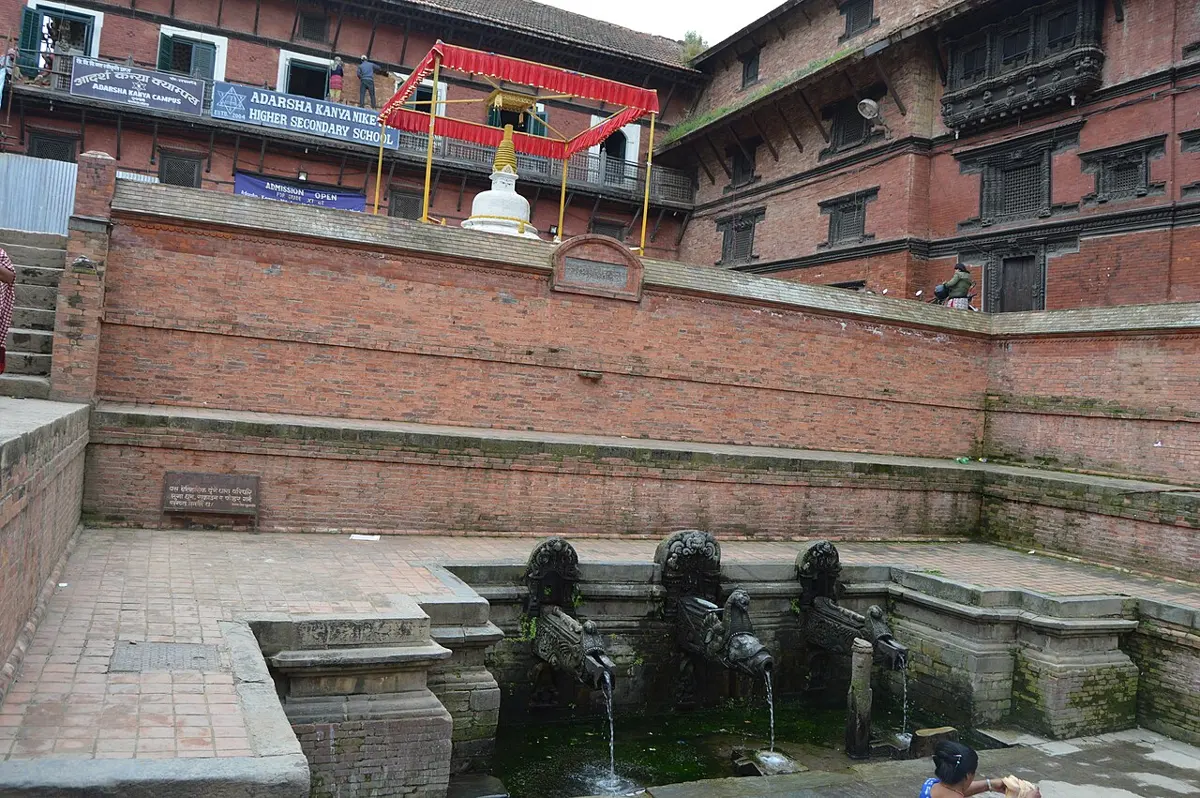
Some of these spouts still run. At Manga Hiti, beside the old palace in Patan, a stone says that a man named भारवि (Bhāravi) built a water spout there in the year we call 570, for his parents’ good and his own, and gave land to keep it. People still queue there with their water jars, though its flow has dropped in recent years. Across the Valley, a survey a few years ago found 479 old spouts, and water still ran from only 171 of them.
Who looked after all these spouts, temples and festivals year after year? Often a group of people who had joined together for that one purpose, called a गोष्ठी (goṣṭhī). One stone, set up at Lele in 604, gives fields to some twenty of them at once, and the list reads like a portrait of village life. There was a गोष्ठी for lamps, one for drinking water, one for keeping a water spout in repair, one for wrestling matches, one for musicians, one for flags, one for incense, and one for the worship of a particular god, as well as groups of Brahmins and, as one reading has it, a house for the sick.
The word lived on. In Nepali and Newari it became गुठी (guthi), and to this day guthis in the Valley’s towns keep temples, run festivals, and look after the land given to pay for them. A Newar family’s guthi, which meets to worship its god and share a feast, is a direct descendant of the groups on the Lele stone.
Trade over the passes
The Valley sat between India and Tibet, and its traders went both ways. One stone from 695 gives land to a group of priests and adds that the traders living on that land may take five porters a year, as unpaid labor, “for trade to Bhoṭṭa”, which is Tibet. Five men a year doesn’t sound like much, and plenty of trade must have gone by other ways, but it is the oldest written word of Nepali traders carrying goods over the northern passes.
Others went south. At Tistung, on the old path from the Valley down toward the plains, two stones of अंशुवर्मा from 607 deal with the customs paid by villagers who went out to sell goods and came home again. They name iron, fly-whisks made from yaks’ tails, deer hair, musk and copper vessels. The worn lines are read in more than one way, as goods freed from customs or as goods that could not be taken out of the country at all, but either way these were what crossed the hills. Musk and yak tails came from the high Himalaya and Tibet, and the Chinese heard that Nepal had copper of its own. Customs on iron, musk, fly-whisks, copper vessels and mustard seed turn up in other stones too.
The kings watched over honest trade, too. A stone of Narendradeva from 679 hands a Buddhist community the market tax of its village and the fines for false weighing scales, collected in the extra month. The old calendar added a month every two or three years to keep in step with the seasons, and on the stones the extra month is always an असार or a पुस. You may have read that scales were checked twice a year, at the end of असार and पुस; the stones put the checking in those extra months, which came only every few years.
A Chinese traveler’s account says the people of Nepal had many traders and few farmers, and that their coins were copper, with a man on one side and horses and cows on the other. The stones, with their endless fields and canals, show a land of farmers. Both can be true: an envoy staying near the palace would have met the traders, not the people planting rice in the villages. Rich traders show up in the stones too, as donors. In 480, the leader of the merchants, a man named रत्नसङ्घ (Ratnasaṅgha), set up a Shiva linga near Pashupati and gave land to pay for its worship.
Gods, monks and women
Ratnasaṅgha’s name is a Buddhist-sounding one, and he set up a Shiva linga. That mixture runs through the whole period. The kings mostly worshipped Shiva or Vishnu, and called themselves devotees of one or the other, but they gave land to Buddhist monasteries as freely as to Hindu temples. The Chinese pilgrim Xuanzang heard that in Nepal monasteries and temples stood wall to wall, with more than two thousand monks. The boundary of Narendradeva’s gift to the monks, walked out on the stone, passes the walls of six monasteries one after another. A couple named Maṇigupta and Mahendramatī set up an image of Avalokiteśvara, the bodhisattva of compassion, for the good of all living beings. Nobody on these stones seems to think it odd that a king devoted to Shiva should look after monks, or a merchant with a Buddhist name after Shiva.
The stones speak of festivals, too, though not by the names we use now. One of Narendradeva’s gives rice and money for a god’s yearly day at a town in the Valley, when everybody living there, “from the Brahmins down to” the lowest, was to be fed, and for a flag at its bullfights; it names a festival of Varāha as well. Another asks a village to hold a celebration for Pashupati and raise a fine umbrella over him. You may have read that Dashain, Tihar and Tij were kept then. The stones we read don’t name them, which doesn’t mean nobody kept them; it only means that how far back they go can’t be told from these stones.
The kings presented themselves as keepers of the Hindu order of four castes, the वर्ण (varṇa): one stone praises a king for having put “all the caste groups” in good order. The stones are mostly the voice of that order: kings, Brahmins, nobles and rich donors. The farmers and porters whose names were older than the Licchavi kings appear in them only as the people a grant was about. You may have read of eighteen castes as well. The only such eighteen is on one stone, वसन्तदेव’s (Vasantadeva’s) gift of a village to his sister जयसुन्दरी (Jayasundarī), which greets the Brahmins and “the eighteen प्रकृति (prakṛti)”. Who they were is argued over. Some historians have read them as castes. Regmi argued that they were eighteen kinds of officials and authorities, as in Indian charters of the time, not castes at all, and Malla took them as peoples living at the edge of the caste order.
Women appear on the stones more often than you might expect, and nearly always as givers. In 540 a woman named आभीरी (Ābhīrī) set up a linga in the temple of Pashupati for her dead husband’s sake, “by her son’s permission”. अंशुवर्मा’s sister, भोगदेवी (Bhogadevī), set up a linga for her husband, and her daughter set up another. The village वसन्तदेव gave his sister went to her and to her descendants after her. And there was the unnamed nun who built a water spout in Patan. These are women of the court and of rich families; what life was like for a farmer’s wife, no stone says.
One damaged stone of the 630s lays down rules for women whose husbands had died or left home for good. It takes for granted that such a woman might choose another husband, and then sets out when the Māpcok office could take charge of her and of her property. It is written about women, by men, and the worn lines make its details hard to read, but it shows that remarriage was ordinary enough to need rules. The pillar of मानदेव speaks of his mother’s wish to die on her husband’s funeral fire, and of how her son kept her from it; no other stone of the period is known to mention that custom.
The Chinese accounts add what the stones leave out, the look of daily life. Houses were built of wooden planks, their walls carved and painted. People ate with their hands from copper vessels, and bathed several times a day. They loved games, and music of conch shells and drums, and many of them were skilled at working out the calendar. Every day they washed the images of their gods with clean water. Even Xuanzang, who thought little of the Nepalis he had only heard about, allowed that they were skilled craftsmen.
The stones agree about the crafts, if only by accident: they speak of brick temples with wooden doors and windows, of stone spouts and images of the gods. The brickwork, carved wood, spouts and carvings that still stand around the Valley were the work of craftsmen whose names nobody wrote down.
So life in Licchavi times, as the stones show it, was village life. Farming families grew rice on canal-fed fields, paid a share of their harvest and a string of small taxes, and carried loads when the palace asked. They ran their own affairs through councils and groups that kept their temples, spouts and festivals going, the ancestors of today’s guthis. Traders carried musk, yak tails and copper between Tibet and the plains. Hindus and Buddhists worshipped side by side, and women of rich families gave gifts in their own names. What the stones can’t show is the life of anyone who couldn’t pay to have a stone cut, and that was most people.
Found a mistake? Please tell us.