
Inside the great white dome on the hill of स्वयम्भू (Svayambhū), where nobody can see it, there is a rock. It sticks up out of the hilltop a little more than three meters, and the dome was built over it and around it, so that it is now completely buried. Standing on the rock is a tree trunk. It is a single pole of sal, about twenty-two meters long, and it runs up through the middle of the whole monument, out through the top of the dome, and on up into the gilded spire you see from the city. The rock can’t be seen, because it has been inside the dome for as long as there has been a dome, and the pole now in place was put there in 1817. Both are known from old drawings, from the records of the people who rebuilt the monument, and from simple measurement: the pole is too short to reach the ground.
That buried rock and that hidden pole are a good way into a different kind of holy building from the tiered temples of Chapter 7. A tiered temple is a room for a god, wrapped in brick and timber and hats of tile. A stupa has no room at all. It is a solid thing, meant to be walked around, not entered. And the Valley has a third kind too, the tall pointed tower called a शिखर (śikhara), built of stone. This chapter is about those two, and about the courtyards where many of the Valley’s small stupas stand.
A hill, a rock and a pole
The oldest stupas in India were mounds of earth heaped over the ashes of the Buddha or of a great teacher. The shape grew from there. A dome is what a heap becomes when it is built carefully, and it was later given a stone or brick skin and a path around it, so that people could walk round it as a way of showing respect.
In Nepal the word used is usually चैत्य (caitya), and स्वयम्भू is the most important of them all. Here are its parts, from the bottom up. First the hill itself, a mile or so west of old Kathmandu. Then the dome, solid, white, almost eight and a half meters high, with small shrines set into its sides. On top of the dome sits a square block about five meters high, the हर्मिका (harmikā). On each of its four sides is painted a pair of eyes. The curl between them that looks like a nose was added only in the early twentieth century.
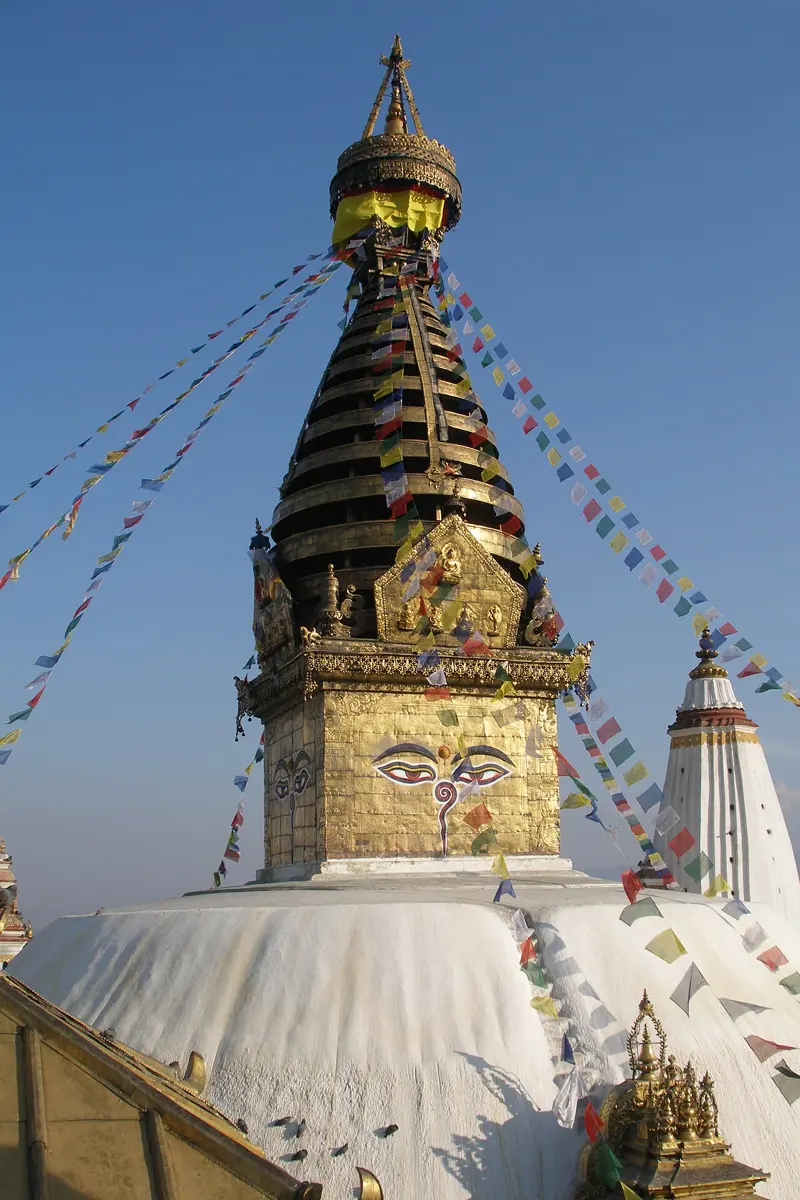
Out of the हर्मिका rises the upper part of the great pole, the यष्टि (yaṣṭi), and around it are stacked thirteen gilded rings, getting smaller as they go up. Above them comes the finial, the गजुर (gajur) again, and over everything a parasol, the छत्र (chatra). The pole rises almost twelve meters above the हर्मिका, so the whole thing stands more than twenty-five meters tall.
Then there is the way you use it. You don’t go inside. You walk round it, keeping it on your right, which means going clockwise. At स्वयम्भू, people are already doing it in the early hours, as part of their daily worship.
Now the surprising part. A tiered temple can be taken down and put back, beam by beam. A stupa looks as if it could never be taken apart, but स्वयम्भू has been, again and again. Records that begin in the thirteenth century show that, from then until the nineteenth, it was rebuilt on average twice a century. Everything above the dome was taken down, the dome itself was cut open, and the old pole was pulled out and a new one set on the rock. The tree had to be a sal some twenty-five meters tall, and trees like that don’t grow in the Valley; it was found in the valley of the Trishuli river or one of its streams, beyond the hills. By 1817 such trees were already rare, which is why the renovations of the twentieth and twenty-first centuries left that year’s pole in place. The monument also grew: it reached its present size only in the seventeenth century, when it was made about a third bigger. The rock was inside it all along.
Why rebuild something that hadn’t fallen down? Not every stupa holds relics, and the old records of स्वयम्भू mention no relics and no relic chamber at all. What makes a चैत्य holy, in the Newar Buddhist way of seeing it, is ritual: the long ceremonies that consecrate it. That holiness is thought to wear thin with time. So the monument is renewed, and the ceremonies are performed again, and the building and its meaning are made new together.
Boudha
The other great stupa of the Valley stands east of the city at बौद्ध (Bauddha), also called खास्ति (Khāsti). It sits on a wide stepped base with many corners, so that from the air it looks like a star round a white circle.

In 1963 the ring of houses around it was all there was, with rice everywhere else. Now the city reaches it on every side.
The earthquake of April 2015 left the great dome of बौद्ध largely whole, but it badly damaged the gilded tower on top. Within about a year and a half the tower was rebuilt and the stupa reopened, and the government didn’t pay for it. Buddhist groups and local and foreign donors gave more than two million dollars, and about thirty kilograms of gold to cover the spire and its thirteen steps, and local volunteers did much of the work. Not everyone was happy. A new concrete platform was laid on top of the dome during the work, and experts from the United Nations worried that it might be too heavy; UNESCO’s representative said they hadn’t been asked.
Small chaityas, and what Ashoka left
The great stupas are only the biggest of a crowd. Walk through any old part of Kathmandu, Patan or Bhaktapur and you will pass small चैत्य at corners, in courtyards and half sunk into the road, most of them of stone. A group of volunteers, Chiva Chaitya, began recording them a few years ago. By 2021 they had listed more than 1,300 and thought the Valley had more than 4,000.
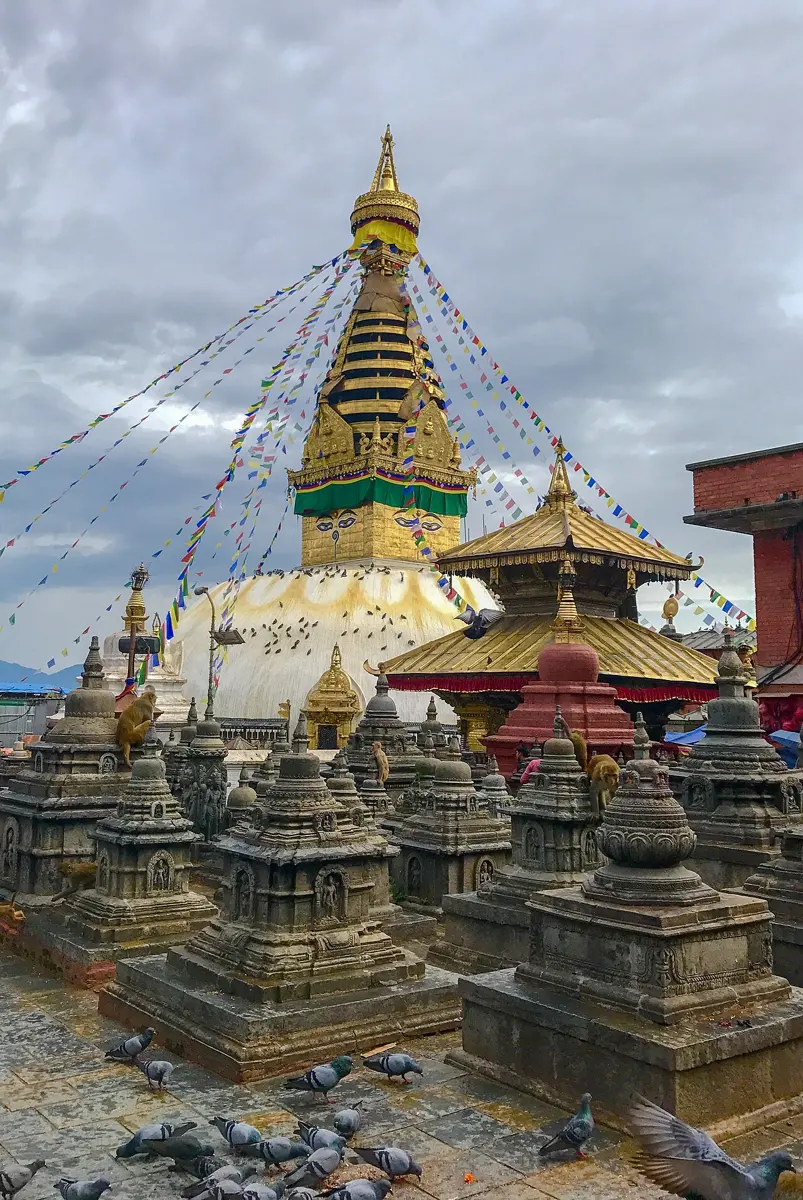
Many were built in memory of someone, and they are worshipped at the moments of a life: on the anniversary of a death, and at a जंको (janko), the ceremony held when an elder reaches a great age. The earliest were plain earth; later ones carry the five Buddhas and a गजुर. One at Thahiti in Kathmandu was built in 1432 by a man named Megharaja Shilpakar, on top of an old water spout. It has all the parts of स्वयम्भू, the five Buddhas, the हर्मिका, the thirteen rings, the umbrella, at a size you can walk round in a minute. The danger to these small ones is mostly not earthquakes. It is roads: at Dallu in Kathmandu, layers of asphalt had buried half of one before the volunteers dug it out.
At the four edges of Patan stand four plainer mounds, at Pulchowk, Lagankhel, Ibahi and Teta. They are known as the Ashoka stupas, after Ashoka, the Indian emperor who spread Buddhism across his empire in the third century BCE. The story is that he came to the Valley himself and built them to mark the four sides of the city. Nepal’s Grade 9 textbook says that Ashoka is believed (मानिन्छ) to have brought the stupa to Nepal, and then that Patan’s Ashoka stupa is the oldest in the country. Nepal’s tourism board is more careful: it says they are “supposed to have been built by Emperor Ashoka of India in 250 BC”.

So what can be shown? Very little. A mound of earth and brick doesn’t carry its own date, and no inscription or dig that we know of dates these four. Historians who have looked at them disagree. One thinks they were raised when Patan itself was founded, near the end of the 300s CE, some six hundred years after Ashoka. Another points out that the many Indian and Sri Lankan records of Ashoka never mention a journey to Nepal, and wonders whether the mounds are older still, holy places from before Buddhism came. There is one real clue elsewhere in the Valley, though. In 2002 and 2003, while the Chabahil stupa on the way to Boudha was being repaired, workers found bricks with writing on them. One, now in the National Museum, reads “Charumati’s stupa” (Caruvati thupa) in the Brahmi script. The historian Kashinath Tamot dates it to the third century BCE because its letters look like those on Ashoka’s pillar at Lumbini. Charumati, in the old chronicles, is Ashoka’s daughter, who married into the Valley. Tamot himself puts it carefully: the brick “lends credence” to the stories of Ashoka’s journey. It shows that someone wrote that name, in that kind of script, on a stupa’s brick. It doesn’t show that the emperor came, and it says nothing about the four mounds of Patan. Tradition and evidence can both be honored, as long as you can tell which one you are looking at.
A tower of stone
The third shape is the शिखर, the tower. Nepal’s Grade 9 book describes it plainly: tall and pointed like a mountain peak, narrowing steadily from the bottom to a point at the top, and with no roof, because the tower itself is the roof. The style is older in India; in the Valley, most of the शिखर temples were built in the seventeenth and eighteenth centuries, under the Malla kings.

The finest of them stands in Patan Durbar Square, the Krishna Mandir, built in 1637 for King Siddhinarasimha Malla. Most temples of its time were brick and wood; this one is stone. It is not a single tower but a cluster. Two stories of open galleries, with rows of slender stone pillars, carry little pavilions with pointed tops, twenty-one spires in all, and from the middle rises the main tower. Krishna’s shrine is at its heart, and the floors above it are said to hold Shiva and the Buddha. Run your eye along the stone beams above the pillars of the two galleries and you are reading the Mahabharata and the Ramayana, scene after scene, carved into them.
A building like this stands in a different way from a tiered temple. There is no frame of timber to bend and creak and spring back. As far as anyone outside can tell, each stone is held in place mostly by weight, its own and that of the stones above, the squeeze of Chapter 6, and at the corners the stones are tied together with stone clips. Surya Bahadur Ranjitkar, the sculptor who worked on its repair, noticed that the clips are shaped like the locking joints used in wooden temples. The builders took a carpenter’s idea and carved it in stone.
In 2015 the Krishna Mandir stayed up, but it didn’t come through untouched. The damage was worst on the floor above Krishna’s shrine. Pillars cracked, and so did the big cornerstones that carry the floors above; at one corner the stone was simply gone. The Kathmandu Valley Preservation Trust, working with its own engineers and craftsmen from Patan and Bhaktapur, decided not to take it down and rebuild it. Instead they propped it up and changed the broken stones one at a time, some of them more than two feet long, each one given two or three weeks to settle into lime mortar before the next was touched. It took about eighteen months. A tiered temple can be taken apart and pegged back together; a stone one is mended a stone at a time, under its own weight.
Courtyards
The last kind of building in this chapter isn’t a monument at all, but it holds a great many of the Valley’s चैत्य. A बहाल (bahāl), or बहा (bahā), is a courtyard you reach through a low gate from the street. It began as a Buddhist monastery, a home for monks, like the monasteries of India it was copied from. But by the twelfth and thirteenth centuries, monks who never married had faded out of Nepal, and the monasteries passed to their descendants, the Shakya and Vajracharya families, who kept them as family property and still look after them.
As buildings, they keep a monastery’s plan. There is an open courtyard, paved, usually with a चैत्य in the middle. Facing the gate across the courtyard is the main shrine building, often with a carved wooden arch over its door. Around the other sides are the houses of the families. Kwa Baha in Patan, founded in the eleventh century, has all three of the things such a monastery must have: a चैत्य, a shrine that anyone may visit, and a secret shrine open only to the senior initiated members. Its चैत्य, in the middle of the courtyard, is a copy of स्वयम्भू, sheltered by an open tiered roof of its own.
A बही (bahī) is the other kind. One study of Patan’s monasteries describes it as usually smaller and probably the older form, built at the edge of town rather than among the houses, raised on a plinth, and marked by a small lantern-like structure on the roof of its shrine. Tha Bahi in Kathmandu is one of the oldest. Tibetan sources say a monastery was built there in 1041 on the advice of the teacher Atisha, who stopped in the Valley on his way to Tibet, on foundations that were already hundreds of years old.
A बहाल is a family’s home as well as a holy place, so go quietly. The Your Town’s Past guide to a बहाल says what to look for, and its guide to a small चैत्य how to find out whom it remembers.
Put together, the Valley’s holy buildings come in three main shapes, each built differently. A tiered temple is a room for a god under stacked roofs of tile, held up by brick and timber. A stupa is a solid mound to walk around, built over something buried, a rock at स्वयम्भू, perhaps relics elsewhere, and renewed again and again with new materials and new ceremonies. A शिखर is a tower of stone, held up by its own weight and mended a stone at a time. Around all three stand thousands of small चैत्य, most of them made in memory of someone. Some of their stories are old tradition and some can be shown, and it is worth knowing which is which.
Found a mistake? Please tell us.