
One day, the Greek writer Herodotus tells us, the Persian king Darius called in some Greeks who were with him and asked them how much money it would take to make them eat the bodies of their dead fathers. No amount at all, they said. Then he called in some Indians, of a people called the Callatiae, who, Herodotus says, did exactly that with their dead, and asked them, with the Greeks listening through interpreters, what it would take to make them burn their fathers instead, as Greeks did. The Indians cried out and begged him not to say such a thing. Herodotus drew a lesson from it: everyone is sure that their own customs are the best. Custom, he wrote, quoting a poet, is king of all.
Whatever the truth of the story, think about the room it needs. A Persian king, Greeks and Indians under one roof, with interpreters to carry the words across. Around 500 BCE that room really existed, because one empire stretched from the edge of Greece to the Indus. What follows is the story of that empire, of the small Greek cities on its western edge that fought it off, and of what those cities did next.
Here is the whole story in a few lines. In the 500s BCE the Persians, from the south-west of today’s Iran, built the largest empire the world had yet seen, from Egypt and the Aegean Sea to the land of the Indus. Its kings ruled through governors, roads, and armies of clerks, and they left their own words in stone and clay. On its western edge lived the Greeks, in hundreds of small, quarreling cities. When the Persians invaded Greece, twice, the cities beat them. One of those cities, Athens, then ran itself for almost two centuries as a democracy, the first well-recorded one, in which ordinary citizens debated and voted on everything. But only men born to Athenian parents counted as citizens: women, slaves and foreigners had no say, and much of the work was done by slaves. Its rival, Sparta, was ruled by soldiers who lived off a large population of enslaved farmers. Finally Alexander of Macedon, from the north of Greece, conquered the whole Persian empire, marched as far as the rivers of the Punjab, and turned back there.
Persia, in its own words
Most of what Europe has long known about the Persians came from their enemies, the Greeks. But the Persians wrote too, and their own records show an empire that saw itself rather differently.
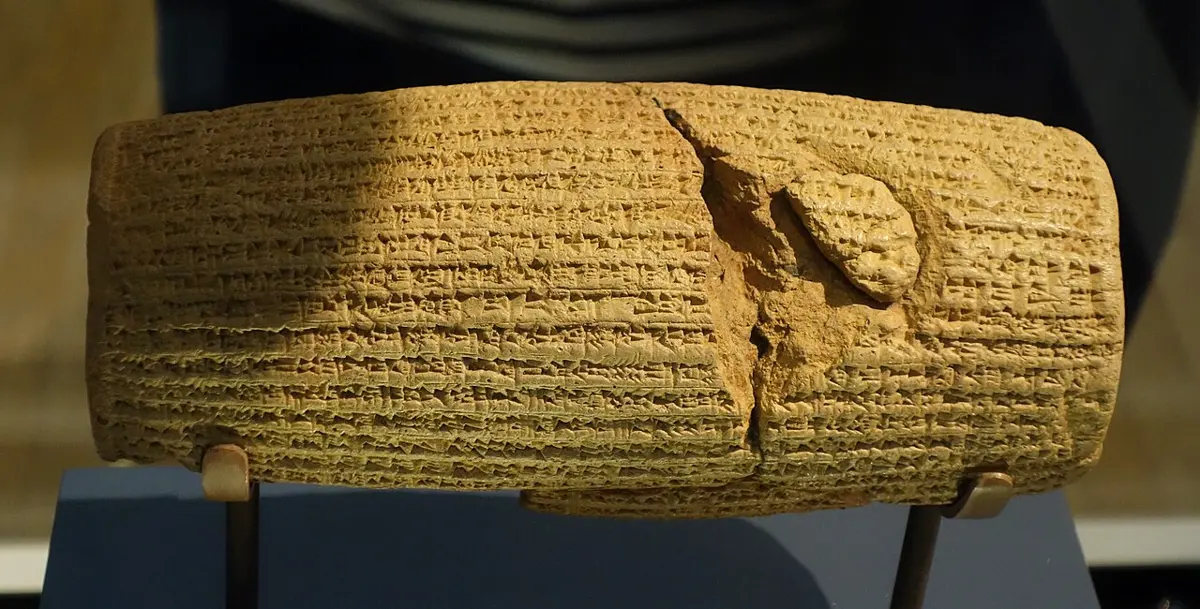
The first great king was Cyrus. When he took Babylon in 539 BCE, a clay cylinder written in Babylonian was buried in the foundations of a building in the city. It says that the city’s own god, Marduk, had grown angry with the last king of Babylon, who had brought ruin on his people “by a yoke without relief”, and had searched all the lands for an upright king. Marduk took the hand of Cyrus and called him by his name. Cyrus entered Babylon “without fighting or battle”, and his great army marched through it in peace, so that nobody had anything to fear. “I am Cyrus, king of the universe,” it says. He sent the statues of gods back to their own temples in other cities, and gathered their peoples and returned them to their homes.
In 1971 Iran’s last Shah called the Cylinder the world’s first charter of human rights, and a copy stands at the United Nations. Most historians disagree. It is written wholly in Babylonian terms, as a building inscription of a kind Babylonian and Assyrian kings had long made, a new king’s advertisement for himself, and it says nothing about rights. But it isn’t empty boasting either. Sending deported peoples and their gods home was a real break with what Assyrian and Babylonian kings had done, and the Hebrew Bible remembers Cyrus as the king who let the exiles from Judah go home and rebuild their temple in Jerusalem. What the Cylinder shows is a conqueror who wanted to be seen as a restorer, and in part was one.
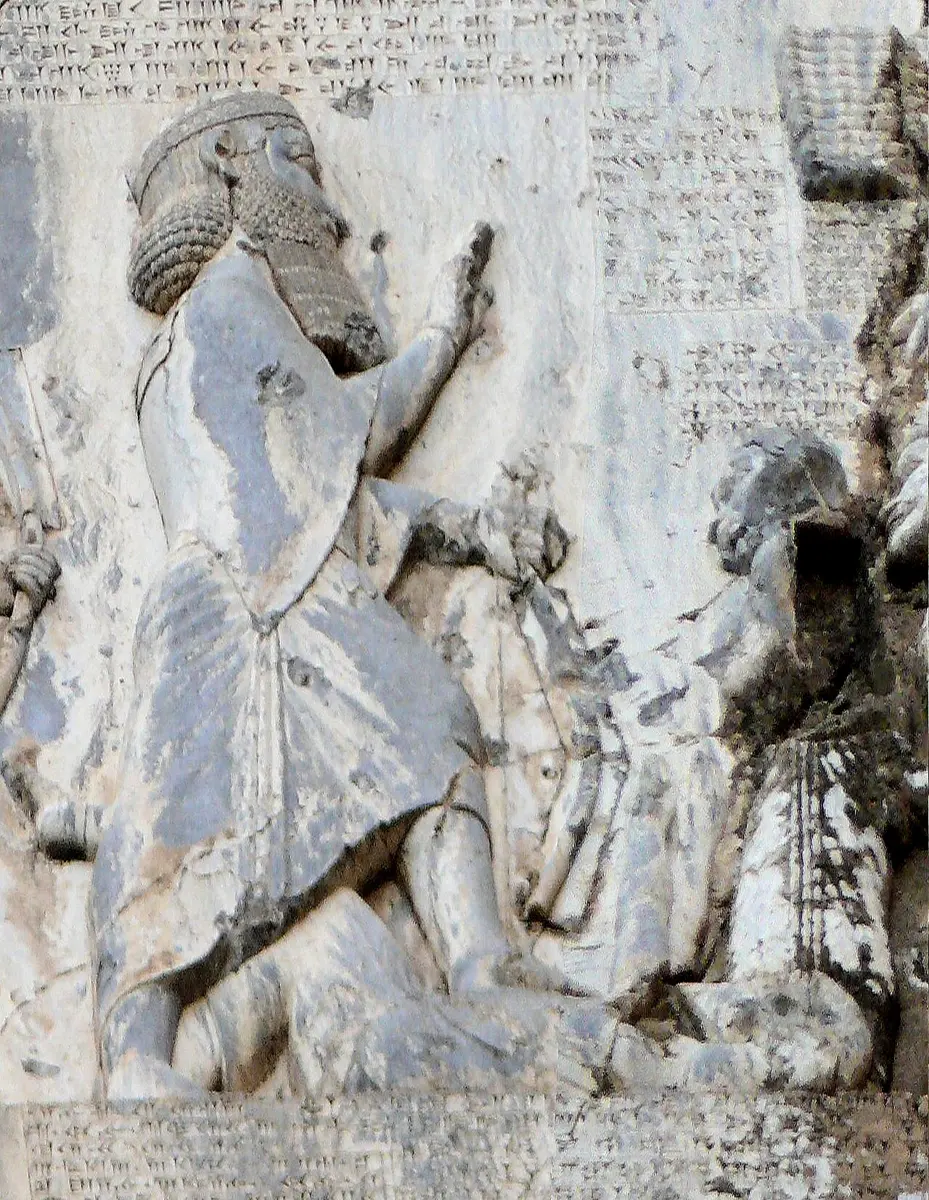
The empire’s real builder was Darius, who took the throne after a year of murder and revolt. He told his side of it on a cliff at Behistun, in western Iran, about a hundred meters above the road, in three languages. “I am Darius, the great king, king of kings,” it begins, and it lists the lands that obeyed him, twenty-three of them, from Egypt and the “Yauna”, the Greeks, to Gandara in the north-west of South Asia. Then it tells how a priest named Gaumata had claimed to be Bardiya, the brother of King Cambyses, whom Cambyses had secretly killed, how Darius killed the pretender, and how he then fought nineteen battles in a single year and captured nine kings. Over and over, the inscription blames one thing: the Lie. “Lies made them revolt,” it says. Darius tells the kings who will come after him to punish liars, and he swears that every word of his own is true: he was no liar and no tyrant, he says, and did no wrong “neither to the weak nor to the powerful”. He even had the text copied and sent to every province, and a copy in Aramaic, the empire’s everyday language of letters, has turned up in Egypt. Some historians wonder whether the man he killed was really an impostor, and not the true prince, with a better claim to the throne than Darius had. We have only Darius’s word.
How was such an empire run? Not only by the sword. In 1933, archaeologists from Chicago dug up tens of thousands of clay tablets and pieces of tablets in the fortification wall of Persepolis, the palace city Darius built. They are the accounts of the king’s storehouses from about 509 to 493 BCE, mostly in Elamite, a language of south-western Iran: food and drink paid out to workers, to the royal family and as offerings to the gods. They show women working beside men. For unskilled work women got about a third less food than men, but for skilled work the same as men of their skill, and some work groups were headed by women. A new mother got extra food, and the mother of a boy got twice as much as the mother of a girl. A royal woman of Darius’s court named Irdabama, whom no Greek writer ever mentions, ran her own estates with up to 480 workers and used her own seal.
Darius also left an account of how his palace at Susa was built, and it reads like a map of the empire. The cedar came from Lebanon, the gold from Lydia in today’s Turkey and from Bactria in today’s Afghanistan, the lapis lazuli from Sogdia in Central Asia, and the ivory from Kush, in Africa, from Arachosia and from India. Greeks and Lydians cut the stone, Medes and Egyptians worked the gold, and Babylonians baked the bricks.
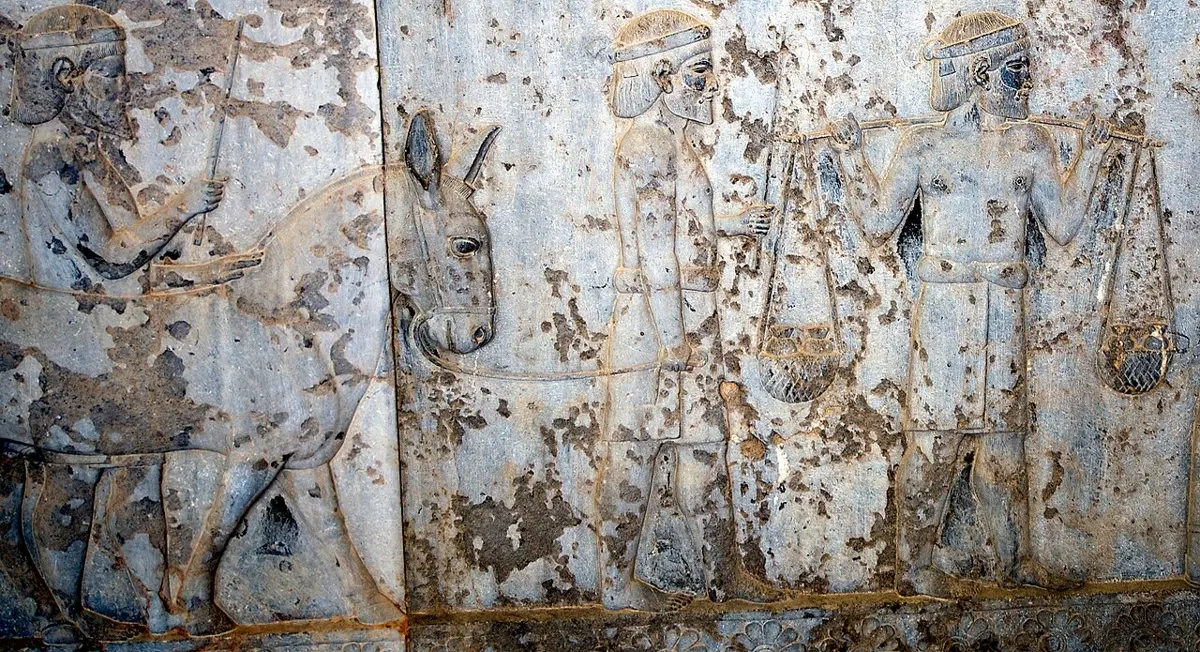
The Indus lands mattered. Darius sent a sea captain named Scylax down the Indus to find where it met the sea, then took the land. Of all the parts of the empire, which paid the king a fixed sum every year, the Indians, the twentieth province, paid the most of all: 360 talents of gold dust. A royal road ran from Sardis, near the Aegean, to Susa, in 111 stages with a rest-house at each, ninety days on foot. The Persepolis tablets show such roads from the inside: officials and messengers coming to Susa and Persepolis from India, Gandara and Bactria, fed from storehouses spaced a day’s journey apart. The king’s messages went much faster, passed from rider to rider with a fresh horse waiting at each day’s stop, so that “neither snow nor rain nor heat nor darkness” held them up.
The small cities that fought back
The Greeks never had one country. They lived in hundreds of separate cities, each with its own laws, coins and army, spread around the Aegean Sea and its coasts, and they shared a language and their gods but very little else. The Greek cities on the coast of today’s Turkey were inside the Persian empire, and around 500 BCE they rebelled. Athens sent twenty ships to help them. Those ships were the beginning of troubles for the Greeks and for the “barbarians”, the Greeks’ word for everyone who didn’t speak Greek.
Darius sent an army to punish Athens. In 490 BCE, at Marathon, the Athenians charged the Persians at a run and drove them back to their ships. The Athenians lost 192 men, the enemy about 6,400. Ten years later Darius’s son Xerxes came himself, with an army Herodotus put at well over two million. Historians who have worked out how much food and water the route could supply think a few hundred thousand at most, which was still enormous. Among them were Indians in clothes of “tree-wool”, as Greeks called cotton, with bows of cane. A small force led by Spartans held a mountain pass at Thermopylae for days and died there. The Persians burned Athens. Then, in the narrow strait of Salamis, the Greek fleet trapped and beat the Persian one, and the next year the Greek armies won on land. Persia never invaded Greece again.
The Persian empire itself went on for another century and a half. To the Greeks it was the great story of their age, the one Herodotus wrote his book to tell, and it left Athens with a fleet and the confidence to make itself a power.
Athens and Sparta
Here is how Athenian democracy worked, in its plainest form. Any citizen could come to the Assembly, which met on a hillside called the Pnyx. Anyone could stand up and speak: the herald opened each debate with “Who wishes to speak?” Then the citizens voted, on war and peace, on laws, and on much else. There was no parliament of elected members. The people governed themselves.
Most other jobs were filled by lot, like drawing names from a hat. Every year 500 citizens over thirty were picked by lot to sit on the Council, which prepared the Assembly’s business. Its chairman was drawn by lot too and served for one night and one day, never again, so that, by one estimate, about half of all Athenian citizens held that post at some point in their lives. Juries of several hundred citizens, sometimes over a thousand, also chosen by lot, decided court cases with no judge at all. Only a few posts that needed real skill, such as the ten generals, were elected. Citizens were paid for sitting on juries and the Council and later for going to the Assembly, so that a poor man could afford a day away from work.
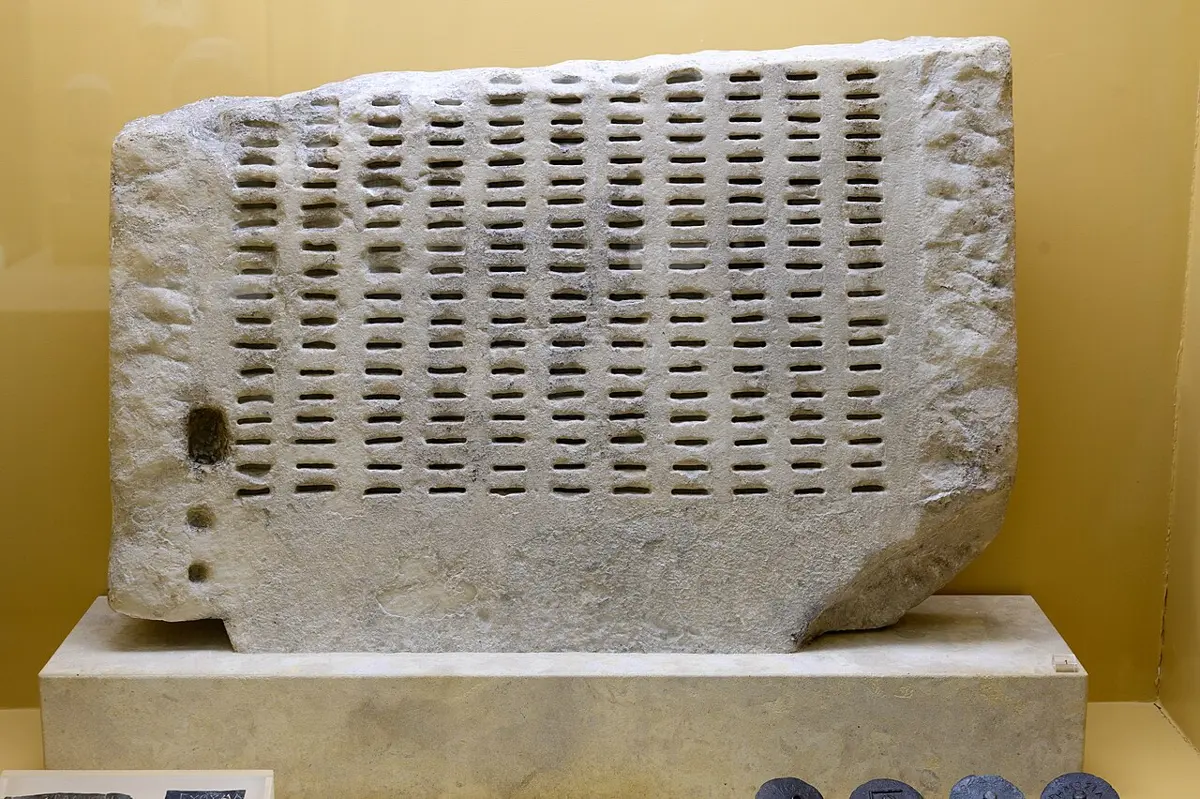
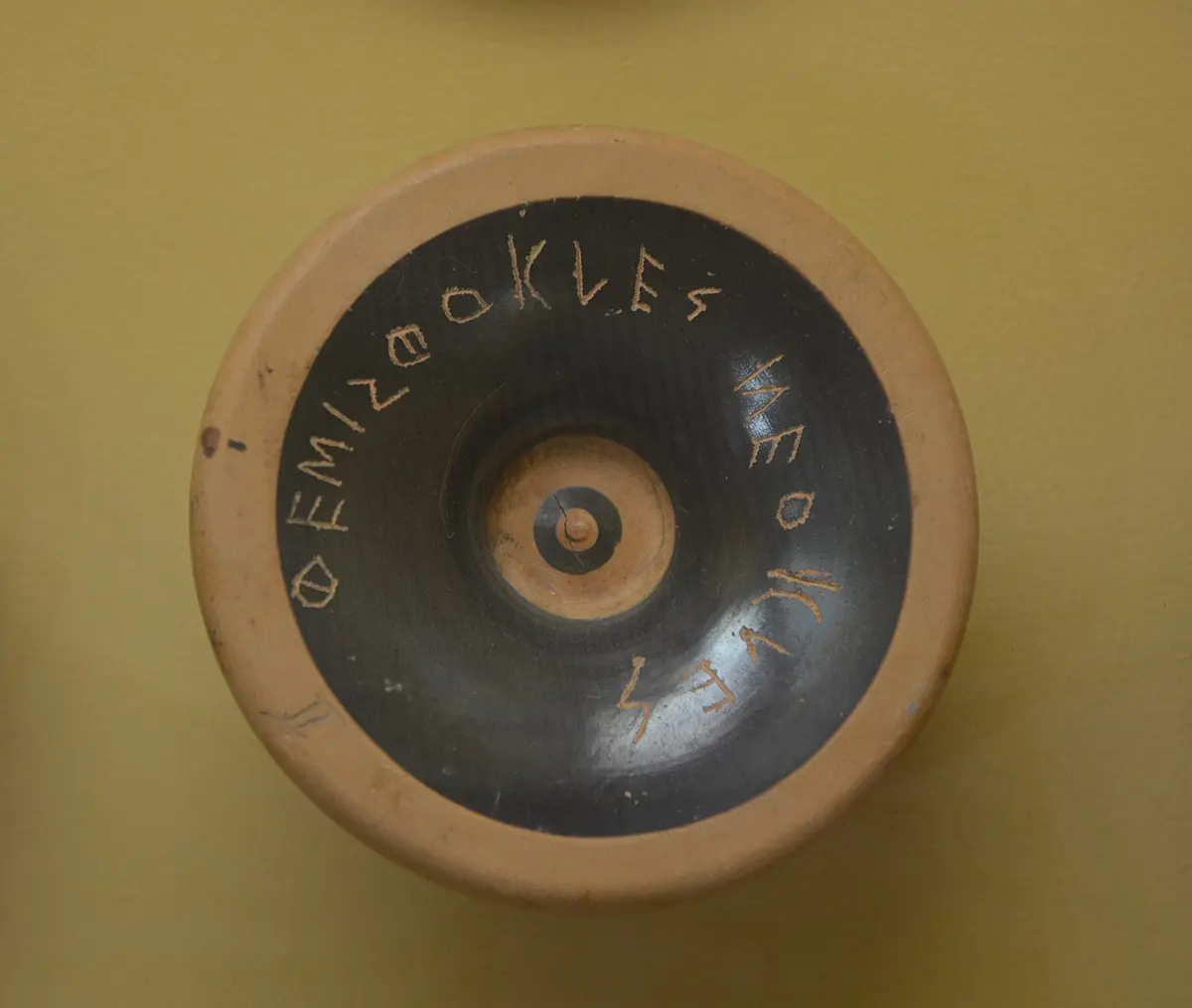
The Athenians had one more device: they could vote a man out of the city. Once a year they decided whether to hold an ostracism. If they did, each citizen scratched a name on a piece of broken pot, an ostrakon, and if a man got enough votes, 6,000 by one account, he had to leave Athens for ten years. It was meant to stop anyone growing powerful enough to make himself a tyrant. Archaeologists have found thousands of these potsherds, about 9,000 from the potters’ quarter alone, and in one well a whole heap of ready-made ballots with the same name, that of the general Themistocles. Someone, it seems, had prepared them for the vote.
Athens’s best-known leader, Pericles, described the city in a speech for its war dead, as the Athenian historian Thucydides gives it. The city was run for the many, not the few, he said, which was why it was called a democracy, and being poor did not bar a man from serving it.
The many were not everyone. Of the men and women living in and around Athens, only the adult men of citizen families could vote, and from 451 BCE only men whose father and mother were both Athenian. In the 400s BCE that meant perhaps 40,000 to 60,000 men.
Women had no vote and no office. An Athenian girl was usually married at fourteen or fifteen, without being asked, passing from her father’s house to her husband’s. Pericles had only one sentence for the widows in his famous speech: the greatest glory would be hers who was least talked of among men, for good or bad. Yet that was the ideal of rich households. Poorer women worked, some of them selling in the market. One man in a court case had to answer the sneer that his mother sold ribbons there and had worked as a nurse. Yes, she had, he said; in the city’s hard times many women of citizen families had become nurses, weavers and workers in the vineyards. Women also had religious festivals of their own.
Then there were the slaves, some of them captives of war, working in houses, on farms, in workshops and in the silver mines. Nobody counted them. Historians’ guesses run from 20,000 to more than 100,000. When an enemy army camped in the Athenian countryside during a later war, more than twenty thousand slaves ran away. There were also thousands of free foreigners, called metics, who lived in the city and could never vote.
Athens was not gentle to other Greeks either. After the Persian wars it led an alliance of island and coastal cities, who paid money each year for a shared fleet. Athens moved the treasury home and spent some of it on the temples of the Acropolis, the Parthenon among them. Its enemies at home complained that the city was dressing itself up with other Greeks’ money “like a wanton woman”; Pericles answered that the allies paid for protection, and got it. When the island of Melos refused to join, Athens besieged it, killed its men and sold its women and children as slaves. Before that, in Thucydides’ telling, the Athenian envoys told the Melians that between unequal powers, “the strong do what they can and the weak suffer what they must.”
Sparta, in the south, was the other great power, and almost the opposite. It had two kings at once, a council of old men over sixty chosen by the loudness of the crowd’s shouting, and officials called ephors, chosen every year from the whole people, who held great power. Boys were taken from their families at seven to be trained together, grown men lived as if in an army camp, and Sparta’s girls ran, wrestled and threw the javelin. Spartan women could own land, and in time they owned about two-fifths of it.
All this rested on the helots, a whole people of farmers held in slavery, who worked the Spartans’ land. The Spartans lived in fear of them. Once they invited the helots who had fought best for Sparta to come forward and be freed, as a test: the ones who stepped up first would be the boldest, and the likeliest to rebel. About two thousand were chosen. They put on garlands and went round the temples, glad to be free. Soon afterwards the Spartans did away with all of them, and nobody ever knew how each one died.
Athens and Sparta fought a long war, and in 404 BCE Sparta won. Athens got its democracy back soon afterwards and kept it for another eighty years, but neither city ever ruled Greece again. That fell to a kingdom in the north.
Alexander, seen from the Indus
Macedon was a kingdom north of the Greek cities. Its king Philip beat Athens and its allies, and his son Alexander crossed into Asia, beat the Persian armies and took the empire city by city. At Persepolis he burned the palace. His general advised him not to destroy what was now his own; Alexander said he was punishing the Persians for burning Athens. A Greek historian who told his story centuries later thought it a mistake. Iran’s Zoroastrian priests remembered him for centuries not as Alexander the Great but as Alexander the Accursed, who killed their priests.
In 326 BCE he crossed the Jhelum in a night of storm and fought a king the Greeks called Porus, who fought from the back of an elephant. Asked how he wished to be treated, Porus answered, “Like a king.” Alexander gave him back his kingdom and more. But on the bank of the Beas, his soldiers, years and thousands of kilometers from home, refused to go further. They had heard of the great kingdoms of the Ganga plain and their thousands of war elephants. Alexander shut himself in his tent for three days, then gave in. When he told them, the soldiers wept with joy and blessed him, because they were the only ones who had ever beaten him. He went down the rivers to the sea, was nearly killed by an arrow through his breastplate at a town on the way, and died in Babylon in 323 BCE.
A young man named Chandragupta had seen him in the Punjab, and later, the story goes, remarked that Alexander could easily have taken the Ganga plain, because its king was so hated. Not long afterwards Chandragupta took it himself, founding the Maurya empire, and he gave Seleucus, Alexander’s successor in the east, five hundred elephants. His grandson Ashoka would one day carve his messages in stone on the same old Persian lands at Kandahar, in Greek and in Aramaic.
The gifts, kept and argued
What did the Greek cities leave the world? A lot, and much of it is true. The word democracy is theirs, and so is the first long record of a people governing themselves. Herodotus wrote, he says, so that what people had done would not be forgotten, and he began his book with what the Persians’ own learned men said about how the quarrel began. Greek thinkers left questions people still ask.
But the gifts are worth arguing over, as Greeks themselves would have. Their democracy was for a few tens of thousands of men, kept fed in part by slaves and paid for in part by other cities’ money, and it put Socrates to death. Greeks also took a great deal from others, and said so. Their alphabet, Herodotus wrote, came from the Phoenicians; land measuring, he thought, from Egypt; the sundial and the twelve parts of the day from Babylon. Nor were they the only people to decide things together. The Buddhist books, telling of the Buddha’s own time, describe the Vajjis, in the plain around Vaishali, who “meet frequently and have many meetings” and “carry on their business in harmony”, and which, the Buddha said, could expect to grow, not decline, as long as they did.
So the story of Greece is a story of two worlds meeting: a Persian empire that spoke for itself in stone and clay and joined up the land from the Aegean to the Indus, and on its edge the small Greek cities that fought it off. One of them, Athens, tried a bold new way of ruling, with every citizen voting and most offices given by lot, while leaving out women, slaves and foreigners; Sparta’s soldiers lived off enslaved farmers. Then Alexander ended the Persian empire, his own army stopped him in the Punjab, and a new empire rose in the Ganga plain.
Found a mistake? Please tell us.