
In the spring of 1254 a Franciscan friar named William of Rubruck, sent by the king of France, reached Karakorum, the capital of the Mongols, in the grasslands of what is now Mongolia. It was not much of a city, he thought. Leave out the emperor’s palace, and it was smaller than the village of Saint-Denis outside Paris. But the whole world seemed to have come to it. There was a quarter of Muslim merchants, where the markets were, and a quarter of Chinese craftsmen. There were twelve temples to the gods of different peoples, two mosques and a church. And at the door of the great palace stood a tree made of silver.
It was a fountain for drinks. Four silver lions at its foot poured out mare’s milk, and pipes inside the trunk carried four more drinks up to its top, wine, clarified mare’s milk, a drink made with honey and a wine made from rice, to pour from the mouths of gilded snakes into silver bowls below. At the top stood a silver angel with a trumpet. When the emperor’s guests wanted a drink, the head butler called out, a man hidden in a vault under the tree blew into a pipe, the angel raised its trumpet and sounded it, and servants in a cellar outside poured each drink into its own pipe. The tree was made by a goldsmith from Paris, Guillaume Boucher. Rubruck had heard of him from a woman from Metz, in what is now France, named Paquette, who had been taken prisoner in Hungary and now lived in the household of one of the emperor’s wives, married to a young Russian who built houses. She had not chosen to come.
The Mongols were herders from those grasslands, and their armies never numbered more than about two hundred thousand. Yet within one lifetime they conquered land from Korea to Hungary, and from Russia to Iran: the largest empire of joined-up land the world has ever seen. They did it with horses, with an army organized more tightly than any of their neighbors’, and with terror, and millions of people died. Then, with most of Asia and Russia under one family, they kept the roads across it safe, and goods, craftsmen, travelers and ideas moved farther than they ever had. A goldsmith from Paris could end up working in Mongolia, and a young metalworker from the Kathmandu Valley could end up at the court of the emperor of China. Disaster and connection came together. And about a century later, along the same roads, came the plague.
No friend but our shadow
The Mongols tell their own beginning in a book called the Secret History of the Mongols. It was written in Mongolian, probably for a great gathering of the Mongol princes held two years after the death of its hero, by someone close to his family. It is the Mongols’ own story, told as they wanted it remembered, part chronicle and part long poem. It survives only because, a century and a half later, scholars in China copied it out in Chinese characters, with a Chinese translation beside every word.
Its hero is a boy called Temüjin. His father, Yesügei, was a chief. Coming home from leaving his son with the family of the girl he was to marry, Yesügei stopped at a feast of the Tatars, old enemies of his, who recognized him and mixed poison into his food. He died three days later. His people soon moved away and left his widow, Hö’elün, behind with her small children. She took up her husband’s standard and rode after them, and brought half of them back, but those too drifted away. So the family lived on what she gathered along the Onan River, crab apples and bird cherries, wild onions and roots she dug with a pointed stick, and on the small fish the boys caught.
The Secret History doesn’t hide what came next. When his half-brothers Bekter and Belgütei snatched a fish from him, Temüjin and his brother Qasar crept up on Bekter with their bows. Bekter saw them coming and sat down to wait. “We have no friend but our shadow,” he said, “no whip but our horse’s tail”: how could they turn on him now? They shot him dead. Their mother knew what they had done from their faces when they came home, and she poured out her fury at them in a long string of comparisons: like a dog snapping at its own afterbirth, like a wolf stalking its prey in a blizzard, like a tiger that never hesitates.
The boy grew up, and in the years that followed, by alliances, betrayals and wars, he brought all the peoples of the grasslands under him. In 1206, the Secret History says, they gathered at the source of the Onan, raised a white standard with nine tails and gave him the title Chinggis Khan. The world mostly says Genghis.
What he did next explains much of what followed. He divided all his people into units of a thousand, each under a commander he had chosen, and the thousands into hundreds and tens. When a clan joined him, its people were spread among different units, so that their loyalty went to the unit and to him, not to their old chiefs. Nobody could leave his ten, his hundred or his thousand for another. Anyone who did was put to death in front of the troops. Every man was a herder who had ridden and shot since childhood, and he went to war with three or four horses, changing from one to the next so that none tired. His bow, made of horn and sinew, shot farther than the longbows of England in the same years. Armies of farmers, who had to get home for the harvest, could neither catch the Mongols nor outlast them.
Chinggis Khan followed no religion of the settled peoples, and he favored none. He honored the learned men of every faith, and his grandsons chose different faiths for themselves, some Islam, some Christianity, some Buddhism. Rubruck met one of those grandsons, the emperor Möngke, who told him: “We Mongols believe that there is only one God, by whom we live and by whom we die.” But just as God gives the hand different fingers, he said, so he gives people different ways.
The Secret History ends with Chinggis Khan’s son and heir, Ögödei, judging himself. He had done four good deeds, he says, among them the conquest of north China and post stations, so that messengers could ride fast across the empire. And he had done four wrong things, among them letting himself be beaten by wine, and secretly harming a man who had served his father loyally.
The conquests
The disaster began with a caravan. Chinggis Khan sent merchants to the lands of the Khwarazm Shah, who ruled Central Asia and Iran. At Otrar, a town on the border, the governor had them arrested and, with the Shah’s approval, killed, and took their goods. The Mongols answered with years of war, the most terrible of all Chinggis Khan’s campaigns.
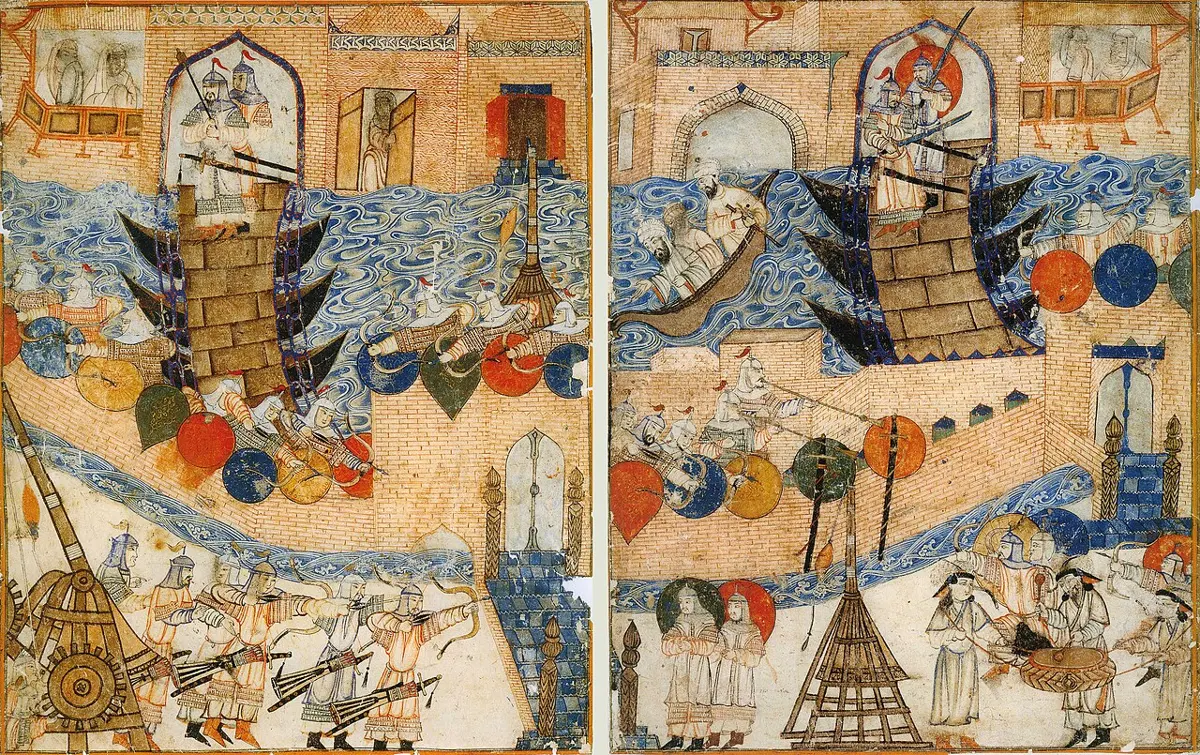
The great trading city of Bukhara surrendered. A Persian historian named Juvaini later told what happened there. Chinggis Khan, he says, rode into the city and climbed into the pulpit of the festival ground, and when the people had been gathered, he asked which of them were rich. Then he spoke. You have committed great sins, he told them, and your great men committed them. How do I know? Because I am the punishment of God. If you had not sinned, God would not have sent a punishment like me. One man who escaped from Bukhara summed it all up in a sentence: “They came, they sapped, they burnt, they slew, they plundered and they departed.” To sap a city was to dig under its walls.
Juvaini was born a few years after these events, and he wrote them down while serving the Mongols: he worked on his history at Karakorum, and later governed Baghdad for them. A city that resisted could expect worse than Bukhara. At Merv, in what is now Turkmenistan, he says, a man and his helpers spent thirteen days and nights counting the dead and reached more than one million three hundred thousand. No city of that time could have held so many people, and historians today don’t believe numbers like these. Nobody knows how many died in the Mongol wars as a whole. The huge totals often repeated rest on guesses, and there is no reliable count. What no one doubts is that the dead ran into millions, from China to Iran.
The people who lived through it wrote as if the world had ended. Ibn al-Athir, a historian in Mosul, in what is now Iraq, put off writing about the Mongols for years, because it was so horrible to tell. When at last he began, he wrote that he wished his mother had never borne him, or that he had died and been forgotten before it happened. Nothing like it, he said, had ever befallen the human race.
Under Chinggis Khan’s grandsons the conquests went on. In Iran, his grandson Hülegü took Baghdad. The caliph surrendered, and the line of caliphs who had ruled from Baghdad for centuries came to an end. A historian who wrote for the Mongol rulers of Iran half a century later, Rashid al-Din, describes how the people who came out of the city hoping to be spared were divided up into thousands, hundreds and tens, the same units as the Mongol army, and killed to the last. Two years later an army from Egypt beat the Mongols in Palestine, and Egypt never fell to them. The sultans of Delhi kept them out of most of India (Chapter 14).
Kublai’s China, and a young man from Nepal
An empire run by one family split as the family did. By about 1260 it had become four realms, ruled by Chinggis Khan’s descendants: the Golden Horde in Russia, Central Asia, Iran, and the largest, China with Mongolia, Korea and Tibet, under Kublai, another grandson. Kublai wanted to rule, not only to conquer. He gave his dynasty a Chinese name, Yuan, built a new capital where Beijing stands today and kept China’s old ministries and provinces. He finished the conquest of south China, so that the whole country was under one ruler again, a foreign one. Mongols came first under him, then Central Asians and Muslims who served them, then northern Chinese, and southern Chinese last of all. He gave money to Buddhist monasteries, to Confucian scholars, to mosques and to Christian churches.
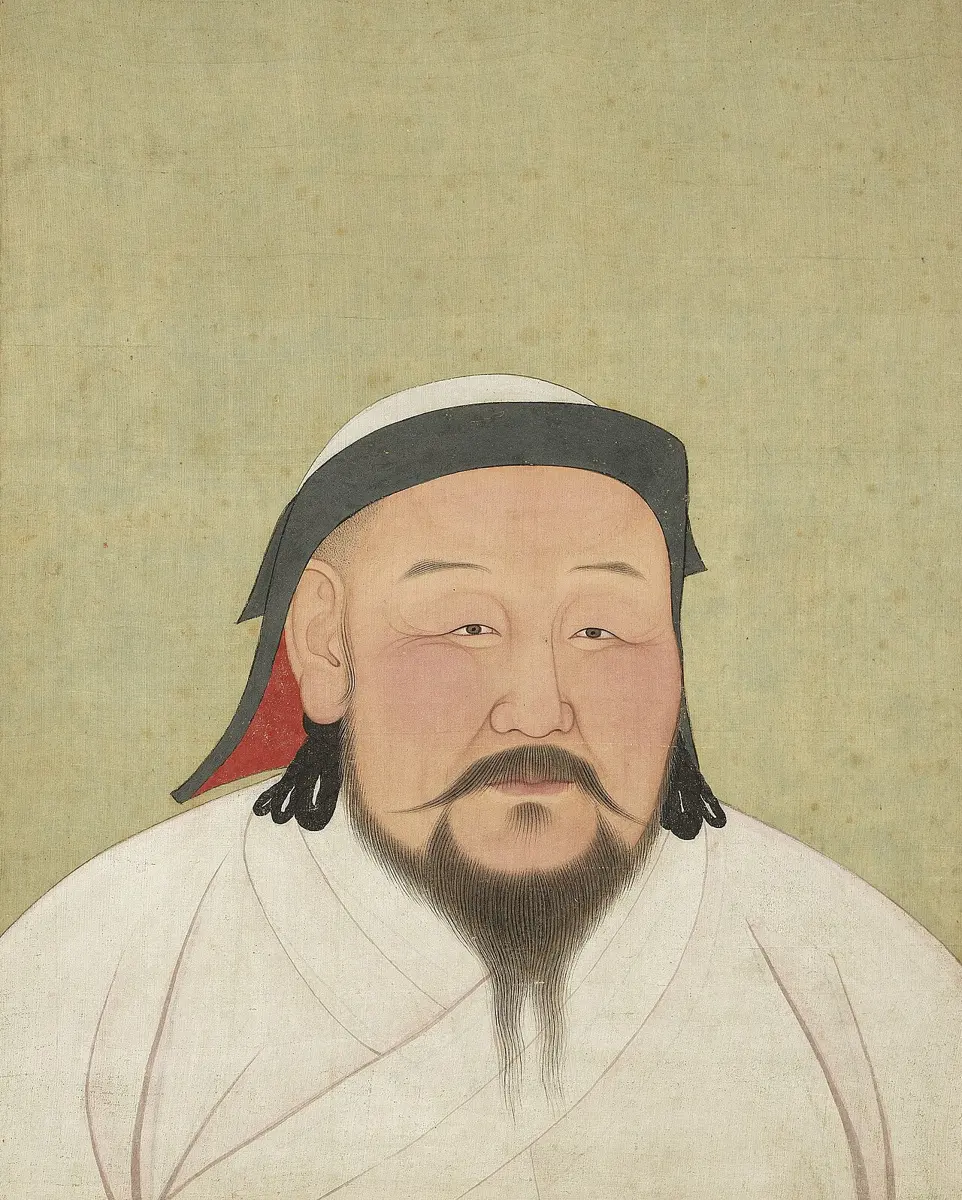
The Venetian Marco Polo, who says he served Kublai for years, describes the emperor’s paper money: made from the inner bark of the mulberry tree, cut to sizes for different values, signed by officials and stamped in red with the emperor’s seal, and anyone who forged it was put to death. People have long doubted that Polo was in China at all. He never mentions the Great Wall, for one thing, and no Chinese record names him. But what he says about money, salt and taxes matches Chinese records, though he couldn’t read Chinese.
In the first year of Kublai’s reign, his teacher, the Tibetan monk Phagpa, was told to build a golden stupa in Tibet, and craftsmen were wanted from Nepal. A hundred were asked for, eighty were found, and nobody could be found to lead them. Then a youth of about sixteen asked to go. People said he was too young, and he answered that he was young in years but not young in mind. His name was Arniko (अरनिको, also spelled Araniko), which the Chinese wrote as Anige.
What happened next is told in his biography in the official history of the Yuan, written for the dynasty that followed. Phagpa was struck by him at once and put him in charge of the work. When the stupa was finished, the young man asked to go home, but Phagpa urged him to come to the emperor’s court instead, so he shaved his head, became Phagpa’s pupil, and went with him. Kublai looked at him for a long time and asked whether he wasn’t afraid to come to so great a country. The emperor cared for every land as a father for his children, Arniko said, so why should a son be afraid before his father? He had come because he had seen how the people of Tibet suffered from war, and he hoped the emperor would bring them peace. As for his skills, he took his own mind as his teacher, and knew something of painting, modeling and casting metal. So Kublai showed him a bronze figure of a man, marked with the body’s points and channels for teaching acupuncture, which an envoy had brought from the Song, the Chinese emperors of the south. It had been broken for years, and nobody could mend it. Arniko had never done such a thing, he said, but he would try. When he brought it back, with every joint and channel in place, the court’s metalworkers were amazed. The biography’s words were polished by court writers, and we can’t know how close they are to what was said.
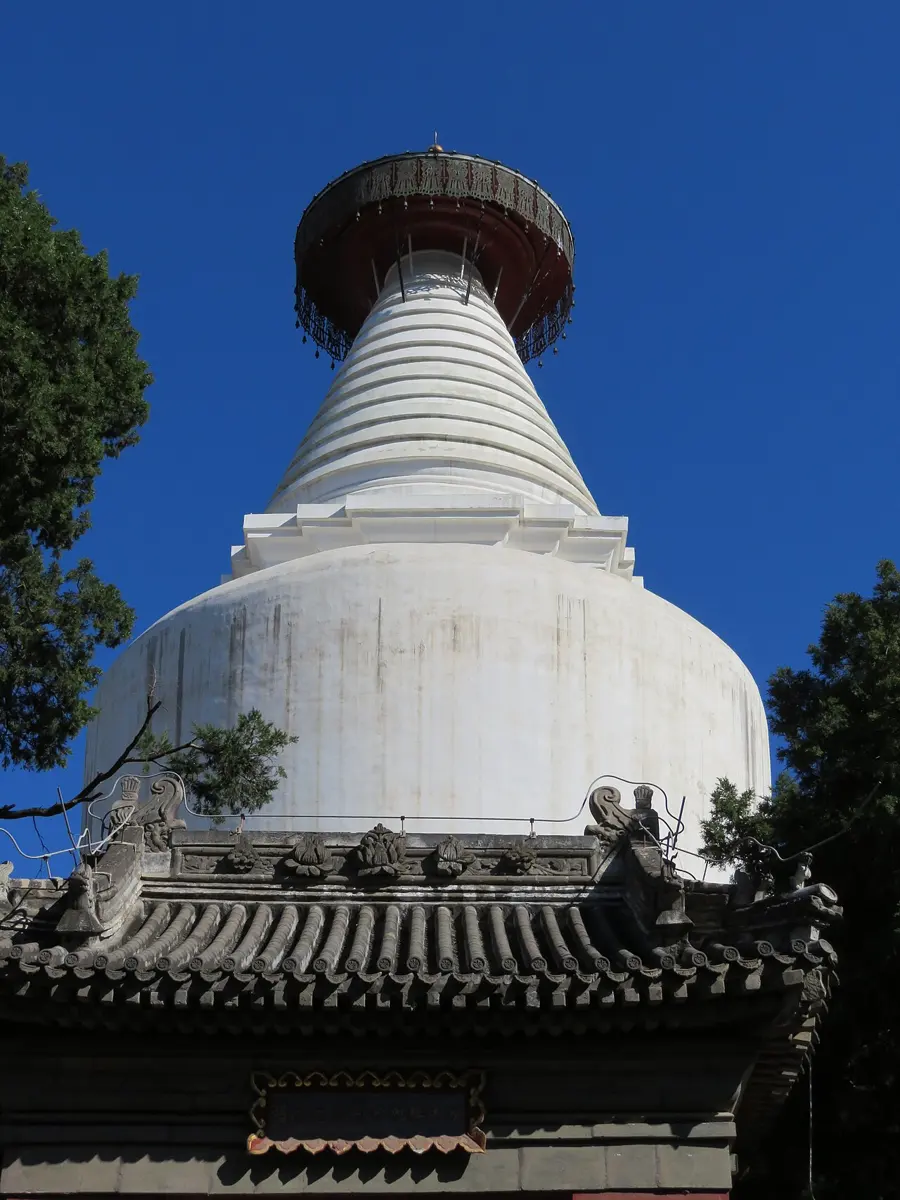
He rose to be head of all the craftsmen of the empire and was given one of the court’s highest ranks, and after his death a duke’s title. He died more than forty years after he left the Valley. Historians credit him with the design of one building that still stands: the White Stupa in Beijing, which Kublai ordered and which took most of a decade to build. It is about fifty meters tall, and it doesn’t look much like the stupas of Nepal.
The same roads
For about a hundred years, merchants could cross from the Black Sea to China under the protection of one family of rulers. The Mongols prized skilled craftsmen and moved them wherever they wanted them: whole communities of weavers of cloth of gold went from Central Asia and Iran to China, and Chinese painters, or at least their pattern books, went to Iran, where the dragons, clouds and twisted trees of Chinese painting turned up in Persian pictures. Rubruck, Polo and Arniko all traveled the empire’s roads. So, it seems, did something that nobody saw.
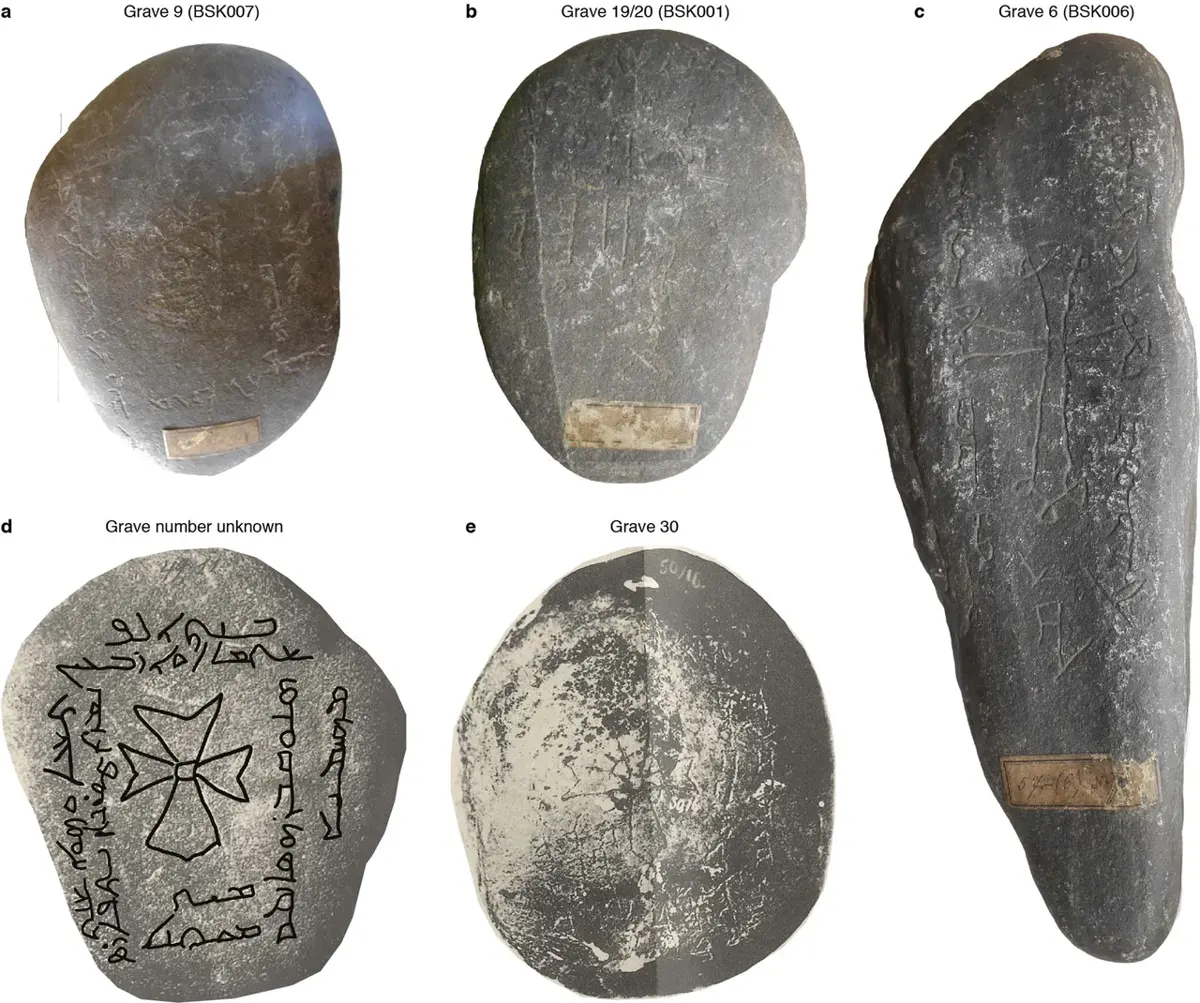
Near Lake Issyk-Kul, in what is now Kyrgyzstan, there were two cemeteries of trading communities whose people came from many backgrounds and had links across Asia. Their gravestones were written in Syriac letters, and some were carved with a cross. When Russian archaeologists dug them more than a century ago, they found hundreds of gravestones, and an unusual number of them were dated to two years, 1338 and 1339. Some gave the cause of death. One reads, in translation: “This is the tomb of the believer Sanmaq. He died of pestilence.”
A few years ago a team of geneticists, archaeologists and historians read the DNA in the teeth of seven people buried there. Three of them showed signs of the bacterium that causes plague. Its genes showed that it was the ancestor of the strains of plague that later swept west: the strains found in the bodies of the Black Death’s victims in Europe all came from it. The same kind of plague still lives today in wild animals, mostly marmots, in the mountains of that region, so it probably jumped to people there, not long before those gravestones were cut.
How it got from there to the Black Sea, where it broke out about eight years later, nobody knows. It may have traveled with traders or with armies. One famous story says that a Mongol army besieging Caffa, an Italian trading port in Crimea, threw the bodies of its own plague dead over the walls with catapults, and that ships fleeing Caffa carried the plague to Italy. The story comes from one Italian lawyer who was probably not there. It may be true, but plague reached Europe from many ports and along many roads. By different estimates, it killed between a third and more than half of all the people of western Asia and Europe within a few years. What it did to Europe afterwards belongs to the next chapter. In China the Mongols’ dynasty lasted less than a century, until a Chinese army took its capital and the last Yuan emperor went back to the grasslands.
Remembered two ways
For Iran’s chroniclers, and for the cities of Central Asia, Russia and China, the Mongols were a catastrophe. For Mongolians, Chinggis Khan is the founder of their nation. In the 1960s, when Mongolia was a communist state close to the Soviet Union, the government planned to celebrate the eight hundredth anniversary of his birth. Moscow’s main newspaper attacked him and the empire he built, and the official who had organized the celebrations was thrown out of the leadership. He was cleared almost thirty years later. Since then Chinggis Khan has been everywhere in Mongolia. In front of the government’s palace in the capital, Ulaanbaatar, a great bronze statue of him sits, and foreign leaders visiting the country bow to it. “I feel so proud to have been born in the land of the Great Khan who conquered most of the world,” a Mongolian singer told a reporter when the country marked eight hundred years since he was made Khan.
Both memories are true, and neither cancels the other. A boy left to starve on the grasslands built a people out of quarreling clans, and his armies emptied cities from China to Iran. His grandsons joined most of Asia and Russia into one world, and craftsmen, monks, merchants and diseases traveled it, the friar from France, the goldsmith from Paris and the young man from Nepal among them.
Meanwhile, in Nepal: Arniko was not the last Newar craftsman to go north; the Valley’s metalworkers and merchants in Tibet are in Over the Passes, in Nepal’s History, for the Curious.
Found a mistake? Please tell us.