
On Muna, a small island off Sulawesi in Indonesia, there is a limestone cave called Liang Metanduno. Long ago someone made a stencil of a hand on its wall: the hand was held against the rock and colored paint put round it, so that when the hand came away its outline stayed behind. Then someone narrowed the painted fingers, so that the hand looks more like a claw. Nobody knows why. Over the years a thin crust of minerals grew over the paint, and a crust like that can be dated. In January 2026 a team of Indonesian and Australian archaeologists reported that the hand is at least 67,800 years old, older than any other cave painting yet dated.
Its finders think the hand was made by people like you, whose ancestors had come out of Africa, along the edge of Asia, and over the sea to an island that boats were needed to reach. Others ask why another kind of human couldn’t have made it. Either way, how people of our kind made that journey, and how they lived for the long ages before anyone farmed, is the subject of this chapter.
Here is the whole story first, in a few lines. Our own species, Homo sapiens, grew up in Africa, beginning about 300,000 years ago, and for most of that time everyone lived there. Then, somewhere around 60,000 to 50,000 years ago, small groups left and spread out, a generation at a time, until people lived on every continent except Antarctica. On the way they met other kinds of human already living in Europe and Asia, and had children with them. And everywhere, all that time, people lived in the same broad way: by gathering plants, hunting and fishing, moving with the seasons, in small groups that knew their land very well. Farming, cities, writing and everything else in this book came right at the end.
How short that end is gets hard to picture, so squeeze the 300,000 years into a single day. Each hour is then 12,500 years, and each minute about two centuries.
The day is nearly over before anyone plants a seed. Foraging, as gathering and hunting are called together, isn’t a stage people passed through on their way to something better. It is how humans have lived for about 95 parts in every hundred of our time on Earth.
A species from all over Africa
In 1960 miners at Jebel Irhoud, a hill in Morocco, broke into an old cave filled with earth, and the next year an almost complete human skull turned up there by accident. For a long time it was taken to be about 40,000 years old, perhaps a kind of African Neanderthal. Then a team led by Jean-Jacques Hublin went back, dug again and dated the burned flints found with new bones. In 2017 they announced the answer: about 300,000 years. The faces were like ours. The backs of the skulls were longer and lower, an older shape. These are the oldest known members of our species, or of the line that became it.
They were found at the far northwestern corner of Africa, and Hublin’s team read this to mean that our species didn’t come from one valley or one cradle. It took shape across the whole of Africa, in groups that were spread out, drifted apart, and met and mixed again over hundreds of thousands of years. The DNA of people alive today says much the same. Among them, the oldest branching shows up in southern Africa: the ancestors of peoples like the Nama began to go their own way from everyone else about 120,000 years ago or more.
That gives a clue to something nobody can dig up. Every people on Earth, from the Kalahari to the Himalaya, has a full language. Words leave no fossils, so nobody knows when language began. But if every branch of the family has it, the gift must be older than the oldest branching, which puts it more than 100,000 years back. One recent estimate makes it at least 135,000.
There is another way to see that Africa was the starting point, and it is in our genes. Each group of people that moved on from Africa carried only part of the variety of the group it came from, and the next group carried part of that. So the variety of human genes is greatest in Africa and falls, step by step, the farther away people live.
How they lived
So what was life like through that long day? The evidence is thin, scattered and easily misread: stones, bones, a few beads, a few marks on rock. But it adds up to people who were anything but simple.
At Olorgesailie, in southern Kenya, people about 320,000 years ago were making small, carefully shaped stone points. Some of their stone, black volcanic glass among it, came from 25 to 50 kilometers away, and they were also gathering iron-rich rocks to grind into red pigment. Nobody knows who these toolmakers were, since no bones were found with them. But whoever they were, they knew where to find good stone far from home, and that may mean they swapped it with other groups. By about 164,000 years ago people in Africa were collecting and cooking shellfish, and by 90,000 they had tools for catching fish.
About 73,000 years ago, in Blombos Cave on the coast of South Africa, someone drew a crisscross pattern on a flake of stone with a lump of red ochre, like a crayon. It is the oldest drawing known. What it meant nobody knows, and it may not be “art” in our sense at all. But it is a mark made on purpose, to mean something to somebody.
Beads tell of people keeping in touch over great distances. Across eastern and southern Africa, people cut beads from ostrich eggshell. When archaeologists compared more than 1,500 of them from 31 sites, they found that between about 50,000 and 33,000 years ago the beads in the two regions were made in the same style, about 3,000 kilometers apart. A style doesn’t travel that far unless people are passing it along. Then, around 33,000 years ago, the styles drifted apart. The rains had shifted: eastern Africa grew drier, and the land between became wetter and prone to floods. The best guess is that the weather pulled the two regions apart, and their people lost touch.
What the stones can’t tell us is how people lived together. For that the nearest thing we have is the foragers of recent times, though they are not a window straight into the past: they live in our own world, beside farmers, traders and governments. When researchers looked at who lived with whom in 32 foraging peoples, more than 5,000 people in all, the average camp had about 28 adults. Grown brothers and sisters often lived in the same camp, and either men or women might stay where they were born or move away. So most of the people in a camp weren’t related to each other at all. Every camp was tied by marriage and friendship to many others, which made a web of people across a wide stretch of land. Something learned in one camp could travel, which may be how the beads’ style traveled too.
Foragers didn’t live only on open grassland, either. In Fa-Hien Lena, a cave in the rainforest of Sri Lanka, people were making tiny stone tools between about 48,000 and 45,000 years ago, and they lived mostly on what was in the trees: more than seven in every ten of the animal bones they left are of monkeys and tree squirrels. People could make a living anywhere they learned to, and that is what let them go everywhere.
Out of Africa, and the people already there
Leaving Africa wasn’t one great march. Small groups crossed into West Asia more than once. A human jawbone from Misliya Cave in Israel, about 180,000 years old, shows that some of our species were there very early. But that land was often dry, and groups seem to have spread into it in good times and died out in bad ones. Hardly anything of those early travelers survives in anyone alive today.
The departure that counts came later. Everyone whose ancestors are from outside Africa, which includes everyone in Nepal, descends mainly from groups that left somewhere around 60,000 to 50,000 years ago, by the reckoning of most geneticists. Nobody can say exactly when, or by which road. The hand on Muna, older than that, doesn’t fit: either people of our kind left earlier, as its finders think, or someone else made it, as some of their critics suggest, or one of the dates will have to give. Nobody has yet made them agree.
Outside Africa, they weren’t alone. Europe and western and central Asia, from Portugal to the Altai Mountains of Siberia, already belonged to the Neanderthals. They were a kind of human who had lived there for hundreds of thousands of years, and made ornaments, among them pendants of eagles’ talons. Our ancestors and the Neanderthals had children together. Their DNA shows it happened over a long stretch, roughly 50,000 to 43,500 years ago, and it left a mark on everyone who came after: most people outside Africa carry one or two parts in a hundred of Neanderthal DNA. The Neanderthals themselves were gone by about 40,000 years ago. In a way, they never quite left.
Not every group of newcomers lasted either. At Ranis in Germany and Zlatý kůň in the Czech Republic, people of our species were living about 45,000 years ago, among the first in Europe. Their DNA shows a mother and daughter, more distant cousins, and a woman in the next country who was related to them, all one extended family of at most a few hundred people spread over a wide land. They left no descendants that anyone has found. They are a branch of the family that simply stopped.
Farther east lived another kind of human, the Denisovans, and they were found the other way round: first their DNA, then their bones. In 2010 scientists read the DNA in a single finger bone from Denisova Cave in Siberia and found it belonged to nobody known. A jawbone found in a cave on the Tibetan plateau in 1980 turned out, from the proteins in a tooth, to be Denisovan too, at least 160,000 years old. Then came a skull from Harbin in northeast China. The story goes that a man working on a bridge dug it up in 1933 and hid it in an old well, and it reached scientists only in 2018. In 2025, proteins from its bone and DNA from the hardened plaque on its teeth showed it was a Denisovan, the first face of one. Our ancestors met these people too, more than once, and the people of New Guinea and the islands near it carry more of their DNA than anyone else on Earth. A piece of it helps many Sherpas and Tibetans live high up, where the air is thin. Nepal’s History, for the Curious tells that story, and what the ground of Nepal itself shows about its first people.
The travelers went along the coasts and up the river valleys, and some went far and fast. During the ice ages so much water was frozen in ice sheets that the sea stood far lower than now. Australia, New Guinea and Tasmania were one land, which scientists call Sahul, and much of Indonesia was joined to Asia. But between them the sea never dried, and reaching Sahul meant crossing open water, in places perhaps as much as 100 kilometers. Whatever boats or rafts they used are long gone, but people did it.
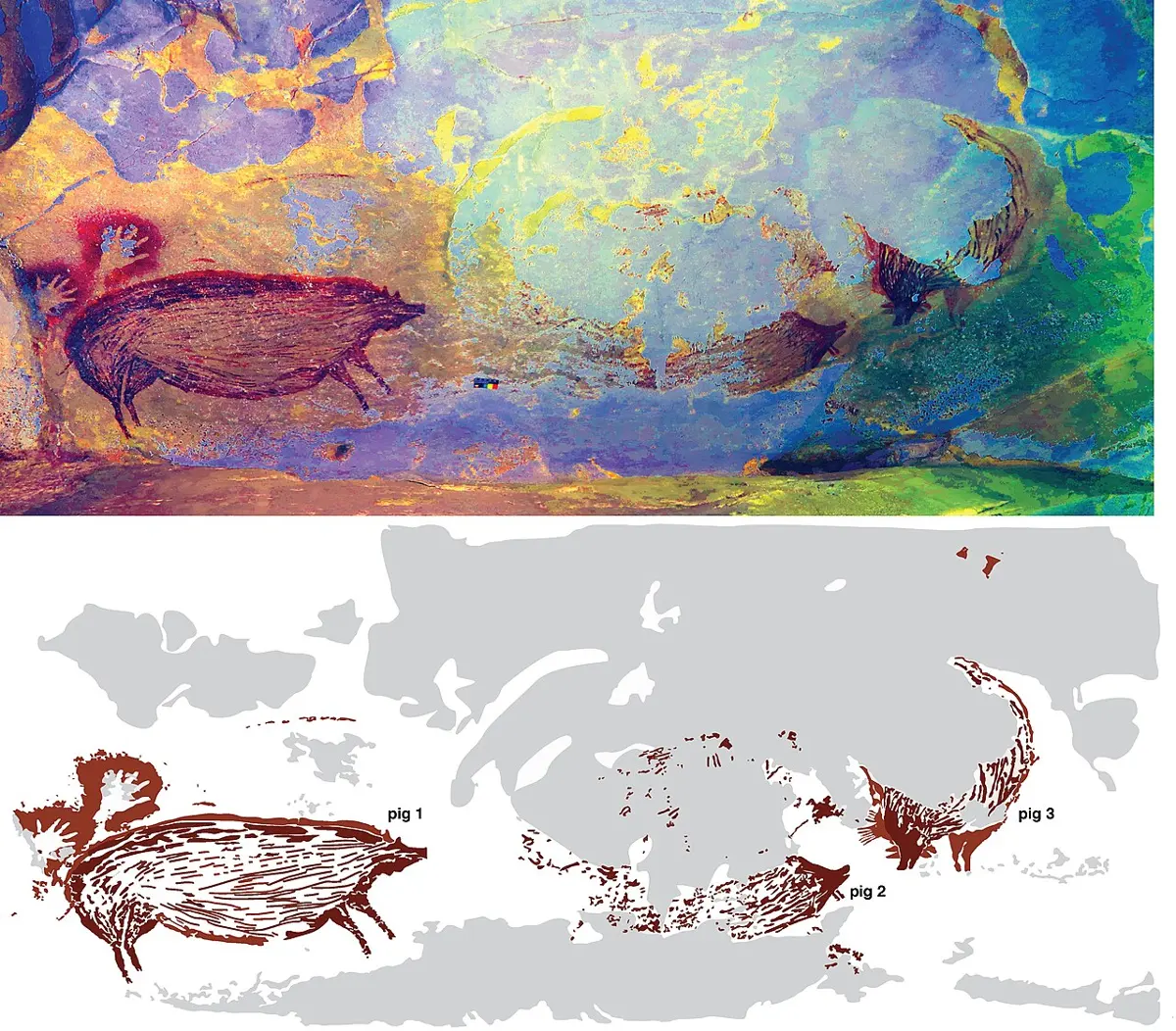
When they got there is one of the great arguments of the subject. The layers in a rock shelter called Madjedbebe, in northern Australia, have tools and ground ochre in them that have been dated to about 65,000 years ago. Most other early sites in Australia are between about 54,000 and 43,000 years old, and the Neanderthal DNA that every person outside Africa shares seems to have come in around 47,000 years ago, which ought to mean that the ancestors of the first Australians hadn’t left West Asia long before then. So some scientists think people arrived around 50,000 years ago and that the oldest dates are wrong. Others take the long view, and they have new support: the DNA passed down by mothers has been read as pointing to about 60,000, and the claw-fingered hand on Muna, if people of our kind made it, puts them on the route to Australia at least 67,800 years ago. Both sides have good evidence, and nobody has yet made them fit.
The last continents
The Americas came last of the big lands. During the coldest part of the last Ice Age, about 20,000 years ago, the sea was so low that Siberia and Alaska were joined by a wide plain, where the Bering Sea is now. People walked across it from northeast Asia. The harder question is when, and how they got south, because the way south was blocked. Ice sheets up to three or four kilometers thick covered much of Canada, and the dry gap between them opened only near the end of the Ice Age, about 13,800 years ago.
For much of the last century, most archaeologists thought the first Americans came through that gap, a little before 13,000 years ago, when a people who made fine spear points, called Clovis after a town in New Mexico, appeared. Then other sites turned up that seemed older. The oldest are footprints. In White Sands, New Mexico, people walked over the soft mud at the edge of a lake, and the mud hardened. Seeds of a water plant in the same layers dated them to between about 23,000 and 21,000 years ago. Other scientists doubted the seeds, since water plants can take up old carbon, so in 2023 the footprints were dated again in two other ways, by tree pollen and by the sand grains themselves, and both gave the same answer. The doubters weren’t won over: they argue that the pollen and the sand could be older than the mud they lie in, and the team answers that they are not. If the team is right, people were in the heart of North America while the ice was at its greatest, so they must have come before it closed the way, or along the Pacific coast by boat.
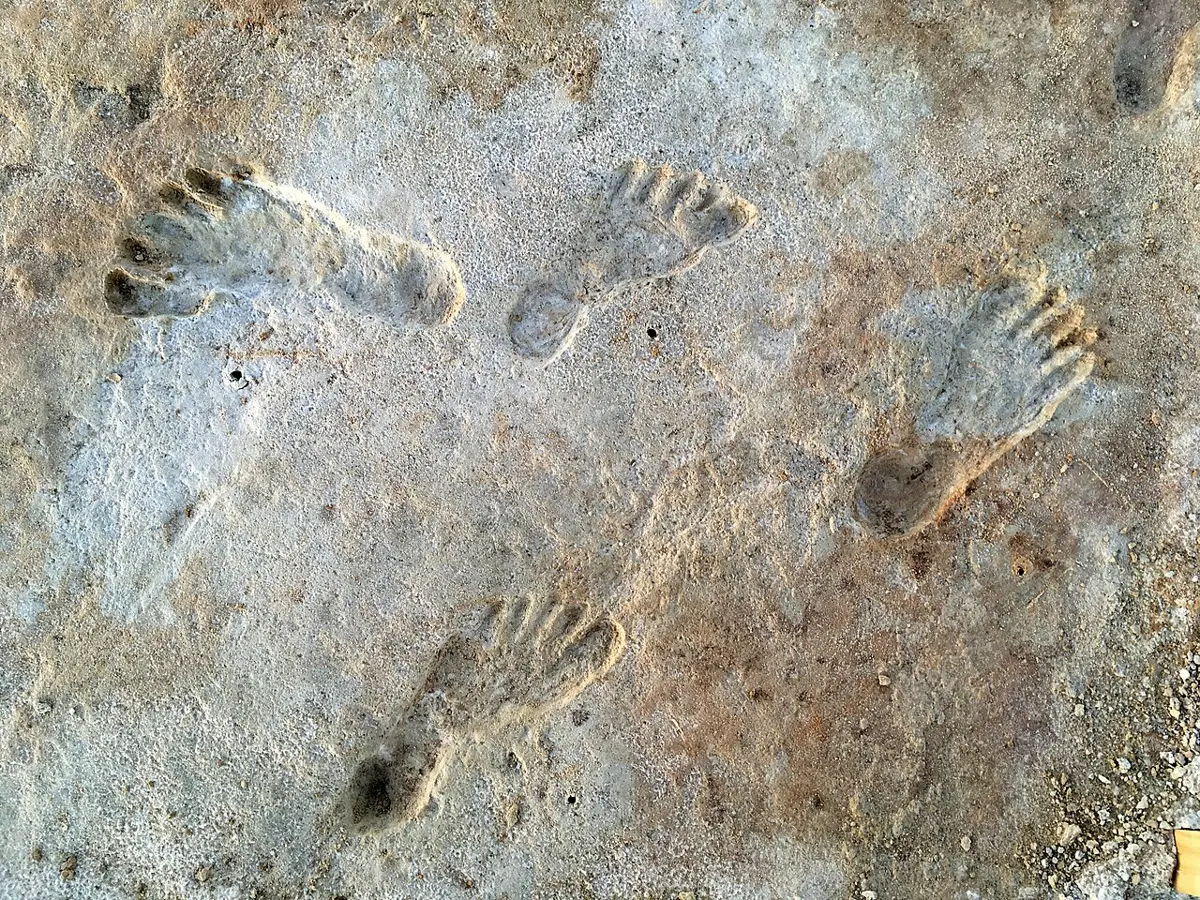
The argument isn’t over. Monte Verde, a camp in southern Chile, was long taken as proof that people had reached South America by about 14,500 years ago. In March 2026 a new study argued that its old dates came from Ice Age wood washed into much younger layers, and that the camp is only 8,200 to 4,200 years old. Its first excavators answered that the new team had studied the ground outside the site, not the site itself. Most archaeologists still think people were in the Americas before Clovis, and came in more than one wave, by land and by sea. When the first ones came is still open.
By the time the Ice Age ended, about 11,700 years ago, people were living on every big land but Antarctica, from the rainforest of Sri Lanka to the Americas. Only the remotest islands were still empty. Everywhere they had gone, they had gone as foragers.
Every one of them, the bead makers of Africa, the families of Ranis, the painters of Sulawesi, the walkers at White Sands, belongs to one family that began in Africa. Our species is about 300,000 years old, grew up across that continent, and for almost all of its time lived by foraging, in small groups tied into wide webs of friends and kin. From around 60,000 years ago people spread over the rest of the world, often by sea, met the other humans already there and mixed with them, and carry a little of them still. What happened after farming fills the rest of this book, but it all happened in the last hour of the day.
Found a mistake? Please tell us.