
Until about forty years ago, Nepal had almost no Stone Age at all. A few polished stone axes had turned up by chance over the years, but nobody knew how old they were, and not one place had been found where people had lived before the time of the Buddha. Then, in the winter of 1983, a German archaeologist named Gudrun Corvinus found her first stone tools in the dry, gullied valleys of Dang and Deukhuri, in the inner Tarai of the west. Within ten years she had found more than ninety places where people had left stone tools behind.
So the first thing to know about Nepal’s first people is that nearly everything we know about them was found in living memory, and much of it is still being worked out. The second thing is the answer this whole chapter leads to, and it is simple. Nobody was first. People have been coming into this land for a very long time, up from the plains to the south, down from the high plateau to the north, and along the hills from east and west. They came at different times, often thousands of years apart, and they kept coming long after history began. Every group in Nepal today descends from many of those arrivals, mixed together. Nobody’s arrival is the beginning.
Four kinds of evidence tell the story, and each tells a different part of it. Stone tools show where people lived and what they did, but not who they were. Old bones, and the DNA inside them, show who people were related to, but very few old bones have been found in Nepal. The DNA of people alive today shows how today’s groups are mixed, though not when each part arrived. And languages show how words traveled, which isn’t always the way families did.
Stones in the dry valleys
The oldest tools Corvinus found were handaxes. A handaxe is a big stone, here quartzite, chipped on both sides into the shape of a teardrop, with a sharp edge running all the way round. For a very long time it was the pocketknife of the Old Stone Age: it could cut, chop and scrape. She found a small set of them at Gadari, on the south bank of the Babai river in the Dang valley, lying in gravel at the very bottom of the valley’s fill, just above the bedrock. She found a second set on Satpati Hill near Triveni, in Nawalparasi, in sandstone that the rising mountains had since bent and folded, and among them what has been called the finest handaxe ever found in Nepal.
How old are they? Nobody knows exactly. The layers they lay in may be several hundred thousand years old, and one estimate puts Satpati at more than 700,000 years, though that has never been confirmed. No bones were found with them, so nobody can say for certain who made them. Handaxes of this kind were made across Africa and much of Asia by older kinds of human, long before people like us arrived in Asia, and that is probably who these were. Corvinus also noticed something telling. In six years of searching Dang she found just one site that old, while younger ones were everywhere. The handaxe makers came seldom.
The layers above tell of the people who came later. On the Arjun river in Deukhuri, under eight meters of silt, she found flakes struck from stones that had been carefully shaped first, a cleverer way of working, like later Old Stone Age tools in India, and more than 30,000 years old. Higher up, near Lamahi, came tiny tools of chert, again like ones found in India. And at the very top, at Brakhuti and Basantapur, lay small polished stone axes beside pieces of pottery pressed with the marks of cord. The tools of the west, in other words, looked south.
Far to the east the tools looked somewhere else. On the old terraces of the Rato Khola in Mahottari, near the village of Patu, thousands of stone tools lay on the ground, washed out of the red soil. Their makers split river cobbles along their natural grain and shaped the slices into flat adzes, tools for cutting and shaping wood. The edges of many still shine, and a study of the wear showed what had polished them: wood, grass and, above all, bamboo. Charcoal found with the tools gives them an age of at least 7,000 years. Corvinus could find nothing like these tools in India, except perhaps in Assam. They looked instead like stone tools from Southeast Asia.
She was racing against time. As the forests of the Dang valleys were cut down, rain carved the bare valley floors into gullies and washed her sites away, tool by tool. She warned that much of what she had found was already gone, and that without more digging there would soon be nothing left. Many of her finds are now in the National Museum at Chhauni.
What about the Kathmandu Valley? For a long time much of it lay under a lake, and the last of the water drained from its middle only about 12,000 years ago.
One more find needs a word, because it is often told wrongly. In the rocks of the Tinau Khola, just north of Butwal, scientists found a single fossil tooth, an upper molar about nine million years old, and described it in 1983. Some books still say that remains like this, under the old name Ramapithecus, prove that people lived in Nepal ten million years ago. The tooth is real, and precious. But it belonged to an ape. Scientists now count Ramapithecus as part of Sivapithecus, an ape they no longer think was an ancestor of humans; some link it instead to the orangutan’s family, though that is still argued. Nine million years ago there were no humans anywhere, in Nepal or out of it.
Graves in the cliffs
People like us, every one of us outside Africa, descend mainly from groups who left Africa sometime between 40,000 and 60,000 years ago. Some of them reached the roof of the world surprisingly fast. At Nwya Devu, in central Tibet, 4,600 meters up, people were making stone tools between 40,000 and 30,000 years ago.
To learn who lived in Nepal’s high valleys, though, stone isn’t enough. You need bones, and for that you need Mustang. Its cliffs are full of caves that people dug by hand, high above the valley floors, and some of them were used as tombs. In one group of caves above the village of Samdzong, about 4,200 meters up, archaeologists found 27 people, laid there some 1,500 years ago, many of whose bones bear the cut marks of a death ritual that stripped away the flesh.
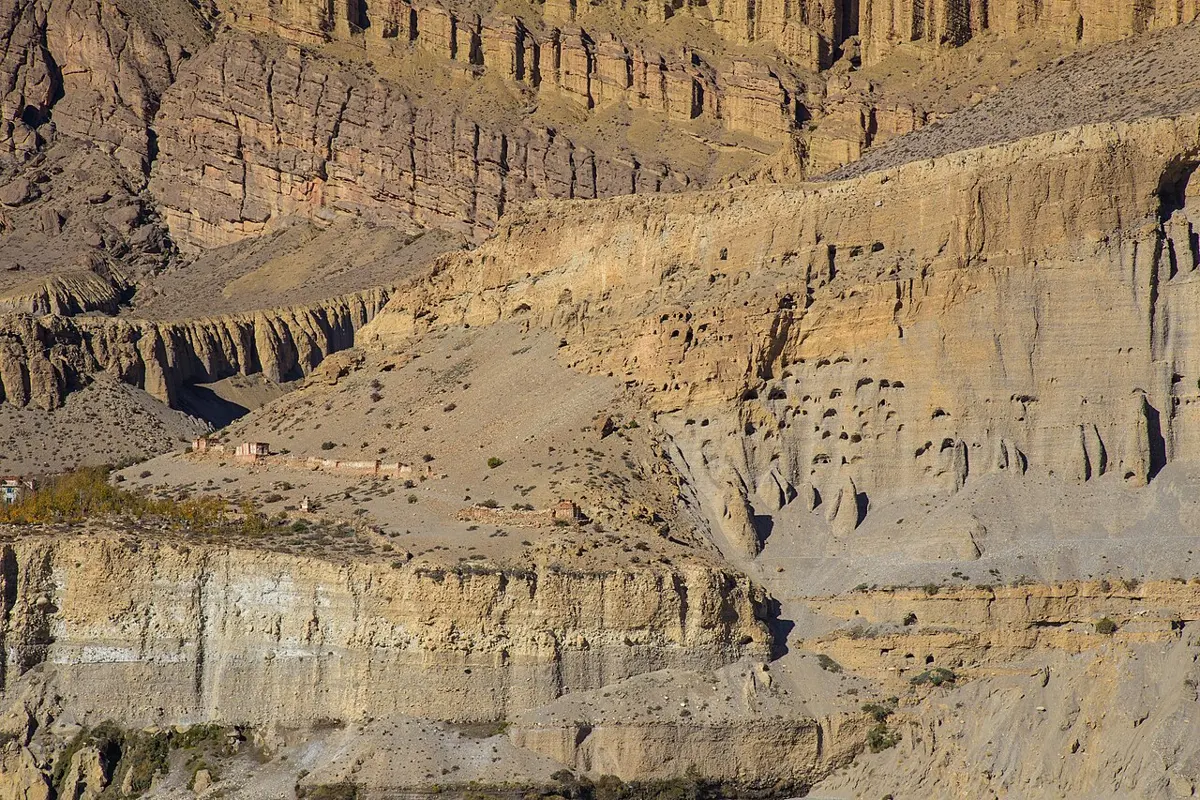
Several of these sites were found by accident, and saved by the people who live there. At Chokhopani, laying a pipe for a small hydropower plant destroyed most of a burial cave. At Suila a new road broke one open, and the villagers gathered up what spilled out and carried it to the monastery at Ghiling. At Lubrak a riverbank washed away from some tombs, and again the villagers rescued what was inside; it is kept in the village’s Bon temple. Small museums at Samdzong and Chhusang now show what was found nearby.
From the teeth and bones of 38 people at seven sites in Mustang and Manang, buried between about 3,500 and 1,400 years ago, scientists read their DNA. The answer was clear. These people were close relatives of today’s Tibetans. Most of their ancestry came from people related to the farmers who lived around 4,000 years ago on the north-eastern edge of the Tibetan plateau, far away in what is now China. A smaller part came from a much older people, known so far only from this trace in the DNA. In most of them only a sliver came from South Asia. And over all those centuries the people hardly changed, even while the things they made, and the way they buried their dead, changed a great deal.
High-mountain people carry another inheritance too. Many Sherpas and Tibetans have a version of a gene, EPAS1, that helps the body cope with thin air and goes with less of the lasting sickness that can trouble people who live high up. That version came, long ago, from the Denisovans, an extinct kind of human who lived in Asia, the plateau included, and mixed with our own ancestors there. A small piece of a vanished people is part of what lets Sherpas live and work so high.
The DNA of people today
Walk up from the Tarai to the Himalaya and you pass, roughly, through three bands of people. In the lowlands most people speak languages that came from the south, related to Hindi and Bengali. In the highest valleys live Sherpas and other peoples close to the Tibetans. And in between, in the hills, Nepali-speaking Khas peoples live beside Tamang, Gurung, Magar, Rai, Limbu and others who speak languages of the same great family as Tibetan but are not Tibetans.
DNA suggests that the hill peoples who speak these languages and the highlanders reached the Himalaya by two different roads. One crossed the Tibetan plateau from its north-east and came down into the high valleys: that is the road of the ancient people of Mustang, and of today’s Sherpas and the Tibetan-speaking peoples of Upper Mustang, Nubri and Tsum. The other went round the edge of the plateau, along its eastern and southern rim, and its people spread along the hills. The two had separated thousands of years before they met again on Nepal’s slopes.
Some peoples remember a much later arrival. Sherpa family histories, passed down by word of mouth, tell of clans who came from Kham, in eastern Tibet, over the high pass of the Nangpa La into Khumbu; their name means “people of the east” in Tibetan. When is not agreed: the tellings differ, and nobody has fixed a date. The DNA can’t settle it either. It shows plainly that Sherpas are a branch of the Tibetan family, but one study of the DNA that mothers pass to their children puts the split within the last 1,500 years, and another, of the whole genome, between about 3,000 and 11,000 years ago.
The Tharu of the Tarai, who have lived with its fevers for a very long time, have a different story in a very different place. Where they came from has long been argued: some see them as the Tarai’s own first people, others look for their roots among peoples to the north or to the east. Their DNA shows two ancestries: up to half of it is East Asian in origin, and the rest goes back to people of the northern plains of the subcontinent.
The Tharu also show that genes and language don’t always travel together. Tharu languages came from the south, though up to half of Tharu ancestry is East Asian. The Newar of the Kathmandu Valley speak a language of the same great family as Tibetan, yet their culture drew on both the south and the north. People change languages; they marry in; they move. Whatever a group is called today, it was made from many parts.
A country of 124 languages
Words keep their own record. The 2021 census counted 124 mother tongues in Nepal, and almost all of them belong to one of four great families of languages, each with relatives far away.
The largest, by speakers, is the Indo-European family, the family of Hindi, Persian and English: 47 of Nepal’s languages, spoken as a mother tongue by 83 people in every hundred. Nepali is one. It grew from the speech of the Khas, whose ancestors came into the subcontinent from the north-west, and it is as close to Hindi as Spanish is to Italian. Maithili, Bhojpuri, Awadhi and Tharu languages belong here too.
The most numerous, by count, is the Sino-Tibetan family, the family of Tibetan, Burmese and Chinese: 72 of Nepal’s languages, from Newar, Magar and Tamang to the many Kirati languages of the east, though together they are the mother tongue of fewer than 17 people in a hundred.
Then come two small families whose speakers live mostly in India, to the south and east. Santhali, Munda and Kharia are Austroasiatic, distant cousins of Vietnamese and Khmer, the language of Cambodia. And Uraon, also called Kurukh, with about 39,000 speakers, is Nepal’s one Dravidian language, the family of Tamil and Telugu; most of its speakers live in eastern India.
And then there is Kusunda. It belongs to no family at all. Linguists have found no language anywhere to which it is related. The Kusunda people, who call themselves the kings of the forest, lived by roaming the forests until not long ago. The census lists 23 people who speak Kusunda as their mother tongue, though even that number has been doubted. In 2025 a newspaper reported that only one fully fluent speaker was left, Kamala Sen Kusunda of Dang; Gyani Maiya Sen, another of the last speakers, has died. Where Kusunda came from, and how long it has been spoken here, nobody knows.
Many beginnings
Put the four kinds of evidence together and the picture is the same each time. Handaxe makers came, seldom, hundreds of thousands of years ago. Later people worked stone in ways learned to the south, in the west of the country, and in ways that look east, in the east. People whose ancestors came from the far side of the Tibetan plateau were burying their dead in Mustang 3,500 years ago. The hill peoples came round the plateau’s rim; the speakers of southern languages came up from the plains and in from the west; the Sherpas’ own histories tell of a crossing of the Nangpa La. And all of them married, traded, changed languages and mixed.
That is why the first chapter of a history of Nepal can’t name the first Nepalis. There was no moment when the country was filled. The land was always being reached, by someone, from somewhere, and everyone who lives in it now carries many of those journeys. When the old chronicles begin, with cowherds and buffalo-keepers ruling the Valley, they begin in the middle of that long story, not at its start.
Found a mistake? Please tell us.