
About fifty years ago a team of archaeologists led by Andrew Moore dug as fast as it could into a mound beside the Euphrates River, in northern Syria. A dam was being built downstream, and the mound, called Abu Hureyra, was about to go under a new lake. It did, and it lies under the water still. But the team got out what it could, including parts of the skeletons of about 162 people, 75 of them children. Years later the bones reached Theya Molleson, who studied ancient skeletons at the Natural History Museum in London.
Many of the grown-ups, she found, had the same odd set of injuries. Their big toes were badly arthritic. The last bone of the spine above the lower back had sometimes crumpled. The knees had grown extra bone, the thigh bones were bent, and the places where the arm muscles fasten on were large and rough, equally on both arms. These people had done the same heavy work, with both hands at once, for hours on end, starting young.
For a while nobody could think what it was. Then a colleague on holiday in Egypt noticed that people kneeling on old temple walls had their toes bent hard under their feet. The houses of Abu Hureyra had grinding stones on their floors: a long, heavy stone worn hollow in the middle like a saddle, and a smaller one to rub across it. To grind grain on a stone like that, you kneel with your toes dug in, lean far forward and push the rubbing stone away with both arms, then drag it back, again and again, for hours every day. The damaged toe bones were mostly the smaller ones, so Molleson thought the grinders were mostly women and girls. With bones this broken and mixed up she couldn’t be certain, but that was her reading.
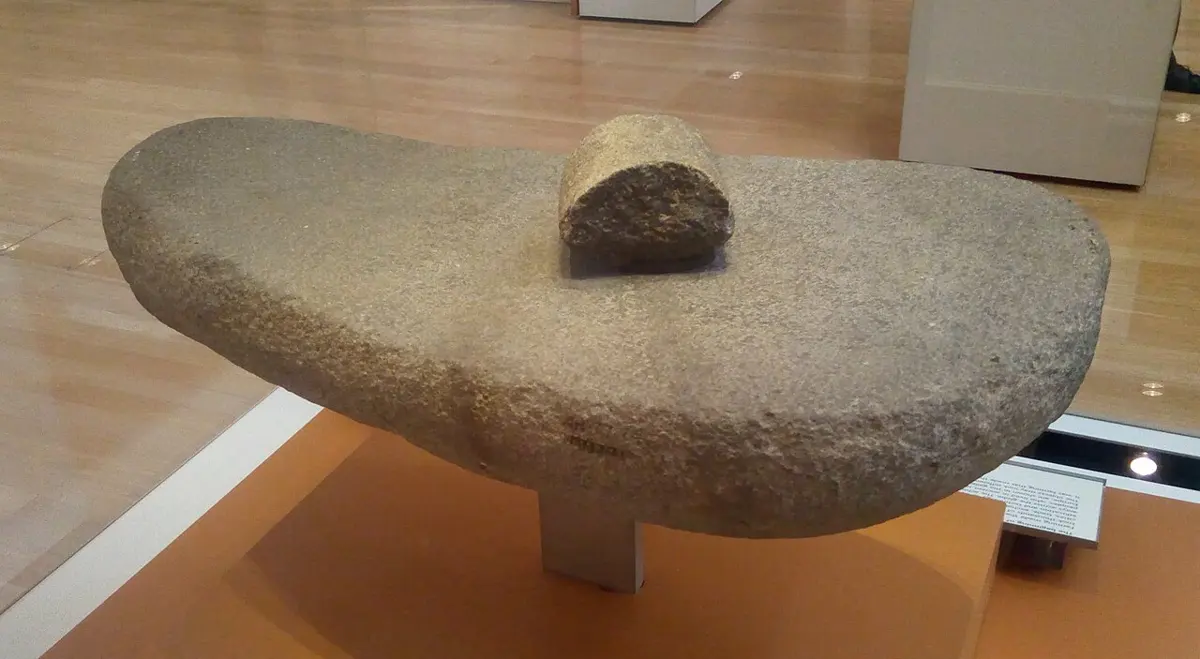
The teeth tell the rest. Grit from the stones got into the flour, and it wore teeth down fast, chipped them and broke them outright. Many people had lost teeth while still young.
This is what the beginning of farming looked like close up. It was not a clever idea that made life easy. It was a slow change, over thousands of years, that got a great deal more food out of the same land and asked a great deal of people’s bodies in return.
Here is the whole story in a few lines. For almost all of human time, everyone lived by foraging: gathering plants, hunting and fishing. Then, starting about 11,500 years ago, just after the end of the last Ice Age, people in several parts of the world began, each on their own, to grow plants and keep animals, until some of those plants and animals changed and came to depend on people. Farming spread out from those places and slowly took over most of the world. It fed far more people, and made villages, towns and in the end cities possible. It also meant harder work, poorer health for most people and, in time, rich and poor. And the first cities are where the word “civilization” comes in, a word with a past of its own.
Taming a plant
Abu Hureyra is a good place to watch it happen, because people lived there on both sides of the change. The first village, from more than 13,000 years ago, was a cluster of houses where foragers hunted gazelle and gathered wild plants, among them the seeds of wild grasses, and may even have kept a few live wild sheep. Then the place stood empty for some centuries. The second village, from about 10,600 years ago, was a village of farmers. They grew emmer and einkorn, two early kinds of wheat, with barley, oats, lentils and chickpeas, and in its later centuries they herded sheep and goats more than they hunted gazelle.
Grinding wild grain was far older than farming. At Ohalo II, a camp on the shore of the Sea of Galilee, people about 23,000 years ago gathered more than 140 kinds of plants and ground wild wheat and barley. Among their seeds are those of weeds, the plants that spring up where people have disturbed the ground, which suggests they may even have tried sowing a little. If so, that was some 11,000 years before anyone farmed for good.
So what changed? The plants did. Wild wheat drops its seeds as soon as they are ripe, so that they fall and grow. That is good for wheat, and bad for anyone trying to gather it. Now and then a plant comes up whose seeds hold on to the stalk. In the wild it leaves no young. But when people reaped the stalks, carried them home and sowed some of the seed the next year, the plants that held on were the ones that got gathered and sown, and year by year there were more of them. In wheat, barley and rice it took something like 2,000 to 4,000 years for nearly every plant to hold its seeds, and by then the plant needed people to sow it. That is what scientists mean by domestication, or taming: a plant or animal changed by living with people, until it depends on them.
Animals went the same slow way. In the Zagros Mountains of western Iran, at a place called Ganj Dareh, people were managing herds of goats by about 10,200 years ago, yet the goats’ bones show no change for about another thousand years. Across West Asia the pattern is the same: people looked after herds and fields for a thousand years or more before the animals and plants looked any different, and different crops and animals were tamed in different corners of the region. Together, West Asia’s farmers ended up with wheat, barley, lentils, peas and chickpeas, and with sheep, goats, cattle and pigs. The site’s Inventions timeline marks farming’s start there.
Many beginnings
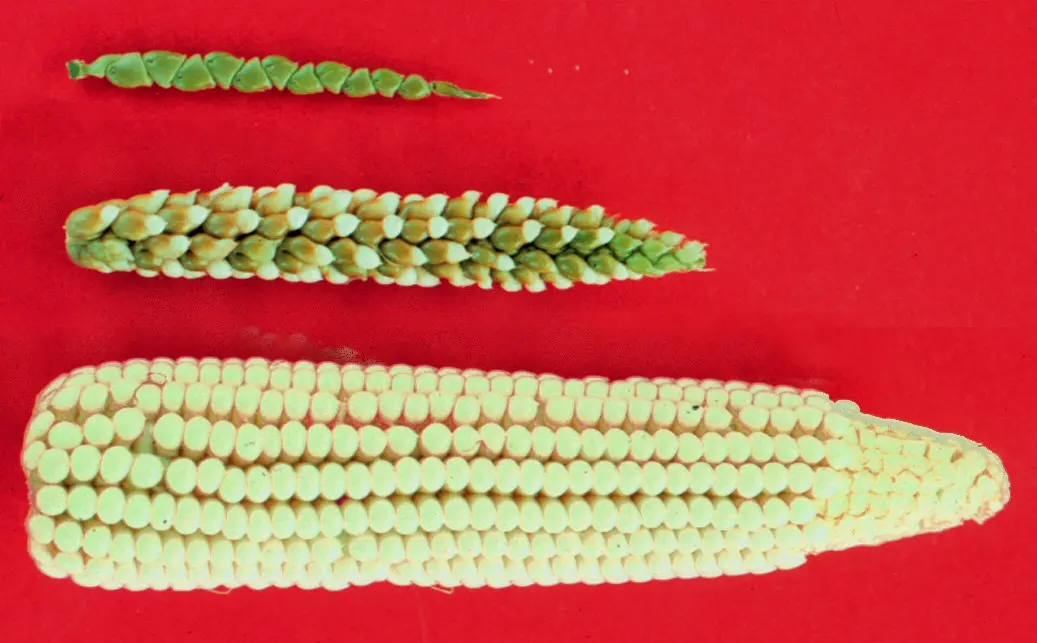
For a long time farming was thought to have begun in West Asia and spread from there. It didn’t. People in at least eleven parts of the world tamed plants or animals on their own, and several more have been suggested. Northern China tamed common millet, and the Yangtze rice. In the highlands of New Guinea, at a swamp called Kuk, people grew taro, and later bananas on mounds of earth. In southern Mexico, people bred maize from a wild grass. On a flooded grassland of the Amazon basin, in what is now Bolivia, they grew squash and manioc and raised thousands of little wooded islands above the floods, and the potato came from the Andes of Peru. The eastern United States had its own seed plants, sunflower among them. In Africa, sorghum was tamed in eastern Sudan and pearl millet in Mali, by herders who added it to their herding, fishing and hunting. Some of these beginnings were nearly as old as West Asia’s: millet, squash and manioc were all being grown about 10,000 years ago. Others, like Africa’s grains, came thousands of years later.
South Asia had beginnings of its own, probably several. Farmers in western India, the south and the Ganges plain tamed plants that grew wild nearby: मास (black gram) and मुङ (mung), गहत (horse gram), small millets, and probably rice. Wheat, barley and lentils came later, from West Asia, and rice from China was crossed with the local kind. Most places got farming in that second way, by taking up a neighbor’s crops or because farmers moved in. It was slow here too: when the Ice Age ended, South Asia was a land of foragers, and only by about 2,000 years ago were most of its people farmers.
Why then, after some 300,000 years of foraging? Nobody knows for certain. The timing points to the end of the last Ice Age, when the world warmed and the climate became steadier than it had been for a long time, as the site’s Deep Time timeline tells. Many scientists put the climate first. Others add growing numbers of people, or people’s own choices about how they wanted to live. It may have been different in each place, and how many places there really were is still argued too.
What farming gave, and what it cost
The great gift was more food from the same ground. A field of wheat or rice feeds many more people than the same land left wild for gathering and hunting. Estimates of the world’s population are rough, but by one widely used set there were perhaps four or five million people on Earth 12,000 years ago, and about 230 million two thousand years ago.
But more food from the land didn’t mean more food for each person. The extra fed extra children, and the children grew up to farm. At Abu Hureyra the change came when pots arrived, in the village’s later centuries. Grain could now be soaked and boiled into porridge, and the teeth show it: far less wear and breakage. One woman lived on with a broken jaw that never fully healed, which Molleson thought she could not have done on the old gritty food. Babies could be weaned onto porridge sooner, and among the skeletons there are now many more children, which suggests women were having more of them. But more children also died, perhaps of infections as the village grew more crowded, and some children’s skulls show the marks of anemia, probably from parasites. And cavities, almost unknown before, now appeared in people’s teeth.
Abu Hureyra was not unusual. Studies of ancient skeletons from every continent mostly found that people grew shorter as they came to rely on farming, and the shrinking went with crowding and with infectious disease, which spreads fastest where many people live close together.
In time farming brought rich and poor as well. Abu Hureyra’s graves show no sign of it. But when researchers compared the sizes of houses across many early farming places, a fair measure of wealth, the gap between big houses and small ones generally grew wider as farming took hold and as communities grew larger. It grew widest in Europe and Asia, where large tamed animals could be owned, worked and handed down.
The American scientist Jared Diamond once wrote an essay about farming called “The Worst Mistake in the History of the Human Race”. It is a famous title, and meant to provoke. Others answer that foragers more often died young, and that farming led in the end to writing and to people learning from one another across a whole society. Both sides agree on one thing. Once a valley was full of farmers, there was no going back: the land could feed its people only if it was farmed.
What a civilization is
Thousands of years after the first farms, in a few places, villages grew into cities, and history books call what came next the first civilizations. The oldest of them, in Mesopotamia, has a story of its own. But the word itself needs a look first.
Nepal’s Grade 9 इतिहास book opens its unit on the world’s civilizations by saying that सभ्यता, civilization, literally means शिष्टता, good manners. Human civilization, it says, began with the कविला, a word that came into Nepali from Arabic, where it means a tribe. The book takes it to mean a family group that lives on its own and has no dealings with any other group, and says such groups are still found today. People passed through that कविला or wild stage, it goes on, from the Stone Age into the age of farming and settled life, and then through the industrial, computer and space ages. It lists what a civilization rests on: good farming, industry, trade, specialists, transport, weapons and armies, law, literature, art, mathematics and science. It says civilization is outward and material while culture belongs to the inner, spiritual life. And it says civilization began by about 4000 BCE, beside rivers.
Some of this holds, and some is an idea historians have given up. To see why, it helps to know where the idea came from.
The word is younger than it sounds. It comes from the Latin civis, a citizen, and civitas, a city or a body of citizens. “Civilisation” first appears in print in French in the 1750s, and soon after in English, when the Scottish writer Adam Ferguson wrote of the human species itself rising “from rudeness to civilisation”. From the start, then, it was a word for a ladder, with someone at the bottom.
In 1877 the American scholar Lewis Henry Morgan built the ladder in full. In Ancient Society he divided the whole human story into seven stages, three of “savagery”, three of “barbarism” and then “civilization”, and gave each a test. A people stepped up from savagery to barbarism when it learned to make pots. It became civilized when it had an alphabet and wrote books, though he allowed carving on stone instead. Morgan believed, generously for his time, that all humans were one family on one road. But the road made a ranking. The peoples of Mexico, Central America and Peru, cities and all, sat in the middle of barbarism, and the Greeks of Homer’s time on the step above.
Ideas like this were everywhere in the 1800s, and they did harm. If peoples could be ranked from savage to civilized, the ones who put themselves at the top could tell themselves they had a duty, even a right, to rule the rest. “Bringing civilization” was a common excuse for empire.
The people who study peoples gave the ladder up first. In 1896 the German-born American anthropologist Franz Boas put his finger on its flaw. The ladder took it for granted that a custom found among two peoples had grown up the same way in both, and so put them on the same step. Nobody could show that. The same custom, Boas pointed out, can come about in many different ways, and neighbors have always traded and borrowed from one another, so each people’s way of life has to be understood through its own history. Boas and his students turned American anthropology against the ladder in the early 1900s, and since then it has also been called racist, for ranking peoples at all.
What has been dug up since fits no ladder either. Foragers in China were making pots 20,000 years ago, about ten thousand years before farming, though for Morgan pots were the step out of savagery. The people of Ohalo II ground wild grain, and the first villagers of Abu Hureyra lived in houses, long before either farmed. And foragers’ camps, as far as anyone can tell, were tied by marriage and friendship to many others, the opposite of a group cut off from every other. There is no single road, and no step on it that makes people better or more polite.
Historians still use the word, but in a narrower, plainer way, and many prefer to say “city”, “state” or “complex society” instead. In the middle of the last century the archaeologist V. Gordon Childe, who still used the old words savagery and barbarism, listed what set the first cities apart from any village. They were bigger and more crowded than any settlement before. Some of their people didn’t grow food at all: craftsmen, merchants, priests and officials, fed from the farmers’ surplus, which was paid as a tax to a god or a king. There were great temples and a ruling class. There was writing and counting, and with them a calendar and early science. There was trade that brought metal and stone from far away. And people belonged to the city because they lived there, not only because of their family. This is what “a civilization” usually means in a history book now: a large, settled society with cities, a government and specialists, and usually writing. It says nothing about manners, and it doesn’t make anyone else uncivilized.
So some of the school book’s lesson is worth keeping. The first civilizations did rest on farming, on a surplus and on specialists. The earliest grew up in the valleys of great rivers, the Tigris and Euphrates, the Nile and the Indus, some five or six thousand years ago, though not every civilization did: the Maya farmed by clearing and burning forest. What has been given up is the ladder: the wild stage at the bottom, the idea that every society climbs the same steps, and the idea that the higher steps hold better people.
Culture needs a word too. Culture is everything a group of people learns and passes on: its language, food, dress, songs, stories and beliefs, and its ways of farming, hunting and building. Every group that has ever lived has had a culture, foragers as much as city dwellers. The split between civilization as outward things and culture as the inner life is an old one, from European writers of the 1700s and 1800s. Today the two words overlap: a civilization is a very large society with a culture of its own, and a village of fifty has a culture too.
So the story runs like this. After some 300,000 years of foraging, people in many parts of the world, each on their own, began to farm, and the plants and animals they lived with slowly changed until they needed people. Farming filled the world with people and settled them in villages, at a real cost in work, teeth, height and health, and in time it brought rich and poor. In a few places villages grew into cities with kings, temples, specialists and writing, and these are what we call the first civilizations: a description of how people lived, not a grade.
Meanwhile, in Nepal: the ground of Nepal has its own early chapter, of stone axes, cord-marked pots, and cave graves in Mustang whose people drew most of their ancestry from people related to the farmers of the Tibetan plateau’s north-eastern edge. Nepal’s History, for the Curious tells what it shows.
Found a mistake? Please tell us.