
On 25 April 1945, before the war in Europe had ended, delegates from fifty countries met in San Francisco to write the rules for a new world body. They worked for two months. On 26 June they signed the result, the Charter of the United Nations, and its first sentence said what they were afraid of. The peoples of the United Nations were determined “to save succeeding generations from the scourge of war, which twice in our lifetime has brought untold sorrow to mankind”. A few lines later came a promise that would matter more than anyone in the room expected: the “equal rights of men and women and of nations large and small”.
In 1945 the United Nations had 51 members. Nepal was not one of them; it would take its seat ten years later. About 750 million people, almost a third of the world, lived in colonies and other territories that ruled no one, not even themselves. By 1994 the members numbered 185, and nearly all of those people lived in countries of their own. This chapter is about the world body and the new flags, and how each shaped the other; about places where independence came with a war, where two peoples claimed the same land, and where one country wrote race into its law; and about why independence was often harder to live with than to win.
The Charter
The idea grew out of the war. In 1941 Britain, its dominions and the governments that had fled to London from occupied Europe promised to work for a world where free peoples could live without fear of aggression. That August, Britain and the United States set out their aims in the Atlantic Charter, and on 1 January 1942, 26 countries at war with Germany, Italy and Japan signed a Declaration by United Nations. That was the first time the name was used, and at first it meant the alliance. San Francisco turned the alliance into a standing body.
The League of Nations, set up after the First World War, had failed partly because the strongest countries were not in it or would not act, so the Charter gave the strongest a special place. Every member got one vote in the General Assembly, where Nepal would one day sit as the equal of the United States. But keeping the peace was the job of the Security Council, today fifteen members, and five of them were permanent: China, France, the Soviet Union, Britain and the United States. A decision on anything that mattered needed the agreement of all five. That is the veto. Members also promised to “accept and carry out” what the Council decided, and to settle their quarrels without using force against any other country’s land or independence.
The veto made the UN possible, because no great power would have joined a body that could order it about. It also meant that the Council could never act against one of the five, or against a friend of one of them. In the UN’s first twenty years the Soviet Union cast almost all the vetoes; from the late 1960s until 1990 the United States cast the most. The Cold War between those two kept the Council stuck on most of the great questions of the age.
So the UN did much of its work elsewhere. In Paris, on 10 December 1948, the General Assembly adopted the Universal Declaration of Human Rights, drafted by a committee led by Eleanor Roosevelt, the widow of the American president. Its first article reads: “All human beings are born free and equal in dignity and rights.” The first draft had said “all men”. Hansa Mehta, a delegate from newly independent India, is credited with the change. No country voted against it, though eight abstained, and it was a declaration, not a law anyone could be taken to court under. But people who wanted rights now had a text to point to, and they did. Its agencies did quieter work too: the World Health Organization led the campaign that wiped out smallpox, declared gone in 1980.
The UN also found a way to stand between armies, something the Charter never mentions. Its first mission, in 1948, sent unarmed observers to watch the truce between Israel and its Arab neighbors, and the observers are still there. During the Suez crisis of 1956 came the first force of armed soldiers, the “blue helmets”, there to keep two sides apart once they had agreed to stop. In the Congo in 1960 nearly 20,000 peacekeepers were sent into a civil war, and 250 of them died, among them the UN’s own head, Secretary-General Dag Hammarskjöld, killed when his plane crashed. In 1988 the peacekeepers won the Nobel Peace Prize. As the Cold War ended, the Council could agree again, and between 1989 and 1994 it started twenty new operations, while the number of peacekeepers rose from about 11,000 to 75,000. Some of those missions, the UN later admitted, were sent where there was no peace to keep.
The flags go up
The Charter did not ask anyone to give up their colonies. It said that rulers of territories “whose peoples have not yet attained a full measure of self-government” held them as “a sacred trust”, and it spoke of the “self-determination of peoples”. Those words were written by powers that still ruled empires. They turned out to be a lever for the people those empires ruled.
The first new flags were Asian. India had been a founding member even before it was free; Pakistan joined in 1947, Burma in 1948 and Indonesia in 1950. In April 1955 the leaders of the new Asia met at Bandung, in Indonesia, with the independent countries of Africa and two about to be, the Gold Coast and Sudan. Twenty-nine countries came, Nepal among them, and the conference asked that Nepal and others still kept out be let into the UN. It agreed that “colonialism in all its manifestations is an evil which should speedily be brought to an end”, backed the peoples of Algeria, Morocco and Tunisia, and set out ten principles for how countries should treat each other. The first was respect for human rights and the UN Charter; the third was “the equality of all races and of the equality of all nations large and small”, the Charter’s own words turned back on the powers that had written them; others were non-interference, settling quarrels peacefully, and not letting the big powers use military alliances for their own ends. Several of those countries would soon refuse to join either side in the Cold War.
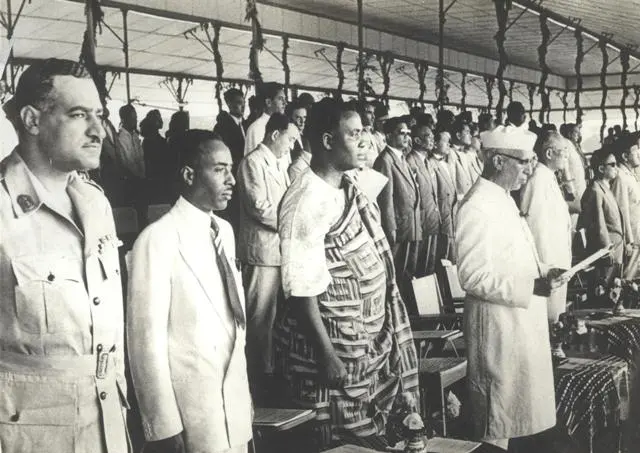
Then came Africa. On 6 March 1957 the Gold Coast became Ghana, and its leader, Kwame Nkrumah, told the crowd: “At long last, the battle has ended!” He added that Ghana’s independence was “meaningless unless it is linked up with the total liberation of Africa.” Within a few years much of it was. In 1960 alone seventeen new members joined the UN, sixteen of them African, and that year the General Assembly declared that colonialism should be brought to “a speedy and unconditional end”.
Most of Britain’s colonies in Africa, and most of France’s, became independent through talks and elections. Where many European settlers lived on the land, it went otherwise. In Kenya the British fought a rising from 1952, known as Mau Mau, that came mostly from the Kikuyu people, many of whom had lost land to the settlers. It was also a civil war, since many Kikuyu fought for the government. Mau Mau fighters killed more than 2,000 people, about 200 of them British soldiers and police. Many thousands of Mau Mau were killed, and the British held many thousands of people in camps without trial. They jailed the nationalist leader Jomo Kenyatta, on weak evidence, as the rising’s organizer. In 1963 Kenyatta led Kenya to independence. Fifty years later, in 2013, the British government admitted that Kenyans had been tortured by the colonial administration, said it “sincerely regrets” it, and agreed to pay £19.9 million, lawyers’ costs included, to settle the claims of 5,228 survivors, though it still did not accept that it was to blame in law.
Algeria was the hardest case. France counted it not as a colony but as part of France itself, and hundreds of thousands of Europeans lived there. The war that began in 1954 was fought with terror on both sides: the nationalist FLN set bombs and killed civilians, Algerians and Europeans alike, and the French army tortured prisoners. It was also a war among Algerians: at its height some 60,000 Algerians, the harkis, served France as auxiliaries. How many died is still argued. Algeria’s official figure is 1.5 million; French estimates mostly run from about 250,000 to 400,000 Algerians, along with about 25,000 to 30,000 French soldiers. In a referendum in 1962, 99.7% of voters chose independence. That year about 650,000 of Algeria’s million Europeans left, and in the months after independence thousands of harkis were killed; how many, nobody can say.
Palestine, 1947 to 1949
The new states of these years include one whose birth is remembered by two peoples in opposite ways. Britain had ruled Palestine since the First World War, after promising, in 1917, to support a national home for the Jewish people there, while doing nothing to harm the rights of the “existing non-Jewish communities”, the Arabs who were most of its people. By 1947 about two-thirds of its people were Arabs and one-third Jews, many of them refugees from Europe or the children of earlier immigrants. The Holocaust, in which six million Jews had been murdered, was two years past. Britain handed the problem to the UN.
On 29 November 1947 the General Assembly voted, 33 to 13 with 10 abstaining, to divide Palestine into an Arab state and a Jewish state, joined in an economic union, with Jerusalem under international rule. India voted against. The Jewish leaders accepted the plan, though it gave them less than they wanted. The Arab leaders of Palestine and the Arab states rejected it: Arabs were two-thirds of the people, they said, and a majority had the right to decide its own country’s future, which was the self-determination the Charter itself spoke of.
Fighting between Jews and Arabs began the next day. In April 1948 fighters of two Jewish militias killed at least 107 villagers at Deir Yassin, near Jerusalem; days later Arab fighters attacked a convoy to the Hadassah hospital in Jerusalem and killed about 79 people, among them doctors, nurses and patients. On 14 May, as the British left, Jewish leaders declared the State of Israel. Its declaration spoke of “the natural right of the Jewish people to be masters of their own fate, like all other nations, in their own sovereign State”, called on the Arabs living in it to take part “on the basis of full and equal citizenship”, and offered peace to its neighbors. The next day the armies of Egypt, Jordan, Syria and Iraq crossed into Palestine. The Arab League told the UN they came to restore law and order and stop the bloodshed, and that the right to set up a government in Palestine belonged to the people who lived there.
When the fighting stopped in 1949, Israel held about four-fifths of the land of the old mandate, more than the UN plan had given it. Jordan held the West Bank and East Jerusalem, and Egypt held Gaza. About 6,000 Israelis had been killed, and many thousands of Arabs. More than 700,000 Palestinian Arabs had fled or been driven from their homes, and few were ever allowed back. Why they left has been argued ever since. Israel’s account was long that Arab leaders had told them to go. The Palestinian account, put by the historian Walid Khalidi as early as 1961, was that Jewish forces had planned to empty the land. Benny Morris, an Israeli historian who read Israel’s own army files, concluded that the war made the refugees, not a plan by either side: most fled the fighting and their fear of it, and some were driven out. Many historians on both sides still dispute how much was planned. In the years after, hundreds of thousands of Jews left or were pushed out of Arab countries where their families had lived for centuries, and most went to Israel.
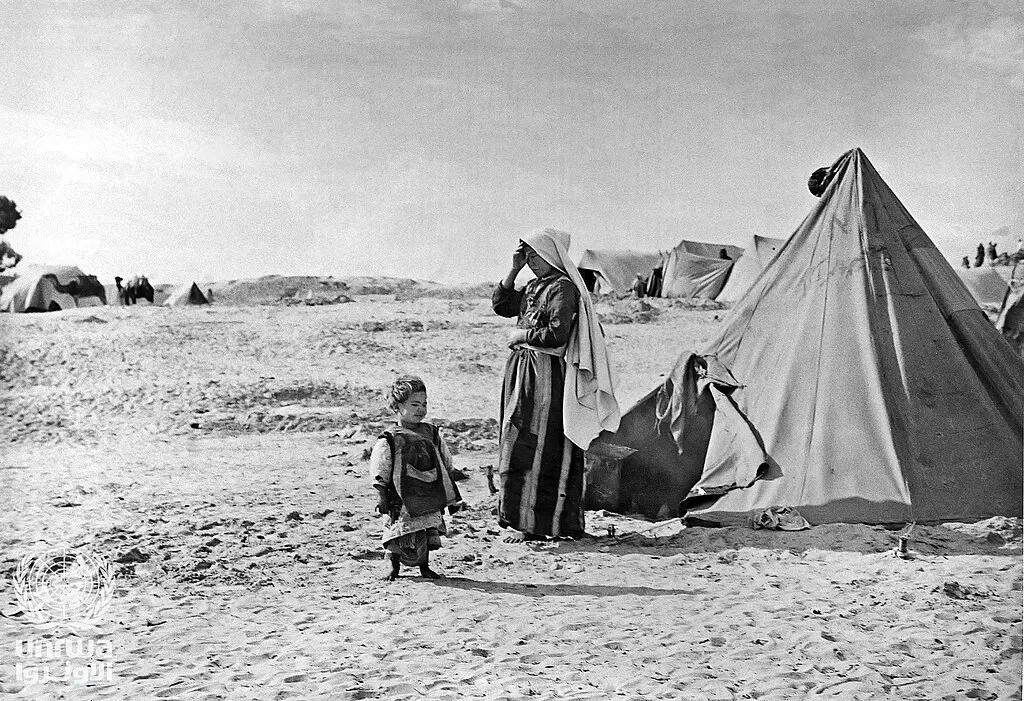
So the same war has two names. Israelis call it the War of Independence, the year a people with no country of its own, after the worst crime ever done to it, finally had one. Palestinians call it the Nakba, the “catastrophe”, the year they lost their homes and their land became someone else’s country. Both are true to the people who remember them. The UN said in December 1948 that refugees who wanted to go home and live at peace should be allowed to, and in 1949 it set up an agency, UNRWA, to care for them. In 1950 it looked after about 750,000 refugees. Their children, grandchildren and great-grandchildren, some 5.9 million people, are registered with it today. In 1967 another war put the West Bank and Gaza under Israeli rule, and the quarrel over the land is still unsettled.
Apartheid, and April 1994
While empires were ending, South Africa, one of the UN’s founding members, went the other way. Its white minority already held most of the land: a law of 1913 left Black South Africans, most of the people, 8% of it, later raised to 13%. From 1948 a new government built that inequality into a system it called apartheid, “separateness”. Every person was registered by race. Marriage across the color line was banned. Cities were divided by race, and people of the wrong race were moved out of their homes. Black adults had to carry passes saying where they were allowed to be, and could be arrested for being anywhere else. In the end Black South Africans were to become citizens of small, poor “homelands”, so that they would not be citizens of South Africa at all.
People resisted peacefully for years. In one campaign in 1952 more than 8,500 people broke the laws on purpose and went to jail. On 21 March 1960 a crowd called out by the Pan Africanist Congress gathered outside the police station at Sharpeville to protest against the passes, and the police opened fire. At least 69 people were killed, most of them shot in the back as they ran. The government declared an emergency and banned the Pan Africanist Congress and the African National Congress, the main movement against it. South Africa now keeps 21 March as Human Rights Day.
After that, some of the ANC’s leaders, Nelson Mandela among them, decided to fight with sabotage. Mandela was caught, and at his trial in 1964 he explained why. He quoted the Universal Declaration of Human Rights, that “the will of the people shall be the basis of authority of the Government”, and said that only when “all channels of peaceful protest had been barred to us” had they turned to violence. He ended: “I have fought against white domination, and I have fought against black domination. I have cherished the ideal of a democratic and free society in which all persons live together in harmony and with equal opportunities. It is an ideal which I hope to live for and to achieve. But if needs be, it is an ideal for which I am prepared to die.” He was sentenced to prison for life.
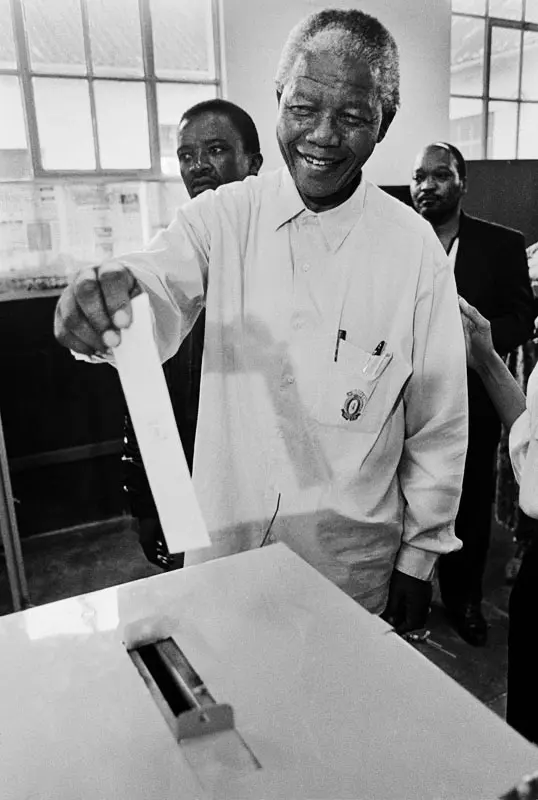
He spent 27 years there. Protest at home and pressure from abroad finally brought the government to talk. Mandela walked free in February 1990, the apartheid laws were repealed, and in April 1994 South Africans of every race voted together for the first time. The ANC won almost two-thirds of the vote, and Mandela became president.
That same April, in Rwanda, extremists from the Hutu majority began killing the Tutsi minority. In about a hundred days some 800,000 people were murdered. The UN had a small force in the country. The Security Council, instead of strengthening it, cut it from about 2,500 soldiers to 270. The UN’s own inquiry later called this a failure “by the United Nations system as a whole”, from a “lack of resources and political commitment”, and its Secretary-General, Kofi Annan, expressed his deep remorse. A peaceful revolution in one country and a genocide in another, in the same month: that is what the age of new flags had won, and how little the world body could do when its members would not act.
Harder than winning
For many new countries, especially in Africa, the years after independence brought disappointment. A Ghanaian historian, writing of the 1950s, said that “it was certainly great to be alive in those days”. Within a decade Nkrumah himself had been overthrown by army officers.
Part of the trouble was the shape the new countries were handed. Their borders had been drawn by Europeans, often across peoples and around nothing in particular. In 1964 Africa’s new states agreed to keep them anyway, since redrawing them would mean endless wars. They also inherited governments built to run a colony, which earned most of their money from taxes on what passed through the ports, the crops and minerals going out and the goods coming in. Whoever held that gate held the country’s money, and so the stakes of holding it were very high. Rulers who had it tried to keep it, rivals tried to grab it, and the army was often the strongest rival. Between 1956 and 2001, by one count, the states of Africa south of the Sahara had 80 successful coups and more than a hundred failed ones.
Many of these countries sold one or two crops or minerals, so they lived at the mercy of world prices. In the late 1970s many borrowed heavily, to pay for oil and big projects. By the early 1980s the world was in recession, the prices of what they sold had collapsed and interest rates had risen, and they could not repay. The International Monetary Fund lent more, on conditions that made governments cut spending and change how their economies were run, and in time it added measures to shield the poor from their effects. Whether the changes helped or harmed is still argued. Independence had given these countries a seat and a vote in the UN, as the Charter promised, but not the money, the strong institutions or the peace they needed to make use of them.
So two facts sit side by side. A world body built by the victors of a war and stuck for decades by the great powers’ rivalry still gave the world shared rules and rights, and those helped hundreds of millions of people win countries of their own. And winning a flag and a seat was the easier part. Living with borders drawn by others, keeping the army in its barracks and paying the bills was the long, hard part, and in many places it still is.
Meanwhile, in Nepal: Nepal joined the UN in 1955, one of sixteen countries admitted together, and its soldiers have served as peacekeepers since 1958. How it got there and what it did is told in Nepal at the United Nations, in Nepal’s History, for the Curious.
Found a mistake? Please tell us.