
On 13 February 1949, a Rana general in Kathmandu signed a short letter to the United Nations. He was Major-General Bijaya Shumsher, in charge of Nepal’s foreign affairs, and the letter asked for one thing: that Nepal be allowed to join. “Nepal is a free and sovereign State in Asia,” it said, and it promised that Nepal would carry out everything that membership asked of it.
It took almost seven years to get a yes. When the letter came before the committee that looked at new members, the delegates of the Soviet Union and the Soviet Ukraine said that, from what they knew, Nepal was not sovereign and independent at all. Kathmandu had to send a report proving it was a country of its own. Most of the committee were satisfied by it. The Soviet Union still voted no, and in September 1949 its single vote was enough to keep Nepal out.
So the first thing Nepal had to do at the United Nations was show that it existed. This chapter is about what it did once it was in: how a small, poor country between two giants used a seat in the world’s assembly, the soldiers it has sent to other people’s wars since 1958, the peace it asked the world to promise it, the garden it asked the world to build at the Buddha’s birthplace, and what the UN has done in Nepal in return.
A seat in the hall
The United Nations was set up at the end of the Second World War, in 1945, by countries that wanted no third one. It works in two main rooms. In the General Assembly every member country has a seat and one vote, the largest and the smallest alike. In the Security Council, which can send armies, order punishments and decide matters of war and peace, only fifteen countries sit today (eleven then). Five of them, the winners of that war (the United States, the Soviet Union, now Russia, Britain, France and China), sit there for good, and each of the five can stop a decision on its own by voting against it. That power is called the veto. The other seats, ten today, are taken in turn by other countries, elected for two years at a time.
A country joins only if the Security Council recommends it and the Assembly agrees, so any one of the five can keep a country out. In the late 1940s the world was splitting into two camps, the United States and its friends on one side and the Soviet Union and its friends on the other, the long contest called the Cold War. Each camp blocked the other’s favorites. The Soviet delegate said plainly that he had nothing against Nepal; he would not let it in while countries he favored, such as Albania, Bulgaria and Mongolia, were kept out. Nepal was caught between them, and so were a dozen other countries, Italy, Ireland, Ceylon (now Sri Lanka) and Finland among them.
The jam broke in December 1955. The two camps agreed to let in a whole batch at once, eighteen countries, and even then it nearly failed. On 13 December China, whose seat was then held by the government on Taiwan, vetoed Mongolia, and the Soviet Union vetoed thirteen of the others, Nepal again among them. The next day the Soviet delegate withdrew those votes and offered sixteen, without Mongolia and Japan. The Council agreed, and that evening, 14 December 1955, the General Assembly voted on each country in turn. Nepal was admitted by 57 votes to none.
The Nepal that got in wasn’t the Nepal that had asked. The Ranas had fallen in 1951, as Chapter 26 tells, Nepal was in the restless decade of short-lived governments that Chapter 28 describes, and a new king, Mahendra, had come to the throne that spring. In 1956 Nepal’s foreign minister, Chuda Prasad Sharma, led the country’s first delegation to the General Assembly.
Friends with everyone
A seat in the Assembly mattered more to a country like Nepal than to most. Nepal has no coast. China lies beyond the mountains to the north, and India on the other three sides, and nearly everything Nepal bought from or sold to the rest of the world had to pass through India. In the hall in New York it had the same one vote as either of them.
Nepal’s answer to its geography, from the 1950s on, was a foreign policy called non-alignment: friendship with everyone and an alliance with no one. In the Cold War, being non-aligned meant joining neither the American camp nor the Soviet one. For Nepal it also meant something closer to home, not leaning so far toward India or China that the other felt threatened. Nepal opened relations with China in 1955, and when the leaders of the countries that called themselves non-aligned first met, at Belgrade in Yugoslavia in September 1961, King Mahendra was among them.
The same idea is written into Nepal’s constitution today, which says that its foreign policy rests on the UN’s Charter, non-alignment, the five principles of peaceful coexistence called पञ्चशील (Pañcaśīla) and international law. Governments of every kind, kings, the Panchayat, the parties and the republic, have kept to it, though they have argued about what it means in practice.
A small country’s diplomats can still matter in that hall. In September 1960 B. P. Koirala, the first elected prime minister (Chapter 28), was in New York for the Assembly and met President Eisenhower there; Nepal’s ambassador at his side was Rishikesh Shaha, later one of Nepal’s best-known historians. Three months later, in December 1960 (वि.सं. २०१७), the king dismissed B. P.’s government, as Chapter 30 tells. In September 1961 the UN’s Secretary-General, the Swede Dag Hammarskjöld, was killed when his plane crashed in Africa, in what is now Zambia, and the Assembly named five people to find out why. Their chairman was Shaha. The commission couldn’t say what brought the plane down, and could rule nothing out; the question is still open more than sixty years later.
Twice Nepal has been elected to one of the Security Council’s elected seats, for 1969–70 and for 1988–89. It hasn’t sat there since. It has put its name forward for 2037–38.
The boldest idea Nepal ever brought to the world was its own. In 1973, at a meeting of the non-aligned countries in Algiers, King Birendra asked that Nepal, “situated between two of the most populous countries of the world”, have its frontiers declared a zone of peace. At his coronation in Kathmandu, on 25 February 1975, he asked again, formally: let the world agree that Nepal would never be a battlefield, and that no country would use it against another.
Why then? Those years had made Nepal feel how small it was. Among other things, Sikkim, a small Himalayan kingdom on Nepal’s eastern border, was drawn into India and became an Indian state in 1975. As Birendra’s government later spelled it out, the proposal meant that Nepal would settle every dispute peacefully, stay out of military alliances, allow no foreign bases and let nothing hostile to other countries happen on its soil, and asked the same of them in return.
Country after country said yes: more than 110 by 1991, the United States among them (President Reagan endorsed it in 1983). Two that mattered did not: India and the Soviet Union. India pointed to its 1950 treaty with Nepal (Chapter 27) as the basis of their relations, and American officials of the time read the plan as a way to get India to promise not to meddle in Nepal’s affairs. Without India, the neighbor that mattered most, the zone of peace could never be more than a wish. After the People’s Movement of 1990 (वि.सं. २०४६, Chapter 32), the new governments let it drop, like much else the Panchayat had stood for. Some still argue it deserves another look.
Blue helmets
The UN’s soldiers wear blue helmets, and Nepal has been sending them out for almost as long as it has been a member.
It began small. In 1958, when fighting broke out in Lebanon, the UN sent officers to watch its border and report who was crossing it, and five of them were Nepali. Peacekeepers aren’t an army of conquest. They are soldiers and police lent by member countries, sent with the agreement of the sides in a war, to watch a ceasefire, stand between the fighters, guard ordinary people or help hold an election, and they are paid for by the UN. The first whole Nepali unit, a battalion of the Purano Gorakh regiment, went to the Sinai desert in Egypt in 1974, to stand between the Egyptian and Israeli armies after their war the year before. In 1978 Nepali soldiers went back to Lebanon, to the force the UN has kept along its southern border ever since, and from the 1990s Nepal Police and, later, the Armed Police Force sent officers too.
Since then the numbers have grown and grown. The Nepali Army counts nearly 150,000 Nepalis who had served in UN missions by early 2024, in more than forty missions, from Congo, Sudan and South Sudan to Haiti, Western Sahara and the Golan Heights. More than 2,500 of them were women, and by 2024 about one in ten Nepalis on a mission was a woman. In 2010 about 5,500 were serving at once; by 2024 it was about 6,000, and for a time Nepal sent more uniformed peacekeepers than any other country in the world.
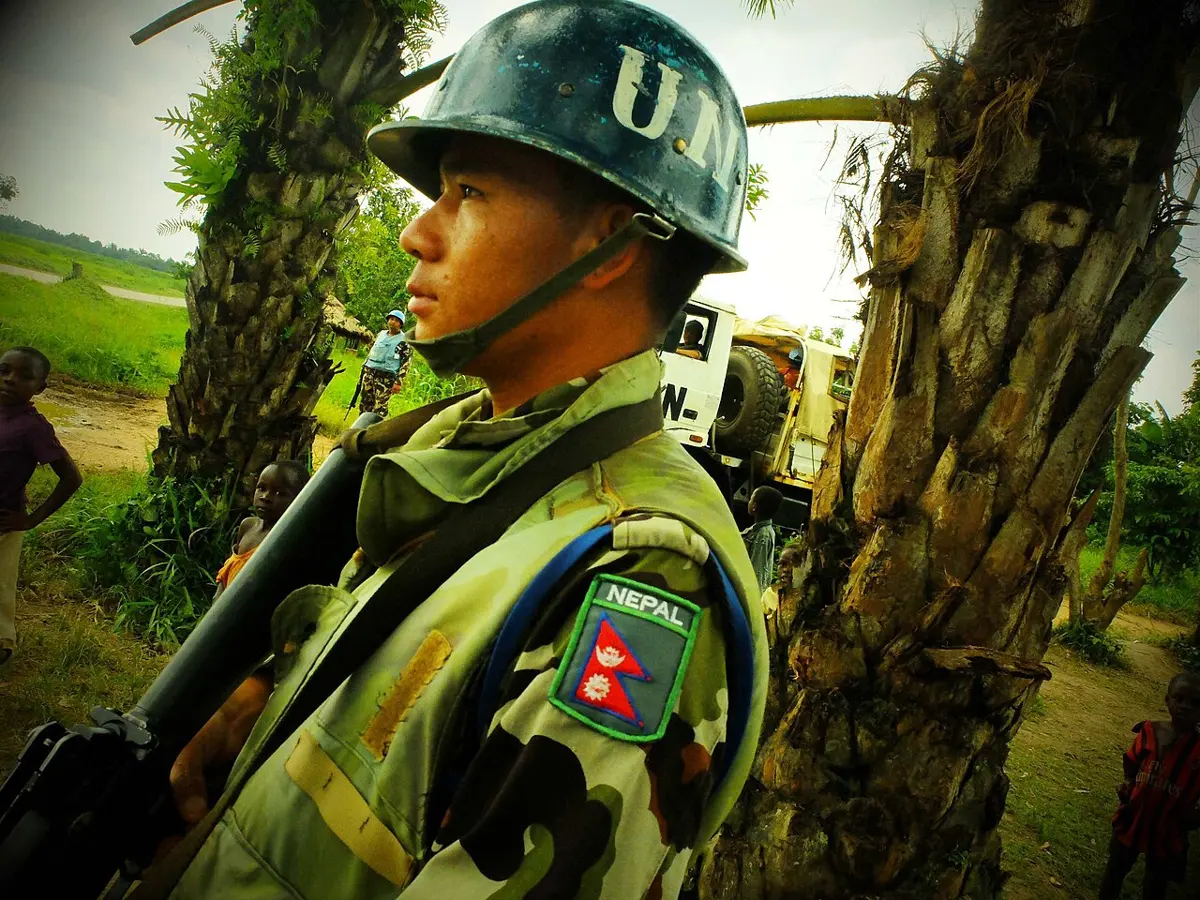
Why so many? Partly for the reasons the policy gives: a country that wants the world to keep the peace for it can show that it helps keep the peace for others, and the work wins goodwill. Partly for plainer reasons. Around 2013 a Nepali soldier on a UN mission was earning four or five times his pay at home, and the money and the experience matter to the soldiers, their families and the army alike. It follows a much older road. For two centuries Nepali men have gone abroad as soldiers, most of them in Britain’s and India’s armies (Chapter 25); the blue helmet takes them abroad under Nepal’s own flag and the UN’s.
It has cost lives. By the UN’s own count, 95 Nepalis had died while serving in its missions by the end of October 2025, from fighting, accidents and illness, nearly a third of them in Lebanon. The Nepali Army gave a smaller figure, 73, in early 2024. The UN counts every Nepali who died in its service, police and civilian staff too; whom the Army’s count covers isn’t said.
And once the cost fell on others. In 2010, after the earthquake that wrecked Haiti, Nepali soldiers were among the UN’s troops there, some of them at a camp near the town of Mirebalais. That October cholera broke out in Haiti, and the first cases were downstream of that camp. A panel of experts the UN appointed found that the camp’s sanitation was not good enough to keep sewage out of the stream beside it, and that the germ was a South Asian kind; it said the outbreak came from a mix of causes and was not the fault or deliberate act of any group or person. Nearly 800,000 Haitians fell sick and more than 9,000 died. For years the UN would not accept legal responsibility. In December 2016 its Secretary-General, Ban Ki-moon, apologized to the people of Haiti: “We simply did not do enough with regard to the cholera outbreak and its spread in Haiti. We are profoundly sorry for our role.” Nobody meant it to happen, but it belongs in this story too.
The numbers are now falling, for reasons that have nothing to do with Nepal. In October 2025, short of money because members had paid late or not in full, the UN began cutting about a quarter of its peacekeepers. And the Security Council has decided that its force in Lebanon, where Nepalis first went in 1978, will stop its work at the end of 2026 and leave within a year. In February 2026 Nepal had about 4,300 people in UN missions, second only to Rwanda.
A garden for the Buddha
In April 1967 the UN’s Secretary-General, U Thant, a Buddhist from Burma, came to Lumbini on pilgrimage. Chapter 6 tells how the Buddha’s birthplace was found by its pillar in 1896; by 1967 it was still a neglected spot near the Indian border. U Thant called it one of the most important days of his life, his grandson says, and one account adds that he wept. Back in New York he set the UN to work on it. An international committee of thirteen countries, later sixteen, was formed in 1970, and the Japanese architect Kenzo Tange, who had designed Hiroshima’s Peace Memorial Museum, was asked to plan the place.
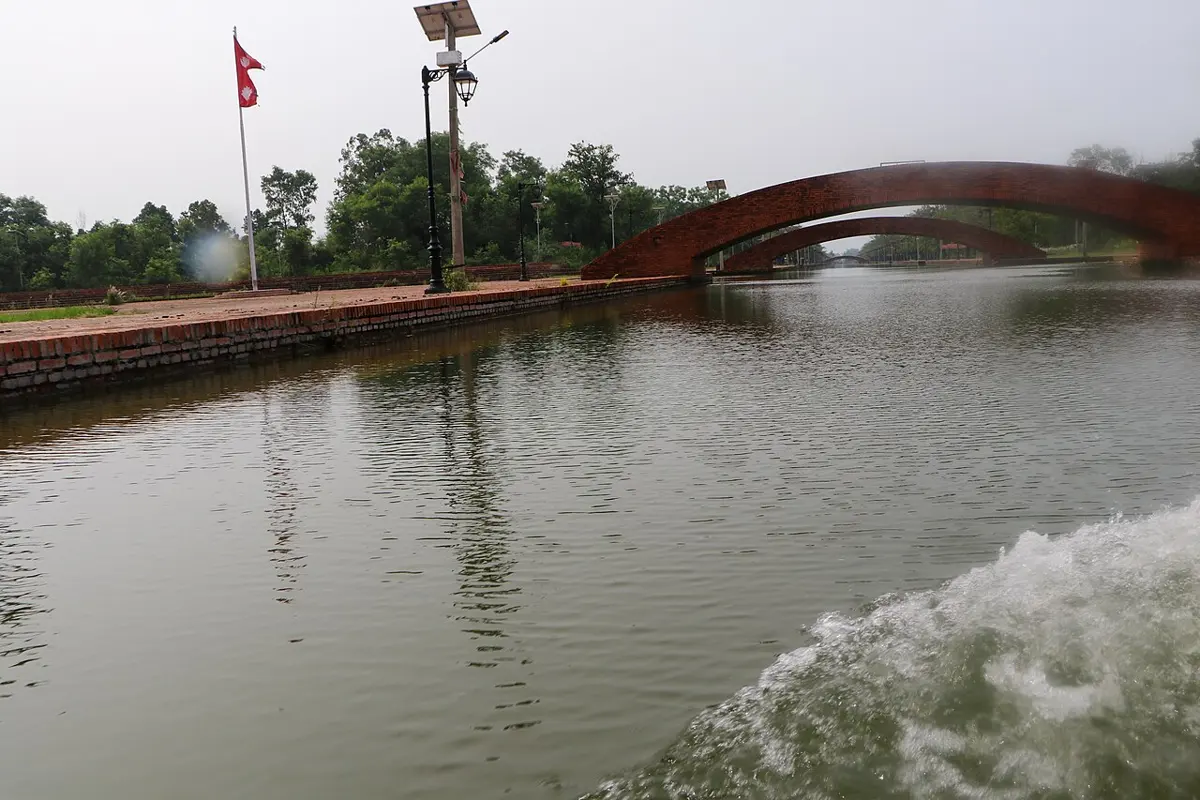
Tange’s plan, finished in 1978 and approved in Nepal soon after, is laid out along a straight canal running north and south through an area of about three square miles: the sacred garden round the Maya Devi temple at the south end, a museum and library at the north, and between them two zones of monasteries, Theravada Buddhists’ on the east and Mahayana Buddhists’ on the west, built by the Buddhist countries and communities of the world. Lumbini was made a World Heritage Site in 1997.
It was meant to be finished by 1985. It wasn’t, and when U Thant died, in 1974, the UN’s interest faded with him. Tange died in 2005 with his plan still unfinished. In 2026 the Lumbini Development Trust said more than 88 percent was done, though others doubt that anyone can put a number on it, most of what remains in the village for visitors, planned in 1978 and promised again ever since.
What the UN has meant to Nepal
Seen from Nepal, the UN isn’t only a hall in New York. The first UN agency to work in Nepal, the Food and Agriculture Organization, came in 1951, before Nepal was even a member, and in 2026 eighteen UN agencies kept offices in the country, working on children’s health, schools, food and farming, refugees and much else. Kathmandu is also home to the UN’s center for peace and disarmament in Asia and the Pacific.
The UN keeps Nepal on its list of Least Developed Countries, poor countries that get easier terms in trade and aid, where it has been since 1971. Nepal was due to leave the list in November 2026; in October 2026, at Nepal’s own request, the UN gave it until 2029.
From 2007 to early 2011 the UN came to Nepal in a different way, with a political mission sent at the request of the government and the Maoists, to watch over the arms and fighters of both sides after the war and help hold the election of the Constituent Assembly. That is part of the story of the peace, in Chapter 35.
And Nepalis have worked inside the UN at every level, from the soldiers to the top. Kul Chandra Gautam, who grew up in the hills of Gulmi, rose through UNICEF, the UN’s children’s fund, to become its deputy head and an Assistant Secretary-General, from 2000 to 2007; he called his memoir Global Citizen from Gulmi.
So the story of Nepal at the UN is a small country’s story. It had to prove in 1949 that it was a country at all, and it got in only when the great powers stopped blocking each other. Once inside, it used the seat to say what it wanted to be, friends with everyone, aligned with no one, and tried to get the world to promise it peace. That never fully worked, because the neighbor that mattered most didn’t agree. What did work was quieter: tens of thousands of soldiers and police sent to keep other people’s peace, at a price paid in lives, and once by others; a garden at the Buddha’s birthplace that the world helped plan; and a voice in a room where every country, however small, has one vote.
Meanwhile, in the world: the United Nations’ Charter was signed by fifty countries at San Francisco in June 1945, two months before the end of the Second World War, and the organization came into being on 24 October 1945, now kept as UN Day.
Found a mistake? Please tell us.