
On a Sunday in January 1905, a priest who ran a workers’ society in St Petersburg, then the capital of Russia, led a march of workers toward the Winter Palace, the home of the Tsar, Russia’s emperor. They carried a petition. It asked for an eight-hour working day, fairer wages and a parliament elected by the whole people, and it ended by saying that if the Tsar would not answer, they would die there in the square before his palace. Soldiers opened fire on the marchers. The government counted 96 dead. Its enemies spoke of thousands. Nobody knows the true number, but with the wounded it ran into the hundreds.
Many Russians had thought of the Tsar as a kind of father, who would put things right if only he knew. After that day, which became known as Bloody Sunday, people said they no longer had a Tsar. Twelve years later they really didn’t.
In 1917 Russia had two revolutions in eight months. In the first, crowds and soldiers in the capital brought down the Tsar, Nicholas II, and a temporary government took his place. In the second, a small, tightly run party called the Bolsheviks, led by Vladimir Lenin, took power for itself. It won a civil war and built the world’s first state run by a communist party. Under Lenin’s successor, Joseph Stalin, that state forced the peasants onto collective farms, and famine and mass shootings followed that killed millions. Yet far away, in India, China, Vietnam and later Nepal, people fighting empires looked to Russia with hope. This chapter is about how all of that can be true at once.
One puzzle first. Russia still used the old Julian calendar, which by then ran 13 days behind the one used almost everywhere else. So the revolutions Russians call February and October happened, by the calendar used in this book, in March and November.
The Tsar’s Russia
Most Russians were peasants. Until 1861 most of them had been serfs, bound to their lord’s land. That year the Tsar freed more than 23 million of them, but they had to pay for the land they got, with interest, over 49 years. So the peasants were free, but poor, short of land, and sure that the great estates were rightfully theirs. In the cities, factories were going up fast, and their workers lived crowded, long-houred lives. And the educated young read about parliaments and socialism abroad and formed underground parties. The Socialist Revolutionaries spoke for the peasants. The Social Democrats followed Karl Marx, who taught that factory workers would one day overthrow the owners. In 1903 the Social Democrats split. Lenin’s side, which won a key vote, called itself the Bolsheviks, “the majority”, and its rivals the Mensheviks, “the minority”. Lenin wanted a small party of full-time revolutionaries to lead the workers.
Over it all sat the Tsar, who believed his power came from God and answered to nobody. In 1905, just as Russia was losing a war to Japan, Bloody Sunday set off strikes across the empire, and that year half the factory workers of European Russia went on strike. In October Nicholas gave way and promised a parliament, the Duma. Its members were elected, but not equally: the vote was arranged in groups, and a landowner’s counted for far more than a peasant’s. When the first two Dumas proved too critical, Nicholas sent them home and changed the rules to give landowners even more weight.
Then came the First World War. By early 1917 Russia’s huge, poorly supplied armies had lost about 1.7 million men killed and millions more wounded or captured. In 1915 Nicholas went to the front to command the army himself, leaving his wife, the Empress, in charge at home. She leaned on Rasputin, a wandering holy man who seemed able to ease the bleeding of her son, who had hemophilia, and rumors about his power, many of them untrue, made the court a scandal. In December 1916 a group of nobles murdered him. The railways, overstretched by the war, could not carry enough food, prices soared, and in the cities people queued for bread.
1917
On 8 March 1917, International Women’s Day, women in Petrograd, as St Petersburg had been renamed, came out to protest about bread. They marched to the factories and called the men out to join them, and within days nearly every factory in the city had stopped. Some troops fired on the crowds. Then whole regiments of soldiers, most of them young conscripts, refused, joined the crowds and handed out rifles. With his capital lost, Nicholas gave up the throne on 15 March, in his train at Pskov, stopped on its way back to the city. Over 1,300 people had been killed. A monarchy three hundred years old had fallen in about a week.
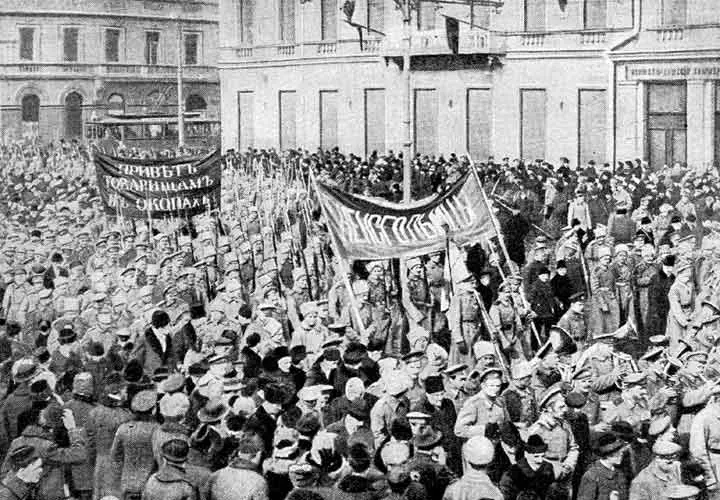
Two bodies now claimed to speak for Russia. Leading members of the Duma set up a Provisional Government, meaning a temporary one, to run the country until an elected assembly could write a constitution. At the same time workers and soldiers elected their own council, the Petrograd Soviet (soviet is Russian for “council”), and soviets sprang up across the country. The government had the ministries; the soviets had the loyalty of the soldiers and workers. People called it “dual power”. The new government gave Russians freedoms they had never had, including the vote for women. But it kept fighting the war, and it left the land question for the assembly to settle.
Lenin was in Switzerland when the Tsar fell. Germany, which wanted Russia out of the war, let him and about thirty other exiles cross its territory by train, and he reached Petrograd in April. At once he set out what the Bolsheviks should do: no support for the Provisional Government, an end to the war, the great estates taken from their owners, and all power to the soviets instead of a parliament. Even many Bolsheviks thought this too much at first. But over the summer it was what tired soldiers, hungry workers and land-hungry peasants wanted to hear.
The Provisional Government, led from July by Alexander Kerensky, a lawyer and moderate socialist, lurched from crisis to crisis. In September the army’s commander-in-chief sent troops toward Petrograd, and Kerensky, fearing a military takeover, turned to the soviets for help. The Bolsheviks helped stop the troops, came out of it as defenders of the revolution, and won over the Petrograd and Moscow soviets. Their party had grown from about 24,000 members in February to around 200,000.
Lenin now pressed his party to seize power. Leon Trotsky, a brilliant speaker who had joined the Bolsheviks that summer, organized it through a committee of the Petrograd Soviet. On 7 November armed workers, soldiers and sailors took over the bridges, the stations and the telegraph. That night they entered the Winter Palace, where the last ministers were holding out with a few cadets and a women’s battalion, and arrested them. There was almost no fighting in Petrograd; in Moscow it took a week of street battles. Kerensky escaped.
The next day a congress of soviets from all over Russia, where the Bolsheviks and their allies held most seats, passed Lenin’s first two decrees. The Decree on Peace called for “an immediate peace without annexations”, meaning without seizing anyone’s land, and promised to publish the old government’s secret treaties. The Decree on Land said: “Landed proprietorship is abolished forthwith without any compensation.” The land went to the peasants’ own committees, much as the Socialist Revolutionaries had long proposed.
Russia then held the election everyone had been promised, for the assembly that would write the constitution. The Bolsheviks won about a quarter of the votes, strongest in the cities and among soldiers; the Socialist Revolutionaries won the most. The assembly met once, on 18 January 1918. Guards closed it in the early hours, and the next day the government declared it dissolved. Within months, once its partners from the Socialist Revolutionaries had left the government, Russia was ruled by one party, in the soviets’ name.
So was October a revolution of the people, or a takeover by a small party? Historians still argue. Soviet histories told it as the workers’ triumph. Some historians call it a coup, power captured by a small minority. Others see a real people’s revolution that carried in it the seeds of the violence and dictatorship to come. The crowds and the soviets were real, and so was the hunger for peace and land. Ruling by one party, and by force, was the Bolsheviks’ choice.
Civil war, and Lenin’s state
Peace came first, and it was harsh. In March 1918, at Brest-Litovsk, Russia signed a treaty with Germany that gave up about a third of the old empire’s people, half its industry and nearly all its coal. Lenin argued that Russia had no army left to fight with. The treaty was canceled when Germany lost the war that November.
By then Russia was at war with itself. The Bolsheviks’ Red Army, which Trotsky built, fought the Whites, armies led mostly by former Tsarist officers. Peasant armies called the Greens fought both, and peoples of the old empire fought for their own independence. Britain, France, Japan, the United States and others sent troops against the Reds, Japan about 70,000 of them. The fighting lasted until 1922.
Both sides killed without mercy. In July 1918 the local soviet at Yekaterinburg had Nicholas, his wife, their five children and four servants shot; whether Lenin ordered it is still argued, and no written order has been found. That September, after an attempt on Lenin’s life, the government declared a Red Terror. Its secret police, the Cheka, shot hostages and “class enemies” and set up camps. Estimates of its dead run from about 50,000 to several hundred thousand. The White armies had their own terror, with tens of thousands of victims at least, many of them Jews. With the hunger and disease that came with it, the civil war killed several million people, most of them civilians, and one or two million fled abroad.
To feed the army and the cities, the government took grain from the peasants by force, a policy later called War Communism. The peasants grew less, and after a drought in 1921 a terrible famine struck. American and European relief fed millions, but between one and five million died, depending on who counts. In March 1921 the sailors of the Kronstadt naval base, once among the revolution’s fiercest supporters, rose and demanded free elections to the soviets, and the Red Army crushed them. That same month Lenin changed course. His New Economic Policy, or NEP, let peasants sell what was left after paying a tax, and let small shops and businesses work for profit, while the state kept the banks and big industry. Trade and food came back.
The new state also promised a different life, and in places delivered it. A law of 1918 let either partner end a marriage and gave children born outside marriage the same rights as any other. In 1920 Soviet Russia became the first country in modern times to allow abortion (Stalin banned it again in 1936). From 1919 the government set out to teach every adult to read. In 1897 only about one person in four in the empire could read. By the census of 1939, nine men in ten and nearly three women in four could.
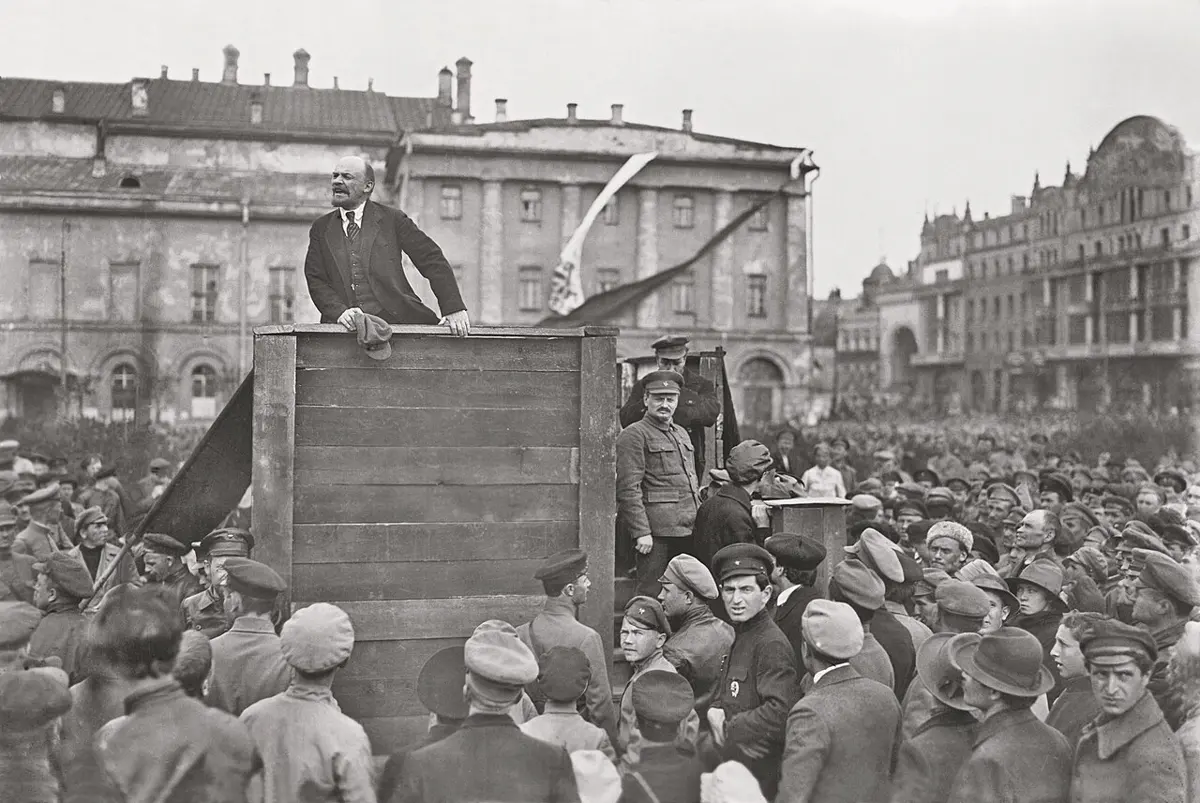
Lenin had a stroke in May 1922 and two more after it. Between them he dictated notes on his comrades. Stalin, the party’s general secretary, he called too coarse for that post, and he asked the others to find a way to move him. When Lenin died in January 1924, his notes were read only to small groups of delegates, and Stalin kept his job.
Stalin
One by one Stalin pushed the other leaders aside. Trotsky was expelled from the party in 1927 and thrown out of the country in 1929; in 1940 an agent of Stalin’s killed him in Mexico with an ice axe. By 1929 Stalin was in charge, and he set off what was called a revolution from above. The NEP was ended. Five-Year Plans poured the country’s money into steel, coal and machines, while ordinary goods ran short. “We are fifty or a hundred years behind the advanced countries,” Stalin told the managers of industry in 1931. “We must make good this distance in ten years.” Old Russia, he said, had been beaten again and again, by Mongols, Turks, Swedes, Poles, the British, the French and the Japanese, because it was backward. The number of factory workers almost doubled in four years.
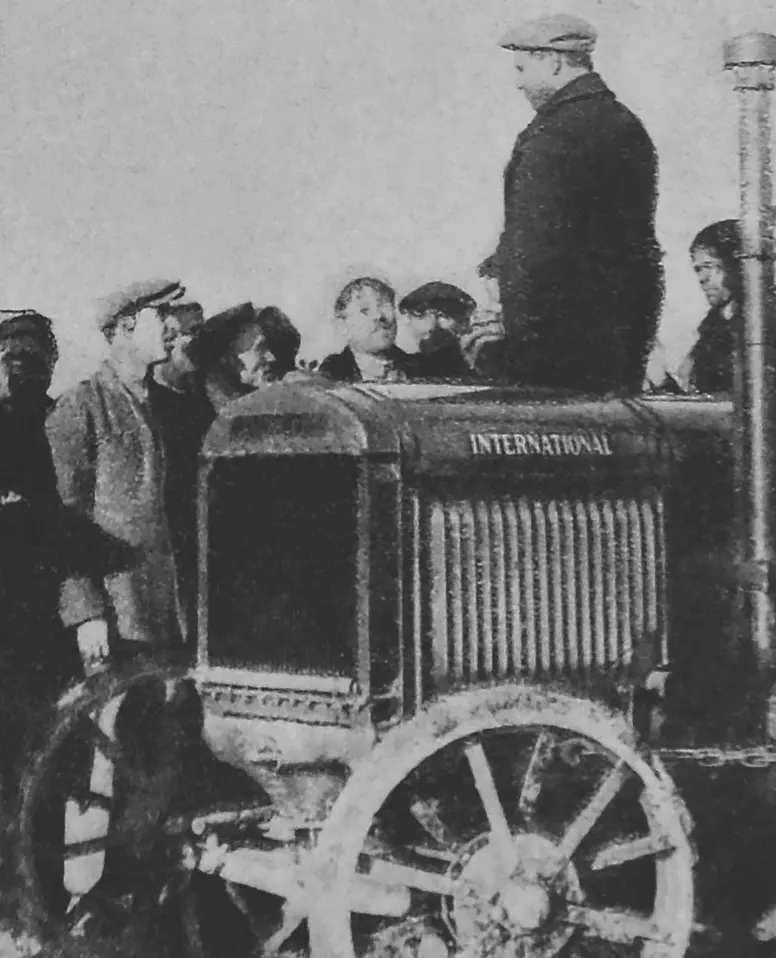
The money and the food for it came from the countryside. From late 1929 the peasants were driven into collective farms, where the land, animals and tools belonged to the farm, and the farm had to deliver grain to the state. Better-off peasants, called kulaks, were treated as enemies; more than two million people were deported between 1930 and 1933 to the far north, Siberia and Kazakhstan. Rather than hand their animals over, many peasants slaughtered them.
The demands for grain did not stop when the harvests fell. In 1932 and 1933 famine spread through the grain-growing lands, and about six million people or more died across the Soviet Union. It struck hardest in Ukraine. There, villages that fell short of their grain quotas were put on blacklists and their shops shut, and from January 1933 starving peasants were forbidden to leave to look for food. Grain was still being sent abroad. Ukrainians call this famine the Holodomor, “killing by hunger”. Most estimates made from the Soviet records put Ukraine’s dead at between about three and five million. In Kazakhstan, where nomads were forced to settle and their herds were taken, about a million and a half people died, roughly a third of all Kazakhs.
Was it genocide, a deliberate attempt to destroy Ukrainians as a people? Ukraine’s parliament said so in a law of 2006, and more than thirty other countries and the European Parliament have since said the same. Historians are divided. Some argue that a famine caused by collectivization was then turned deliberately against Ukrainians. Others call Stalin’s policies criminal but find no proof that he set out to kill Ukrainians as such, and most historians in Russia reject the word. Nobody serious doubts the hunger, or that Stalin’s policies caused it.
Then the state turned on its own. In what is called the Great Terror, from late 1936 to late 1938, the secret police arrested about 1.7 million people and shot about 700,000 of them. These numbers come from the police’s own records, opened after the Soviet Union ended in 1991. Some were party leaders, made to confess in show trials to crimes they had not committed. Most were ordinary people caught in operations against “anti-Soviet elements”: former kulaks, priests, and national minorities such as Poles. The army lost three of its five marshals. Stalin signed lists of names for execution himself. And photographs like the one of Lenin in 1920 were changed, so that people who had fallen from favor vanished from the past too.
Hope from far away
Why, with all this, did so many people across Asia look to Moscow with hope? Because they saw a different Russia from the one inside it.
In 1919 a young Vietnamese man in Paris, later known as Ho Chi Minh, had asked the peacemakers for his people’s rights and got no answer. The next year he read Lenin’s theses on the nations and the colonies. He wrote long afterward that he wept with joy and shouted, alone in his room: “This is what we need, this is the path to our liberation!” Lenin had divided the world into oppressor nations and oppressed ones, and counted 70 percent of the world’s people in colonies and countries under others’ control. Here was a great power that had brought down its own rulers and told the colonized that their fight was its fight.
M. N. Roy, a Bengali revolutionary, wrote theses on the colonies beside Lenin’s in 1920, and Lenin told the meeting that Roy’s were written chiefly from the point of view of India. That October, in Tashkent in Soviet Central Asia, Roy and a few other Indians founded a Communist Party of India. (The party in India counts its start from a meeting at Kanpur in 1925; which date is right depends on which Indian communist party you ask.) Young Indians, among them Muslims who had left India in protest against British rule, made the long journey to study in Moscow. To them it was the center of world revolution, the friend of every fight for freedom from empire, and the place where a new world was being begun.
In January 1930 Bhagat Singh, on trial in Lahore with his comrades, came into court in a red scarf and read out a telegram for the anniversary of Lenin’s death: “We wish success to the great experiment Russia is carrying out.” He was hanged the next year. In September 1930 the poet Rabindranath Tagore spent two weeks in the Soviet Union. He came to see its schools, and he was full of praise for them. But he also wrote that in erasing the line between the individual and society, Russia was behaving “not unlike the Fascists”, and that “there is no end to violence.” Stalin had Tagore’s interview with a Soviet newspaper kept out of print. It came out only in 1988.
So what is there to take from Russia’s revolution? A government that couldn’t feed its people, and couldn’t stop losing a war, fell in a week. The party that took its place promised peace, land, bread and power to the poor. It gave the land, for a while. It gave schooling and new rights to millions, and it gave the colonized world a model and an ally. It also kept power by force, and under Stalin it starved and shot its own people in the millions. All of this happened, and telling only half of it, whichever half, gets it wrong.
Meanwhile, in Nepal: in 1949, in Calcutta, Pushpa Lal Shrestha and a few friends founded the Communist Party of Nepal, and Pushpa Lal also put the Communist Manifesto into Nepali. Its founding is told in The campaign against the Ranas, and their fall, in Nepal’s History, for the Curious.
Found a mistake? Please tell us.