
On a September night in 1931, outside the city of Mukden in Manchuria, China’s far northeast, a Japanese lieutenant set off a charge of explosives beside a railway line. The railway belonged to a Japanese company, and Japan kept an army in Manchuria to guard it. The blast was so weak that it damaged about a meter and a half of rail on one side, and a train ran over the spot soon afterward. It didn’t matter. The officers who had planned it blamed Chinese soldiers and attacked the Chinese garrison nearby, and by the next evening the city was in Japanese hands. Within five months Japan’s army held all of Manchuria.
Since 2017 China has officially dated its war against Japan from that night. Europe’s road to war began later, but why a second world war came only twenty years after the first can be said in a paragraph.
The peace of 1919 left Germany bitter, and Italy and Japan dissatisfied. The League of Nations, set up to keep the peace, had no army and could only ask. Then, from 1929, the Great Depression threw millions out of work and made many people give up on the parties that had governed them. In Italy, Germany and Japan, men came to power who believed their nation needed an empire and could take one by force, and enough ordinary people backed them, or went along, for them to try. Britain and France, the powers that might have stopped them, remembered the last war too well and gave way, step by step, until the step was Poland.
A peace without police
The League of Nations began its work in January 1920. Its rules, the Covenant, asked a great deal of its members. They were to cut their armies “to the lowest point consistent with national safety”. They were to respect each other’s borders. Any war, or even the threat of one, anywhere, was “a matter of concern to the whole League”. A country with a quarrel was to take it to judges or to the League’s Council and wait. And a member that went to war anyway was to be treated as if it had attacked all the others, who would cut off its trade and its money.
The catch was in that last promise. The League had no soldiers. It could act only if its members chose to, and the strongest often didn’t. The United States, whose president had argued for the League, never joined, because its Senate refused. Germany was let in only in 1926 and the Soviet Union in 1934. In practice the League was Britain and France, two empires with no wish for another war.
For a while that was enough. In 1921 the League settled a quarrel between Sweden and Finland over a scatter of islands in the Baltic. And the treaty Germans hated, signed at Versailles in 1919, was being softened year by year. Its reparations, the money Germany had to pay for the war, were made easier to pay in 1924 and cut in 1929, and much of what Germany paid was lent to it by American banks. After 1932 it paid nothing more. So did Versailles cause the next war? It left Germans of every party resentful, and it gave Hitler a grievance to shout about. But a treaty already being taken apart doesn’t explain why Germans turned to a man like him. That took the slump, and before it, a model.
Mussolini, and the crash
The model came from Italy. Italy had fought on the winning side, and many Italians felt cheated when the peace gave Dalmatia, across the Adriatic, which Britain and France had promised them in 1915, to the new kingdom of the Serbs, Croats and Slovenes. In 1919 and 1920 Italian workers struck and occupied factories, and landowners and factory owners grew frightened. Benito Mussolini, a newspaper editor who had once been a socialist, gathered former soldiers into fighting squads, the Fascists. In black shirts they beat socialist politicians and union organizers, and smashed the presses of their newspapers, while the police often looked away and sometimes handed them guns.
In October 1922 the Fascists set out to march on Rome. Fewer than 30,000 of them came. The prime minister asked the king to sign an order for the army to stop them, and the king refused. Why is still argued: he may have doubted the army would obey, or feared a civil war, or simply wanted a weak government gone. Mussolini, who had stayed in Milan, came to Rome and was made prime minister on 30 October. The march that Fascists later celebrated as a seizure of power was really a hand-over. Within a few years, after his followers murdered a socialist deputy who had exposed their violence in parliament, Mussolini ruled alone, with a secret police, strikes outlawed and every party but his own gone.
Outside Italy he was a curiosity until 1929. In October that year prices on the New York stock exchange collapsed. American banks, short of money, called home their loans, and Germany, which had lived on American loans, was hit hardest. Banks failed, firms shut and trade between countries fell by more than half. In 1932 German factories turned out less than half of what they had in 1928. In the summer of 1929 about 1.3 million Germans were registered as out of work. By the winter of 1932 there were more than six million.
Hitler, and the Germans who came along
Adolf Hitler, an Austrian who had fought in the German army, joined a small party in Munich in 1919 that was soon renamed the National Socialist German Workers’ Party, the Nazis. In 1923 he tried to seize power in Bavaria and failed, and in prison he began a book, Mein Kampf (“My Struggle”). It said the Jews were Germany’s deadly enemy and that Germany must win Lebensraum, “living space”, by conquering land to the east, in Poland and Russia, Ukraine above all.
In 1928 the Nazis won 2.6 percent of the vote. After the crash they won 18 percent, in 1930, and in July 1932, 37 percent, which made them the largest party in the Reichstag, Germany’s parliament. They offered to sweep away a republic that seemed to have brought only humiliation, poverty and squabbling parties, and their stormtroopers fought Communists in the streets. Who voted for them is not what people often assume. A study of the results district by district found that the unemployed voted Nazi less than others and Communist more. The Nazis did best among the working poor the slump squeezed: shopkeepers, craftsmen, small farmers, farm laborers and servants. They did better in Protestant regions than in Catholic ones.
The Nazis never won a majority in a free election. In November 1932 their vote fell to 33 percent. What made Hitler chancellor, Germany’s head of government, was a deal. Since 1930 no government could command a majority in the Reichstag, and chancellors had governed by the emergency decrees of the president, Paul von Hindenburg, an old field marshal of the last war. Conservatives around him, believing they could tame Hitler, persuaded him to appoint Hitler on 30 January 1933.
They had misjudged him completely. In February the Reichstag building burned, and the government blamed the Communists. The next day an emergency decree suspended freedom of speech, of the press and of meeting, and the privacy of letters. At the election in March, with stormtroopers attacking their opponents and four thousand Communists under arrest, the Nazis still won only 44 percent. On 23 March the Reichstag met in an opera house, with stormtroopers and SS men in the hall and all 81 Communist members, and 26 Social Democrats, kept away under arrest. It passed the Enabling Act, which said that laws “may also be enacted by the Reich Government”, and that such laws “may deviate from the Constitution”. Only the Social Democrats voted against. In June they were banned too, and three thousand of them were arrested; in a single Berlin district, of five hundred people seized in one week, ninety-one died.
How did a whole country go along? Robert Gellately has argued that most Germans backed the regime: newspapers reported the camps openly, as places to set criminals and enemies of the state straight, and many people approved of such “law and order”; and ordinary people denounced their neighbors to the Gestapo, the secret police. Richard Evans answers that consent means little when choosing otherwise gets you beaten or killed: the Nazis’ violence fell not on a few outcasts but on Communists and Social Democrats, millions of ordinary working people, and fear stayed with everyone. Ian Kershaw, Hitler’s biographer, found a key in a speech of 1934, in which an official told colleagues that Hitler could hardly order everything himself, so it was “the duty of everybody to try to work towards the Führer along the lines he would wish”, guessing what he wanted and doing it without waiting for orders. That, Kershaw argued, is how the regime worked. Officials and party men, but also doctors, judges, businessmen and neighbors settling scores, each with aims of their own, did what they guessed Hitler wanted, and each step went further than the last.
Those wishes were never hidden. In 1935 the Nuremberg Laws made Jews subjects without full rights rather than citizens. On 9 and 10 November 1938, across Germany, Nazi squads burned synagogues and smashed Jewish shops; at least 91 Jews were killed and 30,000 Jewish men sent to concentration camps. And in November 1937 Hitler told his generals that Germany’s problems could be solved only by “greater living space”, beginning with Austria and Czechoslovakia. Where that led is Chapter 31.
Japan’s officers
The slump hit Japan too, and its villages hardest. Its industry recovered faster than most countries’, but many Japanese hoped that Manchuria would lift them out of hardship, and from 1935 poor farming families were encouraged to settle there; about 320,000 went. The Mukden plotters were officers of Japan’s army in Manchuria, and they acted without the government’s order; the government in Tokyo didn’t stop them. At home the newspapers cheered the army and sold more copies by doing so, and the conquest was popular. In 1932 Japan set up a new state there, Manchukuo, with China’s last emperor as its head.
China asked the League for help, and the League sent a commission to look. Its report, published in October 1932, found both countries had real grievances, but said Japan’s attack could not be counted as legitimate self-defense and that Manchukuo could not have been made without Japan’s troops. In February 1933 the League’s Assembly adopted the report. Japan alone voted against, and Siam abstained. Japan’s delegates walked out, and Japan left the League. Nobody did anything more. Manchuria was the League’s first great test, and other governments watched it fail.
Inside Japan the army’s grip tightened, sometimes by murder. Before dawn on 26 February 1936 about 1,500 soldiers led by young officers took over the center of Tokyo. They killed a former prime minister, a general and the finance minister, who had pulled Japan out of the slump and then begun to cut the money for arms. They wanted a “Shōwa Restoration”, rule by the emperor in their sense, freed of politicians and big business. The emperor wanted no mercy. “Killing my ministers is tantamount to strangling me with cotton wool,” he said, and he had the rising put down in four days; nineteen of its leaders were executed. Yet the army came out stronger. The next government agreed that only serving officers could be ministers for the army and navy, which in effect gave the army a veto over every government.
In China, Chiang Kai-shek, the leader of the Nationalist government, had decided to crush the Communists before fighting Japan: “first internal pacification, then external resistance”. In December 1936 two of his own generals seized him at Xi’an and made him join with the Communists against Japan. Seven months later, on the night of 7 July 1937, Japanese troops were holding exercises near a bridge at Wanping, 16 kilometers from Beijing, the bridge Europeans call the Marco Polo Bridge. Shots were fired, a Japanese soldier went missing (he had lost his way and soon turned up), and Japan demanded to search the town. China refused, and fighting broke out. A local ceasefire was agreed within days, but Japan sent more troops, and by the end of July it had taken Beijing. In August the fighting spread to Shanghai, and it was full war.
Who fired the first shots is unknown. In 2010 Japanese and Chinese historians, writing a history of the war together for their two governments, agreed that “Japan’s illegal acts of aggression were the main cause of hostilities”. They still disagreed about that night: the Japanese historians held that it began by accident, while the Chinese left open the possibility that Japan had planned it. The war that followed, from Shanghai and Nanjing onward, is Chapter 32.
Giving way
In Europe the League’s second great test came in Africa. In October 1935 Italy invaded Ethiopia, one of only two African countries Europeans had not taken in the scramble for Africa, the country whose army had beaten Italy’s at Adwa in 1896. This time the League did act, a little. It named Italy the aggressor, and fifty members voted for sanctions, limits on trade with it. But oil, coal and steel were left off the list, for fear Mussolini would answer with war, and Britain kept the Suez Canal open to his ships. In December the British foreign secretary and the French prime minister secretly agreed to offer Italy much of Ethiopia; when the plan leaked, the outcry forced the British minister to resign. Italian planes dropped hundreds of tons of mustard gas, banned by a treaty Italy had signed. In May 1936 Italian troops entered Addis Ababa. Estimates of the Ethiopians killed run as high as a quarter of a million.
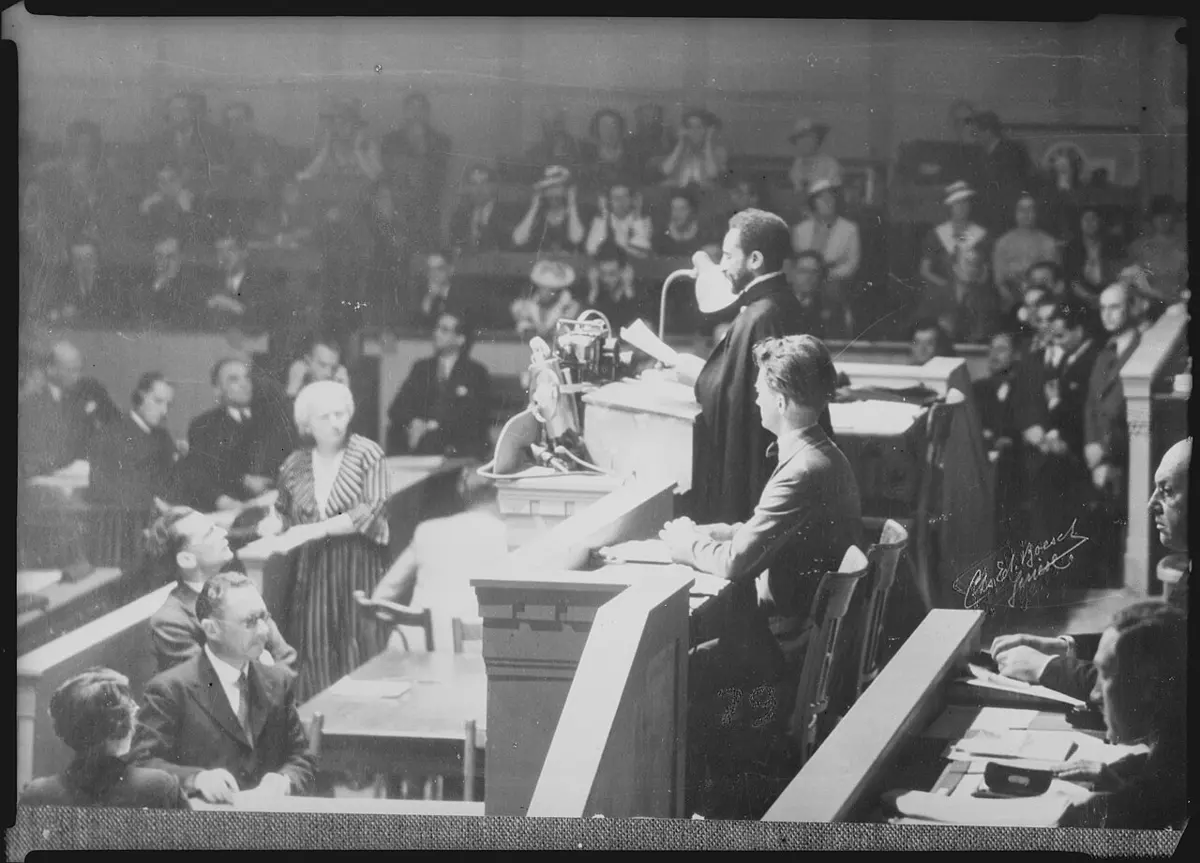
At the end of June the emperor, Haile Selassie, came to Geneva to speak. As he was announced, Italian journalists in the gallery whistled and jeered until they were thrown out. He spoke in Amharic, his own language. He described the gas, falling from sprayers on the planes as “a fine, death-dealing rain”, and he told the delegates that what was at stake was “collective security: it is the very existence of the League of Nations”. “God and history will remember your judgment,” he said, and he asked, “What reply shall I have to take back to my people?” In July the League lifted its sanctions.
Hitler had already begun. In March 1936, while the world watched Ethiopia, German troops marched into the Rhineland, the strip of Germany along the French border that the treaty had left without soldiers. Germans celebrated. France did not act, and Britain’s prime minister said that British people would not stand for using force. That July, Spain’s generals rose against its elected republic. In nearly three years of civil war, Germany and Italy sent the rebels planes and troops, and the Soviet Union sent the Republic arms; Britain and France kept out. In 1937 German bombers flattened the Basque town of Guernica. Hundreds of thousands died before the generals won. By then Germany, Italy and Japan had signed agreements against communism, and Mussolini spoke of an “axis” running through Rome and Berlin.
In March 1938 German troops entered Austria, Hitler’s birthplace, and many Austrians cheered; a vote held afterward, under Nazi control, gave 99.7 percent for joining Germany. Then Hitler demanded the edge of Czechoslovakia, the Sudetenland, where about three million German speakers lived. On 30 September 1938, at Munich, the leaders of Britain, France, Italy and Germany agreed to give it to him, with no one from Czechoslovakia in the room and no one from the Soviet Union, an ally of the Czechs. Neville Chamberlain, Britain’s prime minister, flew home waving a paper that he and Hitler had signed, and told the crowds he believed it was “peace for our time”.
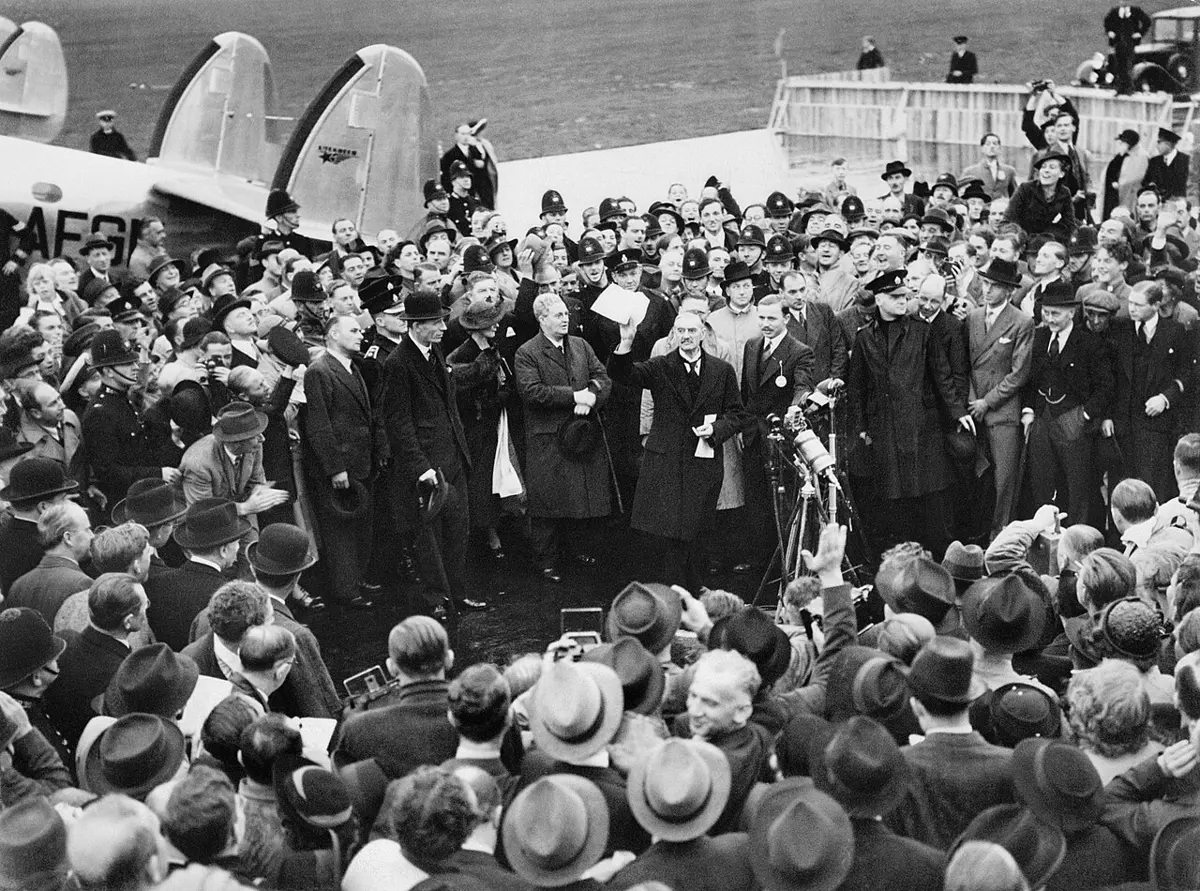
That policy, giving way to some of the dictators’ demands in the hope of satisfying them, is called appeasement. After the war it became a byword for cowardice. Historians since have been more careful. Britain’s leaders faced a public horrified by the memory of the trenches, forces not ready for war and a real fear of communism, and many in Britain thought Germany had been treated unfairly in 1919. One historian called it “a choice of evils”. Another answered that the worst mistake was to believe Hitler wanted peace, when he was set on war. In March 1939 Hitler took the rest of the Czech lands. At the end of that month Britain and France promised to defend Poland, whose port of Danzig and strip of land to the sea, the Polish Corridor, Hitler now demanded.
To fight Poland without risking a war on two fronts, Hitler needed the Soviet Union, the country his book said Germany must conquer. Stalin, its ruler, had been talking slowly with Britain and France about an alliance, and the talks had stalled. On 23 August 1939, in Moscow, the German and Soviet foreign ministers signed a pact: neither country would attack the other for ten years. A secret protocol, which the Soviet Union denied until 1989, divided Eastern Europe between them. In Poland their spheres would meet along the rivers Narew, Vistula and San, and whether there should be an independent Polish state at all, it said, “can only be definitely determined in the course of further political developments.”
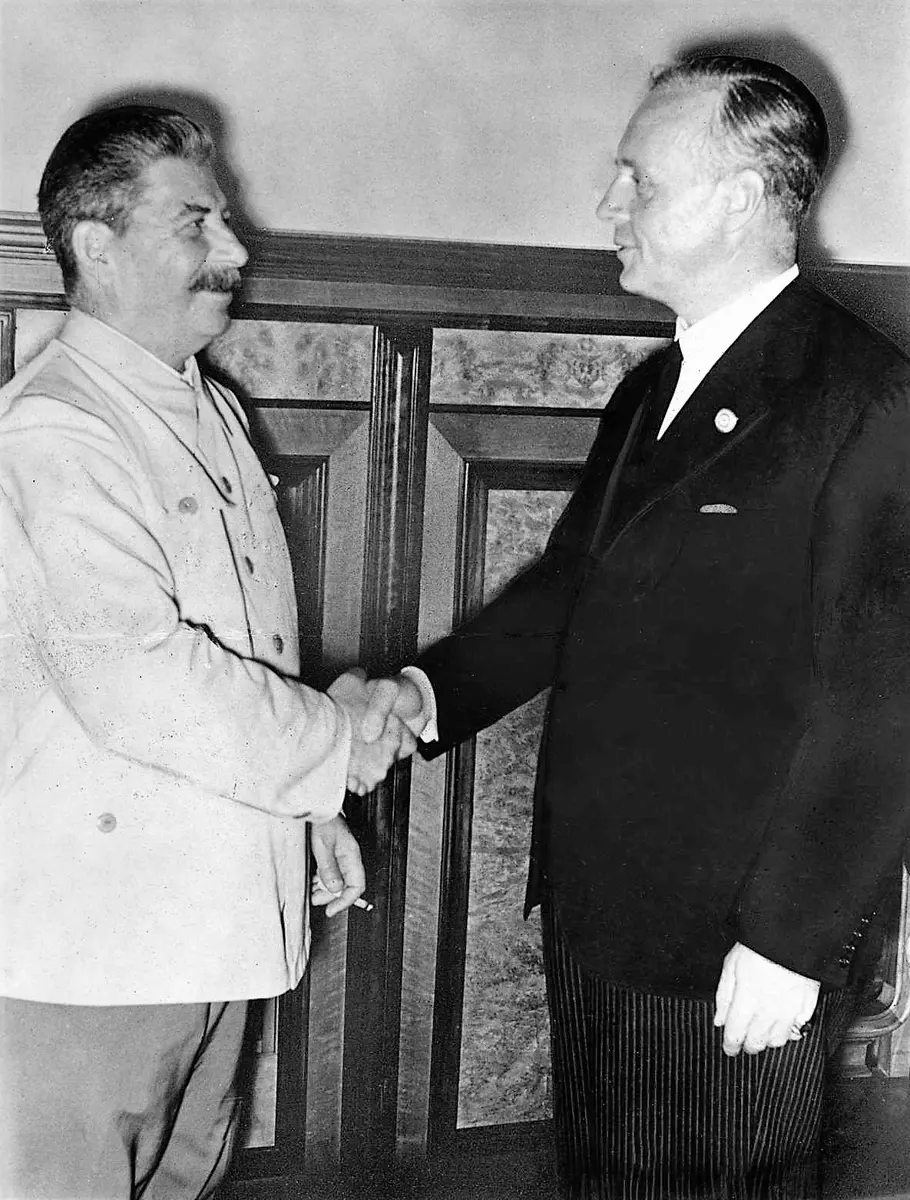
Nine days later, on 1 September 1939, German armies crossed into Poland. On 3 September Britain and France declared war on Germany. Two weeks after that, as the protocol had arranged, the Soviet army marched into eastern Poland, the part the protocol had marked as the Soviet sphere.
So the Second World War did not come from one cause. The peace of 1919 left grievances, and the League was a promise with no force behind it. The Depression broke people’s trust in the parties that ruled them. In Italy, Germany and Japan, men took power who wanted empires and were ready to take them by war, with millions of their own people backing them or going along out of hope, fear or habit. Japan’s officers acted first, in Manchuria, and the League’s failure there and in Ethiopia showed that aggression paid. Britain and France gave way until they would not, and the pact between Hitler and Stalin left Poland alone between them. Who was most to blame in Europe is not really in doubt: it was Hitler, who wanted the war. What historians argue about is why so many people, at home and abroad, let him have it.
Meanwhile, in Nepal: there were no elections to win or lose. One family, the Ranas, had ruled the country since 1846, and in 1930 forty-five young men who asked the prime minister for a public library in Kathmandu were arrested for it. How a few Nepalis began to stand up to the Ranas in the 1930s is in The campaign against the Ranas, and their fall, in Nepal’s History, for the Curious.
Found a mistake? Please tell us.