
In 1068 a judge in Toledo, in Muslim Spain, finished a short book about the peoples of the world and what each had done for learning. His name was Sa‘id al-Andalusi, and he was an astronomer as well as a judge. He sorted humanity into two groups. Eight peoples, he wrote, had cared for knowledge: the Indians, the Persians, the Chaldeans of old Mesopotamia, the Hebrews, the Greeks, the Romans, the Egyptians and the Arabs. Everyone else had not, even the Chinese, whom he called the most advanced of the rest, masters of crafts and painting. He was warm about the Indians. Their way of reckoning with numbers, he said, was the simplest and fastest there was, and showed a sharp mind and a gift for invention.
The Franks, the Arabic name for the Christians of western Europe, were not on his list at all. Their neighbors in the mountains of northern Spain, the Galicians, he put among the peoples given over to ignorance. As for the peoples of the far north, such as the Slavs, he thought the cold had made their bodies big and pale and their minds slow. He was just as unkind about peoples far to the south. This was the science of his day, which tied a people’s nature to its climate, and nobody believes it now. But it tells you how little western Europe counted, seen from one of the great cities of learning nine and a half centuries ago.
And by most measures it was poor. Around the year 1000, the largest cities in the world were in China, in Iraq and in Muslim Spain itself. Western Europe was a patchwork of small kingdoms and lordships, held together loosely by one church and one language of learning, Latin. Most people were farmers who could not read. This chapter is about how that corner of Eurasia changed over the next six hundred years. It borrowed heavily from the Arabic, Indian and Chinese worlds. It was nearly emptied by a plague. It built a printing press, centuries after Asia had first printed with movable type, and made more of it than anyone expected. Then a quarrel about religion, carried by print, split it into camps that fought for more than a century. Why it was this corner, and not another, is one of the great arguments of history, and it isn’t settled.
Learning from Arabic
Seventeen years after Sa‘id finished his book, Toledo fell. In 1085 the Christian king of Castile took the city, with its libraries and its scholars, Muslim, Jewish and Christian. Toledo stayed a city of many languages, and it became the place where western Europe went to read the books it didn’t have.
The most famous of the readers was Gerard, from Cremona in northern Italy. He wanted to study the Almagest, the great book of Greek astronomy, and there was no copy in Latin. It had been translated into Arabic centuries before, in Baghdad (Chapter 14). So Gerard went to Toledo, and there, as a short life of him written after his death says, he saw “the abundance of books in Arabic on every subject”. He learned Arabic and spent the rest of his long life translating. A list drawn up after he died names seventy-one works: the Almagest, which he worked on with a Christian from Toledo who spoke Arabic, Euclid’s geometry, al-Khwarizmi’s algebra, books of medicine, philosophy and astronomy.
Not everyone on the other side was pleased. In Seville, not long before Gerard’s time, a writer on how markets should be run asked that Muslims stop selling books of science to Christians, because the Christians translated them and then credited them to their own bishops.
Toledo was not the only door. In 1202 Leonardo of Pisa, who had learned the Indian numerals as a boy in North Africa, wrote the book that taught them to Europe, and he is remembered today as Fibonacci (Chapter 1). Paper, first made cheap in China, had been made in Baghdad since the 700s (Chapter 14). The magnetic compass, which Chinese sailors were using by about 1100, reached the Arab world and Europe about a century later. Gunpowder was Chinese too, found by alchemists looking for a medicine to make people live forever. The Inventions timeline has each of them. Europe made things of its own too. Craftsmen in northern Italy made the first eyeglasses in about the 1280s, and the first clocks driven by gears and weights went up in its towers around 1300. In the same centuries it built a new kind of school, the university, first at Bologna, then at Paris and Oxford, and put the translated books of Aristotle and Greek and Arabic science at the center of what students read. The thinkers who later grew out of them, Copernicus, Vesalius, Galileo, are on the Science timeline and the Scientists timeline.
The great dying
Then came the plague. In October 1347 twelve galleys from Genoa, an Italian trading city, put in to Sicily, and the disease came ashore with them. It had come from Central Asia (Chapter 17), by routes nobody has fully traced. Within months it was in mainland Italy, and by the middle of 1348 in France, Spain, Portugal and England. It went on through Germany and Scandinavia, and reached Moscow in 1353.
Nobody knew what it was or how it spread. In Siena, in Tuscany, a shoemaker who also collected taxes named Agnolo di Tura kept a chronicle of his city. Of 1348 he wrote that the dead were buried without a priest and without bells, that fathers left their children and wives their husbands, because the illness “seemed to strike through the breath and sight”. And he wrote: “I, Agnolo di Tura, called the Fat, buried my five children with my own hands.”
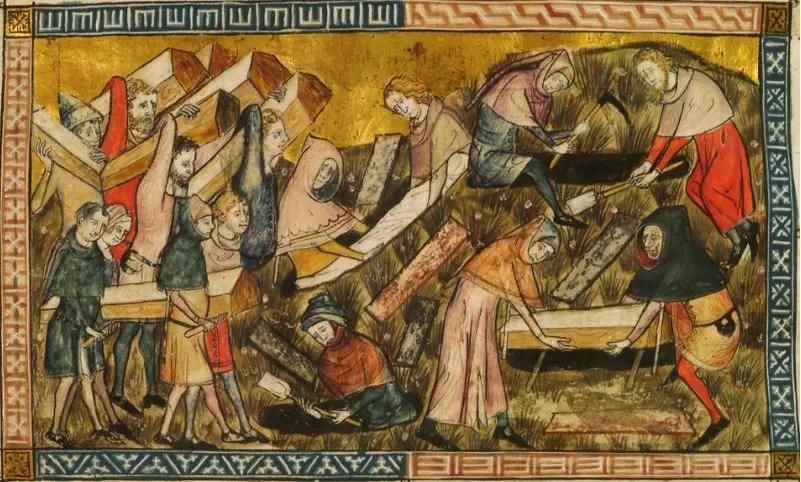
How many died altogether? Nobody counted, and the guesses differ widely. By different estimates, the Black Death killed somewhere between a third and more than half of the people of Europe in four or five years. The highest estimates are about six in every ten. Others think it was nearer to half, or less. A study of pollen from 261 lakes and bogs across Europe found something no chronicle could show. Where many people died, fields went back to weeds and then to woodland, and the pollen in the mud changes. In some regions it changed sharply, in Scandinavia, France, Greece and central Italy among them. In others, such as Ireland, Spain and Portugal and much of central and eastern Europe, farming seems to have carried on and even grown, so the plague may have hit some places far harder than others. It was not only Europe’s disaster, either. In Cairo more than a third of the people died. And it kept coming back. For the next three hundred years, plague broke out somewhere in Europe almost every year.
Frightened people looked for someone to blame, and many blamed the Jews. Rumors said they had poisoned the wells. In February 1349, in Strasbourg, now in France, the Jews of the city were burned alive, about two thousand of them by the count of its own chronicler, before the plague had even reached it. By 1351, Jews had been massacred in some two hundred towns and cities across Europe.
For the poor who lived, life changed in a way nobody had planned. With so many dead there was land without farmers and work without workers, and those who were left could ask for more. In England the king and his parliament tried to stop it. A law of 1351 ordered everyone able to work to do so, at the wages paid before the plague, and no more. It didn’t work. Farm wages in England roughly doubled over the next hundred years, and anger at laws like this one was one of the causes of a great rising of English peasants in 1381. In much of western Europe, the old system in which farmers owed their lords unpaid work slowly gave way to rents in money. A catastrophe had made ordinary labor scarce, and so worth more.
Letters made of metal
About a century after the plague arrived, a goldsmith in the German city of Mainz was trying to print books.
Printing itself was old by then, but not in Europe. Chinese printers had been cutting whole pages into wooden blocks for centuries; the oldest printed book with a date, a Buddhist text from 868, was found in a sealed cave at Dunhuang (Chapter 13). Printing with movable type, a separate piece for each character that can be set into a page and used again, was Chinese too. In the 1040s, a Chinese scholar of the time wrote, a man of no official rank named Bi Sheng made type of baked clay, a piece for each character and twenty or more for the common ones. He set them in an iron frame on a bed of resin and wax, warmed it so they held, and kept two frames going, one printing while the next was set. For a few copies, the scholar noted, it wasn’t worth the trouble. For hundreds or thousands, it was “marvelously quick”.
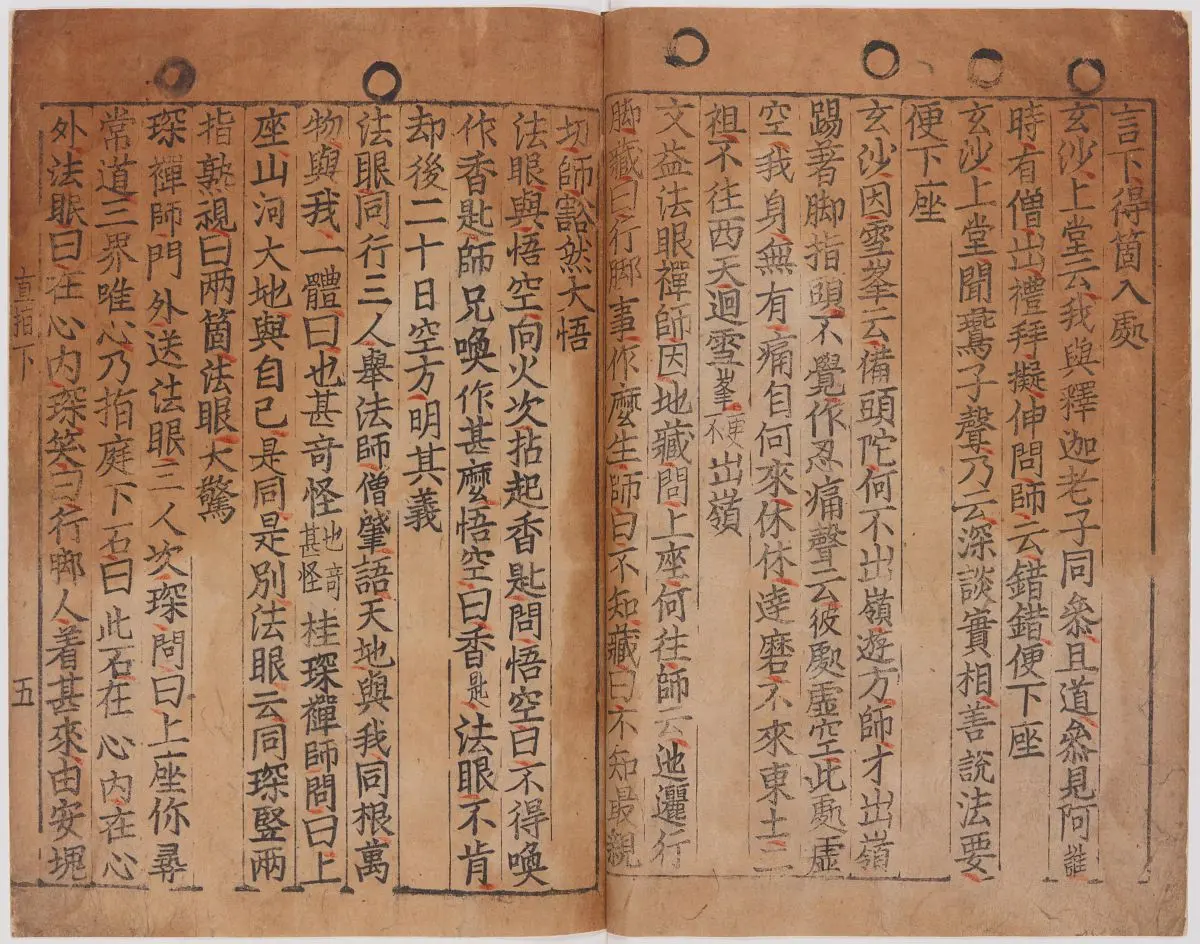
In Korea printers went further and cast type in metal. The oldest book printed that way that still survives is a collection of the teachings of Buddhist masters, printed at a temple in Cheongju in 1377. Only its second volume is left, and it is in the national library of France, in Paris. UNESCO put it on its Memory of the World register in 2001. It was printed seventy-eight years before the Bible of Mainz.
The goldsmith in Mainz was Johannes Gutenberg. Years before, in Strasbourg, he and his partners had made little metal mirrors to sell to pilgrims, who believed a mirror held up to holy relics would catch their blessing. What else they were working on there, nobody knows for sure. His printing in Mainz took borrowed money. What he put together was a mold for casting letters quickly and exactly alike, a metal for them that melted easily, an ink made with oil that stuck to metal, and a press built like the screw presses that squeezed grapes for wine. Whether he had heard of Chinese or Korean type, nobody knows. No document says he did, and no document says he didn’t.
The first printing in Europe with a firm date was not a book at all. In 1454 the pope was selling indulgences, certificates that a Christian’s punishment for sin was lessened, to raise money for the defense of Cyprus against the Ottomans, and that summer Gutenberg was hired to print the forms. Thousands were probably made. The buyer’s name and the date were filled in by hand, and one filled in at Erfurt in October 1454 is the oldest dated piece of European printing.
Then came the Bible, in Latin, in two great volumes. In March 1455 a bishop who later became pope wrote to a cardinal in Rome about it. He had seen pages of it at Frankfurt, he said, in letters so clean and clear that the cardinal could read them “without glasses”. Some said 158 copies had been made, others 180, and buyers had been found for all of them before they were even finished. About fifty survive today, many of them incomplete. Gutenberg himself didn’t get rich. The man who had lent him the money took him to court and won control of the workshop.
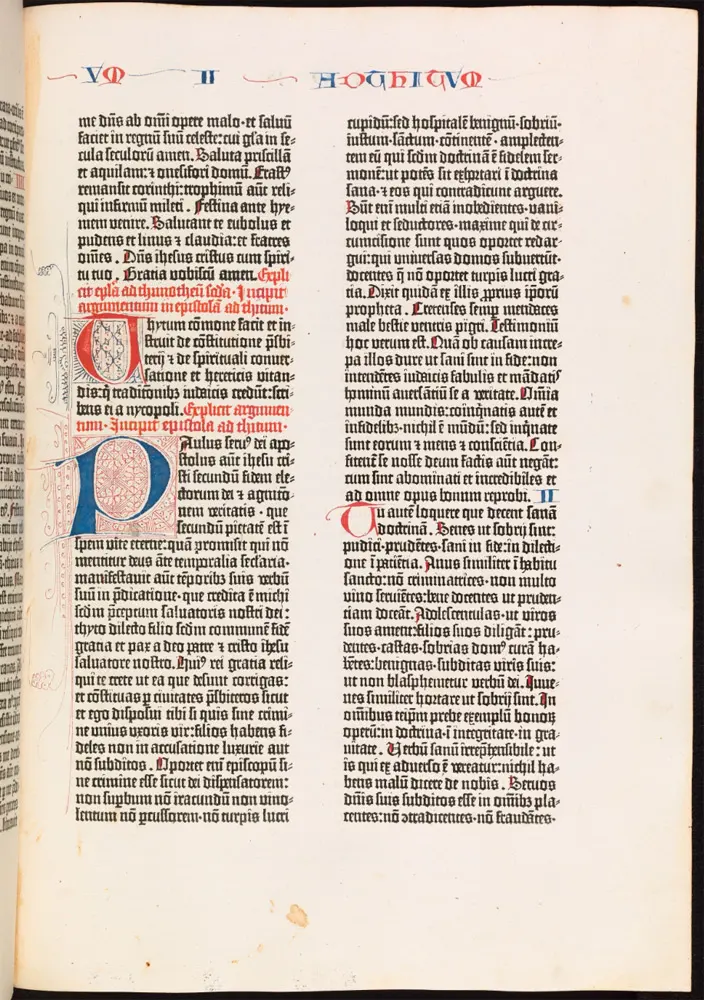
The idea spread faster than anything Gutenberg could have imagined. By 1500 printers had worked in about 280 towns, and about thirty thousand different books and pamphlets from those years are still known. Why did movable type take over Europe so fast, when in China the woodblock stayed the usual way to print for centuries after Bi Sheng? One part of the answer is plain. A printer of Latin or German needed a few dozen letters, many times over. A printer of Chinese needed thousands of different characters. In Korea, metal type was kept for the government’s own books. In Europe, printing was a business, and printers fought over customers in dozens of rival cities.
What print did to Europe is argued. One famous view is that cheap identical copies, in huge numbers, helped drive the great changes that followed in learning, religion and science. Other historians answer that early printed books were full of errors and differences of their own, and that people, not machines, did the changing. Both sides agree that there were suddenly a great many books.
A quarrel in print
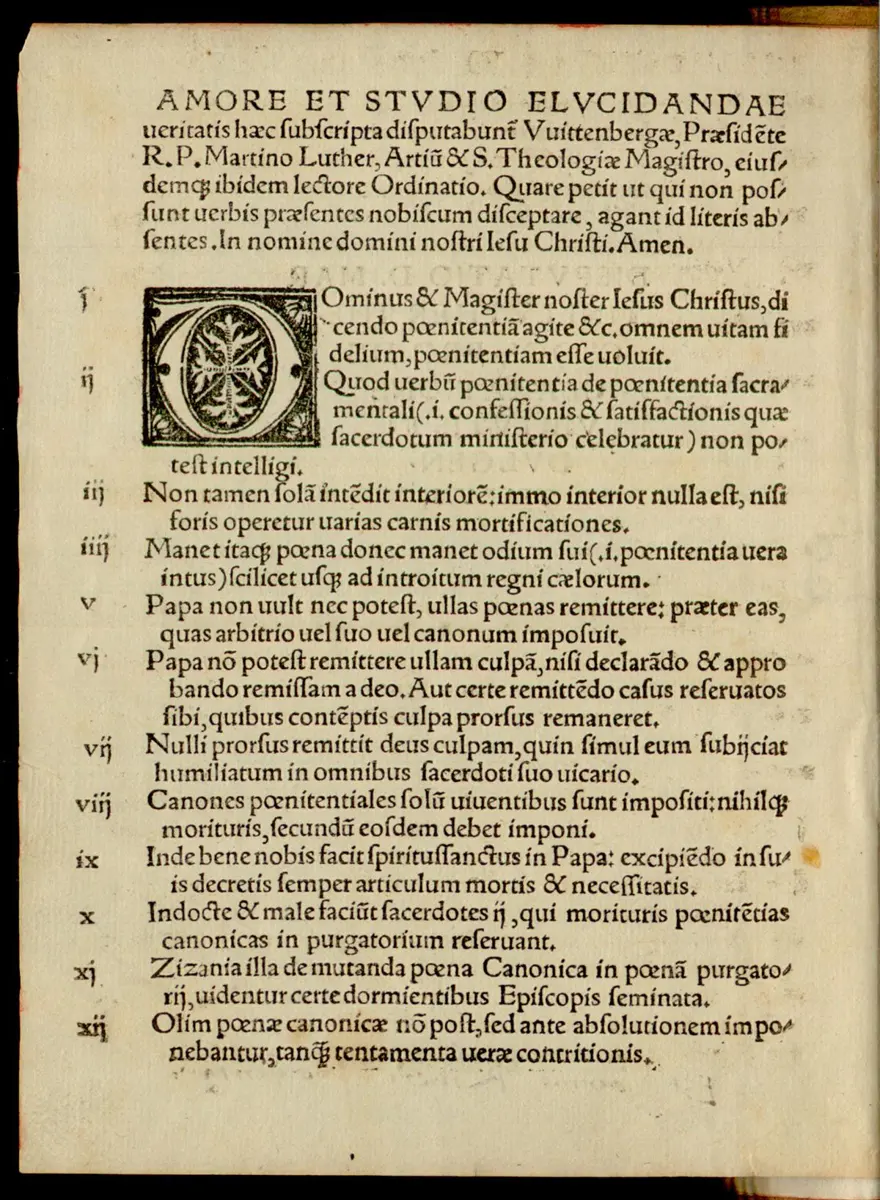
On 31 October 1517 a friar and professor in the small German university town of Wittenberg, Martin Luther, sent a letter to the archbishop of Mainz. With it went ninety-five theses, short statements in Latin to be argued over. They were about indulgences. A preacher had been selling them nearby, and a popular saying of the time had it that as soon as the coin in the box rings, the soul springs out of purgatory, the place where Catholics believed souls were punished and made clean before heaven. Luther thought this was false, and that people were being misled about how to be forgiven.
The story everyone knows is that he nailed his theses to the door of a Wittenberg church. Luther himself always said he had raised his objections through the proper channels, and historians argue about whether it happened. What is certain is that the theses were printed. Before the end of 1517 they had come out in Leipzig, Nuremberg and Basel. Luther went on to write for ordinary readers in German, and printers found that anything with his name on it sold. Within five years of the theses he was the most published author Europe had ever had, and in the pamphlet war that followed, his side outprinted its opponents by about nine to one. The press that had printed indulgences in Mainz now carried the attack on them all over Europe.
The pope excommunicated him, that is, cast him out of the Church, in 1521, and the same year the emperor declared him an outlaw. He died in 1546. Western Christianity, which had been one church under the pope, split into Catholics and the many kinds of Protestants. Luther, who in 1523 had urged Christians to treat Jews kindly, wrote in 1543 that their synagogues should be set on fire and their houses torn down.
The split was not only about faith. Rulers chose sides, and in the German lands, by an agreement of 1555, a ruler’s faith became his state’s. For more than a century, wars mixed religion with land, money and power. In France, Catholics and Protestants fought on and off from 1562 to 1598, and between two and four million people died of the fighting and of the hunger and disease it brought. In one massacre, on Saint Bartholomew’s Day in 1572, Catholic crowds killed thousands of Protestants, perhaps five thousand, perhaps thirty thousand. Then, from 1618 to 1648, came the Thirty Years’ War, fought mostly in the German lands, which killed somewhere between four and a half and eight million people. Parts of Germany lost more than half their people. By the end it was hardly about religion at all. Catholic France fought on the side of Protestant Sweden, against the Catholic emperor, because both wanted him weaker. The peace of 1648 left a Europe of many states, each deciding its own faith, none able to rule the rest.
Why Europe?
By 1600 something had changed. Ships from the Atlantic coast of Europe were sailing to India, China and the Americas, and Europe’s scholars were starting to ask nature questions that its old books couldn’t answer. In a few more centuries, this edge of the world would rule much of it. How did that happen to the corner Sa‘id had left off his list?
Economists who have tried to guess average incomes that far back, and say plainly that they are guessing, put western Europe a little behind China and India in the year 1000 and a little ahead of them by 1500. Others answer that averages hide too much. China is huge, and its richest regions, around the mouth of the Yangzi, may have been as well off as the richest parts of Europe until the late 1700s. On that view, the real gap opened only with coal and steam, and with the land of the Americas, which come later in this book. Others look further back, to Europe’s many rival states. A thinker in trouble in one could move to the next, so no single ruler or church could silence new ideas, while scholars all over Europe wrote to one another and argued as if borders didn’t exist. Still others point to geography: Europe’s coast is cut into peninsulas and its land by mountains, pieces that became separate countries, while China, with a smoother coast, was easier to hold under one ruler, who could, and once did, order the great ships to stop. Historians are still arguing, and the answer may be several of these at once.
What is clear is that nobody in 1068 could have seen it coming. A learned man in Toledo had good reason to leave western Europe off his list. In the six centuries after him it borrowed from the Arabic, Indian and Chinese worlds, was nearly emptied by a plague that made work worth more, printed more books than anyone had imagined, and tore itself apart over religion, ending as a crowd of rival states. Which of these made the difference, if any did, is still argued. The next chapter goes back to the 1400s and follows its ships out into an Indian Ocean that had been trading for centuries without them.
Found a mistake? Please tell us.