
In April 1956 an old oil tanker refitted as the Ideal X sailed from Newark, near New York, for Houston in Texas with 58 containers on board. They were really aluminum truck bodies with the wheels taken off. Each could be lifted off the ship and onto a truck with its goods still packed inside.
That was the whole idea, and it sounds too plain to matter. But think of how a ship was loaded before. Sacks, crates, barrels and bales went aboard one at a time, carried and stacked by hand by gangs of dockworkers. New York and London each had about 50,000 of them after the Second World War. A cargo ship crossing the Atlantic spent as much time tied up in port as it did at sea. Loading loose cargo on a medium-sized ship then cost $5.83 a ton. Loading the Ideal X cost under 16 cents.
The man behind it, Malcom McLean, owned a trucking company, not a shipping line. He understood that a box alone saves nothing. The ships, cranes, trucks, trains and ports all had to be built around it, and it took a decade of argument with ports, unions and governments before the world agreed on the boxes’ sizes. Once it did, moving things across an ocean became so cheap that a factory no longer had to be near the people who bought what it made. It could be wherever the work was cheapest. That is a large part of how Asia became the world’s workshop, and why a shirt or a phone can be made in one country from parts made in five others.
Nepal has no sea, but it lives on these boxes too. Goods from overseas come in containers to Haldia, near Kolkata, and from 2021 private container trains have brought them up to the dry port at Sirsiya, near Birgunj. In one month of 2026 it took in 92 trainloads of them.
The box is one thread in a much bigger story, of nearly everything people make and use shooting upward after 1950, and of what that has done to the air and the ice. In the middle of that story, neighboring countries began to band together, in Europe, in Southeast Asia and, more slowly, here in South Asia.
Everything at once
Here is the plain answer first. For almost all of history the number of people, and the things they made and used, grew slowly. The Industrial Revolution sped things up in a few countries. Then, around 1950, almost everything began to rise at once, and far more steeply than ever before, all over the world. Scientists call it the Great Acceleration.
The name comes from a group of scientists led by Will Steffen, who studied the Earth as one connected system. In a book of 2004 they published graphs of twelve things people do, from making paper to building dams to traveling abroad, and twelve things happening to the planet, from the gases in the air to the fish in the sea, all from 1750. They expected to see the human mark growing from the start of the Industrial Revolution. They didn’t expect what they saw: nearly every line bending sharply upward around 1950. In 2015 they brought the graphs up to 2010 and the bend was still there.
The numbers are worth a moment. In 1950 there were about 2.5 billion people. By 2010 there were 6.9 billion, and in November 2022 the world passed 8 billion. Everything the world produced in a year was worth about nine times as much in 2010 as in 1950, counted in dollars of the same value. The energy people used went up nearly five times between 1950 and 2008. Farmers spread about twelve times as much fertilizer on their fields, which is a large part of why there was food for all those extra people. By 2010 the world had about six and a half billion phone lines and mobile subscriptions. The scientists summed it up by saying that the second half of the twentieth century was “unique in the entire history of human existence on Earth.”
Why then? The graphs show that it happened, not why, and the scientists were careful to say so. What they point to is the way of life the rich countries took up after the Second World War, with growth year after year as the measure of success. Cheap oil, new machines, new medicines that let far more children live, and cheap shipping all played their part, and the rest of the world followed as it could.
It did not happen evenly. In 2010 the rich countries of the OECD, a club of mostly Western economies, had 18 percent of the world’s people and made 74 percent of its output. Most of the extra people were born in Asia and Africa, but most of the extra things were bought in Europe, North America and Japan. The scientists did find some hopeful signs. The rise of mobile phones happened almost entirely in poorer countries, which jumped straight past the expensive business of laying phone wires to every village. Nepal is one of them. And when a chemical used in fridges was found to be thinning the ozone layer high above the Earth, the world agreed to stop making it, and by 2023 the ozone layer was on track to heal, over most of the world by about 2040.
Some scientists wanted to say that the Earth had entered a new age of its own, the Anthropocene, the age of humans, starting about 1950. In 2024 the geologists who keep the official calendar of the Earth’s ages voted against making it a formal age, though they said the word will go on being used to describe what people have done to the planet. So the change is not in doubt. Only what to call it is argued.
Why neighbors band together
The same years saw another new thing: countries in one part of the world joining together. The reasons are the ones in any village. Neighbors share problems that none of them can solve alone, a river, a disease, a road, a market. They can trade more easily with each other than with anyone far away. And if they are tied together closely enough, they are less likely to fight.
Europe is where it went furthest, and it started with the third reason. France and Germany had fought each other in both world wars. On 9 May 1950 Robert Schuman, France’s foreign minister, proposed putting the two countries’ coal and steel, the stuff that armies are made from, under one shared authority. His aim, in his own words, was to make any war between France and Germany “not merely unthinkable, but materially impossible.” In 1951 six countries signed up: France, West Germany, Italy, Belgium, the Netherlands and Luxembourg. In 1957 the same six agreed to a common market, and in 1993 what had grown out of it became the European Union. Today 27 countries belong to it; Britain, a member for decades, left on 31 January 2020. Schuman’s declaration had said it would be so: “Europe will not be made all at once, or according to a single plan.”
Southeast Asia’s turn came in 1967, in the middle of the Vietnam War, with that war on its doorstep. The foreign ministers of five countries, Indonesia, Malaysia, the Philippines, Singapore and Thailand, spent four days at a beach town south-east of Bangkok working out a short declaration. They did much of the bargaining on the golf course and later called their way of working “sports-shirt diplomacy”. The Association of Southeast Asian Nations, ASEAN, was signed into being in Bangkok on 8 August 1967. Brunei joined in 1984, Vietnam in 1995, Laos and Myanmar in 1997, Cambodia in 1999, and on 26 October 2025 Timor-Leste became the eleventh member. ASEAN never tried to be another European Union. It has no shared parliament or money, and it works by agreement among all its members, slowly.
South Asia’s turn
The idea of a South Asian club came from Bangladesh. Its president, Ziaur Rahman, wrote to the other leaders of the region in 1980 suggesting they work together. After five years of meetings, the leaders of seven countries, Bangladesh, Bhutan, India, the Maldives, Nepal, Pakistan and Sri Lanka, met in Dhaka and signed the charter of the South Asian Association for Regional Cooperation, SAARC, on 8 December 1985. Its secretariat, the office that keeps it running, opened in Kathmandu in 1987, and Afghanistan became the eighth member in 2007.
The charter set three rules that explain much of what happened next. The leaders “shall meet once a year”. Every decision needs every member’s agreement. And “bilateral and contentious issues”, the quarrels between two members, are kept out of its meetings. That last rule was meant to stop SAARC from being torn apart by those quarrels. It also meant that it could never settle them.
SAARC did some useful things. Its members signed a South Asian Free Trade Area in 2004, which came into force in 2006, and they founded a South Asian University in New Delhi. But trade among its members never grew much. A World Bank study in 2018 found that trade among South Asia’s own countries was a little over 5 percent of all their trade, against 50 percent among the countries of East Asia and the Pacific. Moving goods across these borders was so slow and costly that trading between Bangladesh and Nepal cost 56 percent more than trading between Bangladesh and Brazil, on the other side of the world.
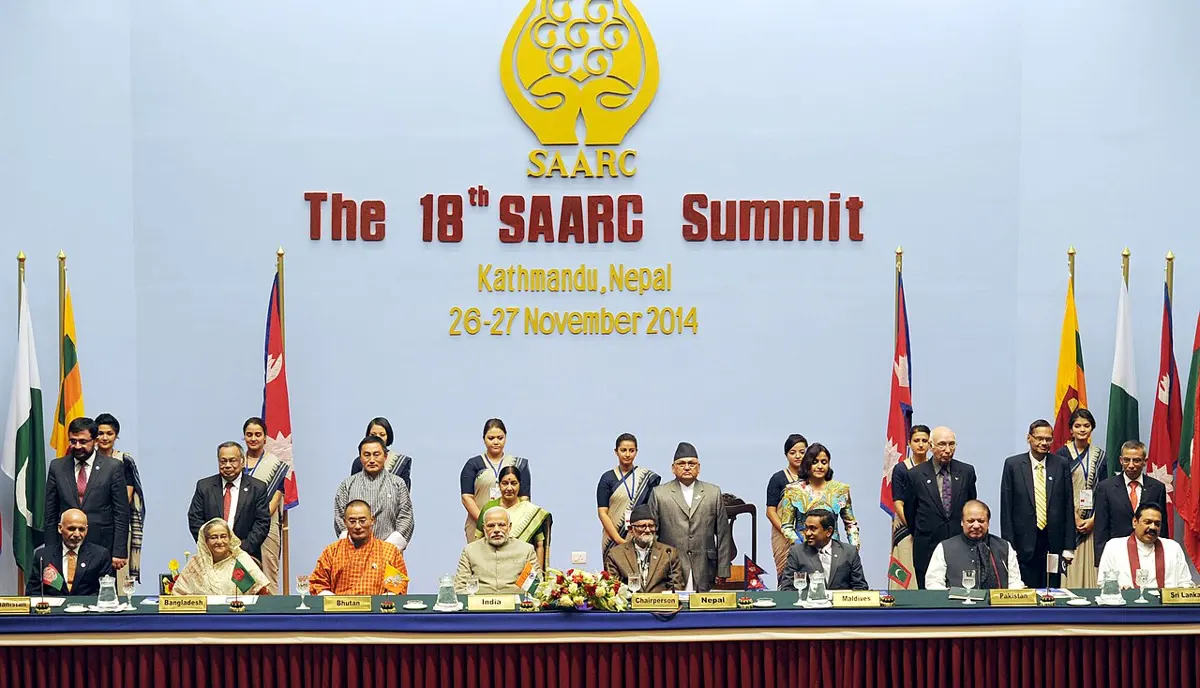
The meetings did not come once a year either. In 29 years there were 18 of them, the last in Kathmandu in November 2014. The nineteenth was to be held in Islamabad in November 2016. In September of that year gunmen attacked an Indian army camp at Uri, in Kashmir, and killed 19 soldiers. India said the attackers had come from Pakistan; Pakistan called the charge baseless. On 27 September India told Nepal, which then held SAARC’s chair, that it would not go to Islamabad, because of “increasing cross-border terrorist attacks in the region and growing interference in internal affairs of member states by one country”. Bangladesh, Afghanistan, Bhutan and then Sri Lanka stayed away too. Pakistan put the summit off, saying it was still ready to hold it. It has not been held since.
Why SAARC has stalled is argued, and each government tells it its own way. India says SAARC cannot work while one member backs terrorism against another; in October 2026 its spokesman said, “Everyone knows which country is responsible for the obstacles to SAARC.” Pakistan says India is the one blocking it; its spokesman has said, “It is India, not any other country in SAARC, that has held it hostage.” An attack on tourists at Pahalgam, in Kashmir, in April 2025, which India blamed on Pakistan and Pakistan denied, and the fighting between the two that followed, pushed them further apart. Writers outside the two governments don’t split neatly by country. An Indian lawyer writing in Pakistan’s Dawn argued that the charter says the leaders shall meet, whatever the quarrels between two members. A scholar in Lahore pointed to the weakness built into the charter itself: since every decision needs every member, SAARC can do nothing without the political will of its two largest members. The smaller members, Nepal, Bangladesh, Sri Lanka, Bhutan and the Maldives, have all asked for the summits to start again. As of November 2026, Nepal still holds the chair it took in 2014, and nothing has come of it.
Meanwhile another group has grown. In June 1997, in Bangkok, Bangladesh, India, Sri Lanka and Thailand set up a group for the countries around the Bay of Bengal. Myanmar joined that December, and Nepal and Bhutan in February 2004, giving it its present name, the Bay of Bengal Initiative for Multi-Sectoral Technical and Economic Cooperation, or BIMSTEC. It reaches from South Asia to Southeast Asia, and it leaves out Pakistan, Afghanistan and the Maldives. Its office opened in Dhaka in 2014, its charter came into force in May 2024, and its leaders have met six times, among them in Kathmandu in 2018, and most recently in Bangkok in April 2025. Indian writers present it as the platform that works where SAARC doesn’t, and as a bridge for India’s trade to the east. Pakistan, left out, has spoken since late 2025 of new groupings of its own. Either way BIMSTEC is still small: trade among its members is about 6 percent of their trade, and the free trade agreement they began discussing in 2004 was still unfinished in 2025.
The bill
The Great Acceleration had a cost that no border holds in. Since 1958 scientists have measured the carbon dioxide in the air from a station high on Mauna Loa, a volcano in Hawai’i, far from any city. In its first full year, 1959, the average was 316 parts in every million parts of air. In 2025 it was 427. The gas comes mainly from burning coal, oil and gas, and it traps heat. About 42 percent of all the carbon dioxide people put into the air between 1850 and 2019 went up after 1990.
The world’s scientists sum up what this has done in the reports of the Intergovernmental Panel on Climate Change, the IPCC, written by hundreds of them and approved by the world’s governments. Its report of 2023 says plainly that human activities, mainly by giving off greenhouse gases, “have unequivocally caused global warming”: the Earth’s surface was 1.1 °C warmer in 2011–2020 than in 1850–1900. It also says who pays. The least developed countries, Nepal among them, gave off about 1.7 tonnes of greenhouse gases a person in 2019, against a world average of 6.9, and the people who did least to cause the warming are being hit hardest by it.
For South Asia the clearest sign is the ice. The snow and glaciers of the mountains from the Hindu Kush to the eastern Himalaya feed 12 rivers that run through 16 countries. About 240 million people live in these mountains and 1.65 billion more downstream. In June 2023 the International Centre for Integrated Mountain Development, ICIMOD, which is based in Nepal, published a major assessment of the region’s ice and snow. It found that the region’s glaciers lost ice 65 percent faster in 2011–2020 than in the decade before. On the path the world’s emissions were then taking, they could lose up to 80 percent of their ice by 2100. An earlier assessment by the same center, in 2019, had found that even if warming were held to 1.5 °C, about a third of the glaciers would be gone by 2100. The meltwater will first swell the rivers, then shrink them, with more floods and bursting glacial lakes along the way; about 200 of the lakes are counted as dangerous.
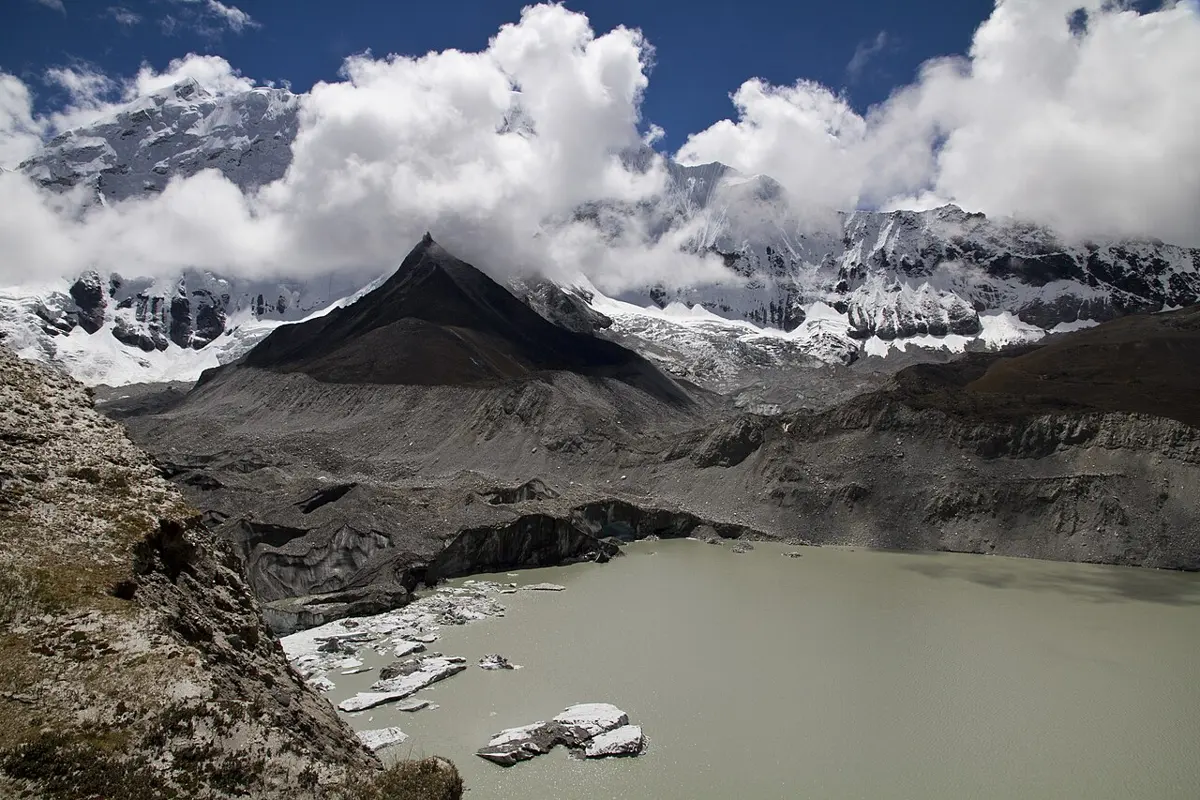
Nobody can fix this alone, which brings the two halves of this chapter together. The glaciers do not stop at borders and neither do the rivers they feed. ICIMOD itself is one answer. Since 1983 eight countries have run it together from Nepal: Afghanistan, Bangladesh, Bhutan, China, India, Myanmar, Nepal and Pakistan. India and Pakistan are both among them, the same two who cannot meet under SAARC’s roof. In this one place, at least, neighbors who disagree about much still share what they know about the ice.
So what does it all add up to? Since 1950 the world has filled up with people and things faster than ever before, and a plain steel box is part of the reason. Many people now live longer and better than their grandparents could have dreamed. The same rise has filled the air with carbon dioxide and is melting the ice above Nepal. Neighbors have learned to band together, most in Europe, a good deal in Southeast Asia, and little so far in South Asia, where SAARC has been frozen since 2016 by the quarrel between India and Pakistan, while BIMSTEC grows slowly beside it. The problems that most need neighbors are the ones now coming down the rivers.
Meanwhile, in Nepal: after 1990 the country opened up, with free elections, private newspapers and FM radio. That is told in The elections of 2048, 2051 and 2056, in Nepal’s History, for the Curious.
Found a mistake? Please tell us.