
In a hospital laboratory in London, a young doctor called Watson, just back from a war and looking for someone to share rooms with, is introduced to a man who has just run up with a test tube in his hand. The man grips his hand and says, “You have been in Afghanistan, I perceive.”
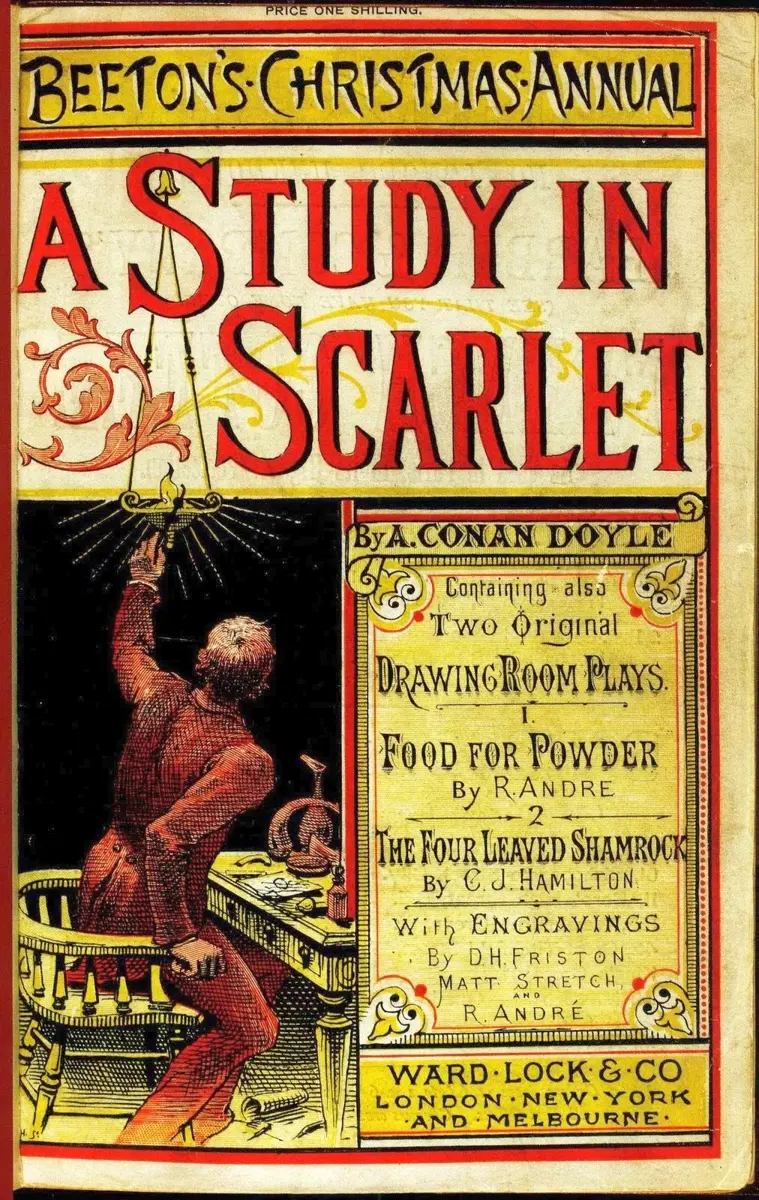
Watson is astonished. The man was Sherlock Holmes, and this was his first appearance anywhere, in A Study in Scarlet, which Arthur Conan Doyle published at the end of 1887 in a Christmas magazine. A few chapters later Holmes explains himself. He didn’t guess, he says, and nobody told him. The thoughts ran through his mind so fast that he reached the answer “without being conscious of intermediate steps. There were such steps, however.” Then he lays them out:
“Here is a gentleman of a medical type, but with the air of a military man. Clearly an army doctor, then. He has just come from the tropics, for his face is dark, and that is not the natural tint of his skin, for his wrists are fair. He has undergone hardship and sickness, as his haggard face says clearly. His left arm has been injured. He holds it in a stiff and unnatural manner. Where in the tropics could an English army doctor have seen much hardship and got his arm wounded? Clearly in Afghanistan.”
It’s a lovely piece of reasoning, and Watson’s reply is the right one: “It is simple enough as you explain it.” That’s what laying out the steps does. Once they’re on the table, anyone can check them. And once they are, something odd shows up. Every step leans on something Holmes doesn’t say.
“A face is dark but the wrists are fair, so he has come from the tropics.” That works only if strong sun is found nowhere but the tropics. “An army doctor wounded in the tropics, so Afghanistan.” That works only if Afghanistan is in the tropics, and if it was the only place in the tropics where an English army was fighting. The first of those is simply false. The tropics end at about 23 degrees north of the equator, and the southernmost corner of Afghanistan is at about 29 degrees, some 650 kilometers farther north.
Holmes was right anyway. Watson had been an army surgeon and was wounded in the shoulder at the battle of Maiwand, in the south of Afghanistan. The answer was true and the chain that led to it had a cracked link. Those are different things, and the gap between them is what this chapter is about.
The step nobody says
Nobody says everything. If a friend says, “Take an umbrella, the sky has gone black,” she doesn’t add, “and a black sky usually means rain.” She doesn’t need to. Arguments are full of steps like that, things the speaker needs for the reasons to lead to the point, but never says out loud. They’re called assumptions, and they come in three kinds. Some are left out because they seem too obvious to mention, like the black sky. Some are left out because the speaker never noticed the gap. And some are left out on purpose, because said out loud they would sound weak.
The word needs a little care, because people use it loosely. An assumption here isn’t anything a speaker happens to believe, or a guess about what kind of person they are. It’s a step the argument can’t do without. There’s a plain way to find one. Put the reason next to the point, and ask what else would have to be true for one to lead to the other. Then try supposing that missing step is false. If the argument falls down, you’ve found something it was resting on. Suppose a black sky had nothing to do with rain: the umbrella advice is left with no reason at all. Suppose Afghanistan weren’t in the tropics, which it isn’t, and Holmes’s last step is left hanging in the air.
The steps nobody says are dangerous for a simple reason. Nobody checks them, because nobody sees them.
On 23 September 1999, NASA’s Mars Climate Orbiter reached Mars after a nine-month journey. It was meant to be the first weather satellite for another planet. It fired its engine to swing into orbit, passed behind Mars, and was never heard from again.

The cause, found six days later, was a missing step. All the way to Mars, the spacecraft had fired small thrusters now and then to keep itself steady. Each firing nudged its path a little, and the navigators had to add up the nudges to know where it was going. The size of each nudge came to them in a file made by the spacecraft team’s software on the ground. The written rules for that file said its numbers were in metric units. The navigators took the numbers as metric, as the rules said. In fact the program that made the file gave them in the units of the old British system, pounds instead of newtons, and a pound of force is about 4.45 newtons. Every nudge was counted at less than a quarter of its real size.
One nudge, too small to matter. But the lopsided solar panel meant the thrusters fired between 10 and 14 times more often than the navigators had expected, and the small errors piled up for nine months. The plan was for the spacecraft to pass 226 kilometers above Mars. Below about 80 kilometers it couldn’t survive the air. Worked out afterward, with the nudges counted right, its closest pass had been about 57. The whole journey, with a model of it to fly, is in Why Did a Spacecraft Crash on Mars?.
The investigators’ report put it in one dull, exact phrase: the navigators “assumed the data was provided in metric units per the requirements.” The rules said metric, so metric it was. And the warning signs were there. For months, some people working on it had noticed that their different ways of tracking the spacecraft didn’t quite agree. The report says the differences were noticed, reported only informally, and “not resolved.” A step that nobody ever says out loud is the hardest one to doubt.
Filling the gap fairly
When you find a step that an argument leaves out, you have to choose how to fill it in, and there is nearly always more than one way.
Suppose a friend says, “Don’t buy that phone. The company only started last year.” What’s the missing step? You could fill it in as “every new company makes bad phones”. That’s easy to knock down: plenty of new companies make good ones. Or you could fill it in as “a company that new may not be around in three years to fix it or send updates.” That one is worth thinking about. Your friend probably meant something like the second. If you answer the first, you haven’t answered your friend at all. You’ve only won an argument with someone who isn’t there.
Choosing the most sensible reading, the one that makes the other person’s argument as reasonable as it can be, has a name among philosophers: the principle of charity. It isn’t about being kind, though it often is kind. It’s about being accurate. Most people who say things have reasons that make some sense to them, and if your reading makes them sound foolish, the likeliest explanation is that you’ve misread them.
Charity even helps Holmes. The book never says so, but a kind reader might take his “the tropics” to mean no more than somewhere hot and sunny, far from England. Read that way, his step holds up a good deal better: a dark face does tell you a man has been somewhere sunny. It still doesn’t take you to Afghanistan rather than India or Egypt, which is the honest weakness that remains once the easy one is cleared away.
The game theorist Anatol Rapoport is credited with a set of rules for doing this properly, which the philosopher Daniel Dennett set down in a book in 2013. Before criticizing anyone, first put their view so clearly, vividly and fairly that they would say, “Thanks, I wish I’d thought of putting it that way.” Then list the points you agree on, and anything you’ve learned from them. Only after that may you say a word against it. Dennett’s point was partly practical. People listen to criticism from someone who has plainly understood them.
None of this means agreeing. Charity is how you find the version of an argument worth testing. If that version fails too, you’ve learned something real, and the person you’re talking to will see that you fought fair.
Needed, and enough
Long before Holmes, the logicians of India had thought hard about the steps people leave out. The oldest text of the न्याय (Nyāya) school of logic goes back to about 200 CE, and its teachers had a standard example that was used for centuries. You see smoke on a hill. You say there is fire on the hill. Why? Because there is smoke there. So far it’s an ordinary argument with a missing step, and the न्याय logicians insisted on saying that step aloud: wherever there is smoke, there is fire, as in a kitchen hearth, and unlike a lake. The rule, then a familiar case where it holds, and a case where neither smoke nor fire is found. The hidden step was put where everyone could see it and argue with it.
They also noticed that the rule doesn’t work backward. Does fire always come with smoke? No. A ball of iron heated red-hot is full of fire and gives off no smoke. That one case was enough to break the rule “wherever there is fire, there is smoke,” and it became the standard example of a rule that runs one way only.
This is an old and very common mix-up, between what is needed for something and what is enough for it. Fire is needed for smoke: no fire, no smoke. But fire isn’t enough for smoke, as the red-hot iron shows. Smoke, on the other hand, is enough to tell you there’s a fire somewhere. Philosophers call the two kinds a necessary condition and a sufficient condition, and they get confused in two ways. One is treating something needed as if it were enough: there’s fire, so there must be smoke. The other is treating the lack of something enough as if it settled the matter: there’s no smoke, so there can’t be a fire. The red-hot iron is the answer to both.
You’ll meet this mix-up long before you meet a hill on fire. To register for Grade 11, the National Examinations Board asks for a GPA of at least 1.6 in the SEE. Reaching that line is needed. It isn’t enough to get you into the subjects you want at the school you want. A school can set its own higher line, and some hold an entrance test and take students from the top of its list. “I got 1.6, so I’m in” treats a needed thing as enough. The mistake runs the other way too. A place at a famous school is enough to show you can study Science, but missing one doesn’t show you can’t. No smoke doesn’t mean no fire.
Valid, sound, and merely likely
Some arguments are built so tightly that their point can’t escape. “Everyone on this bus is going to Pokhara. Dawa is on this bus. So Dawa is going to Pokhara.” If the two reasons are true, the conclusion has to be. Logicians call an argument like that valid. The word doesn’t mean the reasons are true. It means that if they were, the conclusion would come with them. “Every momo in Nepal is made of gold. This is a momo from Nepal. So it’s made of gold” is valid too, in exactly the same way, and its conclusion is plainly false, because its first reason is.
An argument that is valid and whose reasons really are true is called sound. That’s the best kind there is. A sound argument’s conclusion is true, with no room for doubt. If somebody on the bus is getting off at Mugling, the bus argument is still valid, but it isn’t sound, and Dawa may be that somebody.
Most arguments in real life aren’t valid, and aren’t meant to be. “The sky has gone black, so it will rain” doesn’t promise rain. It makes rain likely. A good argument of that kind is called strong, and a strong argument with true reasons is the most you can get about most things that matter: what the weather will do, whether a medicine works, who is telling the truth. That’s fine. It just means the conclusion sits somewhere on the dial between 0 and 100, not at the top.
Holmes called his method the science of deduction, but nearly everything he did was this other kind. A dark face makes the tropics likely. A stiff arm makes a wound likely. Every step was a good guess, not a proof. Good guesses are what most thinking is made of, but they behave in a way that surprises people when they are joined in a chain.
The astronomer Carl Sagan, in a list of tools he called a “baloney detection kit”, put it like this: “If there’s a chain of argument, every link in the chain must work (including the premise) — not just most of them.” The arithmetic is simple. Suppose each step in Holmes’s chain were 90% sure, and the steps didn’t depend on one another. Two steps together are about 81% sure, because the second has to hold in the cases where the first did. Five steps are about 59% sure, not far above a coin toss. Ten are about 35%. Each link can look strong, and the chain they make can still be weak. A chain is never stronger than its weakest link, and it is usually weaker than that.
That’s why Holmes’s confidence is the least believable thing in the story. Each step looked fine, and he finished completely sure. A real detective with that chain should have said, “Afghanistan, probably, but let me ask.” Holmes had the advantage of an author who knew the answer.
Saying every step out loud is how anyone can be checked, from a detective in a novel to a team flying a spacecraft. It’s also how you find out where an argument breaks. Some arguments break at a step nobody said. Others say every step clearly and break anyway: they change the subject, or offer two choices when there are more, or quietly assume the very thing they set out to prove. Those breaks have their own shapes, and they can be learned like the faces of people you know.
Found a mistake? Please tell us.