
In 1802 and 1803 a Scottish doctor named Francis Buchanan, later Hamilton, spent fourteen months in Nepal, and later two years on its southern border, gathering what people could tell him about the country and its past. One thing he wanted to know was simple. West of the Kathmandu Valley there had once been twenty-four small kingdoms, the Chaubisi Rajas. Which were they?
Nobody could quite tell him. He wrote down the list one well-informed man gave him and added, “other lists differ considerably.” One king on his list he couldn’t find at all, nor any place of that name on the maps. In its place he suggested a chief called the Sat Bisi, the “seven-score” raja, because his whole revenue was 140 rupees a year, “a poverty,” Hamilton wrote, “which renders St Marino an empire.” San Marino is one of the smallest countries in Europe.
The twenty-four kingdoms had been gone for only a generation, and already they couldn’t be counted. That is the first thing to know about them.
Twenty-two and twenty-four
The Khas kingdom of Sinja broke up in the late 1300s. Its far corners went their own way, the chiefs who had sent tribute stopped sending it, and from about 1400 a new line of kings ruled from Jumla. For the next three and a half centuries, until the Gorkha campaign of the 1700s, the hills between the Mahakali and the Trishuli were not one country but dozens of small ones. In the plains and the hills to the east were a few more, ruled by families called Sen.
People grouped the western ones by their rivers. The states of the Karnali basin were the बाइसे राज्य (Baise), the twenty-two, and those of the Gandaki basin further east the चौबिसे राज्य (Chaubise), the twenty-four. The numbers were names, not counts. Kingdoms split, merged and were swallowed by their neighbors, so the number at any moment was rarely exactly twenty-two or twenty-four, and the lists that survive, made long afterwards, don’t agree. One count, adding the Baise, the Chaubise, the Valley’s three kingdoms, the eastern kingdoms, Gorkha and Mustang, comes to fifty-four states in the land that is Nepal today. Another historian could make it a few more or a few less.
Even the name “Baise” may have begun as something else. One story Hamilton heard told of a chief’s daughter whose twenty-two sons each took a share of their grandfather’s land, and he thought the name might have come from them. Nobody knows.
Gorkha is a good example of the muddle. Some lists put it among the twenty-four. Others leave it out, and a reader may have learned that it was never one of them. Hamilton noticed that a list given to an earlier British visitor, Colonel Kirkpatrick, in 1793, left Gorkha out, and suspected why. The man who gave it was a Gorkhali, and the twenty-four had all owed some respect to the king of Jumla; to count Gorkha among them would have admitted that Gorkha had once owed it too, which its kings, by then, wished to disown.
Who ruled the hills
At the top, in name, was the king of Jumla. “His superior rank,” Hamilton was told, “was, however, never disputed.” The other kings sent him presents every year, and when one of them died, the new king received the टीका (tika), the mark on the forehead, from Jumla before he could rule. But that was nearly all. Jumla’s king could ask his vassals to stop one of their number from swallowing another, and his call “seems long to have met with a good deal of attention”; he couldn’t make them. They went to war with one another, and sometimes with him. Hamilton, who knew European history, said Jumla’s power was “still more limited than that of the late Cæsars of Germany”, the Holy Roman Emperors, whose title was grand and whose power, by then, was small.
Below Jumla, every hill had its own story. Many of the ruling families were Thakuri and traced their descent from Rajput princes of India, a claim that is hard to test now. But they had not found the hills empty. The kingdoms they took over often had kings already, and those kings came from the hills’ own peoples.
Lamjung is one case where an old document tells how it happened. A family petition kept in the National Archives says that an ancestor named Jitaram Bhandari came to Lamjung from Jumla and didn’t want to live under a king of the Ghale, a family of the hills. He sent to Nuwakot for a man named Kal Shahi and invited him to rule instead. Kal Shahi was murdered by the Ghale, and the Bhandari then put another, Yasho Brahma Shah, on the throne, about 1538. Two decades later a prince of Lamjung, Dravya Shah, took the hill of Liglig during Dashain, and then, in 1559, Gorkha itself from a king of the Khadka family. That is the beginning of the Gorkha kingdom.
Further west, Hamilton was told, Palpa had belonged to a Magar chief before the family that later ruled it arrived, and the hill of Balihang beside it had been the seat of another Magar chief until his neighbors divided his land among them. Before the Rajput families came, he was told, the Magar of these hills had been twelve clans, each called a थुम (thum) and each under a chief of its own; and under Kaski the Gurung kept their own priests, the lamas.
Living on a hilltop
What was it like to be one of these kingdoms? Small, first of all. Hamilton described the capital of Garahang, one of the twenty-four, as a brick castle on the top of a hill with 60 or 70 huts around it and no water nearer than a कोस (kos), a long walk there and back. The seat of Dullu-Dailekh in the west had about 150 thatched huts; Doti’s capital, one of the larger, about 400 stone houses. A king built on a hilltop because a hilltop could be defended. Carrying the water up was someone else’s problem.
Farming fed most people, but a king needed money too, and in the hills money came from three things: mines, trade and roads.
Some kingdoms had mines. Parbat had copper mines, twenty-five of them by Hamilton’s count, and Gulmi had copper and zinc; Kaski had copper, and Dhor and Tanahun had iron. Others had a market on a road. Kaski’s town of Pokhara drew merchants from the Valley, Palpa and Parbat, and its duties, Hamilton wrote, “in so poor a country were reckoned considerable.” Palpa had the best road of all. At Ridi, on the Kali Gandaki, a fair ran for three or four months every winter, “frequented by a great number of traders from all parts of the mountains.” Up the river, at Thak Khola below Mustang, was the chief market for the trade with Tibet; goods came over the passes from the north and went down on men’s backs or on sheep, through Beni, past Ridi, and out of the hills at Butwal. Over the passes, by this road and the others, Tibet sent salt, wool, borax, musk and gold, and the hills sent back grain, cloth and metal. In the west, Jumla had salt of its own, from pools far to the north-east. A king who sat on a road, like Palpa’s, could tax every load that passed.
With so many small states side by side, a king’s safety lay in his friends. Hamilton heard of leagues: the Athabhai, as he wrote it, “eight brothers”, of chiefs who shared an ancestor, and the Satbhai, “seven brothers”, of chiefs who didn’t. Lamjung led a league with Tanahun and Kaski. Palpa led one of six neighbors. Pyuthan had its own allies. Gorkha, he was told, “was always completely unconnected”. Marriages tied the royal houses together too.
Sometimes the neighbors did eat a small state. When Balihang was carved up between Palpa, Gulmi and Khanchi, the three couldn’t agree who should have one piece of it, Khidim, so they gave it to a Brahmin, and none of them got it. Hamilton placed the carving-up about 1700. Another date, which a reader may have learned, puts it nearly two centuries earlier, and it isn’t known which is right.
The Sens and the east
For a while the most powerful family in the hills was the Sens, who ruled Palpa from around 1500. The family’s own histories brought them from Chittor in Rajasthan, other accounts from Bengal, and many books still say they came from India. The Sen king Mukunda Sen marched into the Kathmandu Valley in 1524 and 1525 and again in 1546, and one historian of Gorkha points out that writings from his own time called him a Magar. Who the Sens were is still argued. All the accounts agree that at its height the Sen kingdom stretched along the hills and the plain from Palpa far to the east. One reading of a treaty of the time puts even Gorkha’s hills under it for a while.
Mukunda Sen divided his kingdom among his sons, and the pieces became kingdoms of their own: Palpa, Tanahun and others in the west, and in the east Makwanpur, south of the Valley. From Makwanpur the Sens pushed east, along the low hills and the plain, as far as the Koshi and beyond. They did it with the help of the Kirat, the Limbu and Rai peoples of the eastern hills.
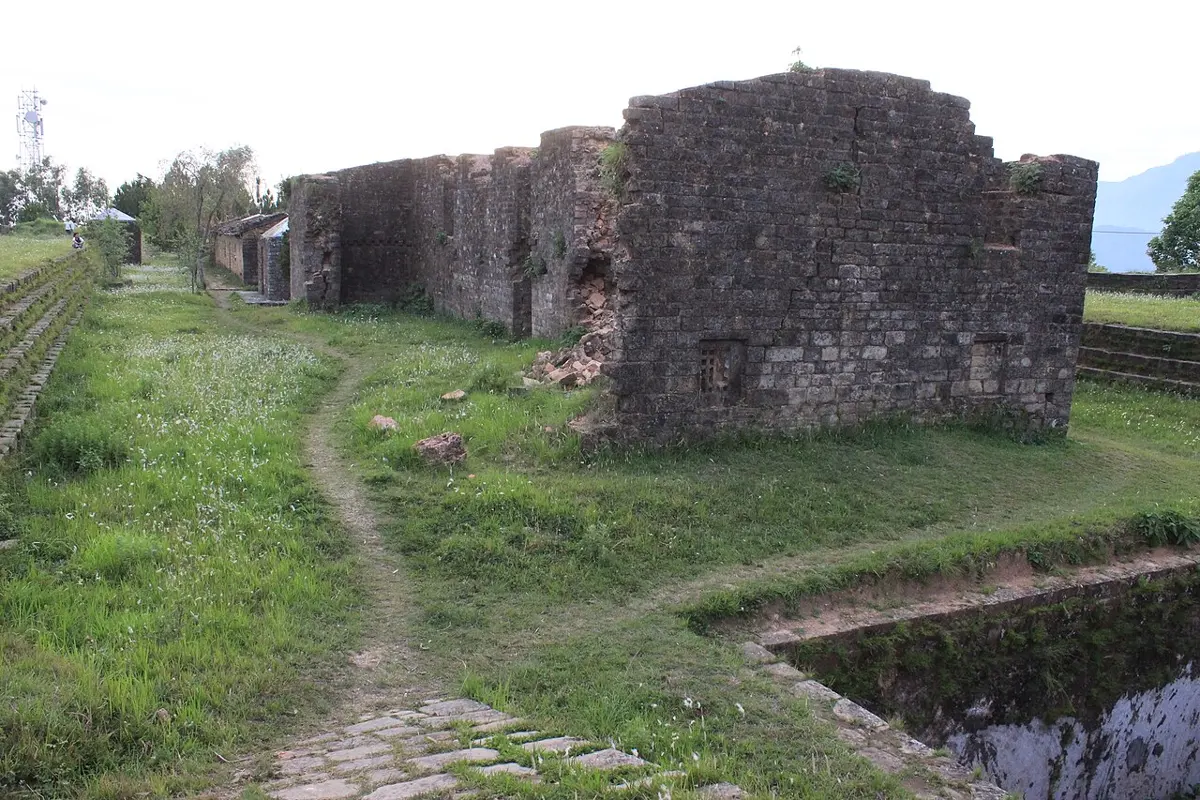
That help shaped how the eastern kingdom was run. The Sen king’s chief minister, the चौतरिया (chautariya), was a Kirat chief, and the office passed from father to son. By the account of the last man to hold it, whom Hamilton met, the chautariya signed every order and the king put his seal on it, and that the chautariya took a tenth of all the revenue. Most of the army was Kirat: of 90,000 Kirat men said to be able to bear arms, five or six thousand were regular soldiers. Their commanders were given land in the hills and shared it among their soldiers. On the plain below, the same kingdom collected its revenue in money, the way the Mughal provinces of India did.
Many of the people on that plain were Tharu. They had lived in the Tarai’s forests for centuries, and they could farm land whose fevers drove newcomers away, so whoever ruled the plain needed them. A collection of fifty royal orders about the Tharu, gathered mostly between Dang in the west and Chaudandi in the east, begins in 1726. Among them are orders under the black seal of the Sen kings, and others from the Shah kings after them. They name Tharu headmen to collect taxes and give Tharu leaders land to clear and farm. The headmen could bargain: a headman, one study of these orders points out, “could also decide to abandon the land, taking his village tenants with him”, and leave the fields to the jungle, to escape a new tax.
In the hills of the far east, the Limbu held land in their own way, किपट (kipat). How it began is told in a Limbu tradition, which the Limbu historian Iman Singh Chemjong wrote down. Groups of people cleared the forest and became its customary holders, and before the gods as witnesses they prayed that they might live on that land from generation to generation; land held by that pledge is kipat. Later, the tradition says, the kipat holders chose a हाङ (hang) as their king, and he “obtained military assistance also from them.” Kipat stayed with the descendants of those who first cleared it; it couldn’t be sold to anyone else. No document from before Gorkha describes it, so its age is argued too. One historian held that kipat began with grants made by the kings of Gorkha; others, looking at how it worked, a custom shared by a whole community, see something much older than Gorkha. What became of it under Gorkha is in Chapter 18.
The Sens’ later story is unhappy. Two of their kings were handed over to the Mughals and taken to Delhi; the eastern kingdom split again into three, Makwanpur, Chaudandi in the hills west of the Koshi, and Vijayapur near today’s Dharan; and in Vijayapur the chief minister had the king killed and put another Sen on the throne. By the 1760s these were small kingdoms, with a powerful neighbor.
The end of the small kingdoms
That neighbor was Gorkha. Prithvi Narayan Shah had married a Sen princess of Makwanpur, and in 1762 he took Makwanpur, one of the forts he took round the Valley before he attacked it (Chapter 17). Chaudandi fell in 1773 and Vijayapur in 1774. In July 1773, from Makwanpur, he wrote to the Kirat leaders of the east who had served its kings: “Yesterday, you were the good servants of the Makwani Raja. As long as you ate his salt, you remained in his service.” Now, he told them, they should serve him, and he pardoned them for what they had done against him in the war.
In the west, Gorkha’s armies took the Chaubise and then the Baise, one by one, over the decades that followed. How they did so is in Chapter 18.
So the fact that the lists don’t agree is the answer, not a gap in it. Between about 1400 and the late 1700s the hills of Nepal were a crowd of small states, too many and too changeable to count, some ruled by Thakuri families, some by the Sens, some by kings from the hills’ own peoples, all living on farms, mines, markets and the tolls of a road. They had a high king at Jumla who could ask but not command, and kept each other in check with leagues and marriages. When one of them, Gorkha, became strong enough to break the balance, the rest went one after another.
Found a mistake? Please tell us.