
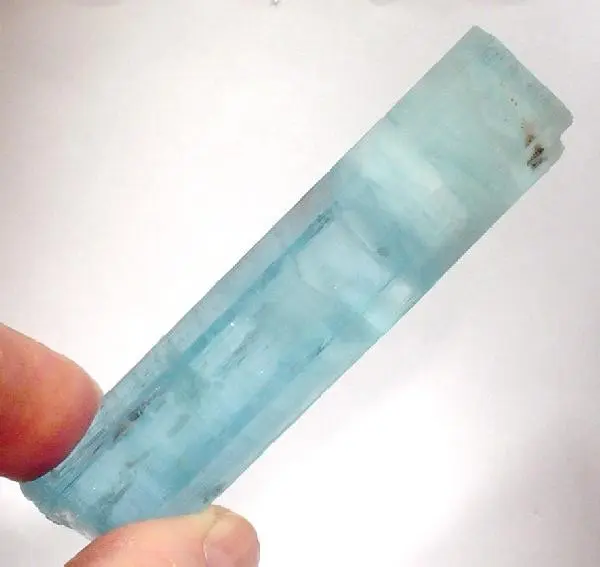
The best aquamarine is clear and blue-green, like a shallow sea. Nepal is far from any sea, but its pegmatites in Taplejung grow aquamarine good enough to be among the country’s most valuable gems. Aquamarine is one color of a mineral called beryl; another color of beryl is emerald.
What beryl is
Beryl is a silicate of the element beryllium with aluminium.
| Property | Beryl |
|---|---|
| Formula | Be₃Al₂Si₆O₁₈ |
| Hardness (Mohs) | 7.5 to 8: harder than quartz |
| Density | about 2.7 times as heavy as water (2.63 to 2.97) |
| Crystals | six-sided columns, usually with flat ends |
| Cleavage | poor; it breaks with a curved or uneven surface |
| Streak | white |
Beryl’s gem names go by color:
| Color | Name |
|---|---|
| greenish blue to blue | aquamarine |
| green (colored by chromium or vanadium) | emerald |
| pink to orange | morganite |
| yellow to greenish yellow | heliodor |
| colorless | goshenite |
How beryl forms
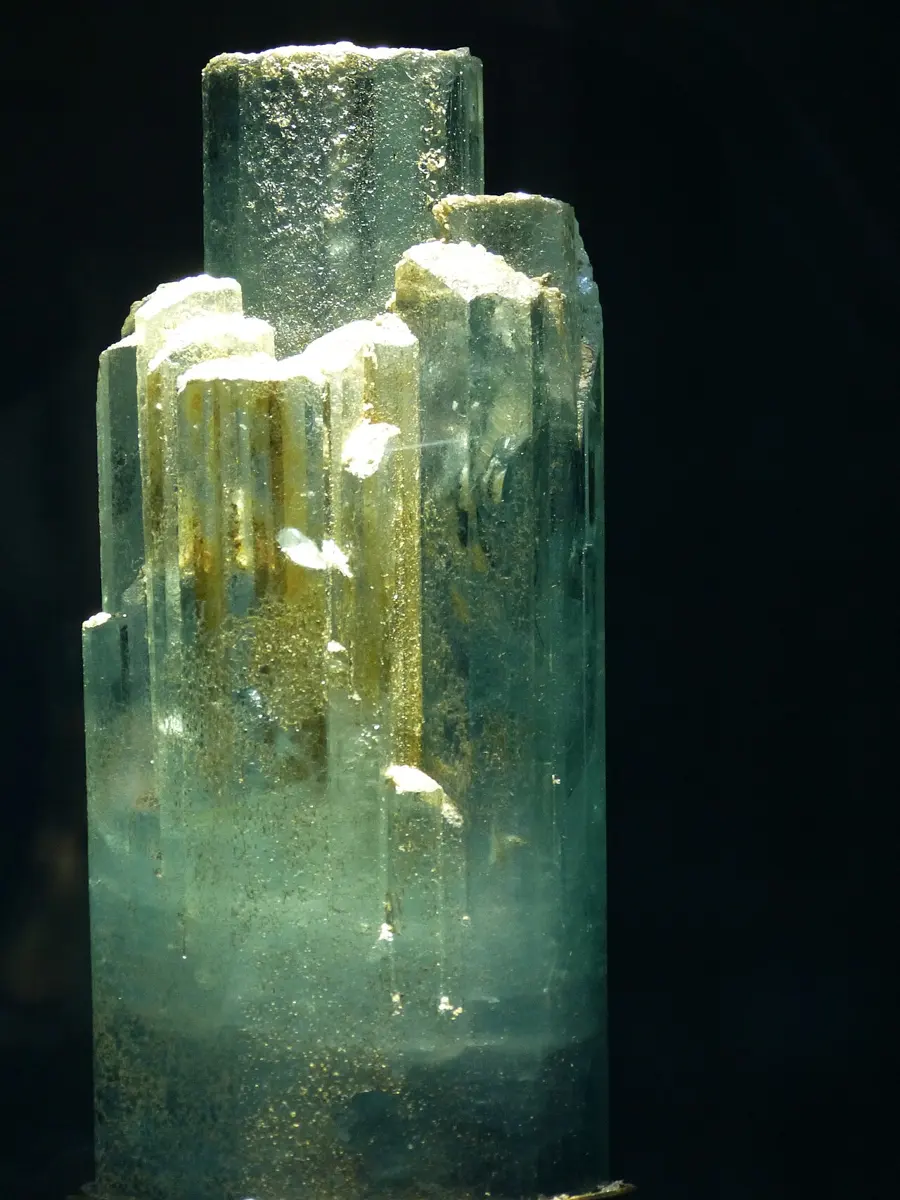
Beryllium is a rare element, and beryl grows where it has gathered: mainly in granite and granite pegmatites, in metamorphic rocks next to pegmatites, and in veins where hot fluids have worked through granite. Pegmatites, where the last, watery part of a magma crystallizes, give the big, clear crystals that become gems.
Beryl and aquamarine in Nepal
Nepal’s gem story began with aquamarine: tourmaline and aquamarine were first found at Hyakule, Sankhuwasabha, in 1934.
- Taplejung: the aquamarine of Ikabu (Ikhabu) and Lodantar is high priced. In 2020 two beryl and aquamarine mines were working in Taplejung. Kalikhola and Phaktanglung in Taplejung are also listed.
- Sankhuwasabha: clear blue gem aquamarine at Phakuwa; also Num, Hyakule, Gunyahang and Sabhapokhari.
- Manang: aquamarine and beryl at Naje.
- Jajarkot: Garkhakot, Lekhpatan and Tikachaur.
- Solukhumbu: Dudhkoshi.
- Other beryl localities include Jagat, Panchmane and Kagtigaon in Kathmandu, and Baguwa, Tarkeghyang and Nibuwagaon in Sindhupalchok.
The aquamarine occurs in pegmatite bodies cutting schist, calc-schist, dolomitic marble and gneiss of the Higher Himalaya. In 2018 the Department of Mines and Geology had issued one prospecting license for beryl. Emerald, the green beryl, is very rare in Nepal.
What beryl is used for
- Gems: aquamarine and emerald, cut for jewelry.
- Beryllium: a very light metal that keeps its shape over a wide range of temperatures. The 18 mirror segments of the James Webb Space Telescope are made of beryllium.
In short
Where these facts come from
- Kaphle K.P., Mineral resources of Nepal and their present status, Nepal Geological Society, 2020.
- Ghimire J.R., An overview of precious and semi-precious stones in Nepal: opportunity and challenges; and Ghimire R.P., Mineral resources, mining and investment opportunities in Nepal; both in Annual Report No. 11, Department of Mines and Geology, 2019.
- Anthony J.W. et al., Beryl, Handbook of Mineralogy, Mineralogical Society of America.
- King H.M., Beryl, Geology.com.