
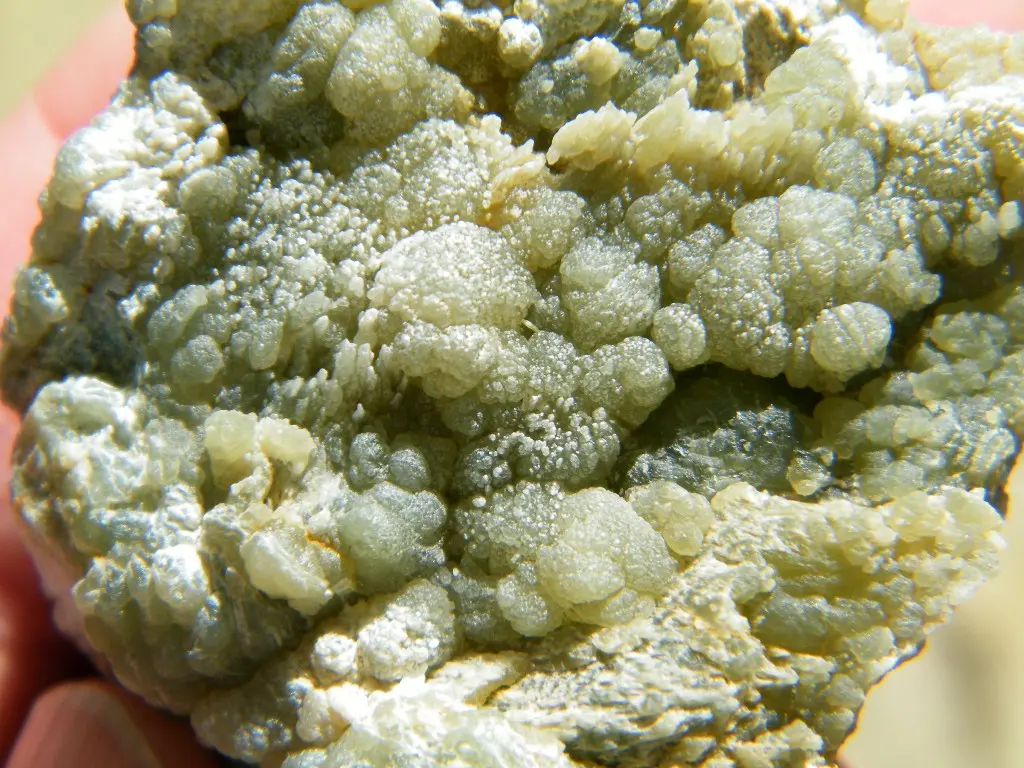
Rub a piece of talc between your fingers and it feels like soap. Press your fingernail into it and you leave a groove. Talc is the softest mineral there is: number 1 on the Mohs scale, the bottom of the ladder every other mineral is measured on.
What talc is
Talc is a magnesium silicate with water built into its structure.
| Property | Talc |
|---|---|
| Formula | Mg₃Si₄O₁₀(OH)₂ |
| Hardness (Mohs) | 1: a fingernail scratches it easily |
| Density | 2.58 to 2.83 times as heavy as water |
| Cleavage | perfect in one direction: it splits into thin, bendable flakes that do not spring back |
| Feel | greasy or soapy |
| Color | white, pale green, gray |
Talc is built of thin sheets stacked like the pages of a book, held together only weakly. The sheets slide over each other at a touch. That is why talc is so soft and feels slippery.
Soapstone is a rock made mostly of talc, with some mica and other minerals. It is soft enough to carve with a knife.
How talc forms
Talc is a metamorphic mineral, found most often in the changed rocks of mountain belts where two plates push together, as in the Himalaya. Many large deposits formed when hot water carrying dissolved magnesium and silica reacted with dolomite marble.
Talc in Nepal
Talc occurs as bands, lenses, veins and pockets, with magnesite, dolomite and talc schist, in Lalitpur, Dolakha, Sindhupalchok, Dhading, Chitwan, Tanahun, Kaski, Syangja, Baglung, Surkhet, Bajhang, Bajura, Baitadi and Darchula.
The Department of Mines and Geology explored in detail only at Kharidhunga in Dolakha, where the talc lies beside Nepal’s great magnesite deposit. Its estimate there is 0.303 million tonnes of talc. The Kharidhunga talc mine, run by Nepal Orind Magnesite, has been working for more than twenty years; it produced 8,557.19 tonnes in 2018. Elsewhere, private companies run small talc mines: by 2018 the Department had issued 18 prospecting and 14 mining licenses for talc. Talc is also one of the few Nepali minerals that is exported.
What talc is used for
- Talcum powder: crushed talc absorbs moisture and oil, which is why it is used in baby powder and many cosmetics.
- Industry: most talc goes into ceramics, paint, paper, roofing, plastics and rubber, as a filler and whitener.
- Carving: soapstone is carved into bowls and figures.
Which of these can you scratch with your fingernail?
Pick an answer to see why.
In short
Where these facts come from
- Kaphle K.P., Mineral resources of Nepal and their present status, Nepal Geological Society, 2020.
- Ghimire R.P., Mineral resources, mining and investment opportunities in Nepal, in Annual Report No. 11, Department of Mines and Geology, 2019.
- Anthony J.W. et al., Talc, Handbook of Mineralogy, Mineralogical Society of America.
- King H.M., Talc, Geology.com.