
Gypsum and rock salt: minerals from dry seas
नुन · What drying seawater leaves behind
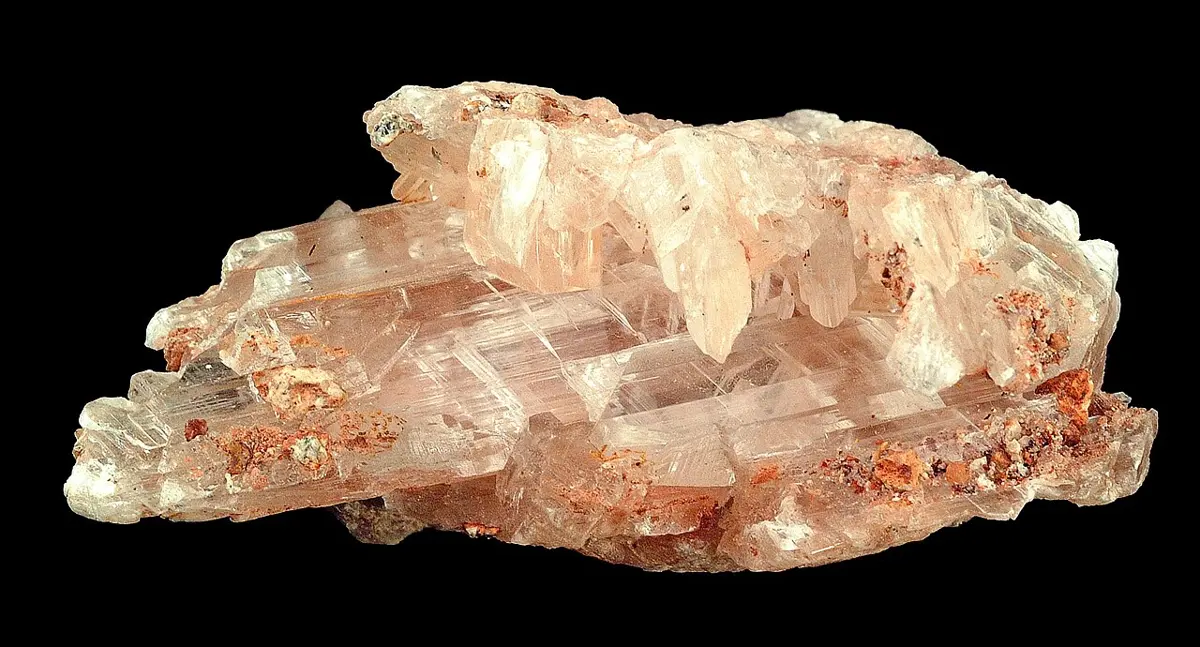
Leave a saucer of salty water on a sunny windowsill. When the water has gone, white crystals are left. On a much larger scale, the same thing happens when a shallow sea or salt lake dries up: the dissolved minerals come out of the water one after another. Two of the commonest are gypsum and rock salt, the mineral called halite, which is ordinary salt, नुन.
Two minerals from drying water
| Property | Gypsum | Halite (rock salt) |
|---|---|---|
| Formula | CaSO₄·2H₂O (calcium sulfate with water locked in its crystals) | NaCl (sodium chloride) |
| Hardness (Mohs) | 1.5 to 2: a fingernail scratches it | 2 to 2.5 |
| Density (× water) | 2.31 | 2.17 |
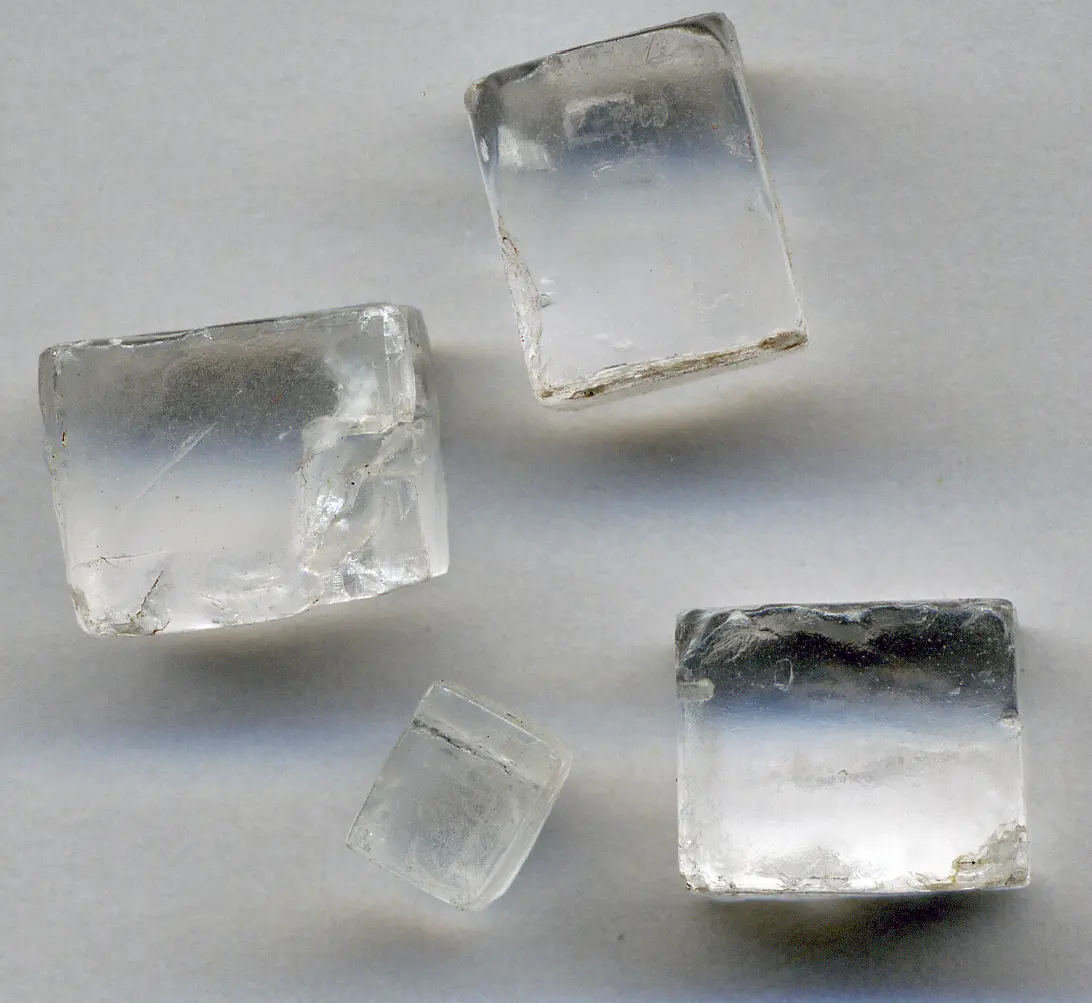
| Cleavage | one perfect: it peels into thin, bendable flakes | three, at right angles: it breaks into cubes |
Gypsum is the mineral of plaster; halite is the salt on the table.
How they form
When salty water evaporates, the dissolved minerals come out in a set order: first a little calcium carbonate, then gypsum, then halite. Pure water carrying calcium and sulfate leaves gypsum below about 42 °C and anhydrite, calcium sulfate without water, above it. Buried layers of salt can be pushed up as domes, with gypsum and anhydrite capping them. Gypsum and salt usually turn up together, so a salt spring is a hint that gypsum may be near.
Gypsum and salt in Nepal
Gypsum. The Department of Mines and Geology has found only minor lenses and irregular layers of gypsum, in Mustang and at Kapurkot in Sallyan, and in parts of Dang and Pyuthan. As of 2018, not one economic deposit had been reported. Nepal’s cement factories, more than 25 of them in 2018, need gypsum: about 3 to 5% of Portland cement is gypsum, which slows its setting. Kaphle reported in 2018 that about 400,000 to 500,000 tonnes a year were imported from India and Bhutan.
Salt. No mineable salt deposit has been found in Nepal. But brine springs, salty water seeping out of shale and limestone, are common in middle and upper Mustang. Local people used to make 10 to 50 tonnes of salt a year by drying brine at Narsing Khola and Chhiding (Chhising) Khola in Mustang and in the Chharkabhot area of Dolpa. The brine holds 1.5 to 3% sodium chloride; some salt crusts there hold up to 72.8% sodium chloride and 24.5% potassium chloride.
The Department lists both among the minerals Nepal imports.
A soft, clear mineral peels into thin flakes and can be scratched with a fingernail. Which is it?
Pick an answer to see why.
What they are used for
- Gypsum: mixed with clinker to make Portland cement; heated, it becomes plaster of Paris; also wallboard, ceiling panels, soil conditioning and medicine.
- Salt: an essential nutrient, a seasoning and a preservative for food, and a source of sodium and chlorine for the chemical industry.
In short
Where these facts come from
- Kaphle K.P., Gypsum prospects in Nepal and their importance in mineral industries, especially in Portland cement production, Bulletin of the Nepal Geological Society 35, 2018.
- Kaphle K.P., Mineral resources of Nepal and their present status, Nepal Geological Society, 2020.
- Ghimire R.P., Mineral resources, mining and investment opportunities in Nepal, in Annual Report No. 11, Department of Mines and Geology, 2019.
- Anthony J.W. et al., Gypsum and Halite, Handbook of Mineralogy, Mineralogical Society of America.
- King H.M., Gypsum and Halite, Geology.com.