
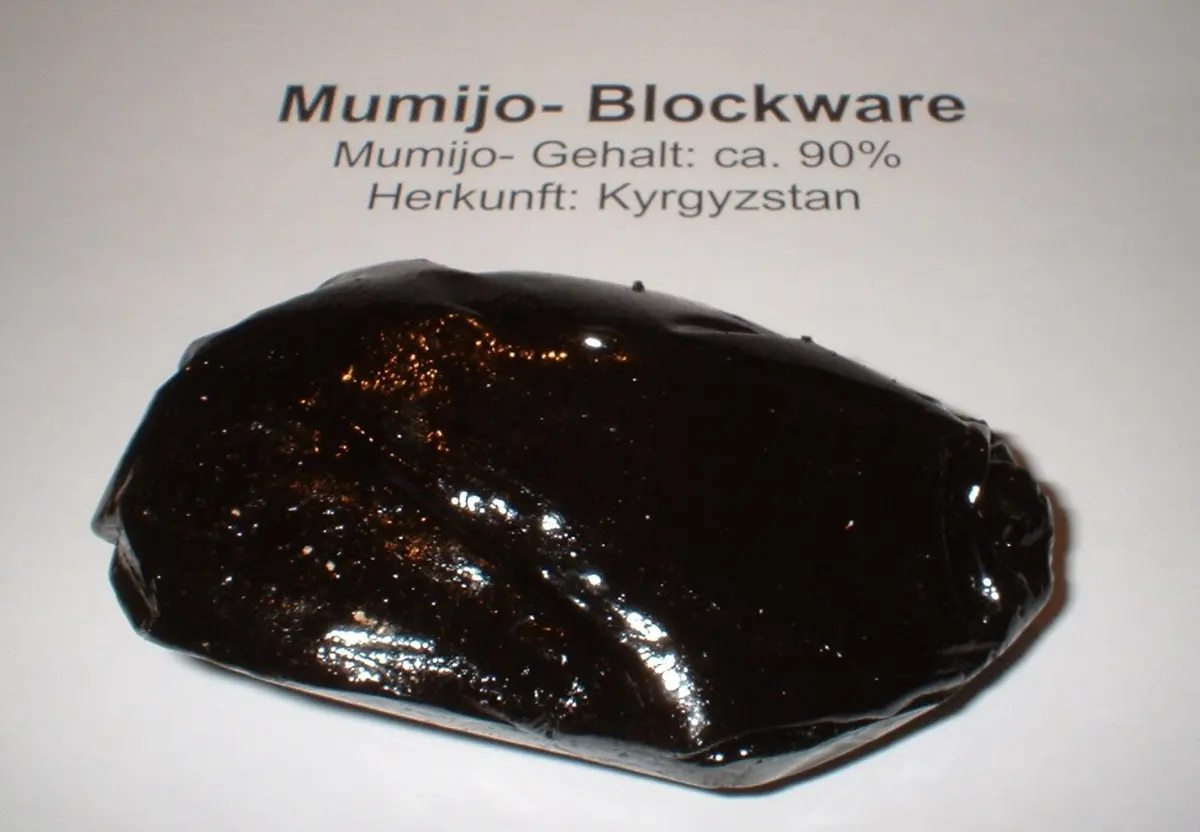
On a stall near Asan, or on a pharmacy shelf, you may have seen small jars of a black, shiny paste. On a phone, an advertisement promises that the same paste gives strength, energy and long life. The label says शिलाजित (shilajit). It comes from the high mountains of Nepal, where people climb cliffs to scrape it off the rock. But what is it? It is not a plant, and it is not quite a stone.
What shilajit is
Shilajit is a pale brown to blackish-brown substance, soft and sticky, that seeps out of layers of rock in many mountain ranges, especially the Himalaya and the Hindu Kush. Raw, it is mixed with bits of rock and soil.
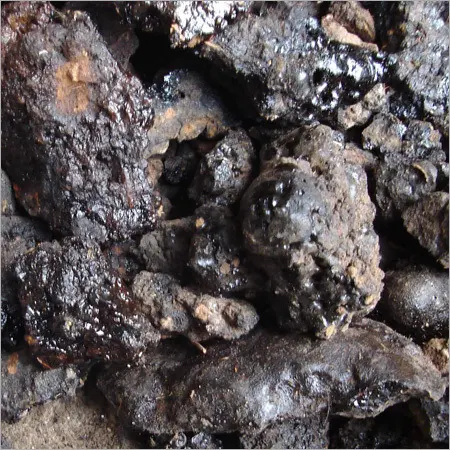
Chemists who gathered what is known about it found that:
- More than 80% of its weight is humic substances: the dark matter that forms when microorganisms slowly break down dead plants. They are sorted by how they dissolve in water: humins (never dissolve), humic acids (dissolve only in alkaline water) and fulvic acids (dissolve at any pH; small molecules).
- Almost 20% is calcium, potassium and magnesium.
- It also holds amino acids, fatty acids, plant compounds such as gallic acid and caffeic acid, and heavy metals such as chromium, selenium and cobalt.
- Shilajit from different regions differs a lot, and no one has yet made a complete chemical analysis of it.
A chemistry study in 1987, of shilajit from Nepal, found that two-thirds of its weight dissolved in warm alcohol mixed half and half with water. From that liquid the chemists grew crystals of calcium benzoate. Benzoates kill germs, and the chemists suggested this may be why shilajit was used against infection in places where keeping clean is hard.
Where it comes from
Nobody is fully sure how shilajit forms. Some writers thought it came from animal droppings, others from rock itself. The leading explanation is that it is plant matter that decayed over a very long time, trapped in the rock. In 2026 a team tested eleven samples from Iran, India, Nepal, Russia and Kyrgyzstan and found nine phenolic acids, compounds made by plants, in them: chemical support for the plant explanation, though not proof.
A survey of the places where shilajit seeps out in the Tibetan areas of Sichuan, in China, found them mostly on sunny, steep slopes and cliffs. There the dark matter flows out of the rock through tiny pores and cracks, and the sun’s warmth may help it ooze out.
Why it is in a minerals series
Like coal, shilajit is not a mineral. To be a mineral, geologists say, a substance must be naturally occurring, inorganic (not made by living things), solid, with a definite chemical composition and atoms in an ordered pattern. Shilajit is mostly organic, made from plants, and it is a soft, sticky mixture with no fixed formula.
It still belongs here, beside the shaligram, for three reasons:
- It comes out of rock, and is gathered from cliffs, not from plants.
- Ayurveda counts it among the पार्थिव द्रव्य (parthiva dravya, substances from the earth), with gold, copper and sulfur. Nepal’s Grade 10 Ayurveda textbook teaches it in that lesson.
- Almost a fifth of its weight is minerals: calcium, potassium and magnesium.
Nepal’s export rules list it with the forest products, beside the herbs of the high mountains, not with things mined. A herbal medicine specialist at the government pharmacy told Nepal News that the Department of Plant Resources counts it in both its mineral and its plant groups.
Where it is found in Nepal
The 1987 chemistry study described shilajit as embedded in rocky sediments in western Nepal, between 2,500 and 5,000 m, and popularly used in Nepal as a tonic.
No survey that we found maps where it occurs district by district. News reports name these places:
| Who said it | Where |
|---|---|
| Kantipur, 11 July 2026 | the high cliffs of Jumla, Humla, Mugu and Dolpa |
| Nepal News, 19 March 2026 | Dolpa estimated to hold the most; collected before from Humla, Jumla, Myagdi, Baglung, around Bagmati Province, and from Khotang and Sankhuwasabha in the eastern hills |
The same Nepal News report says experts blame the 2015 earthquake, centered near Barpak in Gorkha, for disturbing many of the places where shilajit seeped out. The government pharmacy at Singha Durbar, it reports, once produced 8,000 to 10,000 kg of shilajit and now produces about 3,000 kg. (In the same report, the pharmacy’s accounting officer put the year before at about 2,000 kg.)
How it is gathered
Gatherers scrape the raw shilajit off the rock by hand. Kantipur reported in 2026 that there are no clear standards for collecting it, too few ways of managing the danger, and only a few laboratories that can test its quality.
Cleaning it
Raw shilajit carries stones, soil and dirt. Ayurvedic texts say only cleaned, or शोधित (shodhit, purified), shilajit should be used as medicine.
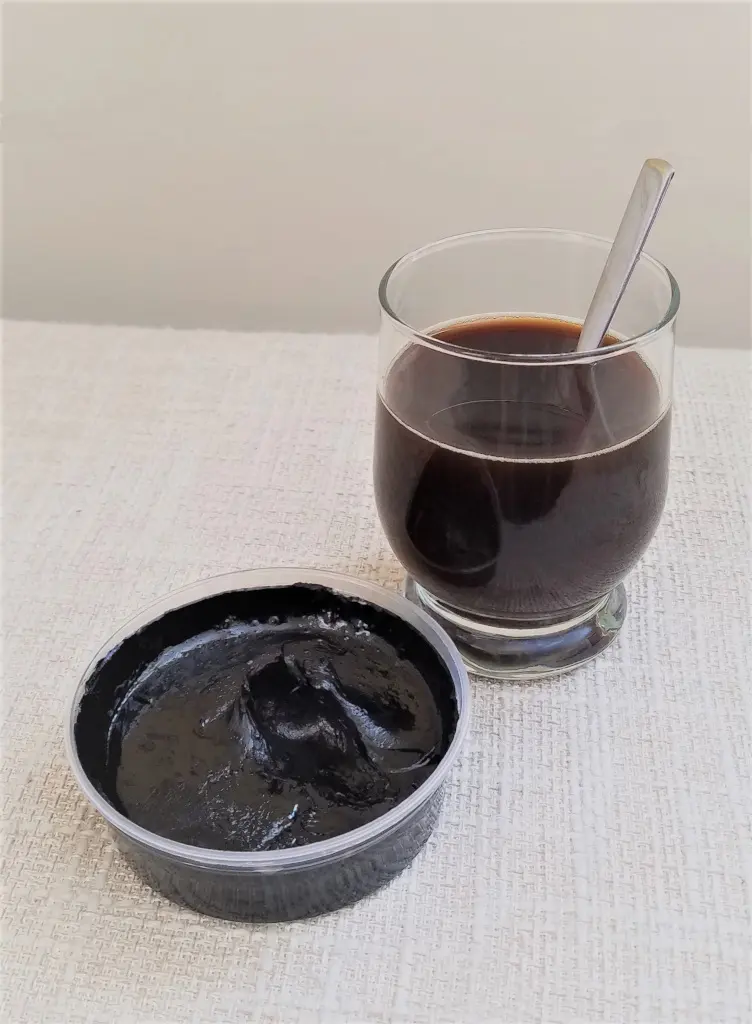
A 2024 study from a company in Nagpur, India, describes the traditional method:
- Boil the three dried fruits of त्रिफला (triphala: अमला, हर्रो and बर्रो, amala, harro and barro) in water, and strain the liquid.
- Soak small pieces of raw shilajit in that liquid for 24 hours. Stones and soil sink to the bottom.
- Pour off the dark liquid at the top and evaporate it to a thick paste.
From each kilogram of raw shilajit they got about 400 g of the cleaned paste.
The cleaning is also where the money is. According to Bhaktabahadur, raw shilajit sells for about Rs 42,000 a kilogram, and once cleaned, processed and packed it fetches more than double. Sold raw, his 10 kg would have brought only about Rs 420,000 (10 × 42,000). Sold processed, the same shilajit brought him Rs 1,008,000 that year, which, the report says, will cover his family’s expenses for the year.
The trade
| Who said it | What they said |
|---|---|
| Suman Pandey, president of the Ayurveda Medicine Producer Association of Nepal, to Nepal News, March 2026 | 12 companies in Nepal produce shilajit, about 36,000 kg a year, worth roughly Rs 720 million; with Indian brands sold here, the trade in Nepal is about Rs 1 billion |
| Singha Durbar Vaidyakhana (Nepal’s oldest government pharmacy): its accounting officer, and the report, in Nepal News, March 2026 | it made about 2,000 kg the year before, and sells 100 g for Rs 1,000 |
| Kunwar, Ansari and Luintel, Journal of Forest and Livelihood, 2009 | shilajit is on the government’s list of forest products banned for export in crude form, and they found the choice of what to ban was made ad hoc, not from a scientific study |
| Nepal News, March 2026 | Nepali law prohibits exporting raw shilajit, yet raw shilajit is smuggled to Indian companies (the report does not name the law) |
| Kantipur, July 2026 | traders also send Jumla’s shilajit to India |
The prices in these reports don’t agree: Rs 42,000 a kilogram for raw shilajit in Jumla, against Rs 1,000 for 100 g (Rs 10,000 a kilogram) of the government pharmacy’s cleaned shilajit, and about Rs 20,000 a kilogram if Rs 720 million is shared over 36,000 kg. Neither report explains the gap.
In Nepal it is sold as capsules, powder and paste.
Shilajit in Ayurveda
In Sanskrit it is शिलाजतु (shilajatu). Nepal’s Grade 10 Ayurveda textbook describes it as black like lac, soft, salty in taste, with a smell like cow’s urine, and calls it an important रसायन (rasayana, a medicine said to give long life and strength) in रसशास्त्र (rasashastra, Ayurveda’s science of mineral medicines). The book lists its traditional uses:
- long life (रसायन) and strength;
- प्रमेह (prameha: diabetes and urinary disorders);
- controlling obesity.
It is taken only after cleaning, mixed with other Ayurvedic medicines, or with milk, honey or ghee, and the same book, in its section on joint pain, says to use it on the advice of an Ayurvedic doctor or health worker. In Jumla, Kantipur reported, people take it with milk for joint pain, rheumatism and weakness, and experts there say the same: only on a doctor’s or an Ayurvedic expert’s advice.
Shilajit has been used for thousands of years in traditional medicine in a number of countries. A 2011 review counted it in 20 classical Ayurvedic preparations and 24 branded medicines.
What science has tested
Testing a remedy fairly is hard: people must be given either the remedy or a dummy (a placebo) without knowing which, in large enough numbers to tell a real effect from chance. For shilajit, few such tests exist, and products differ so much from region to region that one test says little about another product.
| Claim | What reviews of the tests found |
|---|---|
| “An antioxidant; strengthens immunity” | A 2011 review found the antioxidant tests used doses that don’t match real use and no proper comparison; the immune claims “may be considered as unproven.” A 2014 review counts both among the effects that studies “indicate”, but says few well-controlled studies in people exist. Not shown in people. |
| “Fights cancer” | A 2026 systematic review found 9 studies, all in cells or animals; no tests in people. |
| “Raises testosterone” (a hormone; the “strength” in the advertisements) | A 2024 systematic review of 52 studies of “testosterone boosters” found most did not work. One purified, branded shilajit extract was rated “possibly effective” for older men whose testosterone is low, from a single study. Some evidence, weak. |
| “Full of minerals” | Almost a fifth of its weight is calcium, potassium and magnesium. But a 2026 study of raw shilajit from five countries measured one of its minerals, selenium, and found so little that shilajit is “unlikely” to be a useful source of it. |
| Energy, fatigue, the brain | A 2014 review says animal and human data support it against tiredness, but that there are “relatively few well-controlled human studies”, more in animals and cells, and calls for tests of standardized products. A 2012 review’s hopes for the brain rest on laboratory tests, with trials in people still to come. Some evidence, mostly in animals and the laboratory. |
In short
Where these facts come from
- Agarwal S.P. et al., Shilajit: a review, Phytotherapy Research 21, 2007 (abstract).
- Kamgar E., Kaykhaii M., Zembrzuska J., A comprehensive review on shilajit: what we know about its chemical composition, Critical Reviews in Analytical Chemistry 55, 2025 (abstract).
- Carrasco-Gallardo C., Guzmán L., Maccioni R.B., Shilajit: a natural phytocomplex with potential procognitive activity, International Journal of Alzheimer’s Disease, 2012.
- Kong Y.C. et al., Chemical studies on a Nepalese panacea: shilajit (I), International Journal of Crude Drug Research 25, 1987 (abstract).
- Kamgar E. et al., Plant-derived phenolic acids in shilajit: a comparative HPLC-MS/MS analysis across five regions, Scientific Reports 16, 2026 (abstract).
- Kamgar E. et al., Occurrence and speciation of selenium in shilajit from diverse geographical origins, Biological Trace Element Research, 2026 (abstract).
- Ding R. et al., Mechanisms of generation and exudation of Tibetan medicine shilajit (Zhaxun), Chinese Medicine 15, 2020.
- King H.M., What is a mineral?, Geology.com.
- Curriculum Development Centre, आयुर्वेद, कक्षा १० (Ayurveda, Grade 10), 2082, Lesson 2, पार्थिव द्रव्य (शिलाजित), and its section on सन्धिवात (joint pain).
- Budha D.B., ‘शिलाजित’ संकलन गर्न जोखिमयुक्त भिरको यात्रा (The perilous journey to the cliffs to collect shilajit), Kantipur, 11 July 2026.
- Aryal N., Nepal sits on a shilajit goldmine, yet watches India profit from it, Nepal News, 19 March 2026.
- Kunwar S.C., Ansari A.S., Luintel H., Non-timber forest products enterprise development: regulatory challenges in the Koshi Hills of Nepal, Journal of Forest and Livelihood 8(2), 2009.
- Keshwar U. et al., Assessing the effect of shodhana (purification) process by Triphala decoction on shilajit using HPTLC, International Journal of Ayurveda and Pharma Research 12(6), 2024.
- Wilson E. et al., Review on shilajit used in traditional Indian medicine, Journal of Ethnopharmacology 136, 2011 (abstract).
- Stohs S.J., Safety and efficacy of shilajit (mumie, moomiyo), Phytotherapy Research 28, 2014 (abstract).
- Das S.S. et al., Pre-clinical evaluation of shilajit in cancer: a systematic review, Cureus 18, 2026 (abstract).
- Morgado A. et al., Do “testosterone boosters” really increase serum total testosterone? A systematic review, International Journal of Impotence Research 36, 2024 (abstract).
- Aldakheel R.K. et al., Rapid determination and quantification of nutritional and poisonous metals in Ayurvedic herbal medicine (rejuvenator shilajit), Biological Trace Element Research 200, 2022 (abstract).
- Hussain A., Saeed A., Hazardous or advantageous: uncovering the roles of heavy metals and humic substances in shilajit, Biological Trace Element Research 202, 2024 (abstract).
- Stavropoulos K. et al., Pseudohyperaldosteronism due to mumijo consumption during pregnancy, Gynecological Endocrinology 34, 2018 (abstract).
- शिलाजित and शिलाजतु in the Nepali Brihat Shabdakosh (Nepal Academy).