
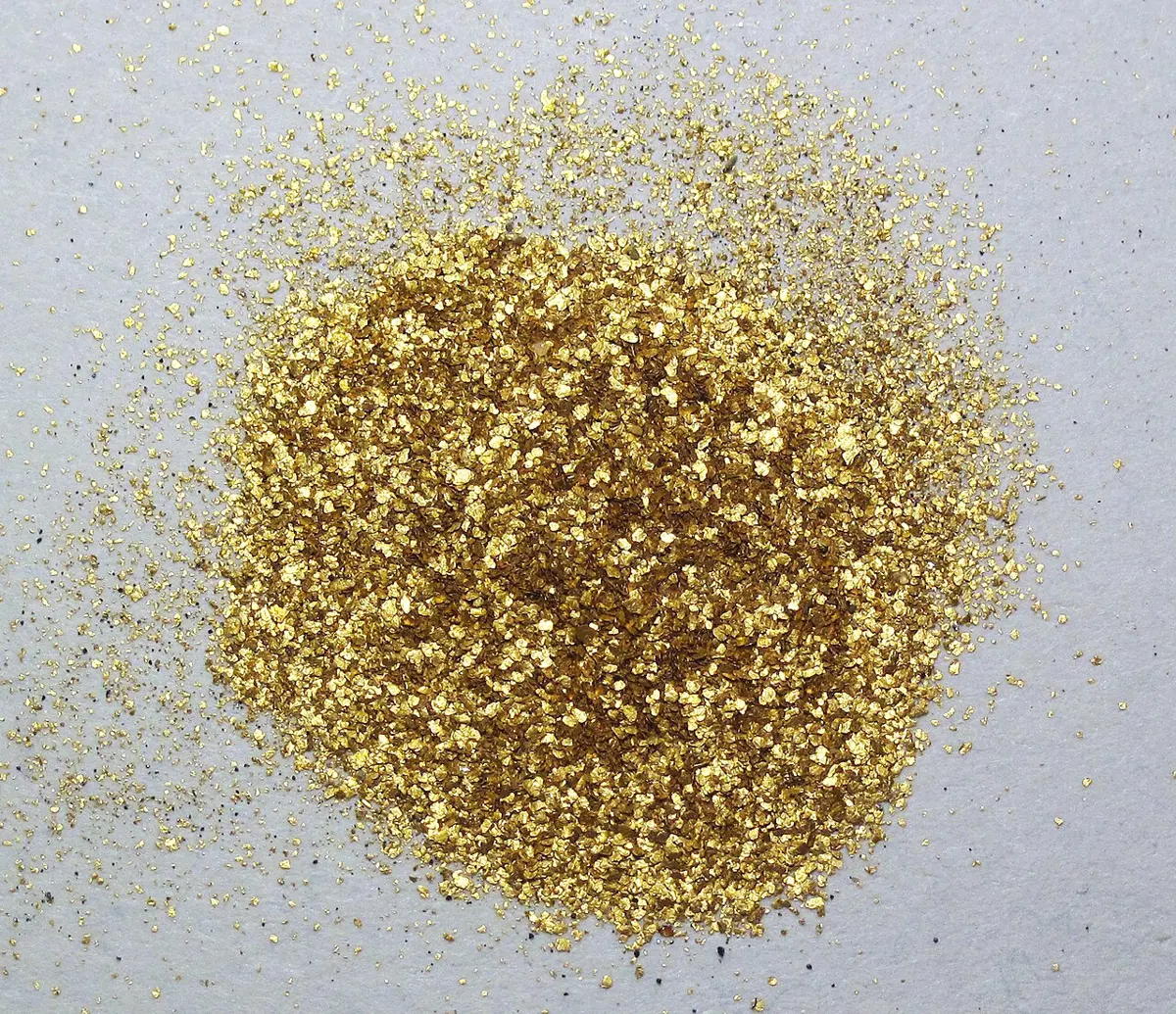
On a gravel bar of the Kali Gandaki or the Karnali, someone bends over a shallow pan, swirling water and sand round and round, until a few specks of yellow glitter in the bottom. That is gold, सुन, and the people who have long done this work in Nepal are the Bote, a people who live along Nepal’s big rivers.
What gold is
Gold is a native element: it is found as the pure metal, not joined to other elements in an ore. Its symbol is Au.
| Property | Gold |
|---|---|
| Formula | Au |
| Hardness (Mohs) | 2.5 to 3: soft |
| Density | 19.3 times as heavy as water |
| Color | golden yellow |
| Streak | golden yellow |
| Toughness | very malleable: it bends and flattens instead of breaking |
| Rust? | never: gold does not tarnish or rust |
A lump of gold weighs more than seven times as much as a lump of quartz the same size. That great weight is the secret of panning.
How gold gets into rivers
Gold forms deep underground in quartz veins, carried by hot fluids together with silver and minerals such as pyrite, chalcopyrite and arsenopyrite. That is primary gold, still in the rock.
When the mountains wear down, the gold is freed. It does not rust away, and rivers carry it down and leave it in their gravel, on flood plains and old terraces. That is placer gold, and it is what panners collect. Geologists think the placer gold in Nepal’s rivers comes mainly from the Higher Himalaya.
Gold in Nepal
Placer gold is panned by the Bote from the gravel of the Mahakali, Chamliya, Jamari Gad, West Seti, Karnali, Bheri, Rapti, Lungri Khola, Phagum Khola, Kali Gandaki, Myagdi Khola, Modi, Madi, Marsyangdi, Trishuli, Budhigandaki and Sunkoshi, on their flood plains and terraces.
Primary gold has been found in the rock at Lungri Khola in Rolpa (Damphutar, Dokadhunge, Phuliban, Sherma and Gam), at Bangabagar, Gorang and Jamari Gad in Baitadi, Bamangaon in Dadeldhura, Khandeshori in Darchula, the upper Bauligad in Bajhang, and rarely around Bering Khola–Sunmai in Ilam. Geologists see a good chance of finding more in the Higher Himalaya, but none of these has been proved to be a deposit worth mining.
In 2012/13 the Department of Mines and Geology issued 2 mining licenses and over 30 prospecting licenses for placer gold. The two mining licenses produced nothing for a long time and were closed, and by 2020 not one gold license had been renewed. Nepal is a net importer of gold.
What gold is used for
Jewelry and ornaments, coins, dental work, electroplating and coating other metals, and electronics.
Why does gold stay in a gold pan while sand washes out?
Pick an answer to see why.
In short
Where these facts come from
- Kaphle K.P., Mineral resources of Nepal and their present status, Nepal Geological Society, 2020.
- Ghimire R.P., Mineral resources, mining and investment opportunities in Nepal, in Annual Report No. 11, Department of Mines and Geology, 2019.
- Anthony J.W. et al., Gold, Handbook of Mineralogy, Mineralogical Society of America.
- King H.M., Gold, Geology.com.
- सुन and बोटे in the Nepali Brihat Shabdakosh (Nepal Academy).