
Before 1951, much of Nepal’s iron was made in Nepal, from rock dug out of its own hills and smelted with charcoal. In Ramechhap a gun factory ran on local iron. Village names still remember it: Falam Khani, “iron mine”. The rock was iron ore, and the two most important iron ores are hematite and magnetite.
Two iron oxides
| Property | Hematite | Magnetite |
|---|---|---|
| Formula | Fe₂O₃ | Fe₃O₄ |
| Hardness (Mohs) | 5 to 6 | 5.5 to 6.5 |
| Density (× water) | 5.26 | 5.18 |
| Color | steel gray to black, or red to reddish brown | black |
| Streak | red to reddish brown | black |
| Magnetic? | no | strongly |
Both are about five times as heavy as water, so a lump feels surprisingly heavy in the hand.
Two other iron minerals also occur in Nepal’s ores: goethite (limonite, a rusty brown iron oxide with water) and siderite (iron carbonate).
The streak and the magnet
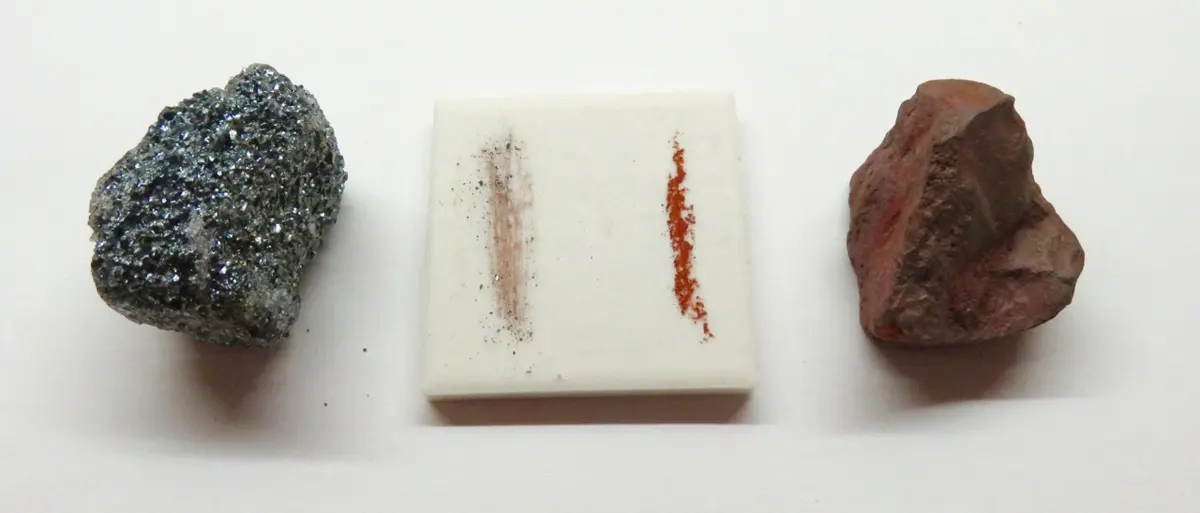
The color of a mineral can fool you: hematite can be shiny black or dull red. Its streak, the color of its powder, does not change. Rub it on the back of an unglazed tile and the powder is always red-brown. The name hematite comes from the Greek for “blood-red”.
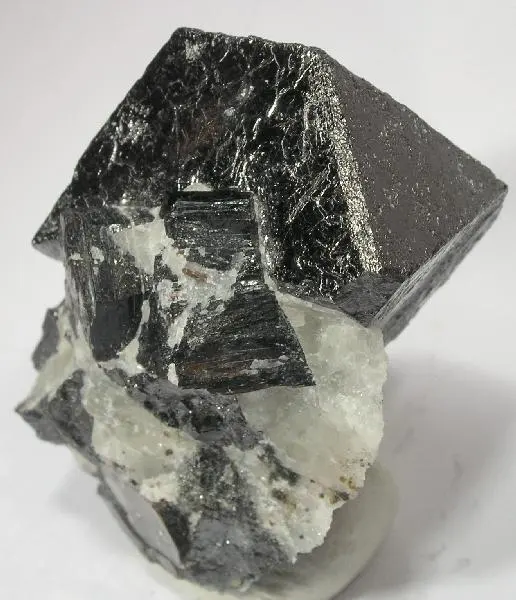
Magnetite’s powder is black, and magnetite is one of the very few minerals a magnet will pick up. Some pieces, called lodestone, are magnets themselves. Hung on a thread, a lodestone turns to point along Earth’s magnetic field: the first compasses, used in China as early as 300 BC, were made this way.
How iron ores form
Hematite and magnetite form in all three kinds of rock: in sedimentary rocks laid down in water, in igneous rocks crystallized from magma, and in metamorphic rocks changed by heat and pressure. Hematite is a common rock-forming mineral all over the world. Iron also gathers near the surface as rocks weather, in red soils and in laterite, a red earth rich in iron and aluminium.
Iron in Nepal
Iron ore is known at more than 88 places in Nepal. Some were mined and smelted for more than 100 years, until 1951 (2007 BS); after that the mines closed, as policy changed, charcoal for smelting ran short and deeper mining became difficult. Before 1951, Nepal exported iron and copper to Tibet.
The best-known deposits, with the Department of Mines and Geology’s estimates:
| Deposit | District | Estimate |
|---|---|---|
| Phulchoki | Lalitpur | 10.67 million tonnes at 54 to 58% iron |
| Thoshe | Ramechhap | 10.5 million tonnes at 30 to 66% iron |
| Dhaubadi–Pokhari | Nawalparasi (Nawalpur) | 100 million tonnes at 23 to 58% iron |
| Labdi Khola | Tanahun | 1.08 million tonnes at 38% iron |
| Jirbang | Chitwan | 0.8 million tonnes |
Other iron deposits and old workings are known in Parbat (Falamkhani and Dhuwakot), Baglung, Baitadi, Bajhang and many more districts.
- Thoshe was mined on a small scale through the Rana period. A gun factory using its iron was set up at Thoshe Megchan in 1921; its remains still stand. A private company, N & C Minerals, has estimated about 15.9 million tonnes at 45.3% iron there and holds a mining license, but as of 2020 the mine had not started.
- Phulchoki, the hill above Godawari, has stayed undeveloped: it lies in an environmentally sensitive area, and Nepal lacks enough electricity and good coal to smelt it.
- Dhaubadi in Nawalparasi is a hematite deposit. The Department began exploring it in 2012, has surveyed it with electrical methods, and in 2020 was preparing to mine it.
Red earth
Hematite crushed to powder is red, and people have used it as paint for tens of thousands of years: cave paintings 40,000 years old were made with hematite. In Nepal, red clay and white clay (kamero, कमेरो) are used in villages to paint house walls, and red laterite clay from Panchkhal (Kavre), Hetauda, Udayapur, Nawalparasi and other places goes into cement factories, partly in place of iron ore. The Nepali गेरु is the dull red mineral earth used to color houses, rooms and cloth.
What iron ore is used for
Hematite is the most important ore of iron. Iron, made into steel, goes into buildings, bridges, machines, tools and vehicles. Hematite is also still used as a red pigment, and magnetite was the first material used to make a compass.
A heavy black rock leaves a reddish brown streak on a tile, and a magnet does not pull it. What is it?
Pick an answer to see why.
In short
Where these facts come from
- Kaphle K.P., Mineral resources of Nepal and their present status, Nepal Geological Society, 2020.
- Ghimire R.P., Mineral resources, mining and investment opportunities in Nepal; and Prospecting for hematite ore deposit in the Dhaubadi–Pokhari area, Nawalpur district, using geophysical techniques; both in Annual Report No. 11, Department of Mines and Geology, 2019.
- Anthony J.W. et al., Hematite, Magnetite and Goethite, Handbook of Mineralogy, Mineralogical Society of America.
- King H.M., Hematite, Magnetite and The streak test, Geology.com.
- गेरु and कमेरो in the Nepali Brihat Shabdakosh (Nepal Academy).