
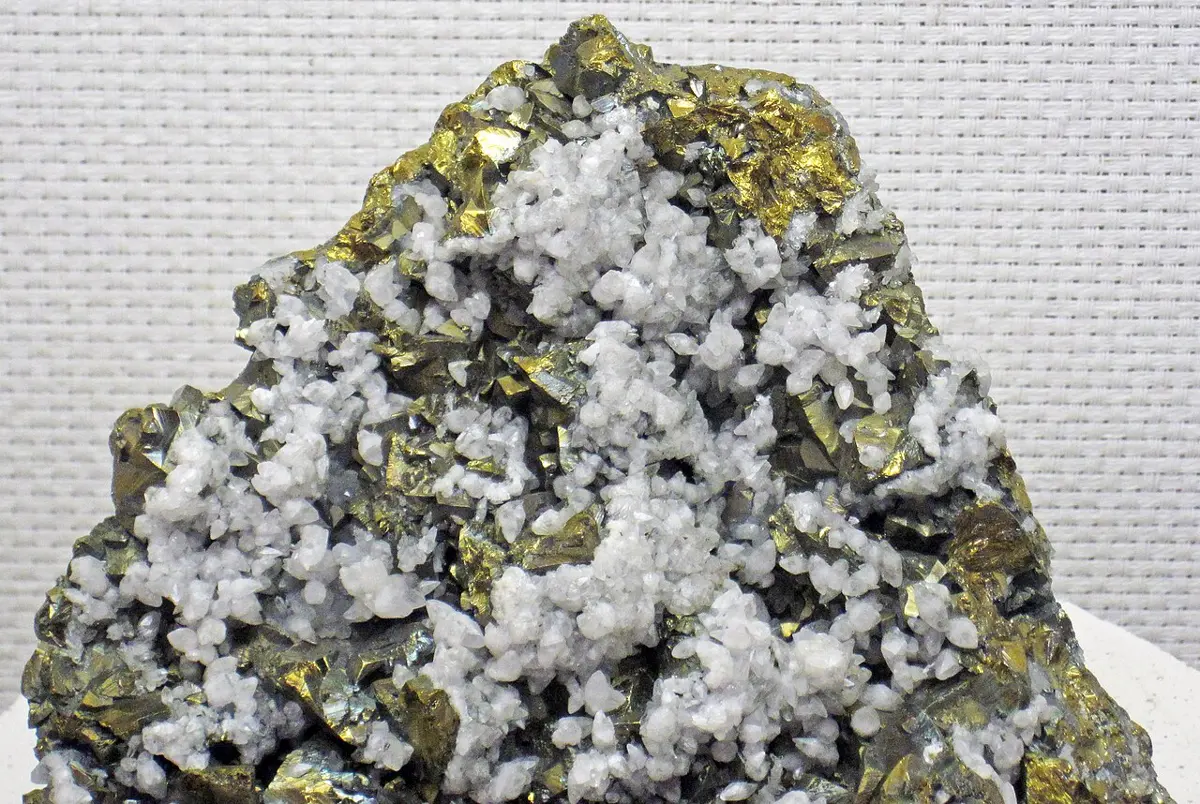
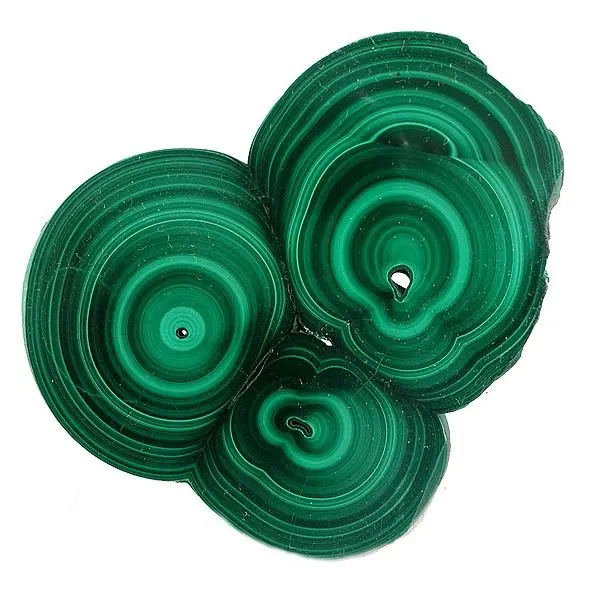
Copper ores: brassy chalcopyrite, green malachite
तामा · The metal of Nepal’s old mines
A water jar, a puja lamp, the wire inside a phone charger: they all hold copper, तामा. For a long time Nepal dug its own. Old pits, slag heaps and smelting places are scattered across the hills, and some villages are still named for their mines: Taba Khani (ताँबा, another word for copper, as the dictionary gives it) and Shisa Khani, the lead mine. Before 1951 Nepal exported copper and iron to Tibet.
The ores
Copper sometimes occurs as the metal itself, but most of it is locked in minerals. The commonest in Nepal:
| Mineral | Formula | Hardness | Color | Streak |
|---|---|---|---|---|
| chalcopyrite | CuFeS₂ | 3.5 to 4 | brass yellow; tarnishes dull, or purple and blue | greenish black |
| malachite | Cu₂(CO₃)(OH)₂ | 3.5 to 4 | bright green, often in bands | pale green |
| azurite | Cu₃(CO₃)₂(OH)₂ | 3.5 to 4 | azure blue | pale blue |
Nepal’s ores also include covellite, cuprite, bornite and chalcocite.
Chalcopyrite is the most important ore of copper and has been for thousands of years. It is easily mistaken for gold, so it is sometimes called “fool’s gold” too. But gold is soft, bends instead of breaking, has a yellow streak and is far heavier. Chalcopyrite is brittle and its streak is greenish black.
Malachite forms at shallow depths, in the zone above copper deposits where air and water change the copper minerals, often together with blue azurite. Its green does not fade in light, so a green stain on a rock is a hint that copper may lie below.
Copper in Nepal
Copper ore is known at more than 107 places in Nepal. Copper was mined here from early times. Small mines at Gyazi (Gorkha), Okharbot (Myagdi) and Wapsa (Solukhumbu) worked until 1995, making 20 to 50 tonnes of copper a year. Since then no copper mine has been in production.
The Department of Mines and Geology lists eight copper deposits, each under 2 million tonnes, with 0.4 to 3.2% copper. Three of them:
| Deposit | District | Estimate |
|---|---|---|
| Kalitar | Makwanpur | 2.29 million tonnes, 0.5 to 1.5% copper |
| Wapsa | Solukhumbu | 2.53 million tonnes, 0.88 to 3.24% copper |
| Bamangaon | Dadeldhura | 1.71 million tonnes, 0.2 to 0.43% copper |
Other copper prospects include Dhusa (Dhading), Bhut Khola (Tanahun), Pandav Khani (Baglung), Baise Khani and Ningre (Myagdi), Mul Khani (Gulmi), Sikpashore (Dolakha), Chhirling Khola (Bhojpur), Janter Khani (Okhaldhunga) and Siddhi Khani (Ilam). A private company holds a mining license for Bamangaon, but by 2020 it had made slow progress.
What copper is used for
Most copper goes into the electrical industries: wires, and electrical and electronic goods. It is also used for coins, crafts, alloys, and household vessels and utensils.
You find a rock with a bright green crust in an old mine. What does it probably contain?
Pick an answer to see why.
In short
Where these facts come from
- Kaphle K.P., Mineral resources of Nepal and their present status, Nepal Geological Society, 2020.
- Ghimire R.P., Mineral resources, mining and investment opportunities in Nepal, in Annual Report No. 11, Department of Mines and Geology, 2019.
- Anthony J.W. et al., Chalcopyrite, Malachite and Azurite, Handbook of Mineralogy, Mineralogical Society of America.
- King H.M., Chalcopyrite and Malachite, Geology.com.
- तामा in the Nepali Brihat Shabdakosh (Nepal Academy).